There are now more than a dozen places where you can access an Anthropic Pre-IPO exposure, divided into three completely different product structures, with synthetic perpetuals occupying the majority.
Written by: angelilu, Foresight News
Entropy, the market deployer on Hyperliquid, has launched ANTH on August 25, a Pre-IPO perpetual contract linked to Anthropic, which is one of the most noteworthy launches in the Pre-IPO sector for the second half of this year.
One week after the launch, ANTH on Entropy was reported at $1,980.1. According to its pricing rules, this figure corresponds to an implied valuation of approximately $1.98 trillion. According to reports from media such as 21st Century Business Herald in August, Anthropic is expected to be listed in October with a target valuation of about $2 trillion—thus the on-chain quote is about 1% lower compared to this.
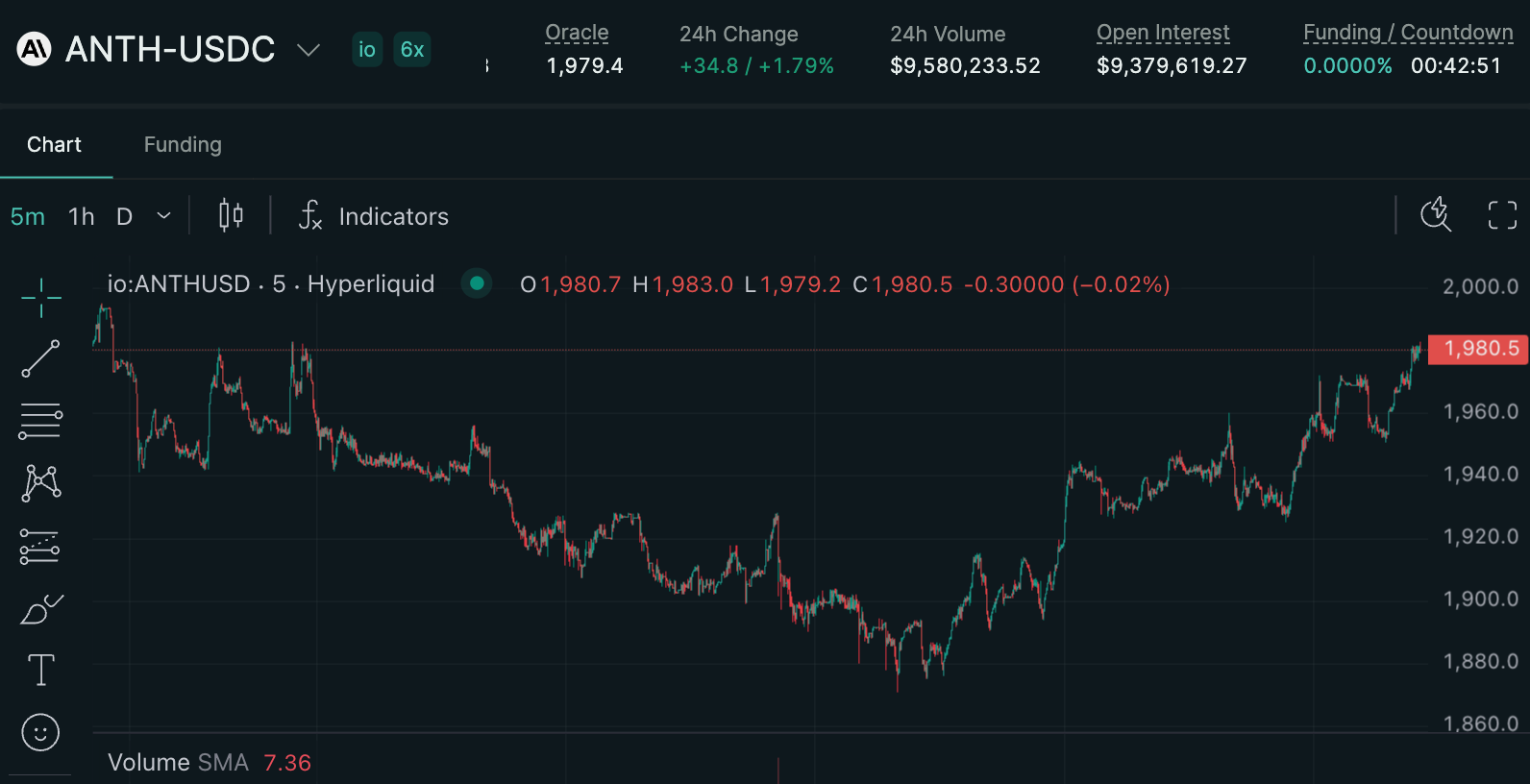
As of September 2, 10:00, Entropy data shows that the 24-hour transaction volume of ANTH was $9.63 million, with open contracts worth $9.3 million.
However, Entropy is not the only option—there are now more than a dozen places where you can access Anthropic Pre-IPO exposure, divided into three completely different product structures, with reported prices ranging from $872 to $1,946, each with different implications and risks across various levels.
The first half of the year saw a boom in SPV tokenization, while the second half shifted to synthetic perpetuals
In the first half of this year, the mainstream play for Pre-IPO exposure was subscription systems and SPV tokenization, both advocating for real equity backing.
The representative of SPV tokenization is PreStocks, where the platform holds company shares through special purpose vehicles (SPV) and then shards the exposure to sell to retail investors. It claims to have real equity exposure—the official website states that the tokens are "backed 1:1 by the SPV's exposure to the underlying company's shares," with prices closely corresponding to the share price.
PreStocks' Anthropic token reached a historic high of $1,408.85 on May 9. The critical turning point occurred on May 13. Anthropic issued an official statement stating, "We do not allow special purpose vehicles to acquire Anthropic stock; any transfer of shares to an SPV... is invalid," and that unauthorized transfers "will not be recognized on the company's books," explicitly naming intermediaries like Open Door Partners, Hiive, and Forge. The PreStocks' Anthropic token dropped 34% in seven days, and the narrative of "backed by real stocks" was thus undermined.
As of this writing, the ANTHROPIC on Solana is priced at $871.75, with a market cap of about $6.44 million, a 24-hour transaction volume of only $411,000, and a circulation of 7,383 tokens, primarily trading on DEXs like Meteora and Raydium.
The other type is the subscription system—where the platform opens a window to sell shares at a self-defined price and then opens another window to buy back; MSX represents this. But this is not a market that can be traded at any time; it is closer to new stock issuance, with no matchmaking between buyers and sellers throughout the process. MSX’s second tranche of Anthropic subscriptions opened on May 16, and buyback applications are currently open, with a subscription price of 855 USDT, corresponding to a valuation of $950 billion; as of the publication of this article, the exact redemption price has not been verified.
The third type is the current mainstream play—synthetic perpetuals. On June 2, just hours after Anthropic secretly submitted its S-1 to the SEC, Binance launched the ANTHROPICUSDT Pre-IPO perpetual (at the time priced around $1,734), followed by Bitget, with Kraken launching on June 15 and Coinbase on June 22, and Bybit following thereafter. These products are purely synthetic and cash-settled, not touching real equity. In the same month, Ventuals, the earliest to offer Pre-IPO perpetuals on-chain, ceased operations, leaving this line vacant until Entropy launched ANTH on August 25 to take it over.
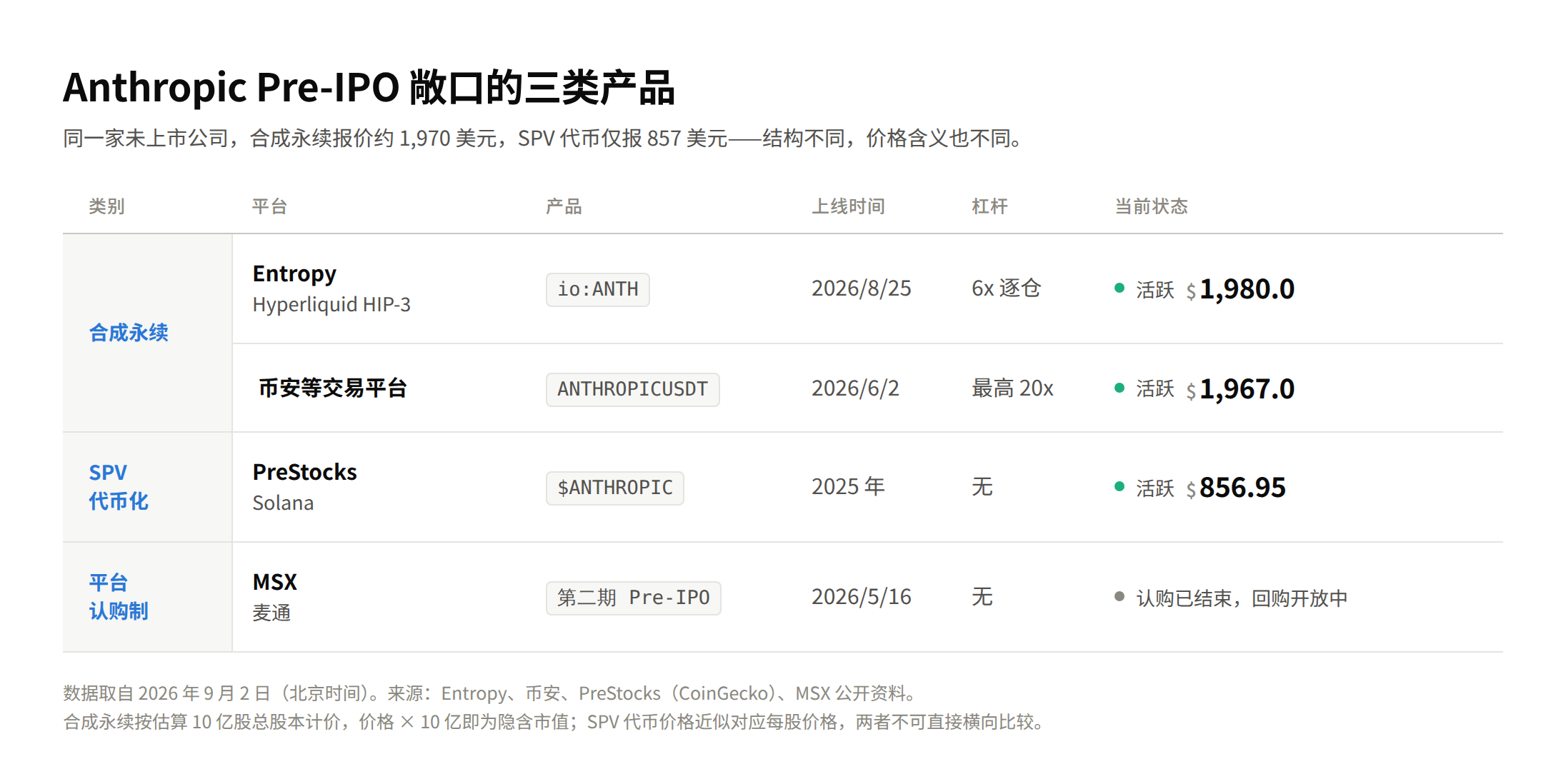
Pricing implications and risks of synthetic perpetuals
Exchanges like Binance, Coinbase, Kraken, Bybit, Bitget, etc., as well as ANTH launched on Entropy, all belong to the synthetic perpetual category. They do not involve real equity and are purely cash-settled contracts. Users do not hold any shares or certificates, only a price that can be longed or shorted and leveraged.
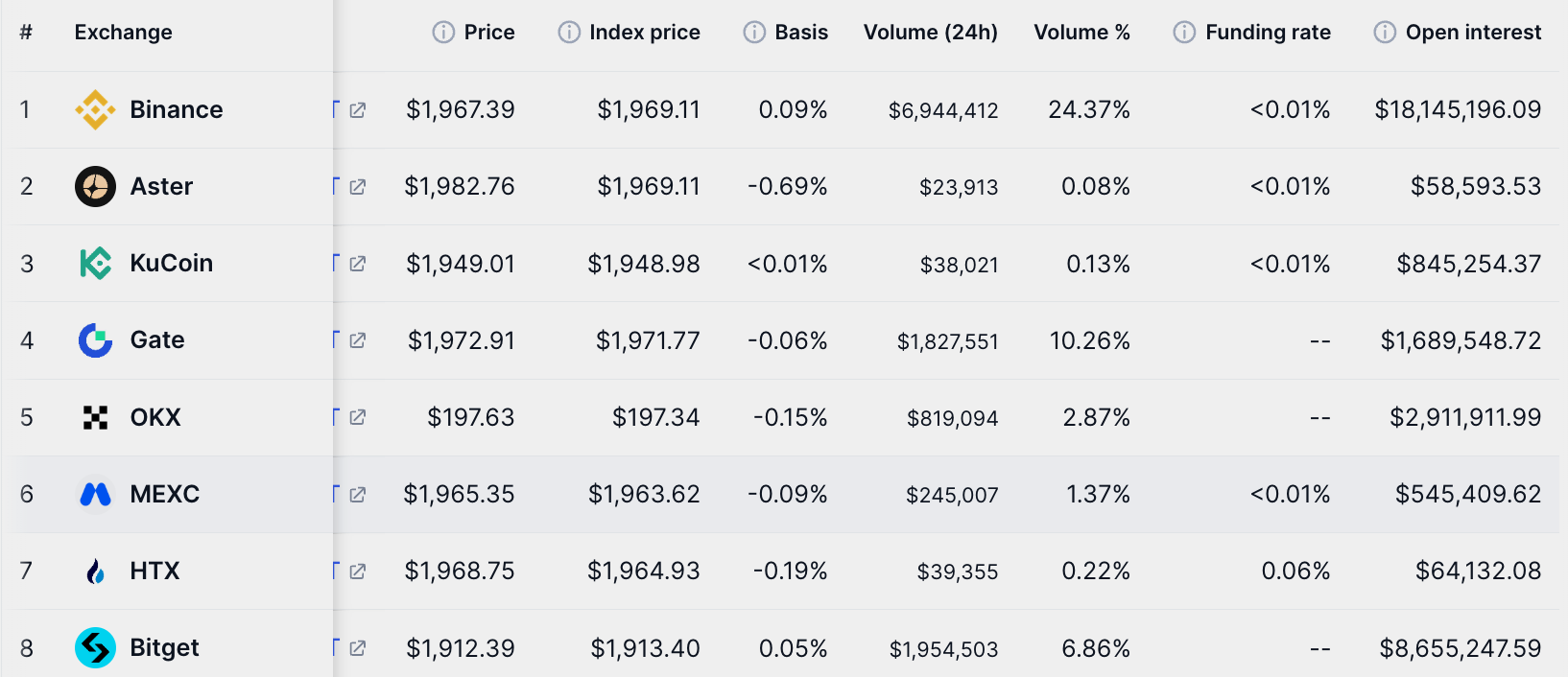
To understand the quotes, you must first convert them, as the valuation bases used by various platforms differ: Binance, Bitget, and others value based on 1 billion shares, while OKX already implemented a 10:1 rebase on June 30, 2026, changing its estimated share capital to 10 billion shares, leading to its quotes being about 1/10 of those of other platforms, yet corresponding company valuations are consistent. All platforms state that this share capital is an estimated value, and actual share capital will be according to company disclosures.
Entropy is more direct; every $1 contract price represents a market cap of $1 billion. Therefore, Binance’s $1,967.0 corresponds to about $1.967 trillion, and Entropy’s $1,980.1 corresponds to about $1.980 trillion, with price discrepancies still existing across platforms.
The biggest risk of this type of Pre-IPO is that prices have almost no external anchors. The three platforms that revealed methods have remarkably consistent practices: Binance's Pre-IPO marks price by taking "the average of the last 10 seconds of transaction prices on this platform"; Kraken uses its own PreMarket synthetic index, which according to its documentation, is entirely derived from the contract’s own order book without using external data sources; Entropy’s oracle is weighted by its own order book EMA and private placement data aggregation, with its own weight ceiling at 95% and external minimum retained at 5%. Entropy is the only one that has left space for external data (Bybit and Bitget have not provided equivalent detailed public explanations).
With such pricing sources, is there any mechanism to pull deviant prices back? Perpetual contracts have no expiration date; they rely solely on funding fees to pull prices back to oracles—when the contract price is higher than the oracle, long positions have to periodically pay short positions, with the greater deviation resulting in greater payments. However, Entropy has adjusted this funding fee to normal levels of 1/800, reasoning that slow updates of private placement data would unduly penalize those who react to data sooner; the cost is stated in the same document: the funding fee now only serves as a "loose anchoring against extreme, sustained deviations."
What if it does not go public? Entropy’s ANTH has a clear settlement date of August 18, 2028; should it still not go public by then, it will settle based on the trailing TWAP cash for the last 6 months at the marked price in cash, with the operator also retaining the right to settle using a 30-day TWAP in advance and modify the settlement standards. Kraken, on the other hand, does not set an expiration date; once the company goes public, the contract converts to ordinary shares perpetual at the xStocks spot price.
Is the pricing accurate?
Returning to the initial figures: the quoted $1.98 trillion on-chain and the $2 trillion IPO target valuation differ by only about 1%. Is this accurate?
This question was genuinely contrasted three months ago. SpaceX went public on June 12, with an issuing price of $135 (corresponding to about $1.77 trillion valuation), opening at $150 on the first day and closing at $160.95, a rise of 19.2%, with a closing market cap exceeding $2.1 trillion. However, before the listing, space perpetual quotes across platforms ranged from $162 to $180, with implied valuations of $2.1 trillion to $2.3 trillion—20% to 35% higher than the issue price, yet they almost perfectly matched the first-day closing market value.
In other words, the perpetuals accurately reflected the price the market was willing to pay, not how much the company is worth—it was synonymous with the enthusiasm of the public market. Moreover, this is just one sample; the real test will wait until the end of the six-month lock-up period in December.
Returning to Anthropic. After unpacking the pricing mechanism, this proximity is even harder to consider "market discovery." These platforms’ prices before the company's IPO are almost entirely generated by their own transactions (Entropy’s external data accounts for a maximum of only 5%), and the funding rates have been pressed to extremely low levels, offering little capacity to pull prices back.
At the same time, the size of the participating funds is still relatively small—according to CoinGlass data, the total open contracts for ANTHROPIC perpetuals across 12 exchanges amount to about $46.32 million, plus Entropy’s $9.3 million, making a total of about $55.62 million—using it to mark a $1.98 trillion valuation gives a ratio of about 36,000 times difference between the two.
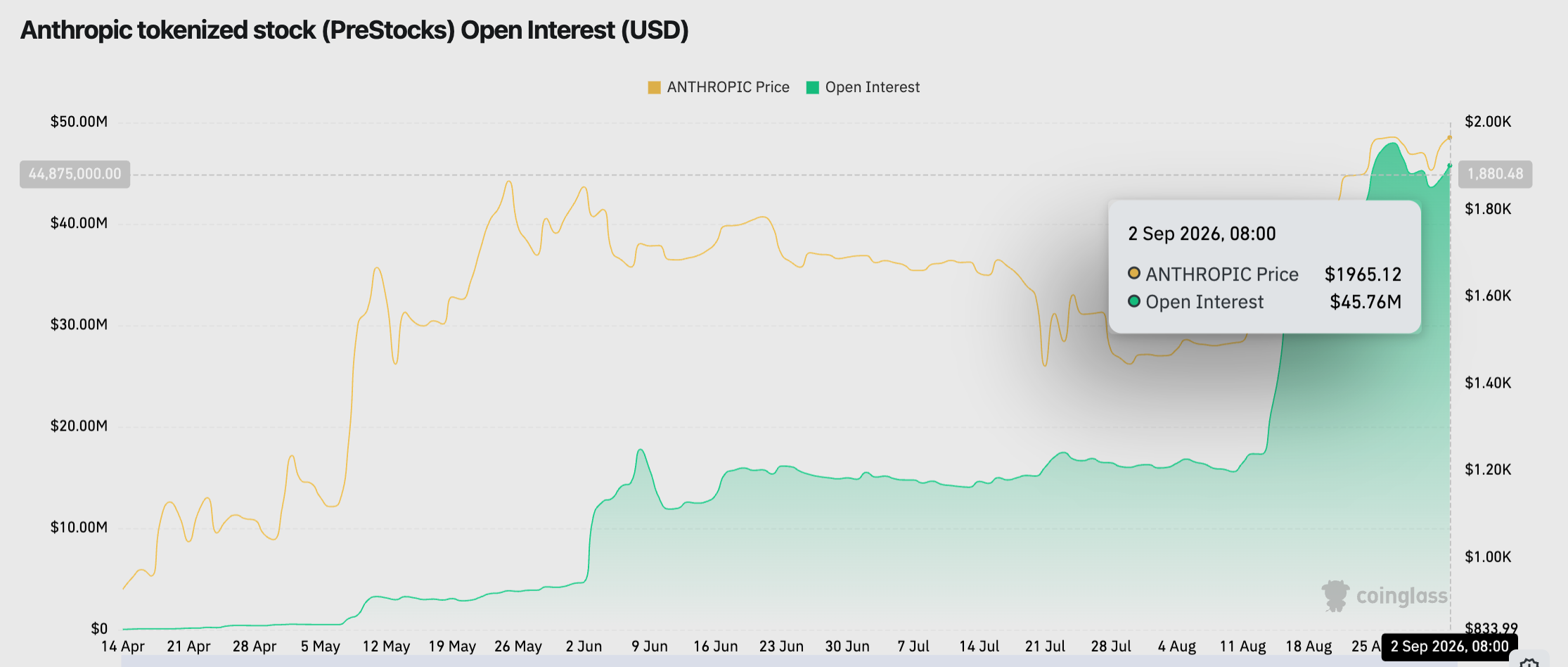
A market that does not source data externally, has a low funding rate, and where internal arbitrage has not fully come into effect has come up with a figure that is highly consistent with media reports. A more reasonable explanation is not that it calculated Anthropic's value, but that the people within the market read the same batch of IPO reports.
This does not mean that this price is incorrect—Anthropic has not publicly disclosed its stock price, and no one can judge right or wrong. What it means is that this price can tell you mainly what the people on the order book are thinking, rather than how much Anthropic is worth. It’s fine to treat it as a trading target, but care should be taken when considering it as a valuation reference.
免责声明:本文章仅代表作者个人观点,不代表本平台的立场和观点。本文章仅供信息分享,不构成对任何人的任何投资建议。用户与作者之间的任何争议,与本平台无关。如网页中刊载的文章或图片涉及侵权,请提供相关的权利证明和身份证明发送邮件到support@aicoin.com,本平台相关工作人员将会进行核查。


