Author: New Intelligence
Today, exciting news has come in.
Ultraman revealed in the latest podcast that Astra's ability to operate a computer has reached human level!

Moreover, Fable 5.1 is not far away.
Some have discovered that Anthropic's latest model, Fable 5.1, has quietly appeared in the API route of Amazon AWS Bedrock!
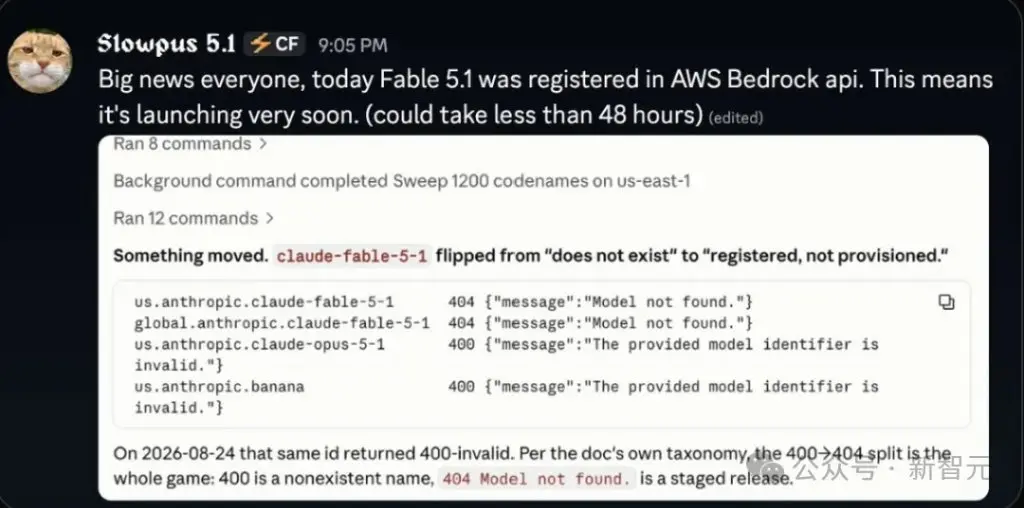
It is very likely that Astra and Fable 5.1 will be released around the same time.
The exciting moment is just around the corner.

Astra's ability to operate computers has reached human level
Currently, this podcast has only released a one-minute teaser.

In the interview, the host posed the question: "Do you think AGI has arrived?"

Ultraman answered: "It's close, at least very close... AGI feels like a milestone, while superintelligence feels like a monster that can expand infinitely. As for Astra, it feels like it has completely reached human level in operating computers."


In fact, recently, the "Astra that reaches human level" mentioned by Ultraman has quietly leaked a number of practical demos.
Last Sunday, Astra exposed a series of very shocking front-end demos.
For example, this test below.
With a simple prompt—"Build a magnificent sci-fi spaceship with an explorable interior structure"—without any multi-turn dialogue iteration, the AI directly produced a complete 3D world in "one shot."


As this influencer said, AGI might not arrive in the way of "chatbots becoming smarter," but rather it might quietly appear in the form of "creating a complete world with a single sentence."
Moreover, OpenAI's ambitions go far beyond this.
Astra is not meant to compete with Fable on who can chat smarter; it is born for "continuous intelligent agents."
The details of Astra that have been disclosed are as follows.
Impressive 56K Tokens reasoning: 3D pagoda
Astra's latest output of 3D voxel art, the pagoda, is stunning.

At maximum inference intensity, consuming 56K inference tokens and taking 38 minutes, Astra has recreated a 3D building that has achieved a very high level in composition, color expression, and overall rendering effect.

This reflects extremely hardcore spatial imagination and code execution ability.

"Never Stopping" Digital Workers
It is no longer a passive tool of "you ask one question, it answers one question." Astra can work continuously for days or even weeks; it has long-term memory and can remember your corrections.
Multi-Agent Collaboration and Cross-Tool Operations
It can generate multiple intelligent agents to collaboratively tackle research-level mathematical proof problems.
Even more terrifying is that it can take over your computer desktop at "superhuman speed," collaborating across software and even working alongside other AI agents and humans.
This confirms what Ultraman said in the podcast: "The ability of AI to use computers has officially reached human level."
Fable 5.1 Appears in AWS Bedrock Routes
Moreover, today there is news that Fable 5.1 is not far away.

Some developers have announced a significant discovery: Anthropic's latest model, Fable 5.1, has quietly appeared in the API route of Amazon AWS Bedrock!
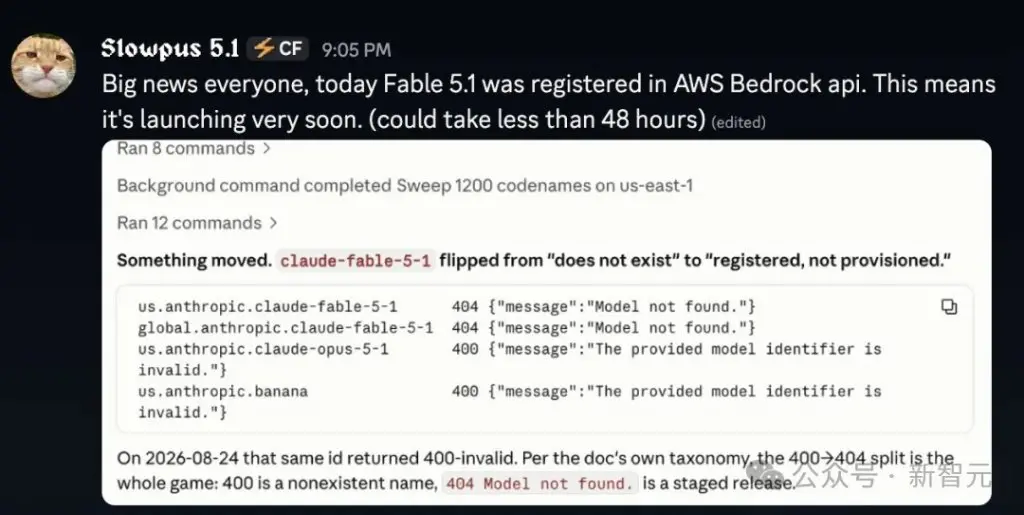
When developers called the model identifier for Fable 5.1 in the system, the system originally returned a "400" error (the provided model identifier is invalid, belonging to a made-up name); but now, it returns a "404" error (model not found).
This indicates that AWS's underlying system has officially recognized and accepted Fable 5.1, just waiting for the model itself to be uploaded.
This underlying change is consistent with the performance observed just days before the release of Opus 5.1.
Additionally, over the past two weeks, many have been gray tested, and various signs indicate—
The release of Fable 5.1 is now on a countdown, likely within the next 3 to 4 days.
If Anthropic cannot seize the ecological position before the release of Astra, Fable 5.1 may be outcompeted.
Furthermore, there are also tests of Opus 5.1 in incognito mode, with quite good results.


After months of practical testing, why can Fable 5 dominate GPT 5.6?
Furthermore, recently the well-known community Bridgemind concluded after several months of practical testing that GPT 5.6 is being overshadowed by Fable 5.


Over the past few months, he has been intensively using Fable 5 and GPT 5.6 Sol every day, and here are his impressions.
GPT 5.6 Sol is a powerful backend machine, but it is defeated by "over-engineering."
In backend processing, GPT 5.6 Sol performs better. It is very fast, has lower calling costs, and excels in data security.
Even in mathematical logic deductions, Sol has already significantly widened the gap with Fable and previous generation Opus.
Once the work enters a deep and complex stage, Sol is the more powerful backend engine.
However, it has a critical flaw; as soon as the instructions are slightly relaxed, GPT 5.6 will suffer from the "over-engineering" occupational disease.
What is clearly a simple function, it insists on creating an entire set of large, complex systems; you need to restrict it very precisely.
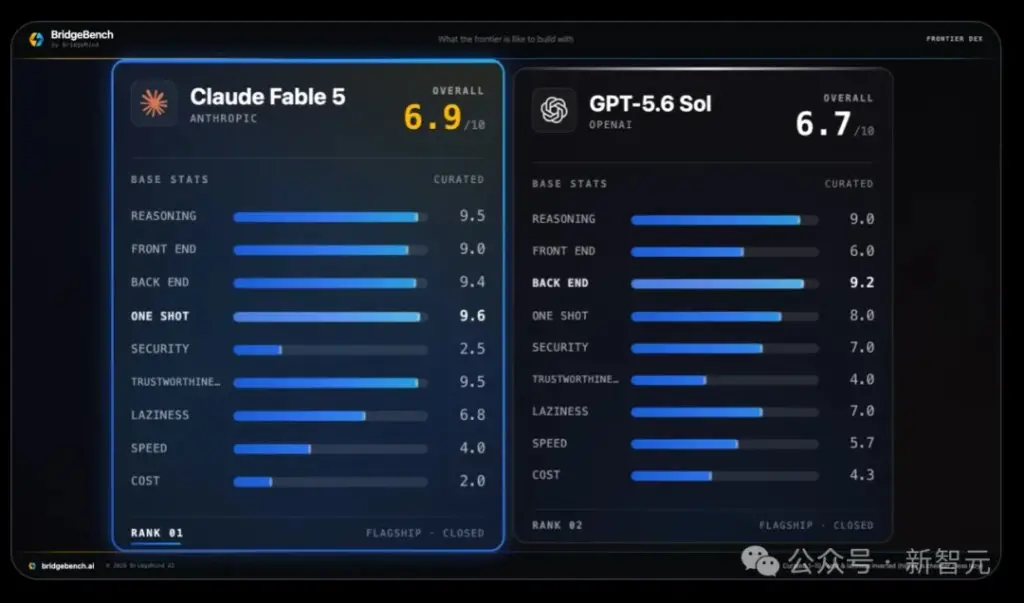
However, Fable 5 remains the de facto No.1.
It wins in two soul-stirring areas: front-end UI design and the "one-shot" ability.
When you throw a bunch of disordered requirements at Fable 5, it often delivers a finished product that "feels complete" on the first try.
Its extremely high first-hit rate, coupled with outstanding visual presentation and aesthetic taste, allows users to experience what true "smoothness" means.
This is why Fable 5 remains the first choice in developers' minds—it can not only get the job done but also do it beautifully.
There are reports that Astra has now opened closed beta testing to some partners to collect feedback, and if all goes well, we will soon be able to experience this new species.
Next, who will take the lead, Astra or Fable 5.1?
免责声明:本文章仅代表作者个人观点,不代表本平台的立场和观点。本文章仅供信息分享,不构成对任何人的任何投资建议。用户与作者之间的任何争议,与本平台无关。如网页中刊载的文章或图片涉及侵权,请提供相关的权利证明和身份证明发送邮件到support@aicoin.com,本平台相关工作人员将会进行核查。


