Author: Thejaswini M A
Source: Token Dispatch
Compilation and Arrangement: BitpushNews
Preface
Jesse Leimgruber is the co-founder of AI hardware company OpenHome, and he also holds shares in Anthropic. A few months ago, he revealed on the X platform that he might be interested in selling these stocks.
To keep track of the numerous buyers approaching him, he even developed a custom CRM system, as there are hundreds of buyers reaching out to him, all ready to make cash payments at any time.
A "very well-known growth fund" gave a company valuation bid of up to $1.05 trillion. He mentioned that a large VC even said that if he was willing to pledge his Anthropic stock, they could directly grant him the title of General Partner (GP). However, he later admitted that without these stocks, the partner title wouldn’t exist at all.
Market demand has gone crazy to the extreme. A banker even offered an early employee of Anthropic, willing to sell a small portion of their shares, the condition of a free $4.8 million mansion in Marin County. Another investor posted a 14-acre estate on LinkedIn, converting to an implied company valuation of over $800 billion.
A secondary market matching agency stated that a shareholder was acquiring shares at a valuation of $1.15 trillion. The head of brokerage firm Rainmaker Securities frankly stated that there were no sellers in this market, only an extreme imbalance in supply and demand.
Leimgruber revealed that he had used Ventuals to assess how much his stock was worth (Ventuals was a set of order books on Hyperliquid where traders could leverage bets on Anthropic’s valuation).
We do not know how Leimgruber ultimately handled his stocks. He might have sold a portion, sold everything, or not sold a single share because private equity transactions typically remain undisclosed; from public traces, he appears to be just an "intended seller."
But Ventuals later shut down, the founding team joined Phantom, and trade.xyz almost took away all the liquidity on the HIP-3 protocol.
Anthropic is clearly set to become the next highly sought-after publicly listed stock. But for retail investors, unless you are an Accredited Investor, there is no way to access private equity. And to become an Accredited Investor, you must first be extremely wealthy.
Another option is Hyperliquid's HIP-3 protocol, where Ventuals once existed. Now, HIP-3 has replaced Ventuals with Entropy. But why does Entropy tell its story better than Ventuals? Can we be sure it is better? Let's explore this track further.
“Autopilot” For Crypto Investment
You may already be exhausted from tracking several selected tokens. The crypto market is no joke; it can wipe out your funds if you make the wrong moves.
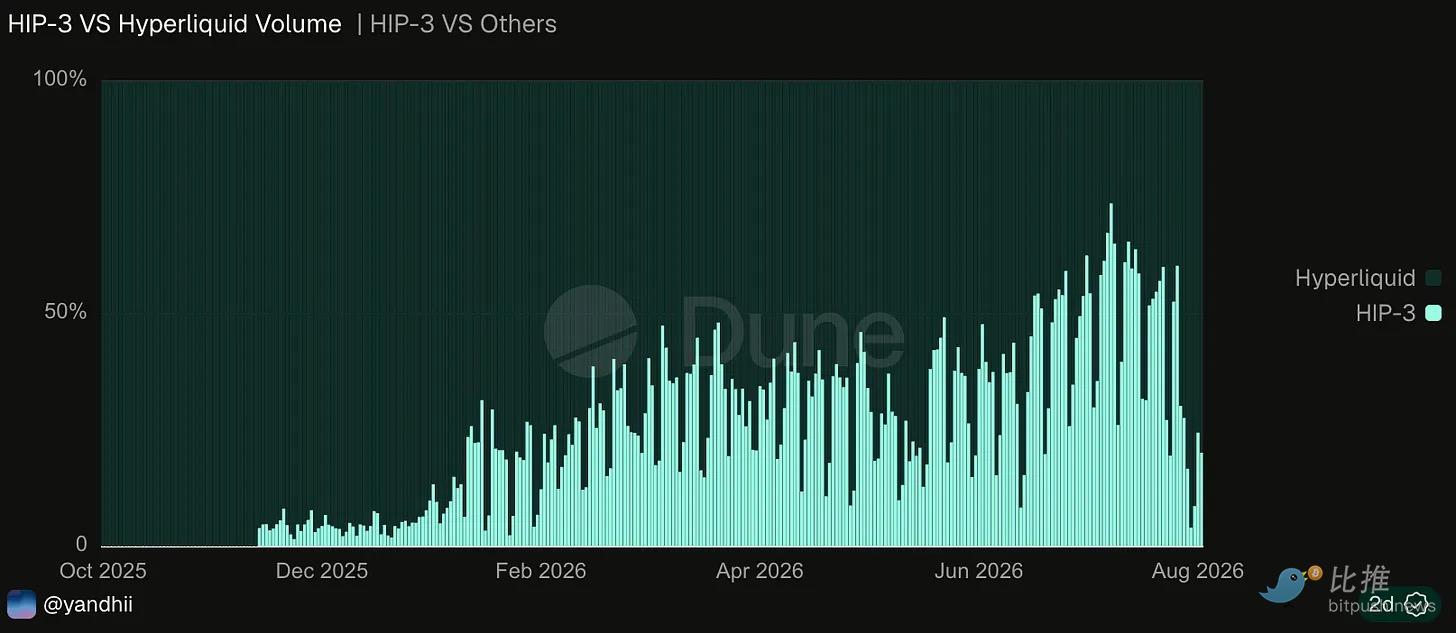
On October 13, 2025, Hyperliquid launched the HIP-3 protocol, allowing anyone to launch perpetual contract DEX (decentralized exchange) on Hyperliquid. However, the premise is that you must own $40 million. The trading fees here are double Hyperliquid's native rates: deployers retain 50% of the fees, while Hyperliquid uses the remaining 50% to fund token buybacks. Currently, about 30% of Hyperliquid's perpetual contract trading volume flows through the HIP-3 market.
On August 24, 2026, Entropy locked in 500,000 HYPE as collateral (worth $40 million, supported by a $14 million funding round led by Ribbit Capital), meeting the deployment requirements for Hyperliquid HIP-3.
Entropy's ANTH token uses market cap quoting (1 = $1 billion) to avoid the unknown total equity amount. Therefore, if the price is $2,000, it means a $2 trillion valuation. Like all assets on HIP-3, you don't actually own the shares of Anthropic; Anthropic doesn't care about your existence at all. What you hold is merely an entry of a smart contract on Hyperliquid's ledger. This entry mathematically tracks the implied market cap price of Anthropic listed on the Entropy exchange. Regardless of whether the company goes public in the future, you have no way of converting this synthetic position into actual company stock.
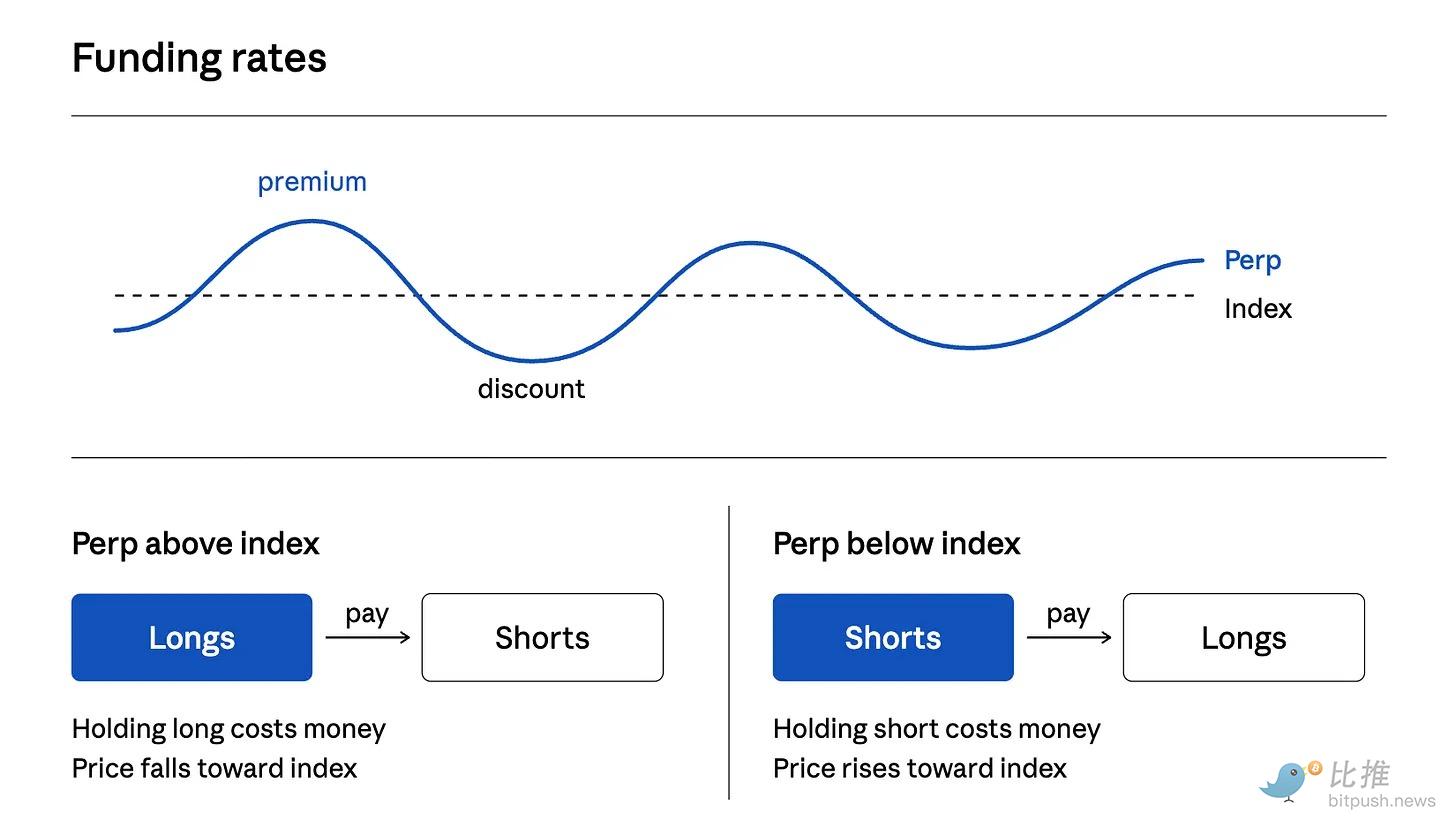
If Anthropic is still not publicly listed by August 18, 2028, ANTH will be settled in cash according to the average price over 30 days of its own marked price. The funding rate will continue to run during this period. This contract can be settled without reliance on the accuracy of any external data.
This year, Hyperliquid's deployers tested two more pricing engines to manage the synthetic asset before the IPO.
The first one is the previously mentioned Ventuals. It combined the hybrid valuations of the private market with its own order book prices but did not set a limit on the funding rate.
The other deployer, trade.xyz, completely ignored external valuations, purely basing contract pricing on the 30-minute average price of its internal trades. It still contributes the majority of trading volume on HIP-3.
trade.xyz was the first HIP-3 trading pair launched by Hyperunit in October 2025, achieving $1.3 billion in trading volume within three weeks. As the predominant third-party builder on the platform, Trade.xyz accounts for more than half of Hyperliquid's total monthly trading volume.
Data Source: tokenterminal
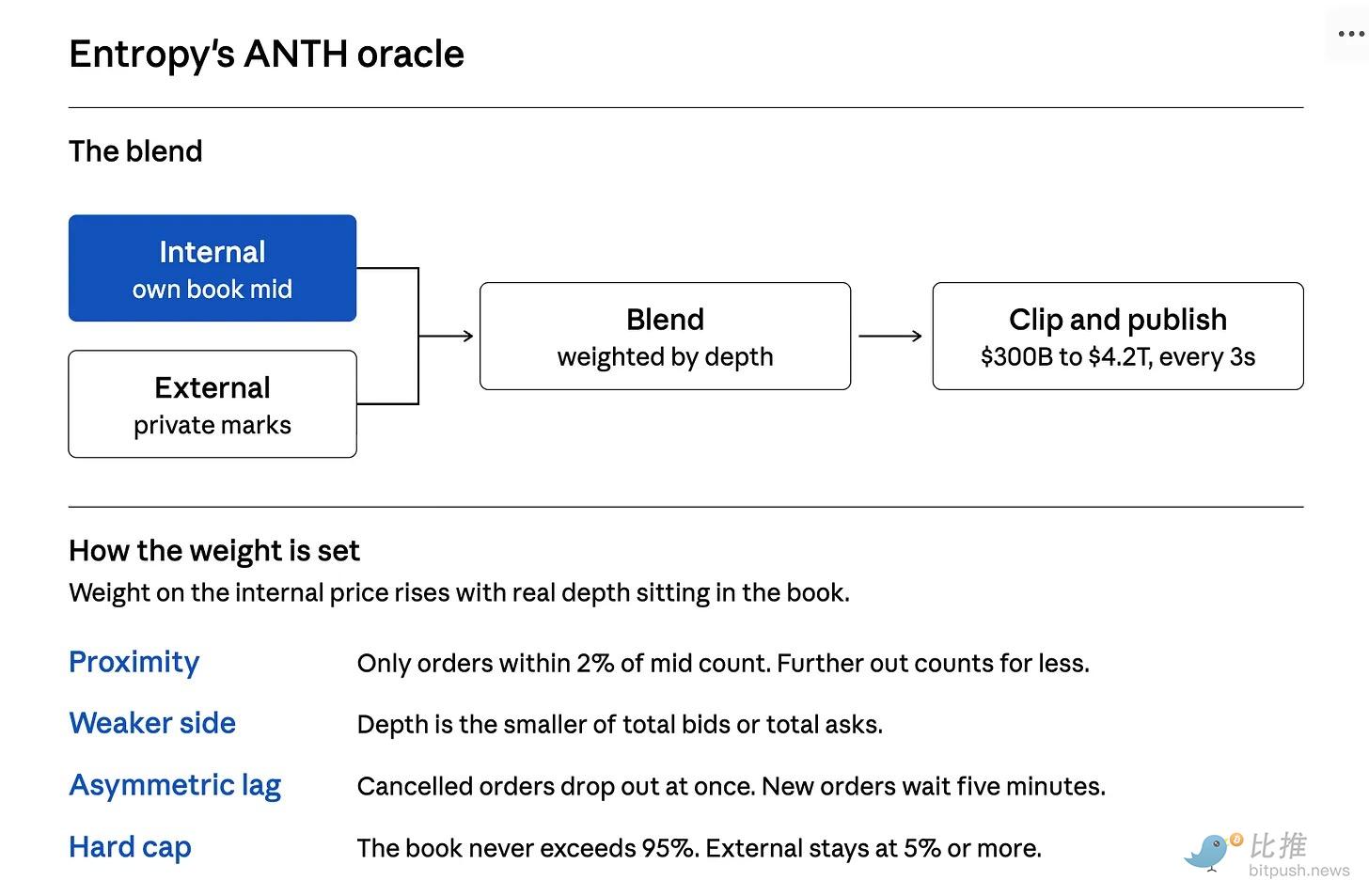
Trade.xyz's oracle strictly relies on its own internal trades' 30-minute average price. It imposes a strict cap on the funding rate and converts the contract into standard derivatives at the time of the company’s IPO. In contrast, Entropy used a hybrid oracle that combined real-time order books with private market valuations, weighting the order book up to 95% only when depth was sufficient; otherwise, it defaults to using outdated secondary market marks. Additionally, as mentioned earlier, Entropy quotes total market cap, not individual stock prices.
To understand how far Entropy can go, Ventuals is a must-know cautionary tale. It was the first platform to launch the perpetual synthetic market for Anthropic before its IPO. But the process was not very enjoyable.
Alvin Hsia, Emily Hsia, and Aris Samad founded Ventuals later in 2025, backed by Paradigm. They were among the first to run perpetual contracts before an IPO on HIP-3.
Margin was the first problem they faced. The three founders did not have 500,000 HYPE at hand. So they created a vault called vHYPE: you deposit HYPE and receive a voucher token; the vault uses this HYPE as collateral while paying you staking rewards throughout the lock-up period. Traders essentially funded the exchanges they would participate in next.
Ventuals opened the order books for OpenAI, Anthropic, and SpaceX. The first $100 million in trading volume took 73 days, while the next $100 million took only 17 days. By February 2026, the platform's trading volume had exceeded $200 million, with over 11,000 people trading there. Hsia later wrote that employees from SpaceX, OpenAI, and Anthropic told him they were using this order book to anchor their own company's equity value; later funds expressed the same view, as did Leimgruber. That was its peak moment.
However, Ventuals' SpaceX contract plummeted by 45% in a single trading day without any incidents occurring that day. The order book emptied in an instant, with just a few orders smashing the price down. The team subsequently compensated traders, which was a decent move. But Ventuals' mechanism was: as long as its price deviation from the real valuation remained within 5%, a standard annual fee of 15% was charged; once the price deviation exceeded 5%, the penalty nature of the fee would surge exponentially. By later reports, the annual funding rate on the Anthropic order book was as high as 8,700%.
Typically, traders correct mispricing by buying undervalued assets and selling overvalued ones. But in this case, they couldn't do that. Ventuals' contracts were purely synthetic assets that could not be settled with real Anthropic shares—especially after Anthropic restricted the transfer of equity in the secondary market.
As depositors hoped to end the one-year lock-up period early, vHYPE's trading price was at a 20%-30% discount compared to standard HYPE. Subsequently, they shut down the project.
Entropy sounds extremely similar to Ventuals, so it primarily addresses those specific failure pain points. First, it limits the annual funding rate to around 10%, preventing the 8,700% slippage fees that caused Ventuals' collapse; second, it uses a hybrid pricing oracle, relying on internal order book data only when liquidity is ample, otherwise defaulting to private market valuations. Like Ventuals, Entropy also prices Anthropic based on total market cap rather than individual stock prices.
But Entropy lacks the simple listing conversion mechanism that trade.xyz has. If Anthropic is still not listed by August 18, 2028, ANTH will be settled in cash at its own average price over 30 days. If an IPO occurs, Entropy states that the oracle will switch to the 1-hour average price of the marked price for the three days before the listing and then track the public market. Hyperliquid cannot convert market cap contracts into individual stock contracts, so after being listed, ANTH will still be quoted in billions. Whereas trade.xyz adopted individual stock quoting from the outset, so it does not have this issue.
The common supporting argument in the market centers around the luxurious background behind Entropy.
Ribbit Capital invested in Bitcoin and Coinbase in their Series A funding round in 2013, and began investing in Robinhood (including a bailout funding in 2021) since 2014, as well as investing in Ripple, Xapo, and Blockstream. In public financial disclosures, it still holds HOOD and COIN. Its recent crypto investments include Polymarket, Lighter, Tempo, Morpho, Bridge, and it led a $14 million funding round for EntropyIO on August 24, 2026.
Ribbit's old line of business is selecting capital distribution businesses, such as brokers (Robinhood), exchanges (Coinbase), prediction markets (Polymarket), and on-chain perpetual contracts (Lighter and now Entropy). But the mere fact that Ribbit funded $14 million only means it holds equity in Entropy; the collateral it staked still risks being liquidated (slashed).
Team members formerly worked at institutions like Citadel, Optiver, Polymarket, and Millennium, which also cannot provide absolute guarantees.
In addition to Anthropic, Entropy has also listed SanDisk (SNDK). SanDisk is already publicly traded on Nasdaq, so all platforms can directly replicate the same spot price. Within days, SNDK also went live on trade.xyz, Lighter, Ondo, Variational, and Aster. Trade.xyz has about $174 million in open interest and $276 million in 24-hour trading volume, while Entropy’s open interest is only about $5.6 million, with a trading volume of $55 million.
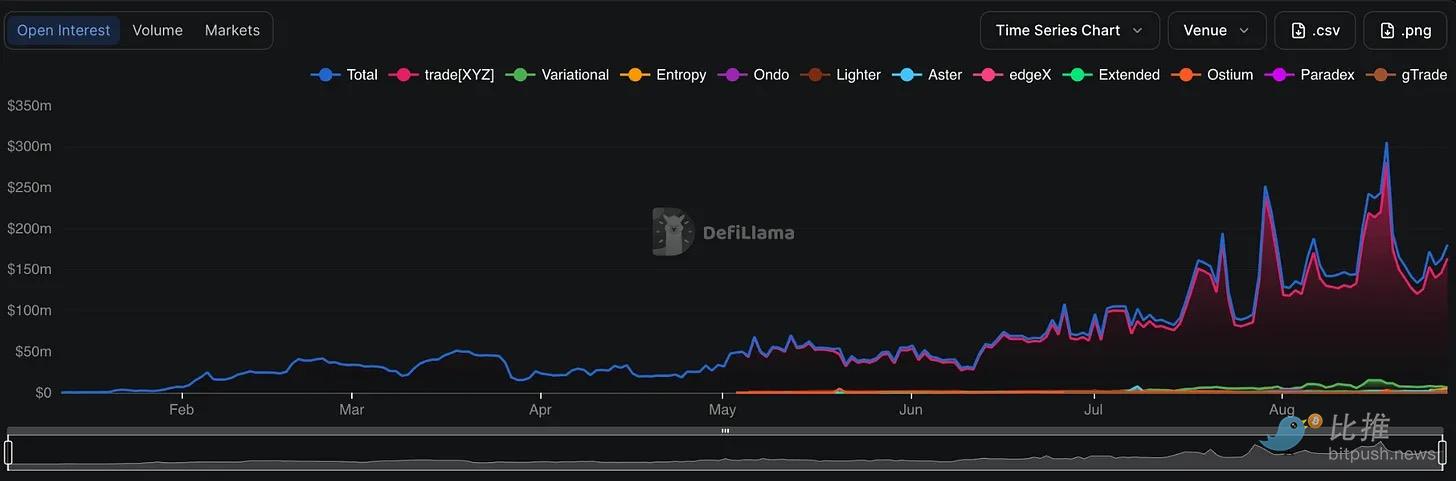
Data Source: defillama
If trading volume is high but open interest remains low, it indicates that traders are rapidly entering and exiting, aligning with behaviors typical of arbitrage, market making, or automated robots stabilizing price differences across platforms. Persistent real demand typically shows through continuous increases in open interest, representing that traders are establishing positions and holding them longer.
In other words, the reason SNDK contracts can maintain accurate pricing is that automated bots continuously align crypto exchange prices with Nasdaq stock prices in real-time. But ANTH cannot do that because there are no live stock prices to replicate.
Therefore, whenever trading activity is low, ANTH contracts must rely on outdated private valuations, historical funding rounds, or rumors. Essentially, Entropy has not changed the reality that "decentralized exchanges excel at pricing publicly listed stocks but struggle to accurately price unlisted private companies."
On August 19, a deployer named "Kraken HIP-3 test DEX" opened up star gating on the Hyperliquid testnet. Blockworks analyst Shaunda Devens found it whitelisting 10 wallets and using 3 of the 5 new management tools—canceling user orders, forcibly liquidating positions, and transferring collateral out of accounts. Meanwhile, a validator in the testnet registry appeared with a registration name of "Kraken Exchange Validator."
Neither Kraken nor Hyperliquid has confirmed whether they own this testnet DEX. Devens believes this could be real as Kraken's parent company, Payward, has deployed xStocks on HyperCore, and these three tools are typically what a regulated compliance body would require. Until someone formally confirms, it shouldn’t be seen as an official product.
Entropy explicitly prohibits users from strictly regulated regions (USA, UK, EU, Canada, Australia, Singapore). If these users are permitted to trade in the future, it is likely to be achieved through a licensed, centralized structure that is legally allowed to confiscate assets and manage risks, such as Kraken's model.
Traditional stock exchanges (like Nasdaq or the New York Stock Exchange) rely on a human "listing committee" to review and approve which assets can be traded. In contrast, Hyperliquid's HIP-3 protocol states: there is no need to apply for permission from the committee; anyone who locks in $40 million in token collateral will be automatically granted permission to go live in the market.
The potential dynamics of the Kraken testnet suggest that regulated financial institutions want to use this technology, but they cannot legally operate in an unlicensed environment. To comply with government regulations, these institutions are adopting HIP-3's blockchain infrastructure while re-hard coding their strict rules, approved user whitelists, and manual risk control teams (risk desks) back into the system.
If Entropy can succeed, it will bridge a whole new category of private equity assets on Hyperliquid's track. If it fails... well, that can merely be another cautionary tale for the next builder. Watching this network continually evolve and learn from its own ruins is indeed a fascinating thing.
The market will eventually see a turning point, so the best strategy right now is to keep building while the night is still young.
免责声明:本文章仅代表作者个人观点,不代表本平台的立场和观点。本文章仅供信息分享,不构成对任何人的任何投资建议。用户与作者之间的任何争议,与本平台无关。如网页中刊载的文章或图片涉及侵权,请提供相关的权利证明和身份证明发送邮件到support@aicoin.com,本平台相关工作人员将会进行核查。


