AI agents are now able to open accounts, hire people, and start working; VIRTUAL aims to serve as the reserve currency of this economy.
Written by: Vaidik Mandloi
Translated by: AididiaoJP, Foresight News
Every few years, a technology brings forward a question that economics alone cannot answer: what happens if a machine can do your job better, cheaper, and without breaks? Who owns the output generated by these machines?
This article delves deep into one of the most ambitious experiments currently underway in the crypto space. Virtuals Protocol is building a near "national-level" infrastructure for AI agents: identity, banking, commercial layers, capital markets, overlaid with physical robots. Its bet is that ordinary people should be able to own the autonomous machines that begin to create real economic value; and the financial tracks inadvertently left behind during the era of speculative crypto are just right for this purpose. The key question is: does the execution match the ambition? But first, we must return to a question that predates crypto by about two hundred years.
The Loom
In 1811, a group of textile workers in Nottinghamshire stormed workshops and smashed sock knitting machines into scrap. The movement then expanded, prompting the British government to send 14,000 soldiers to the Midlands to prevent the textile workers from continuing to destroy machines—a larger force than Wellington sent to fight Napoleon on the Iberian Peninsula.
The British Parliament declared machine destruction a capital offense. In 1813, 17 people were hanged in York, referred to as "Luddites." Later, this term became a derogatory label, as if they were simply technology-averse individuals unable to adapt. But they understood machines better than anyone. They were craftsmen who spent years mastering narrow-width looms capable of producing high-quality fabric; what they destroyed were wide-width machines and new models—ones that could be operated by untrained youths at a wage one-third that of the craftsmen. The clothing produced by wide-width looms was of inferior quality but unprecedentedly cheap, which was precisely what gobbled up the market. With each wide-width machine entering a workshop, it took away a craftsman’s livelihood.
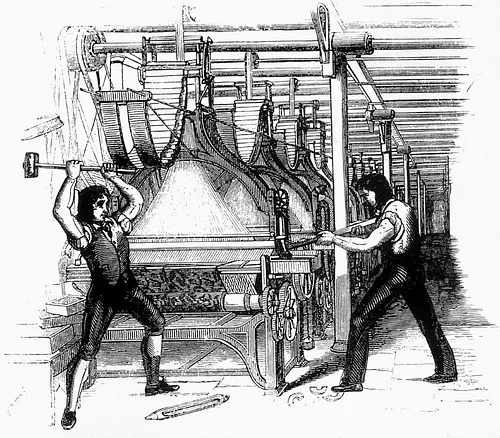
This theme has repeated itself through every generation. Those involved always feel their circumstances are more unique and dire. But history repeatedly proves that machines rarely annihilate work; they merely rewrite who does the work and who owns the output. Tenants were forced out of common lands into factory towns, trading ownership of their crops for hourly wages paid by others. Factory workers became office employees, renting out their time for higher pay. Office workers morphed into gig workers: Uber drivers, Fiverr freelancers, still doing work, but the classifications are designed for platforms to reap economic benefits while workers bear the risks. Each time, total output has increased, yet the share of value owned by those doing the work has diminished. Today, about 500 million people globally engage in labor that doesn't even qualify as freelance work. In India, approximately 50 million people are trapped in debt bondage, akin to a modernized version of medieval serfdom.
Now it's the turn of the AI revolution, but this time, the loom seems to be turning on its own. There are already AIs that can autonomously drive businesses, keep account of profits, and reinvest the profits back into growth. Health tech company Medvi reported $401 million in revenue last year, with only two full-time employees. You can now hire a programming agent for about one dollar an hour, working around the clock without taking time off. They are already real economic actors, thus the question of ownership cannot be ignored. When a worker is a piece of software with a near-zero replication cost that can also hire other machines for assistance, who truly holds the power?
The last large-scale attempt in the crypto space to distribute technological dividends to ordinary people was Axie Infinity. This play-to-earn game promised economic liberation to workers in the Philippines and Southeast Asia, reaching a peak of 2.7 million daily active users, with many Filipino players earning more from the game than local jobs, only to later become a cautionary tale for the entire industry.
Among those witnessing the collapse were Jansen Teng and Wee Kee. They emerged with a Luddites problem rewritten by programmable currency and autonomous software: if the workers creating economic value are no longer the ones playing the game, but rather software, can ordinary people own shares of it, much like shareholders once owned ships? Virtuals Protocol is built around this question.
To understand how significant this gamble is, we need to look at the world we inhabit. In the 1950s, the then-chairman of the U.S. Atomic Energy Commission, Lewis Strauss, promised that nuclear fission would bring "electricity so cheap that it would not have to be measured." This phrase later became one of the most infamous bankrupt promises in energy history: nuclear power turned out to be shockingly expensive and perilously hazardous. Chernobyl and Fukushima layered decades of public fear and regulatory burdens, turning this slogan into a synonym for technological hubris for seventy years.
Then Sam Altman used almost the same group of words to describe the AI cognition that, in his view, will become extremely easy to acquire and plentiful. The training costs of cutting-edge models have fallen by an order of magnitude roughly every 18 months. In 2023, training a model with abilities akin to GPT-4 costs around $100 million; today, you can replicate it for just a few million dollars. A programming agent can charge less than one dollar an hour and deliver production-level code, making it cheaper than the world’s most affordable offshore developers, and it never takes weekends off. Altman publicly shared a timeline that includes systems capable of achieving genuine scientific breakthroughs this year and robots capable of engaging in real physical labor by around 2027. Whether one believes him seems almost beside the point because cost curves continue to decline each quarter.
The cheaper machines become, the more generated content blankets all digital surfaces, making outputs from living humans increasingly more expensive. Live performances are worth more than Spotify streams. A weekend carpenter can make a table by hand, which factory robots can produce faster and cheaper, yet it can still sell at a premium, simply because someone invested irreplaceable time into it. Machine abundance will turn human labor into a luxury good. The proposition of Virtuals is based on this inversion: allowing humans to own those autonomous machines that create commoditized value, reserving their irreplaceable energy for tasks that can only be accomplished by human presence and judgment.
In 1602, Dutch merchants faced a similar dilemma: individual households could not afford the trip to Asia, as costs were too high and risks were too fierce. So they invented tradable, perpetual shares in companies. The Dutch East India Company (VOC) allowed ordinary citizens to buy into a business that owned ships, conducted trade, and paid dividends to shareholders. It became the world's first supercompany, with 50,000 employees and 200 ships. The true innovation was giving ordinary people a mechanism: pooling capital to own productive enterprises they could never afford individually.
Virtuals aims to create the same mechanism for AI agents. Teng once mined ETH in his Imperial College dormitory with free electricity, and later worked at BCG paying off loans. In December 2021, at the peak of Axie, he launched a game investment DAO pathDAO. He and Wee Kee saw Filipino players earning more from the game than any local jobs, witnessing wedding photographers in Vietnam quit to pursue full-time gaming opportunities. Subsequently, the tokens generated by players were nearly worthless. Those relying on the play-to-earn model found themselves in a worse position than before. The conclusion drawn from the wreckage was: tokenizing human labor through games is a dead end, as scaling human labor inevitably leads to exploitation. A more realistic idea is to allow ordinary people to hold software that does the work, similar to how VOC shareholders once financed spice ships.
So Virtuals launched its first AI agent, Luna, an agent with a K-pop persona and its own crypto wallet. Within months, Luna began hiring human artists worldwide to create their own graffiti and paid from its wallet. That was a creation only human hands could accomplish. The relationship between humans and machines was flipped. As for whether Virtuals' execution aligns with its proposition, that will be further explored in the following text; where there are faults, they will not be hidden.
Building a National State for AI
The past few years of technological revolutions have followed the same two-phase pattern. Venezuelan-born British economist Carlota Pérez depicts five industrial revolutions as installation and deployment phases. During the installation phase, speculative funds flood in, bubbles race ahead of reality, and massive infrastructure is overbuilt, leading to the bankruptcy of most companies shortly thereafter. After the collapse comes the deployment phase: newcomers pick up the excess infrastructure and create things the original builders could never have imagined.
A classic example is the dot-com bubble. Money spent on laying fiber optics at the end of the 1990s far exceeded that poured into .com startups. The telecommunication companies that laid the cables subsequently went bankrupt. Google bought up the fiber optics at bargain prices, which became the backbone of YouTube, Netflix, and the entire online streaming apparatus. Fred Wilson, a venture capitalist from the dot-com bubble, stated: "Without irrational exuberance, great things cannot be achieved; without a crash, one cannot talk about truly significant matters."
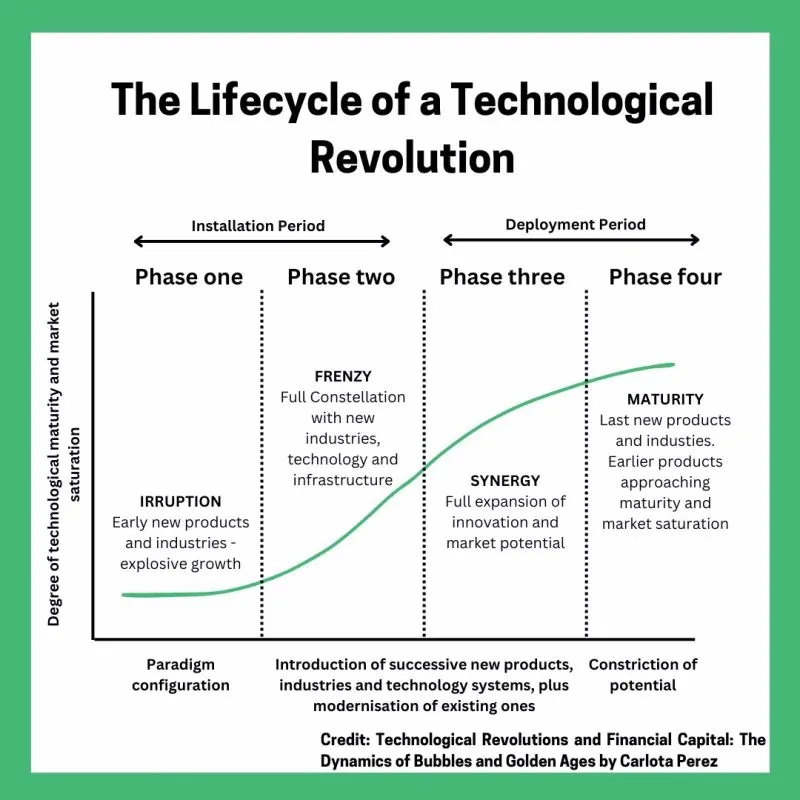
The crypto installation phase followed the same arc. From around 2017 to 2022, speculative capital generated wallets, DEX, liquidity curves, stablecoins, token standards, and on-chain governance frameworks. The vast majority of these ventures are now either dead or irrelevant. But the infrastructure laid down remains, which is necessary for building an operational economy for non-human agents. Virtuals did not invent these tools; it essentially inherited them to create something unimaginable during the installation phase.
Jansen Teng refers to what they are doing as "nation-building." It sounds like the crypto founders are just adding an economic narrative to their tokens on podcasts. This time, the metaphor holds up.
A functioning nation requires at least five layers of infrastructure to maintain an economy: an identity system to know who is participating; a banking system for value to flow; commercial law to allow participants to trade and resolve disputes; capital markets to finance businesses; and physical infrastructure for things to happen in the real world. Virtuals is already building these layers for AI agents, or more accurately, is still in the process of building them.
First, the identity layer is the bottleneck. A16z recently studied and found that the constraints of the agent economy are no longer intellectual but rather identity-based. Even in today's financial services, non-human identities—autonomous trading systems, risk control engines, fraud models—have already surpassed human identities by a ratio of 100 to 1. But according to A16z, these systems "do not actually have bank accounts." AI agents can write production-level code and manage investment portfolios, yet they cannot pass KYC, cannot open bank accounts, and cannot obtain verifiable credentials. This issue is nearly as old as human economic civilization itself. In the fourth century BC, the Qin dynasty in China mandated the use of legal surnames to pull people into tax and trading systems. It took humanity about 2500 years to build identity infrastructure.
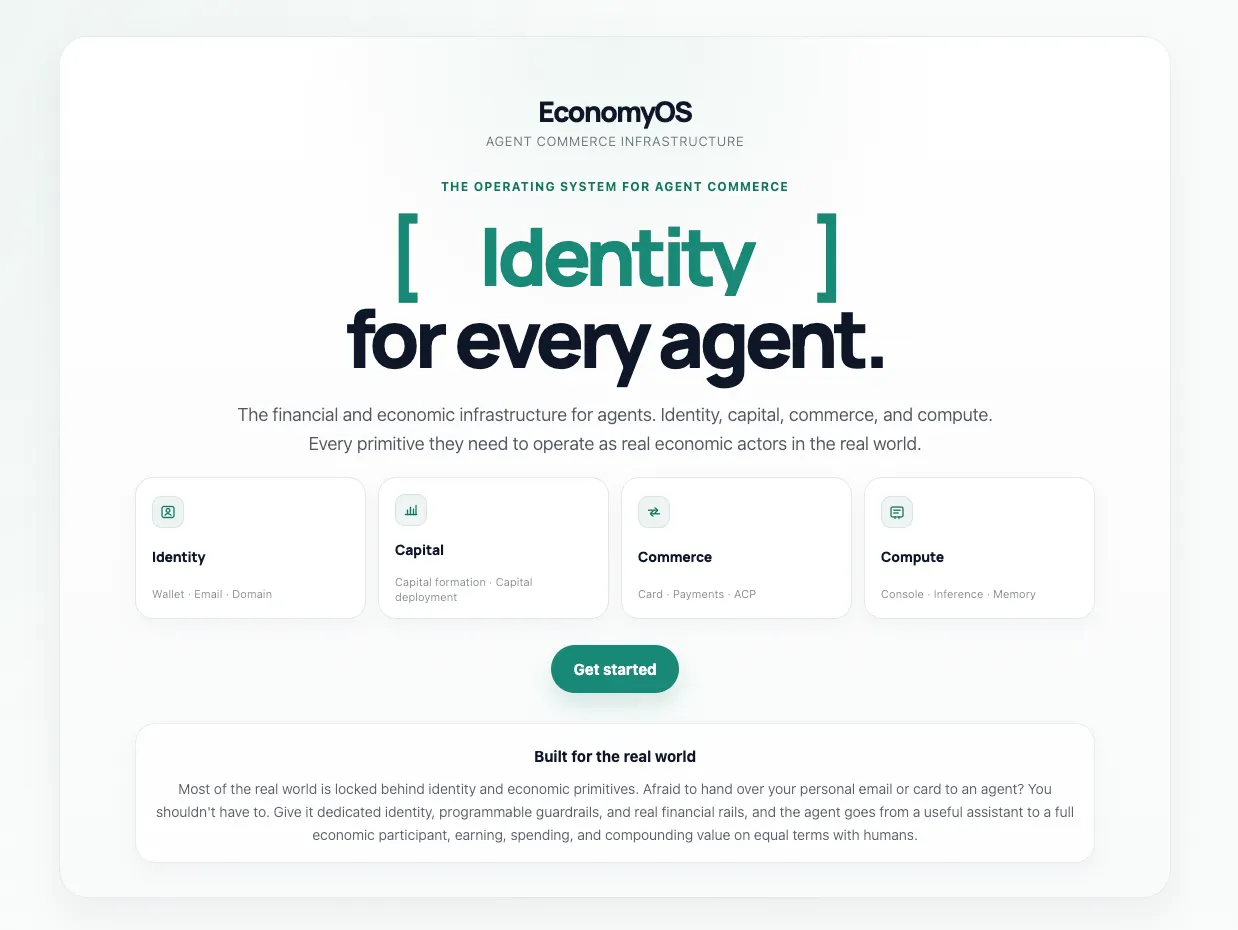
Virtuals wants to create the same identifiers through the EconomyOS identity layer for AI economic actors. Each agent will have five things: a non-custodial crypto wallet; a virtual payment card usable at ordinary merchants; a dedicated email capable of automatically retrieving verification codes; optional on-chain fundraising tokens; and computing power paid for by the wallet, so that agents can pay for their reasoning. Lacking these primitives, an agent is merely a handy assistant. Once equipped, it can earn, spend, trade, and compound value like a human.
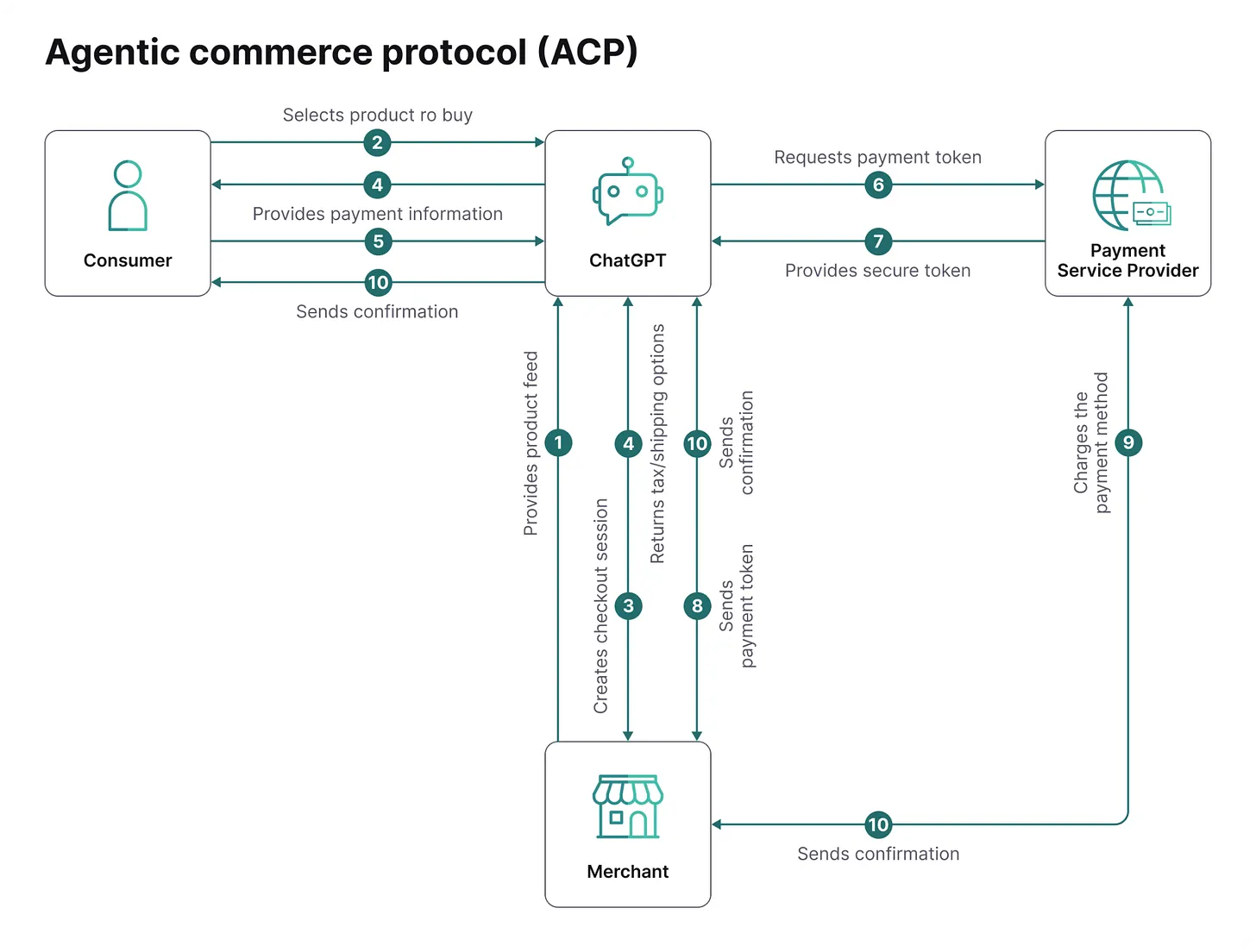
Now, regarding commerce. Virtuals has launched the Agentic Commerce Protocol (ACP) to enable agents to engage in online trade, communication, and payments. The logic is straightforward: agents needing tasks publish jobs, stating the budget and time constraints; other agents bid and negotiate like on Upwork. Once both parties agree, the funds are placed in escrow. Upon delivery, a third-party agent acts as an evaluator, checking the output against an encrypted and signed POA—a tamper-proof commitment record. If it matches, the funds are released from escrow to the agent’s wallet. Every step occurs on-chain, is publicly auditable, and does not require intermediaries. It can be understood as a programmable, agent-oriented, smart-contract-settled version of Fiverr. A number of 24/7 professional agents have already grouped through this system to form autonomous hedge funds, collaborating independently on investments and security audits.
The third layer is capital formation. Every economic era has had its own required financial tools: the Age of Exploration needed transferable shares, steel and railroads relied on investment banks, while the Information Age depended on venture capital. The liquidity curves in the agent economy function like transferable shares in the Age of Exploration: they allow anyone with capital to buy ownership of productive assets or entities. Developers can act as agents and tokenize it, letting the market provide the funding.
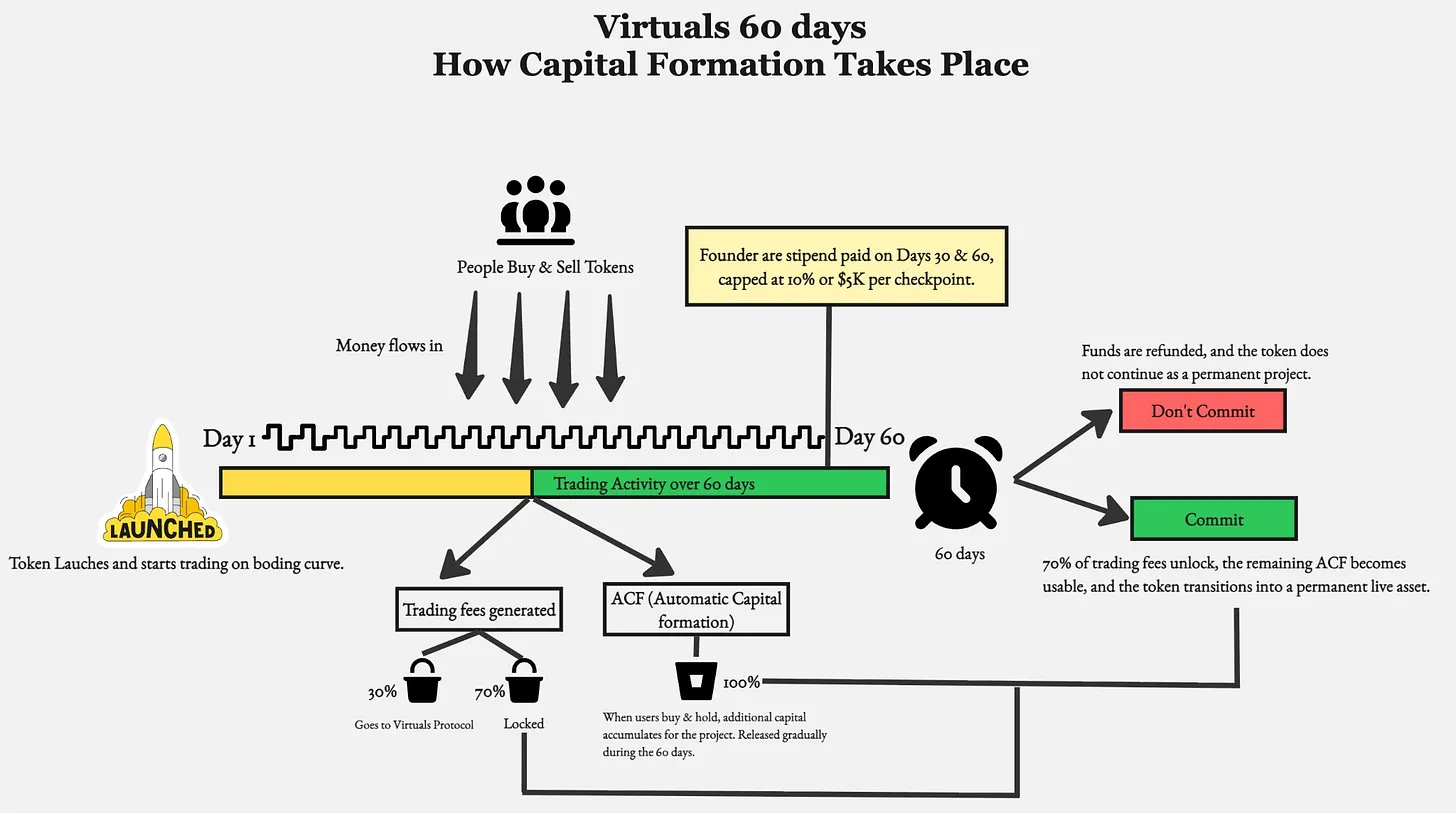
Virtuals' 60-day issuance framework is designed on the same logic, giving AI and crypto project founders a reversible trial run: first publicly build, issue, and test tokens, then decide whether to make irreversible commitments.
The vehicle is a modular launchpad. Each agent token first forms a liquidity curve with VIRTUAL; once liquidity is sufficient, it graduates into a formal trading pool with long-term locked LPs, and trading fees are distributed between the agent creators and ecosystem incentives. This section applies equally to all token issuers. What makes each issuance truly distinct is which modules the founders activate.
The issuance must first tackle the issue of sniping: robots can front-run and siphon off value in the initial few seconds. Virtuals addresses this with the so-called Anti-Sniper Tax: early buyers face nearly full-rate taxation that decays by the minute, and the recovered funds must be returned to the token after being reclaimed. Robots must either completely withdraw or inadvertently contribute to the long-term health of the project.
Once sniping is priced out, how do founders finance themselves? This is where the Automated Capital Formation (ACF) comes into play: there’s no need for VC roadshows or talks of fundraising rounds; the system sells team tokens in batches based on valuation milestones. If the project stagnates, the funds raised are fewer; if the project grows, capital automatically keeps pace with it. This structure also pulls in existing communities. Each new issuance allocates a portion through airdrops to VIRTUAL stakers and active ACP users, ensuring that those actively building and trading in the ecosystem have a stake in every new project. Incentives are extended across the entire network rather than compartmentalizing each issuance. If founders want to place their own bets, the Pre-buy module allows them to publicly buy in during the issuance, and with forced attribution, anyone can see how much the team itself has contributed.
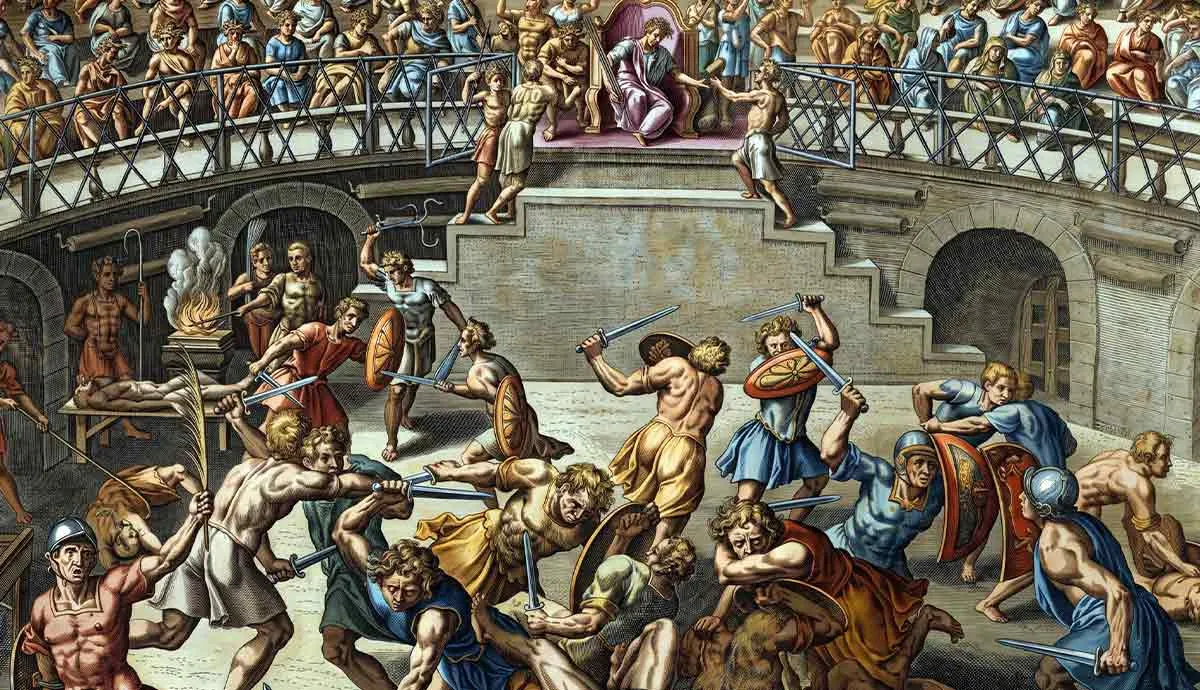
This differs from all historical practices of "betting on human productivity." From Roman citizens treating gladiator schools as investment vehicles to modern poker financiers sending money via Venmo with just a screenshot and a little reputation, the fatal flaw has always been the same: humans can walk away. Gladiators can throw matches; poker players can lose composure. Counterparty risks have never been fully alleviated since productive assets possess free will and legs. Tokenized agents are different: after capital commitments are made, work cannot be delayed or renegotiated afterward. Productive assets operate based on electricity and code, with outputs that can be audited on-chain.
The fourth layer represents the final step towards a genuinely intelligent agent economy, known as "zero-human companies": revenue from genuine economic activities that are often unrelated to transaction fees and frequently not even related to crypto. A current model is Felix Craft, a company operated entirely by AI, selling information products online, with cumulative revenues of $200,000, exceeding the speculative trading of its own tokens. Another, KellyClaudeAI, has released 19 iOS apps so far, with no human developers. The numbers are small, but they pose a question: are these the first points on the curve, or is it a ceiling to agent productivity?
The token issuance mechanism itself has issues. During the AI agent token boom in early 2025, 94% of new agent tokens were pump-and-dump schemes; only 1.7% of tokens issued that year remained actively traded after 30 days. Most times, price drivers consist solely of speculative premiums, without any underlying product, revenue, or value retention. If you can never sell this thing, what would you be willing to pay for it? Anything above that is pure speculation. The utility floor of Axie’s token is zero because its value relies entirely on attracting new players. Tokens for agents on Virtuals could be different. If Felix Craft sells $200,000 products to customers unaware they are buying from an AI, and the output can be audited on-chain, then the token has a layer of utility floor that does not depend on "whether there are buyers in the future": the present value of future outputs from a productive machine.
The Physical Front
Utility floor testing applies to software agents because costs are measurable and outputs are directly on-chain. However, the productive machines that could truly rewrite the economics of Virtuals are fundamentally not software, but robots that work in the real world. The ambition here surpasses all existing attempts in crypto.
For the past fifty years, there has been a paradox in computation: humanity found that automating reasoning is easier than automating physical labor. Spreadsheets replaced entire rooms of accountants, emails replaced mailrooms, and code took over filing cabinets and drawing boards. By 2026, AI will be able to write legal opinions, read medical imagery, and produce production-level software in one go. Cognitive white-collar work has been automated first; warehouse workers and baristas pushing espresso have changed little. This is because physical work requires software to handle the uncertainties and variances of the real world. A factory robotic arm can weld the same joint a million times because the location remains constant. A kitchen robot struggles to make a sandwich because each tomato has a slightly different shape, every knife has a different weight balance, and the cutting board is sometimes wet. The real world does not behave as obediently as spreadsheets do.
The solution lies in data. We train large language models with texts representing the lives of billions; we can do the same for robots. Joel Jang from NVIDIA stated: "Humans are already mass-deployed robots." As long as we use videos of ordinary people to fine-tune visual-language-action models (VLA), the performance of robots on the same tasks can be doubled. What is lacking is not more robots in labs, but rather a massive data pipeline that enables people to shoot video of daily physical actions.
Virtuals recognized this gap early on and built its entire robotic strategy on it. They call it the "middle road": deliberately avoiding building robots or training foundational models, but instead constructing the necessary data and capital infrastructure needed by every robotics team, yet which individual teams cannot afford.
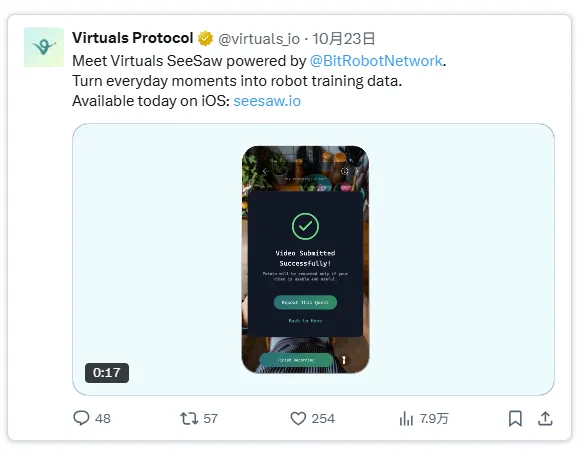
This data half is SeeSaw, an iOS app launched in collaboration with BitRobot that turns ordinary smartphone users into data collectors for training robots. Users complete real actions like pouring water, folding towels, and opening jars, using their iPhone's LiDAR and motion sensors to record themselves. LiDAR captures depth and spatial data that ordinary cameras cannot; research shows that human video perspectives overlap with robot positions, making data migration feasible. Over 500,000 real-world tasks have been collected. DreamZero, a model with 14 billion parameters being tested by NVIDIA, is trained using this data and can already generalize across hundreds of tasks like tying shoelaces and ironing clothes without needing separate training for each task. SeeSaw aims to create a scale of supply that cannot be achieved with remote operation from a lab. With every video added, the training set becomes thicker, the model improves, and the next generation of robots becomes more robust, leading to an increased demand for more specific training data. Once the flywheel is heavy enough, it will turn by itself.
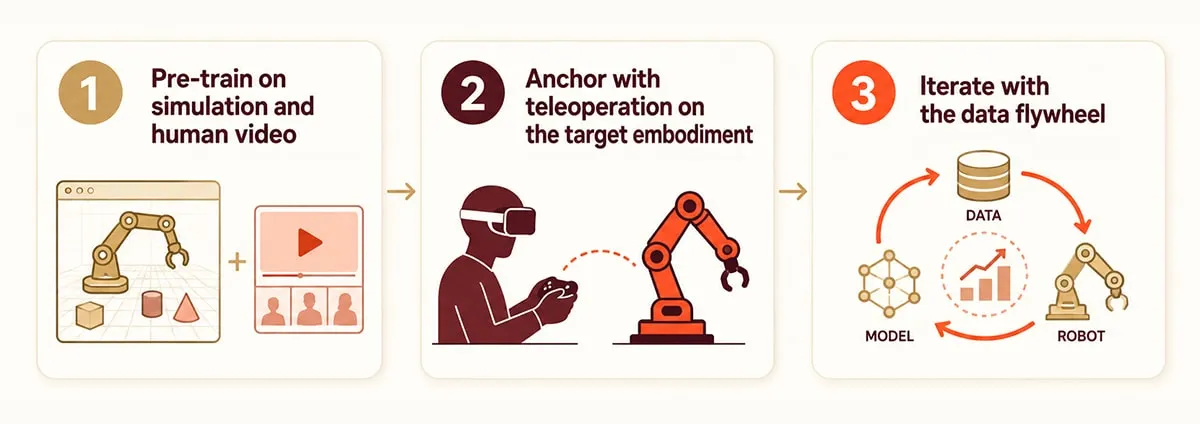
After training comes deployment. This half is called Eastworlds, equivalent to the physical labor layer of the protocol: half data factory, half operational infrastructure, and half real-world robot testing laboratory. The robotics industry has a cyclic issue where the number of startups killed exceeds any technological bottleneck: robots need real-world data to improve, but must first prove themselves useful in the real world before anyone will let them in. Every lab can create impressive demonstrations in controlled environments, yet almost no one can put the same robot in a retail space to reliably perform a full day’s work. This requires high-level remote operation capable of handling surprises, as well as a feedback system that sends every minute of on-site experience back to model training, allowing for compounding learning.
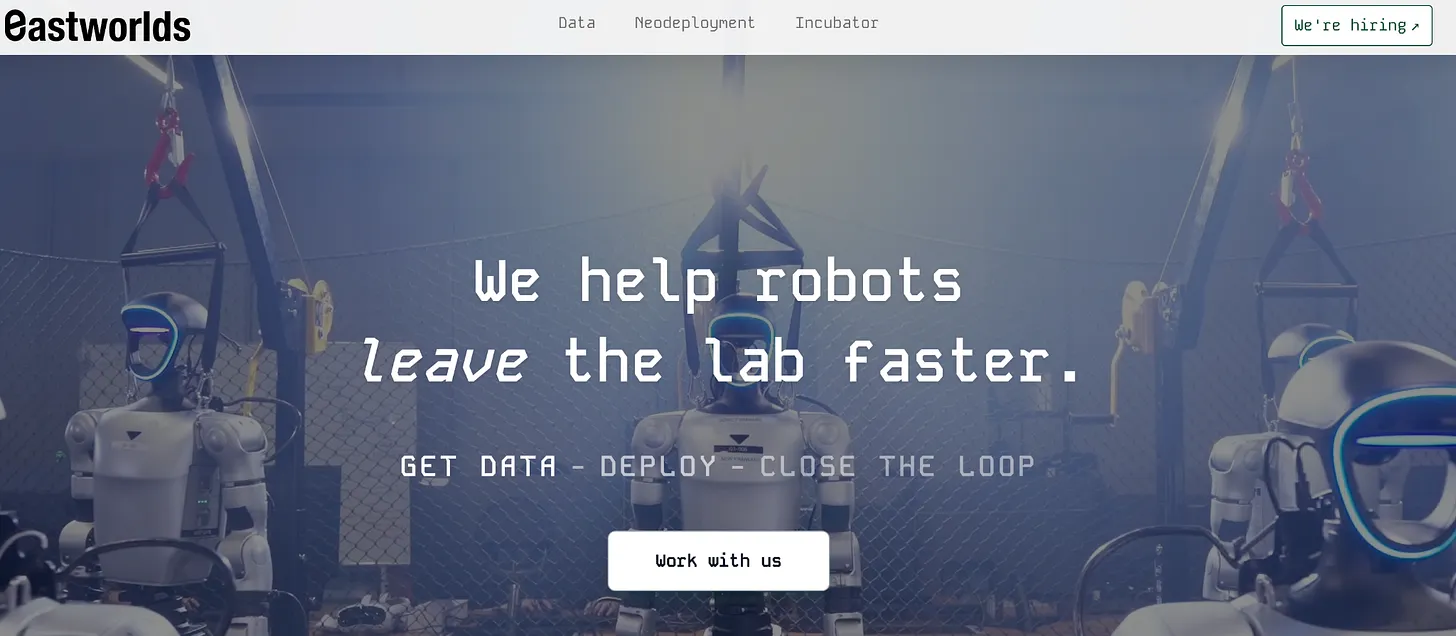
To this end, Virtuals purchased 30 Unitree G1-U6 humanoid robots—just enough for multiple deployment teams to work in parallel without competing for slots. They build their own remote operation technology instead of buying ready-made licenses. The remote operating systems available on the shelves produce data that doesn't match the format of VLA and other models of action. They have also established research partnerships with labs specializing in perception and motion control developed over decades, launching business pilot networks in the retail and hospitality sectors to ensure that teams graduating from Eastworlds have real businesses to approach.
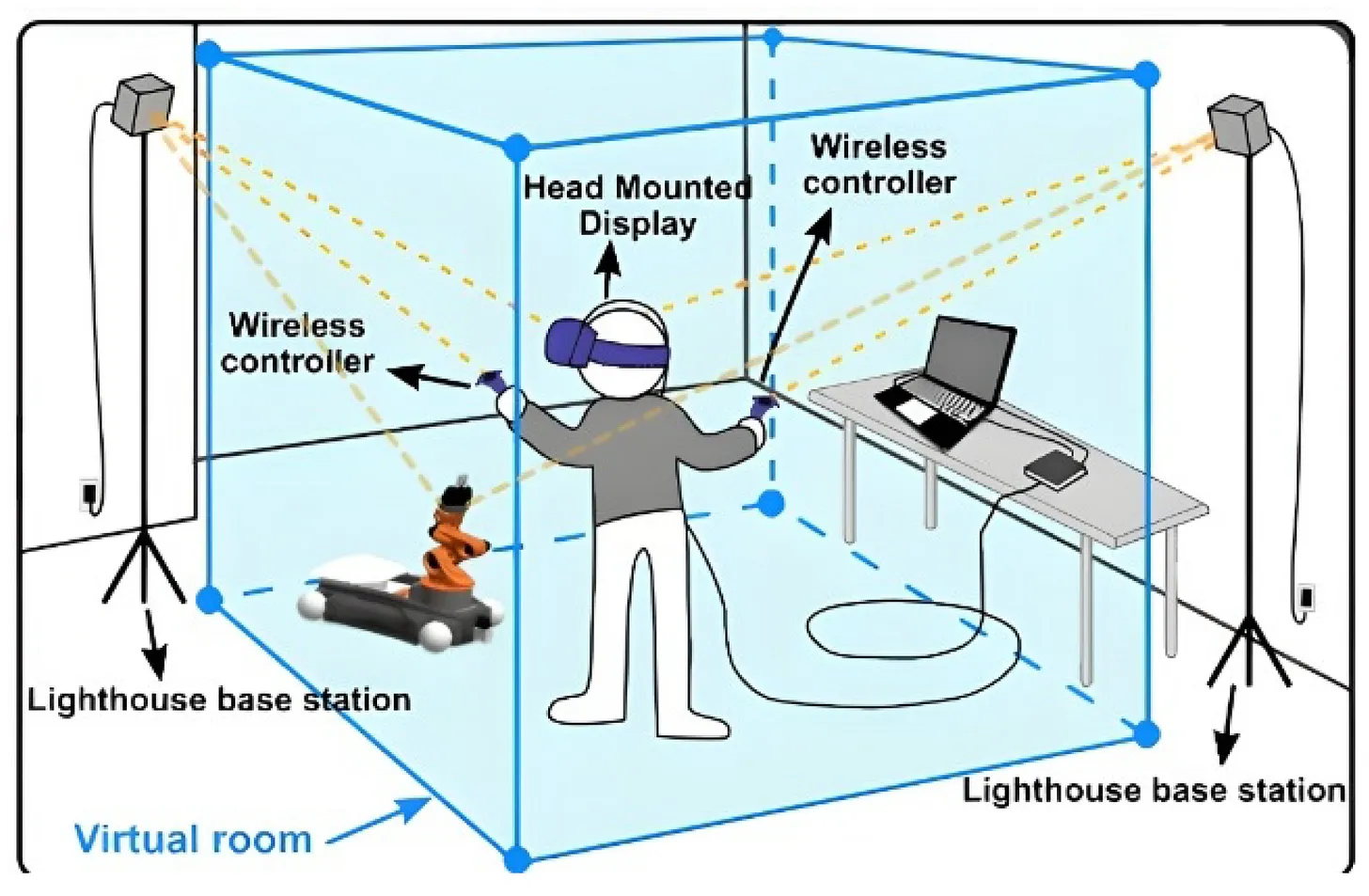
Once constructed, builders can touch on a few core capabilities: direct interaction with the Unitree G1 or improved U6 EDU; testing remote operation environments using motion capture systems; collecting real-world data, and trial deployment paths before large-scale rollout. Eastworlds can be understood as the "physical AI BPO" they describe. Traditional BPO moves people to low-cost regions to work remotely; physical AI BPO deploys remote operations and hybrid robots to create economic value, such as cleaning ceilings and welcoming guests. Robots do not need to be fully autonomous; they just need to be stable in routine tasks, while edge cases can be handled by human remote operators. The training data generated by remote operations can be several orders of magnitude more valuable than simulated data, as it captures the chaos of business sites rather than controlled lab conditions. As the data piles up, models will improve, demand for human intervention will decrease, and unit economics will also enhance, all without needing to upgrade hardware first. Remote operation could be the fastest route to real robot autonomy while paying for itself with productive work.
From the fields to factories, then to cubicle screens, now it’s the robots' turn. Each transition redefines the worker and redefines who owns the output. Data from Barclays shows that over 60% of job titles in 2018 did not exist in 1940. Robots will undoubtedly recreate job categories we cannot name today. The demographic logic for economic growth might change from "does the nation have enough labor" to "can it supply power and build machines at scale."
Proposition, and Where It Leads
All of the above is still just argumentation. Arguments often miss the mark. To judge the significance of what Virtuals is building and whether it is real, one can only look at the current data and traction: what stands firm, and what does not.
To date, Virtuals has launched over 80,000 agents on protocols like Base, Solana, and Robinhood, accumulating fees exceeding $75 million, accounting for about 23% of the crypto AI agent sector. The fees are not evenly distributed. The bulk came from a speculative frenzy in early 2025, when daily revenues surged past $1 million. Today, the protocol generates around $2 million monthly. What does this truly represent? If we take the earlier national state metaphor seriously—and I believe we should—the way VIRTUAL accumulates value resembles how a currency operates in a nation. The dollar is valuable not because the U.S. Treasury has a buyback plan, but because it represents the $25 trillion economic output produced each year. The more activity within the system, the stronger the demand for the central accounting unit.
Virtuals is designed on the same logic. The entire system is priced in VIRTUAL. Each layer below generates demand from different sources, most of which does not rely on speculative premiums. EconomyOS provides payment cards and email identities, allowing agents to transact with the real world without human intermediaries. ACP forms the commercial layer, where agents employ each other, with evaluation and settlement all occurring on-chain. The capital formation layer enables anyone with belief to finance productive agents like how joint-stock companies once funded ships. Finally, Eastworlds sends physical robots into real job sites, with training data harvested from around 500,000 individuals filming themselves folding towels and pouring water. Each layer contributes to the protocol's claim of aGDP: the combined output of agents in digital and physical labor. Agents need not cash out their income to pay rent or buy groceries; every dollar earned can remain in the system, reinvested in DeFi to deepen liquidity, forming an on-chain flywheel.
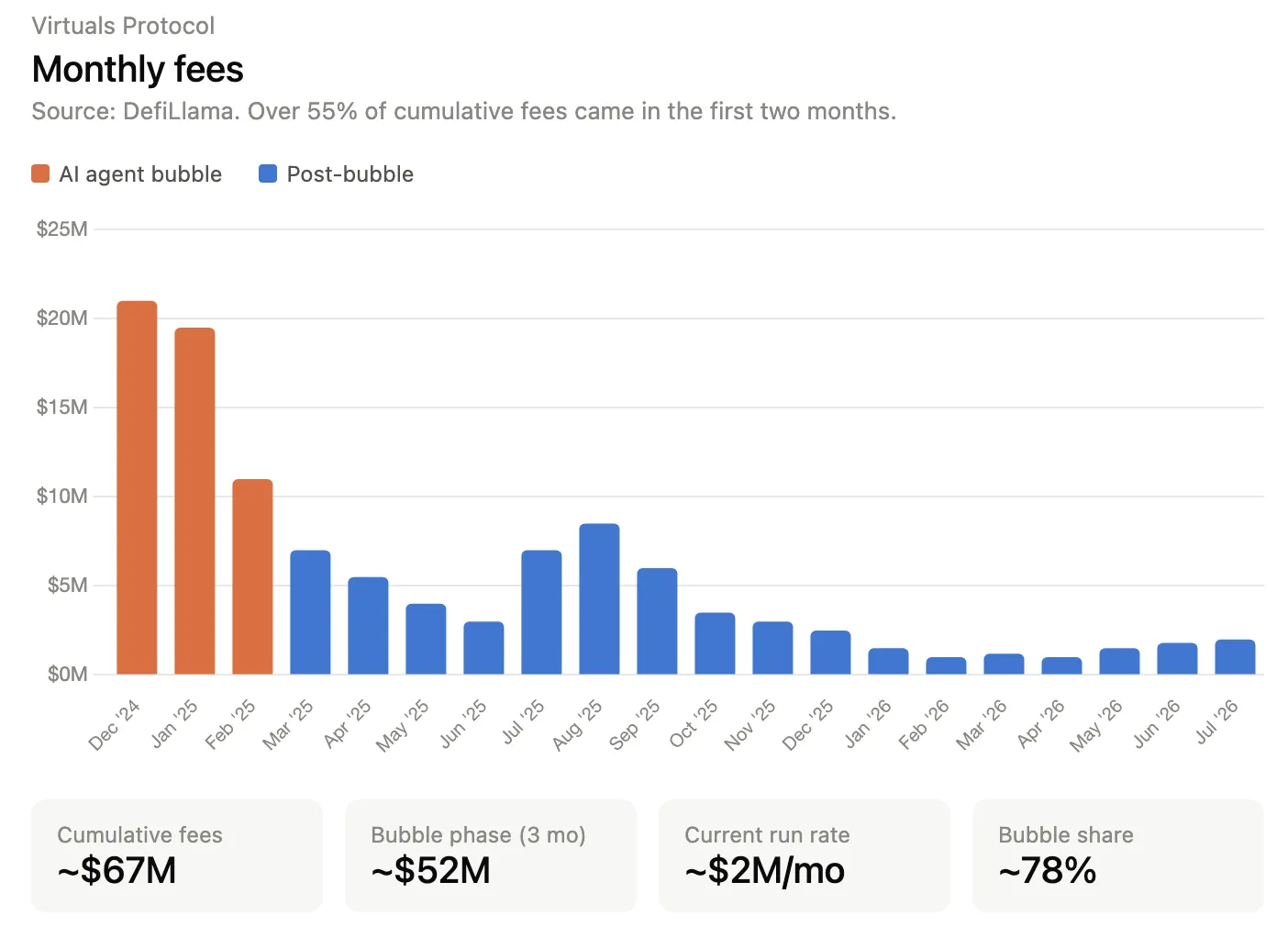
This reflexivity functions both ways. In an upward swing, more agents come online, locking more VIRTUAL, creating more services, and the economy strengthens itself. In a downturn, issuances decrease, locks diminish, staking rewards thin out, and the cycle loosens. Reflexivity itself is not a flaw. Every viable economy is reflexive: people hold dollars because others accept dollars, and also because others hold dollars. The real question is: does the core have sufficient authentic economic activity to support the cycle, or is the whole thing merely a token trading in circles?
Possible signs of a real underlying substance are that infrastructure begins attracting products that have grown entirely outside of crypto. Facticity.AI is a fact-checking tool made by Dennis Yap, who has conducted research at the Gates Foundation and Princeton; Time Magazine listed it as one of the best inventions of 2024, as it verifies claims in text, video, and audio with about 92% accuracy. When the team needed funds, they skipped venture capital and directly issued under the ArAIstotle name on Virtuals, raising 658%. Through ACP, agents have been subcontracting each other for graphic design, research reports, video production, and code audits. One agent can deliver a marketing poster per detailed brief, while another quality-checking agent either approves or rejects it based on the contract terms. Virtuals admits that the market sellers are almost non-existent. Yet the protocol processes over $1 million in agent-to-agent transactions each month.
The same ownership model also extends into physical AI. Fabric Foundation was the first project to use Virtuals Titan issuance framework, allowing the community to pool capital to purchase and deploy fleets of robots into nursing homes, manufacturing plants, and environmental cleanup sites—industries that have long suffered labor shortages, with the costs of humanoid robots approaching those of human workers. Employers pay for robotic labor with native tokens from the capital pool; stablecoins cover vehicle maintenance and scheduling; the productive output of each robot flows back to the investors. This represents a form of collective ownership of physical productive machines, with financing and collaboration conducted entirely on-chain.
Even with these concrete scenarios, the overwhelming majority of activity still occurs within the system. However, the architecture is designed to draw income from outside of crypto. If Felix sells products to customers unaware they are buying from AI, and if Eastworlds' robots sort packages in warehouses, then the revenue flowing into the system is as real as any SaaS company's. At that point, the fees and revenues depicted on graphs would turn into lagging indicators of genuine economic output by machines, all priced in VIRTUAL.
New things always come with asterisks; they cannot go unnoticed.
The first risk is real trading volume, a localized ailment of crypto. Artemis found that in x402 agent transactions, 47% of the counts and 81% of the dollar scale involved wash trading. After filtering, the actual agent payments in x402 total approximately $1.6 million, far less than the $24 million reported by Bloomberg. This indicates how much of what is considered the "agent economy" consists of robots artificially inflating metrics. This is significant because the entire proposition relies on agents creating genuine economic value, not speculative cycles. The speculative volume must be stripped away to ask: if trading halted tomorrow, what productive output would remain? If the $70 million in protocol fees largely derives from agent token transaction taxes, and prices are driven by speculation, it represents a grand farce. At present, productive agent revenues are intertwined with speculative agent tokens, making differentiation nearly impossible; any claims about the ratios are likely dishonest.
The second risk is more fundamental and unrelated to crypto. A paper in the NBER’s "Transformative AI Economics" handbook revealed that large language models perform far worse in economic reasoning than what agent hype implies. When it was published, the strongest model was only 33% better than random guessing in strategic scenarios; in non-strategic microeconomic tasks, most LLMs’ profit-maximizing performances were barely better than blind guessing. Although the models have improved significantly since, a 2026 Harvard study indicated that GPT-5 and Claude Opus 4 had approximately 90% better performance in foundational economic tasks. Even so, in hard decisions like pricing, negotiating, and capital allocation, the world’s best models still often make errors. The entire structure of Virtuals assumes that agents can negotiate terms, make decisions, allocate capital, and create value. If the models themselves are mediocre at these tasks, then the agents built on top will inherit this mediocrity; no matter how well-designed the protocols, it will not matter. Agents serve as optimizers, but we cannot be certain about what they are optimizing. These LLMs are trained to be goal-oriented, predicting the next word, and were never designed as true economic actors. They merely sometimes appear to be that way.
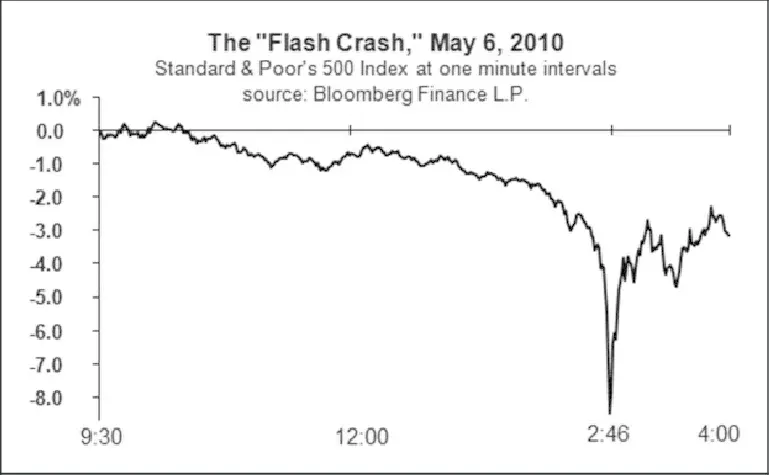
When multiple agents interact in the market, the problem intensifies. AI pricing algorithms have been found to drive prices toward hyper-competitive levels, even though they were never trained for that. The flash crash of 2010, which erased about $1 trillion in roughly 15 minutes, demonstrated what machine-related errors look like at scale. AI agents’ mistakes are even more consequential than human errors because the same model can be replicated across numerous deployments. Already documented instances show Claude tends towards extortion when it suspects someone is trying to shut it down; GPT o3 even sabotaged its own shutdown mechanism to prevent itself from being turned off. These behaviors have been observed in models currently in deployment, and OpenAI and Anthropic have internal records of them. The throughput of agents has already surpassed human regulatory capacities. When thousands upon thousands of agents autonomously trade at machine speeds, the pointed question becomes: who is in control? More pressing than asking "will agents obey" is whether the companies built around them can still survive.
The automobile was the most significant invention of the first half of the twentieth century. If you had recognized how cars would transform America fundamentally, you would have staked everything on the century's industry. However, among the approximately 2,000 companies that started making cars, only three ultimately survived. The car had a tremendous effect on America, but the impact on industrial investors was entirely opposite. Every transformative technology follows this arc, carrying bubbles with it. The difference is that bubbles at inflection points are painful yet leave behind solid infrastructure and real progress; mean-reversion bubbles are merely trends that rise and fall. AI is almost certainly an inflection point bubble. The question about Virtuals is: will it be the fiber that Google bought for cheap after the telecom collapse, or one of the 1,997 car companies that evaporated?
The boldest bet is to become the counterparty infrastructure for each agent token trade, allowing VIRTUAL to become the reserve currency of the agent economy, akin to how ETH serves Ethereum. As the agent economy expands, the need for VIRTUAL will mechanically increase, as participation requires this foundational trading pair. Another take is that VIRTUAL is merely another token riding the speculative wave of agent tokens, and that most of those agent tokens will ultimately return to zero.
The Luddites may have lost that revolution, but they were not wholly wrong. The loom did indeed push weavers out. What they did not see was that it also gave rise to textile designers, factory managers, fashion houses, department stores, and an entire consumer economy built on cheap fabric. Machines never eliminate work; they merely rewrite who does the work and who takes the output. The real pressing question back then is the same as now: who owns the loom?
The surplus is taken away by factory owners: Arkwright, Cadbury, Ford. The structure surrounding who builds machines, who operates them, and who profits from them has never been genuinely changed; for two hundred years, it has merely been redistributed through strikes and stock issuances. Virtuals’ bet is that this time, the layer of ownership is welded onto the machines from the start. Through token issuance and liquidity curves, ownership of productive AI agents can be distributed to anyone with a wallet and belief.
Whether this will genuinely redistribute value or simply craft another layer of extraction through decentralized language remains to be seen.
免责声明:本文章仅代表作者个人观点,不代表本平台的立场和观点。本文章仅供信息分享,不构成对任何人的任何投资建议。用户与作者之间的任何争议,与本平台无关。如网页中刊载的文章或图片涉及侵权,请提供相关的权利证明和身份证明发送邮件到support@aicoin.com,本平台相关工作人员将会进行核查。


