Author: Caixin News
On Friday evening at 10 PM Beijing time, Federal Reserve Chair Kevin Walsh appeared at the Jackson Hole Economic Symposium, delivering a speech titled "In Our Time."
Overall, Walsh's speech at Jackson Hole sent a clear and cautious hawkish signal. He believes that the U.S. economy and labor market remain resilient, the current financial environment cannot be described as significantly restrictive, and inflation is still well above the Fed's 2% target, thereforeprice issues should continue to be the primary concern of monetary policy.
In his speech, the Fed Chair emphasized: “My standard is: We must be confident that underlying inflation is clearly and sufficiently moving toward our target. If not, we still have work to do.”
Walsh also stated that although the CPI and PCE inflation data for the summer were better than expected, “they did not lead me to believe that there has been a meaningful improvement in underlying inflation trends.”
Regarding external criticism that he "insists on not providing forward guidance," Walsh took the opportunity to elaborate in unprecedented detail.
Walsh believes that while forward guidance is necessary during crises, it should be significantly weakened during normal times. He thinks thathinting at or even almost committing to a future interest rate path too early may superficially enhance transparency but can actually create new misguidance: on one hand, it constrains the Fed’s future flexibility to make decisions based on economic changes; on the other hand, it may lead the market to excessively trade on “guessing the Fed” instead of independently judging economic fundamentals.
He is particularly wary of the resulting "hall of mirrors problem"—the market prices based on the Fed's guidance, and the Fed in turn references market prices for judgments, which could ultimately lead both sides to overlook new economic changes.
For this reason, Walsh neither supports normalizing forward guidance nor is willing to provide a mechanical "reaction function" for policy; instead, he prefers to minimize prior commitments, allowing the market to form its own judgments, while the Fed bases its decisions on real-time data, trends, and more robust policy rules, maintaining sufficient freedom whenever a real decision is needed.
As of 10:45 PM Beijing time, after Walsh's speech, the CME "FedWatch" tool indicated thatthe probability of a Fed rate hike in September has warmed to nearly 60%, compared to only 35% the previous day. Spot gold briefly plunged $50, with the latest quote around $4550 per ounce.
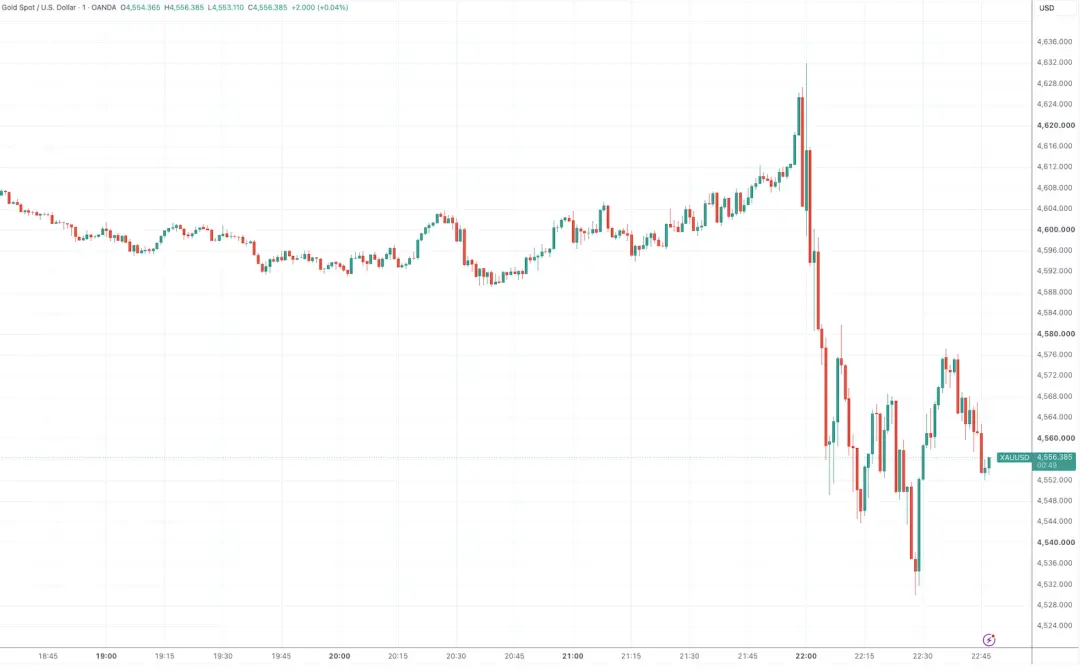
(Source: TradingView)
The following is a full translation of Walsh's speech (the script source is from the Fed's official website, assisted by artificial intelligence translation)
In Our Time
Federal Reserve Chair Kevin Walsh
August 28, 2026
Delivered at the Economic Policy Symposium “Financial Innovation: Implications for Payments and Policy” held in Jackson Hole, Wyoming. The symposium is hosted by the Kansas City Fed.
Thank you all. It is great to be back here, and I am glad to see so many familiar faces. I have been looking forward to this weekend—where better to mark my 100th day as Fed Chair than here?
We owe thanks for the warm hospitality to Jeff Schmider, President of the Kansas City Fed, and his colleagues. Jeff, thank you to all of you.
Jeff and the other organizers have also arranged some recreational activities later today. I suggest everyone be very cautious in making their choices.
As I learned many years ago, you can experience two completely different hikes on the trails around Jackson Hole. I can sum up my experience hiking with former Fed Vice Chair Don Cohen in two words: I survived. Those marathon-style "death marches" powered by sheer will allowed me to see another side of Don that I was unprepared to face.
The other type of hike—I will connect it with my old colleague, former Fed Chair Ben Bernanke. Walking with Ben is much more leisurely; we simply stroll along the winding paths of the Rockefeller Preserve.
So before setting out, check your own physical condition, and then ask yourself, “Is today a Cohen day or a Bernanke day?”
The best part of this gathering isthat it helps all of us clear our thoughts and think more clearly about the world and time we inhabit.For me, this is the right place, and you are the right audience to deeply explore those most important ideas.
"Innovation" is the theme of this conference. I believe that the public and markets, through their collective wisdom, have recognized that innovation in the way the Fed implements policy will help us achieve price stability alongside full employment.
Next, I will briefly outline the substance of my remarks this morning.You can call it an outline… or a hiking roadmap… but definitely do not call it "forward guidance".
First, I will discuss several long-term issues that the Fed is currently studying, including the latest universal technology—artificial intelligence (AI)—and where it might lead the economy.
Next, I will discuss the practice of forward guidance policy and the interaction between central banks and financial markets.
Then I will introduce some core principles that I believe should guide the implementation of monetary policy.
Finally, I will share my judgment on the current economic situation.
Preparing for Future Policy Environments
Against the backdrop of the unchanging Teton Mountains, we are here to examine an economic picture that is anything but static.
Not long ago—on the eve of the 2008 crisis and in the subsequent decade—economists and policymakers were still talking about "secular stagnation" and "global savings glut." A widely accepted view at the time was that excess capital would remain idle for a long time, as there simply would not be enough attractive investment opportunities. All good things had already been invented. Therefore, economic growth would be slow and sluggish.
However, times have indeed changed. We have reached a historical turning point.
One clear example is artificial intelligence—a term that has been around for 80 years but is now used to denote the latest wave of technology—whose pace of advancement has even surpassed the predictions made by its most fervent advocates just a few years ago.
The potential for significantly higher economic growth is on the rise. A growing pool of capital is flooding into various AI-related infrastructures. A kind of "super Moore's Law" seems to be unfolding. At the same time, economies of scale are changing the methods and pace of innovation.
Capital and labor are coming together to create large language models at the core of AI. Users purchase tokens to gain access to use these models. It has been reported that the annual sales of tokens from just two leading AI labs have already exceeded $100 billion, a more than 500% increase from a year ago.
The Fed is closely watching all of this.We recognize that AI is a new variable—potentially even a new factor of production—that will impact the economy and the implementation of monetary policy. This also opens up several significant research directions:
Will the application of AI drive a significant and sustained increase in productivity across the economy? If so, when might it happen?
Will the use of tokens complement or compete with labor? Will the next generation of AI models require higher capital intensity, or might the models themselves ultimately help us design solutions with lighter capital inputs?
Other unresolved questions include what kind of market structures will ultimately form. It is not clear where capital returns will ultimately land, nor how long this process will take. In the early stages, how much of the economic surplus will flow to owners of scarce assets—AI labs, chip manufacturers, energy producers, and cloud service providers? Over time, how much value will ultimately flow to businesses and consumers? What do these changes mean for workers? What broader implications will they have for the employment goal in the Fed’s responsibilities?
Similarly, we currently do not know what the equilibrium price of tokens will be. Will different types and qualities of tokens arise such that people are willing to pay increasingly higher prices to access the most cutting-edge and best models? Will the prices of tokens from the old generation of models eventually fall to their marginal cost levels?
We will employ a "productivity and employment working group" to delve into these questions. I recently had initial communication with the heads of this working group and four others, and their progress is encouraging.
However, it should be clear that the recommendations from these working groups will be submitted in the future and will not affect our decisions made in the current policy environment. But I believe thatinvesting today in such thinking for future policy challenges will prepare us much more thoroughly.
Forward Guidance and Its Alternatives
While these working groups carry out their work, I have not been waiting but have already begun pushing for innovation at the Fed to truly adapt its responsibilities. For example,I have begun to change the form and function of the so-called Fed Chair's "forward guidance". You may know that I have long felt uneasy about prematurely announcing future policy decisions. I prefer to take another path… I will explain the reasons next.
Transparent communication about future policy decisions is not inherently a virtue. Communication must serve the Fed's most important responsibility: to get monetary policy right.
During the global financial crisis, my colleagues and I established forward guidance as a normalized practice. At the time, it was essential, and we launched this practice with great fanfare. But like many other legacies left by past crises, I believe this practice has been in existence for too long.
In normal times, the role of forward guidance should be limited and clearly bounded. Otherwise, it may create obscurity in the name of clarity. Excessive disclosure of the policy discussion process and making too many commitments regarding future policy decisions can mislead markets, businesses, and households. Moreover, I believe that when policymakers make quasi-commitments on interest rates throughout the economic cycle, we actually limit our freedom to make the right choices when real decisions need to be made.
To get the policy right, we must also properly manage the relationship between financial markets and the central bank. The Fed needs to receive clear market signals, and these signals should be as unfiltered as possible… including the structure of the market… the levels and changes in asset prices across industries… the prices and volumes of U.S. Treasury securities… the foreign exchange value of the dollar… the costs and availability of credit… and the prices of a broad range of commodities.
These indicators and others should help the Fed judge recent economic activity and inflation prospects throughout the business cycle. They should also reveal the state of the broader financial environment… and the risks and uncertainties within the financial cycle.
Meanwhile, market participants themselves should also track the real information across the economy.They should form their own judgments; develop their own expectations regarding output, employment, and inflation; and always pay close attention to risks..
The Fed should remain humble, but not naive. The Fed plays a crucial role in the economy and markets, and our policy tools are powerful. We decide the path of short-term interest rates. Therefore, market participants will always try to predict what we will do next. Butwe should not indulge a mechanism that leads market participants to primarily decide their next trade by guessing the Fed.
Economic literature has long described this distortion effect: the so-called "hall of mirrors problem."If the market largely relies on the Fed's guidance, and the Fed in turn relies on market prices, then we are all more likely to overlook new changes… more likely to be caught off guard when conditions suddenly shift… and more likely to make mistakes in policy making.
Ironically, market participants may not be the ones to bear the highest cost of the "hall of mirrors problem." Those most seriously harmed are likely to be those without financial assets. If the Fed misjudges inflation and also misjudges the economy, who will suffer the most? Not the high-net-worth individuals in financial markets. Ultimately, it is the hardworking ordinary Americans who have to face excessive inflation or suddenly unstable employment.
Then, if forward guidance does not apply in normal times, should the new Fed Chair at least commit to providing a clear reaction function? Of course, he should tell us where interest rates will head if the data significantly deviates hot or cold.
I wish we truly understood the economy to such an extent that we could provide a mechanized, fail-safe answer—something we could strictly rely on like a simple function akin to the Taylor rule. But our knowledge is far from reaching that level—at least not yet—and the most important factors determining appropriate monetary policy will themselves change over time.
Demonstrating the Fed's reaction function through predictions theoretically works better than in reality; it works better in the lab than in practice. I am not the only one who has noticed this. For example, the forward guidance from 2021 likely slowed down the Fed's subsequent policy response to high inflation.
During my tenure as Chair, my colleagues and I will work to build more reliable models and more robust rules to guide policy decisions. We will approach this work with the understanding that accurately predicting the economy remains merely a goal. When geopolitical factors, global supply chains, and technology are changing at such a rapid pace, it is wise to remain humble about what we can know and what we cannot.
In the same spirit, for any issues that may affect Fed monetary policy decisions, we should be open to hearing a wide range of viewpoints. If our goal is to make optimal decisions, we should not exclude differing views on the economy.
So how can we chart a better course for policy? In the next part of my remarks, I will share some core principles that guide my thinking on the appropriate implementation of monetary policy… and then I will fulfill my promise to discuss my judgments about the economy.
Core Principles
Now let’s talk about principles…
First, I note that in our field, people often mistake yesterday's news for what is happening at this moment. The real challenge is to distinguish between the two. In other words, we must continuously test reality to ensure that we do not base future-facing policies on outdated or inaccurate data. We should also not rely on isolated data points. Trends are what matter. The Fed is a decision-making institution. We must make choices amid uncertainty, so the data we rely on must be as relevant, timely, accurate, and directly usable for decision-making as possible.
Second, the Fed takes action to ensure that total demand in the economy broadly aligns with total supply. However, what we can directly observe is only economic activity itself. We can never directly see what is truly happening on the supply side; we can only infer it. Therefore, assessments of the current and future balance between total supply and total demand are inherently imprecise.
Third, there should be no misunderstanding: the Fed’s 2% price stability goal, measured by the personal consumption expenditures (PCE) price index, is a firm, fixed goal. Another aspect of this goal that we must clarify: price stability will not happen automatically, and inflation does not necessarily have mean-reverting characteristics. Achieving price stability is the job of the Fed.
Fourth, the Fed also bears the responsibility of achieving maximum employment. Achieving the dual mandate's two goals is not a "choose one" problem. I do not believe the Fed's dual mandate conflicts with each other. After all, high inflation itself severely damages economic prosperity.
Fifth, short-term interest rates are the primary policy tool for achieving the dual mandate. Unconventional policies taken to stimulate economic activity may be suitable for true crisis periods but should be used minimally, or even not at all, in other situations.
Sixth, money matters. This view is not currently popular, but I believe that there is, of course, an important relationship between money and monetary policy. We should pay attention to the money created by the central bank, as well as the money coming from banks and the financial system. Indeed, financial innovation and other factors will change the mechanisms connecting the monetary base, money circulation velocity, and the broader economy. But this is no reason for us to neglect how money ultimately affects the financial environment and prices.
Finally, a quieter, more purposefully communicative Fed will be more capable of achieving its goals. And whether we fulfill our responsibilities can also be held accountable—that is the only true standard by which to test our credibility. To borrow a line from General Chuck Yeager: "When the moment of truth arrives, there are only reasons or results."
The Current Economic Situation
So, under these principles, how do I judge today's economy? What is really happening outside?
You may have already seen from the minutes of the July meeting the FOMC's unanimous judgment: the labor market is stable, economic output is robust, but inflation is still too high. I, along with the vast majority of my colleagues, believe that it is wiser to wait for more new information between the two meetings—especially considering potential new changes in supply chains, investment flows, and geopolitics—before judging whether an adjustment to interest rate policy is appropriate. At the same time, we collectively stated that we are ready to take action as needed.
Personally, I am greatly impressed by the overall performance of the U.S. economy today, and the economy appears to have strengthened. One standard for judging how strong an economy is is how well it can endure shocks. From this perspective, both "Main Street" in the real economy and "Wall Street" in the financial markets have demonstrated extraordinary resilience.
Here are a few observations:
Business capital expenditures—the "seed grain" for future economic growth—are rapidly increasing. The year-on-year growth in investment in equipment and intangible assets over the past four quarters is approximately 9%, the highest growth rate since 2021. This year, more than half of the growth in capital expenditures can likely be attributed to AI-related infrastructure development.
For S&P 500 component companies, profits have grown more than 20% over the past year. Compared to historical levels, corporate profit margins are relatively high. Overall market volatility is low. We are closely monitoring the internal structure of the market to observe performance across various industries.
The market has high expectations for future growth in capital expenditures and corporate profits. I will continue to watch changes in their growth rates themselves, which is known as the "second derivative." The subsequent effects this generates—on asset prices, business confidence, consumer income, and consumer spending—are equally very important.
The credit spreads of corporate bonds and leveraged loans are close to the low end of historical ranges, and issuance in these markets has also been quite strong this year. If we step out of the fixed income market and take a look at the banking industry, the July senior loan officer opinion survey indicated that banks told us the credit standards for commercial and industrial loans are currently at the relatively loose end historically. This also helps explain why such loans have increased this year. The credit and loan markets show almost no signs of being constrained by monetary policy.
Certain sectors—such as housing and agriculture—are indeed under pressure. But overall, it would be hard for me to claim that I would describe the broad financial environment as "restrictive."
Despite experiencing various shocks, real consumer spending remains healthy, having grown more than 2% over the past four quarters. When looking at consumption in conjunction with the strong investment we observe, private domestic final purchases (PDFP) have also increased. So far this year, the growth rate of PDFP is close to 3%. Compared to GDP, this measure typically contains stronger economic signals, and the trend it currently exhibits is also positive.
On the employment side of the Fed's dual mandate, the U.S. is performing well. The labor market is quite stable. The unemployment rate is currently at 4.1%, still low by historical standards, and there has been little noticeable change over the past few years. The number of initial unemployment claims, calculated using a four-week moving average—this is a well-tested, robust real-time indicator—currently approaches decades-low levels.
In my view, the current relatively low turnover rate in the labor market is partly due to the large-scale re-matching that occurred between employers and employees after the pandemic.
When labor supply is almost no longer growing, the number of new jobs added each month will naturally be lower. The labor market will always have areas worth paying attention to—like recently graduated young people. But overall, those who wish to work are generally able to keep their jobs or find new ones. They may certainly be concerned about possible disruptions in the labor market in the future, but thus far, I believe the U.S. labor market is consistent with a state of full employment.
However, on the price stability side of our dual mandate, the data is more troubling. The Fed's preferred inflation measure—the year-on-year change in the PCE price index—is currently 3.7%, while the annualized increase over the past six months is 4.1%. The comparable index for the consumer price index (CPI) is also high, with both core PCE and CPI inflation measures remaining elevated. None of these indicators are perfect, but they all tell a similar story: inflation remains above our 2% target. Therefore,the Fed's primary focus currently should be on prices.
The task for policymakers is to identify potential trend inflation, which means excluding various special, one-off factors and observing general price changes across the economy. We need to judge whether potential inflation is rising, falling, or stagnating. We want to understand not only the direction of its changes but also the speed of these changes. Each of the broad inflation indicators mentioned has shown significant declines from the peaks reached in 2022. However, the progress made over the past two years has been relatively limited.
Moreover,though PCE and CPI data this summer were better than expected, these data did not lead me to believe that there has been a meaningful improvement in underlying inflation trends.
Data shows that wage growth is currently quite moderate. However, in tracking potential inflation, wage growth has long been shown not to be a reliable predictor of future inflation.
To evaluate potential inflation, I find it very helpful to break down the 199 components of the PCE price index. In the past 12 months, of the goods and services in the PCE basket, 54% of items have seen price increases exceeding 3%. This proportion is significantly lower than the post-pandemic peak of about 77%, but still far higher than the pre-pandemic 20-year average of 32%.
Just looking at the last six months, the conclusion is similar: Of the items in the PCE basket, 49% have experienced annual price increases exceeding 3%. Again, this is significantly lower than the post-pandemic peak, but still at a rather high level.
The recent overall rise in commodity prices is also noteworthy. What we need to assess is whether these trends currently suggest an upward risk for inflation.
Furthermore, it is also very important to determine whether the inflation data that has persistently appeared over the past five years has permeated people's expectations. The good news is that medium-term inflation expectation indicators remain stable overall. The inflation compensation indicators in the swap markets are also conveying similar and strong signals.
Especially considering recent developments, market prices still reflect a confidence—confidence that we can achieve price stability. This not only reflects the Fed's credibility as an institution but also aligns with the Fed's finest traditions. And I can assure you… the market is right.
Historically, market-based inflation expectation indicators have a characteristic: they often remain very resilient and robust until they lose stability. These expectations do not change easily, and currently, they remain well-anchored. But we must monitor them closely. Ensuring that inflation expectations do not become unanchored is the Fed’s job.
There is one signal that nobody should ignore: the sustained, elevated inflation over the past 65 months clearly indicates a responsibility that falls squarely on the central bank. And that is exactly where the accountability should lie.
My standard is:We must be confident that underlying inflation is clearly and sufficiently moving toward our target. Otherwise, we still have work to do.This is our job… our mission… and it is a responsibility we must fulfill.
Conclusion
Standing here today, I am committing to a discipline, not a specific policy decision.
In such a significant time, my colleagues and I at the Fed are certainly not the first to hold these positions. We are determined to savor the moment and to do the work to the highest standards we can.
We embrace humility but with a resolute determination to take our responsibilities seriously. Much depends on the choices we make. A prudent monetary policy can help families and businesses thrive. If monetary policy is effectively implemented, it can expand and deepen the momentum of economic growth in the U.S.… while helping to consolidate America’s leadership position in the world. I also know that our country needs us to think deeply and act wisely.
It is a great honor to serve the Fed once again. I am truly grateful for the encouragement and valuable advice given to me by my colleagues… as well as the support I have received today from many of you… Thank you for your patience in listening this morning. Thank you.
免责声明:本文章仅代表作者个人观点,不代表本平台的立场和观点。本文章仅供信息分享,不构成对任何人的任何投资建议。用户与作者之间的任何争议,与本平台无关。如网页中刊载的文章或图片涉及侵权,请提供相关的权利证明和身份证明发送邮件到support@aicoin.com,本平台相关工作人员将会进行核查。


