Bank of America warns that long-term US Treasury yields are dominating the global bubble, becoming the "Achilles' heel" of the AI bull market. Tonight, the Jackson Hole meeting will be a critical battle for controlling interest rates, with the "successful script" of Waller's speech aimed at achieving a flattening of the yield curve bull market—by releasing credible hawkish signals on inflation to anchor the short end while providing dovish hints on long-term bonds, thereby supporting the Treasury's bond repurchase plan. A failure could lead to severe revaluation of global assets.
Written by: Xu Chao, Wall Street Journal
Michael Hartnett, Chief Strategist at Bank of America Securities, warns that the movement of long-term US Treasury yields is becoming the core variable in current global asset pricing—the bond market is "leading" the bubble, rather than following it. Tonight, Federal Reserve Chairman Waller will deliver a speech at Jackson Hole, which the market sees as a key battle to stabilize long-term rates.
In the "Flow Show" report dated August 28, Bank of America states that the "successful script" of Waller's speech is to achieve a flattening of the yield curve bull market—by releasing credible hawkish signals on inflation to anchor the short end while providing dovish hints on long-term bonds to support the Treasury's bond repurchase plan. If this operation successfully threads the needle, risk assets and the dollar are expected to rebound in tandem. However, if the communication of policy fails, the 10-year US Treasury yield could break through the 4.7% and the 30-year might exceed the 5.3% intervention warning lines set on August 19, leading to a weakening of the dollar, while defensive assets would outperform cyclical stocks and long-duration assets.
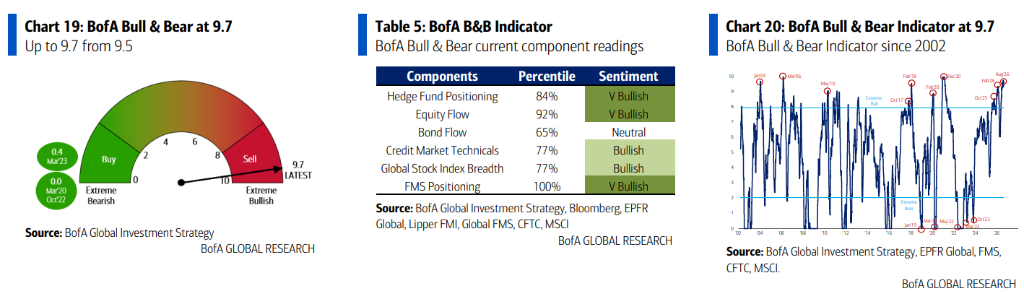
Bank of America’s bull-bear indicator climbed further this week to 9.7, remaining deep in the "extreme bullish" area, with the sell signal triggered on May 26 still having the S&P 500 index up 2.8%. Meanwhile, 82% of global stock market indices are currently in "overbought" conditions, just one step away from triggering the breadth rule sell signal threshold of 88%. On the funding side, both gold and cryptocurrencies recorded their largest single-week inflows since October 2025, while US stocks experienced their first net outflow in five weeks.
Bond Market Dominance: Long-Term Yields are the Achilles' Heel of the AI Bull Market
Bank of America’s strategy team explicitly points out in the report that the core proposition of the current market logic is "the bond market leads the bubble, rather than the bubble leading the bond market." This judgment directly determines the fate of the technology sector: the AI infrastructure builders (semiconductors, represented by the SOX index) and direct beneficiaries of AI (the "Magnificent Seven" MAGS) underperform compared to the AI application sectors (healthcare XLV, finance XLF), and this trend can only reverse once the 30-year US Treasury yield falls below 5%.
Bank of America further elaborates on the necessity of policies to suppress long-term yields.
First, the AI capital expenditure wave of tech giants requires a low-cost financing environment— the report notes that since the Federal Reserve cut rates in October 2025, the stock prices of the "Magnificent Seven" have stagnated, marking the end of the nascent bond rebound.
Second, if consumers, worried that the $40 trillion national debt will prevent the government from supporting the market in the next crisis, are forced to significantly increase precautionary savings, this will systematically suppress consumption.
Against this backdrop, Bank of America qualifies the current policy as a new phase of "quasi-quantitative easing / yield curve control," believing this mechanism aims to maintain both economic prosperity and political capital. Notably, the Treasury's bond repurchase plan expires on November 4, just one day before the US midterm elections.
Capital Flows: Gold and Crypto Lead, US Stocks Show Pressure Signals
As of the week ending August 26, global capital flows showed significant divergence. Bonds continued to attract $17 billion in inflows, marking a record 70 consecutive weeks of positive inflows; gold recorded inflows of $7.3 billion, the largest single-week inflow since October 2025; cryptocurrencies attracted $3.2 billion, also a new high since October 2025.
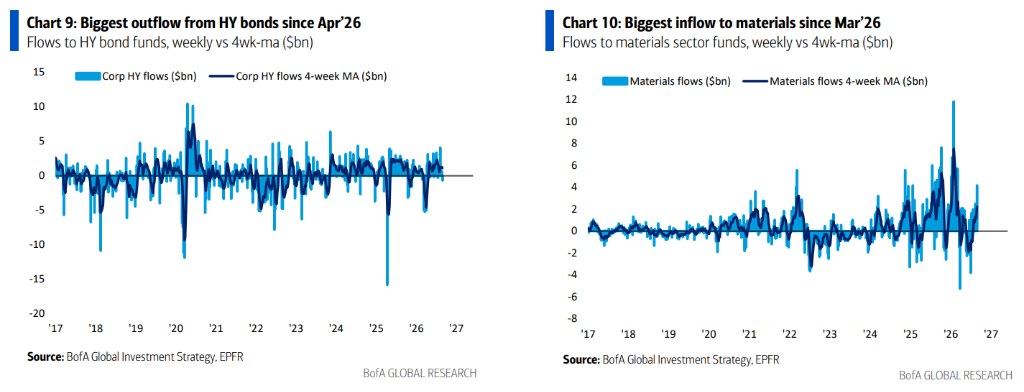
In contrast, US stocks experienced their first net outflow in five weeks ($4.4 billion), and high-yield bonds recorded their largest single-week outflow since April ($700 million). By sector, the technology sector saw inflows of $4.6 billion, the highest in four weeks, while the materials sector related to commodities saw inflows of $4.2 billion, the largest since March; meanwhile, healthcare experienced outflows of $1.1 billion, its largest single-week outflow since March.
Bank of America's private client data corroborates this defensive trend. With $4.7 trillion in assets under management, private clients currently have a stock position of 66.2%, while cash allocation has fallen to a historic low of 9.4%, but the inflow into bonds over the past four weeks has reached its highest since May, with a focus on increasing holdings of investment-grade bonds, municipal bonds, and TIPS ETFs, while reducing positions in utilities, healthcare, and REITs ETFs.
Extreme Bullish Pricing: Market Consensus is Fragile, Contrarian Risks are Accumulating
Bank of America’s bull-bear indicator has risen to 9.7, further climbing from 9.5, with several sub-indicators showing extreme bullish signals: hedge fund positioning is at the 84th percentile, stock flow is at the 92nd percentile, and fund manager survey positioning is at a full 100th percentile. The report points out that the current consensus position among investors is based on four major assumptions: "no macro hard landing, no Fed rate hikes, no cuts in AI capital expenditure, and Democrats not sweeping Congress," which presents an overall "fearless" pattern.
However, contrarian signals are emerging. 82% of global stock market indices are in overbought territory, nearing the breadth rule sell threshold of 88%, with only a few markets such as China, India, and Brazil yet to trigger an overbought signal. Risk assets have been slowly rising throughout the summer without a clear leading sector, primarily driven by position inertia.
Bank of America's strategy team identifies two potential "flip catalysts": first, compromise in the US-Iran conflict could trigger a final fall in oil prices, leading to a commodity retracement; second, if the Republican Party loses the Senate or even the governorship of Texas in the midterm elections, the market will interpret this as voters prioritizing controlling inflation and living costs over tax cuts and deregulation, which would open a trading window with expected EPS peaking.
Global Central Banks Shift to Rate Hikes, Policy Hedging Becomes New Mainline
At the macro level, Bank of America's report records an important turning point in global monetary policy. In the past three months, global central banks have completed 12 rate cuts and 13 rate hikes, with the net direction turning towards tightening; Bank of America predicts an additional 17 rate hikes and four rate cuts within the year. This week, the most notable occurrence was South Korea's "bubble-ized" completion of its second consecutive rate hike.
Bank of America believes that central bank rate hikes around the world help to coordinate with the Treasury's bond repurchase and foreign exchange intervention operations to jointly suppress long-term rates. This "quasi-quantitative easing" framework after policy implementation could produce two asset allocation effects: reducing dollar exposure and increasing gold allocation. This logic also corroborates this week's record inflow of gold since October 2025.
Year-to-date asset return rankings show that commodities are at the top with a 61.8% increase, followed by oil rising 44.4%, gold prices up 5.9%, while Bitcoin has dropped 10.5%, the 30-year US Treasury has declined 1.9%, and government bonds overall have fallen 1.1%. Bank of America's strategy team continues to recommend holding natural resource ETFs (GNR) as a tool to hedge against policy and political risks.
免责声明:本文章仅代表作者个人观点,不代表本平台的立场和观点。本文章仅供信息分享,不构成对任何人的任何投资建议。用户与作者之间的任何争议,与本平台无关。如网页中刊载的文章或图片涉及侵权,请提供相关的权利证明和身份证明发送邮件到support@aicoin.com,本平台相关工作人员将会进行核查。


