The trading volume of the stock market in the tens of billions is reshaping the asset pathways for the next generation
Written by: ChandlerZ, Foresight News
As the technology for the issuance of stock tokens gradually matures, the market is beginning to realize that the challenges are concentrated after the issuance. Tokens need to have continuous pricing, sufficient liquidity, and a channel back to real assets. Early tokenized stocks often remain at the asset mapping level, with tokens on-chain but trading still revolving around Wall Street's business hours. Once the underlying market closes, market-making depth and price anchors weaken.
In July 2026, this market first entered the monthly trading range of 10 billion USD. According to statistics from Binance Research, the trading volume of tokenized stocks reached 18.2 billion USD, 4.4 times that of June, and also exceeded the total of the previous six months. Among them, DEX traded 12.8 billion USD, while CEX traded 5.4 billion USD. Trading occurred more in on-chain wallets and smart contracts, and tokenized stocks began to form a circulation network independent of traditional brokerage accounts.
The trading volume of tokenized stocks in July was about 2.3% of the same period's trading volume of SPY; in June, this ratio was 0.4%. In one month, this ratio expanded nearly 5.8 times, indicating that crypto platforms and on-chain markets are taking on more demand for US stock trading.
Binance's bStocks is one of the most active products in this growth cycle. Launched on June 11th, by August 23rd, the cumulative trading volume reached 10.4 billion USD, of which over 70% came from the on-chain market. In July alone, the DEX trading volume of bStocks reached 7.4 billion USD, accounting for 85% of the total DEX trading volume of tokenized stocks that month. Binance Research also calculated that on July 29th, the market value of bStocks exceeded 500 million USD, approximately 27% of the global market value of tokenized stocks.
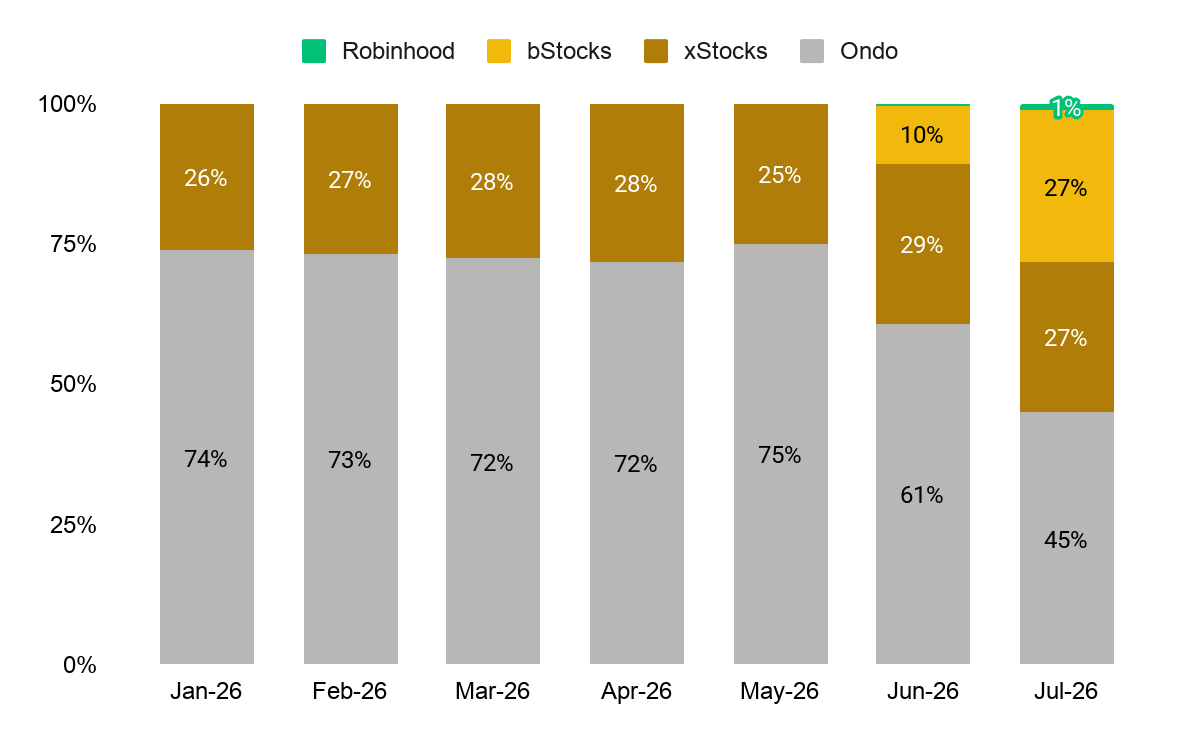
bStocks' share in the global market value of tokenized stocks increased from 10% in June to 27% in July
Source: Binance Research "Stock Price Discovery Moves On-Chain"
By August 3rd, the bStocks asset value, as tracked by Token Terminal, reached approximately 624 million USD, surpassing about 579 million USD for xStocks, rising to second among tokenized stock issuance projects tracked on the platform, only behind Ondo Finance. Within less than two months of its launch, bStocks has already secured hundreds of millions of assets and billions of transactions.
bStocks is issued by BTech Holdings Limited, registered in the Abu Dhabi Global Market (ADGM). Its legal form is a certificate representing relevant financial instruments, allowing holders to obtain economic exposure to corresponding US stocks or ETFs, without being directly registered as shareholders of listed companies. At the time of issuance, a special purpose vehicle holds the underlying stocks through regulated brokerage and custody arrangements, and then mints BEP-20 tokens on BNB Smart Chain in a 1:1 relation. The product documentation states that the underlying assets implement segregated custody and daily reconciliation, and reserve proof is released on-chain simultaneously; corporate actions like dividends and stock splits are transmitted to the tokens through quantity adjustment mechanisms.
Qualified Binance users can hold traditional stock positions and convert supported stocks into bStocks at a 1:1 ratio or trade bStocks directly on the spot market. Once tokens are withdrawn to BNB Smart Chain, they can enter self-custodied wallets, DEX, and supported DeFi protocols. Conversions are subject to applicable regional and user eligibility limits, and on-chain transfers incur network fees. Thus, an exposure to US stocks can circulate between traditional stock accounts, Binance order books, and on-chain wallets.
When Wall Street is closed, bStocks anticipates 92% of Monday's opening price gap
After the close on Friday Eastern Time, corporate announcements, geopolitical events, and macro policies are still in flux; the main liquidity in traditional stocks contracts with the closure of US trading hours and halts over the weekend. New information can only be released in concentration at Monday's opening, causing price gaps relative to Friday's closing prices. In the past, market judgments during this time mainly relied on news, research, and over-the-counter quotes, lacking prices that ordinary investors could directly execute.
Data shows that in July 2026, 62% of bStocks transactions on Binance occurred during US stock market closures. From June 11 until July 28, the cumulative trading volume during the closed market period reached 1.5 billion USD. In just the week of July 28, 92% of on-chain bStocks transactions and 59% of Binance transactions occurred during the US stock market closure period.
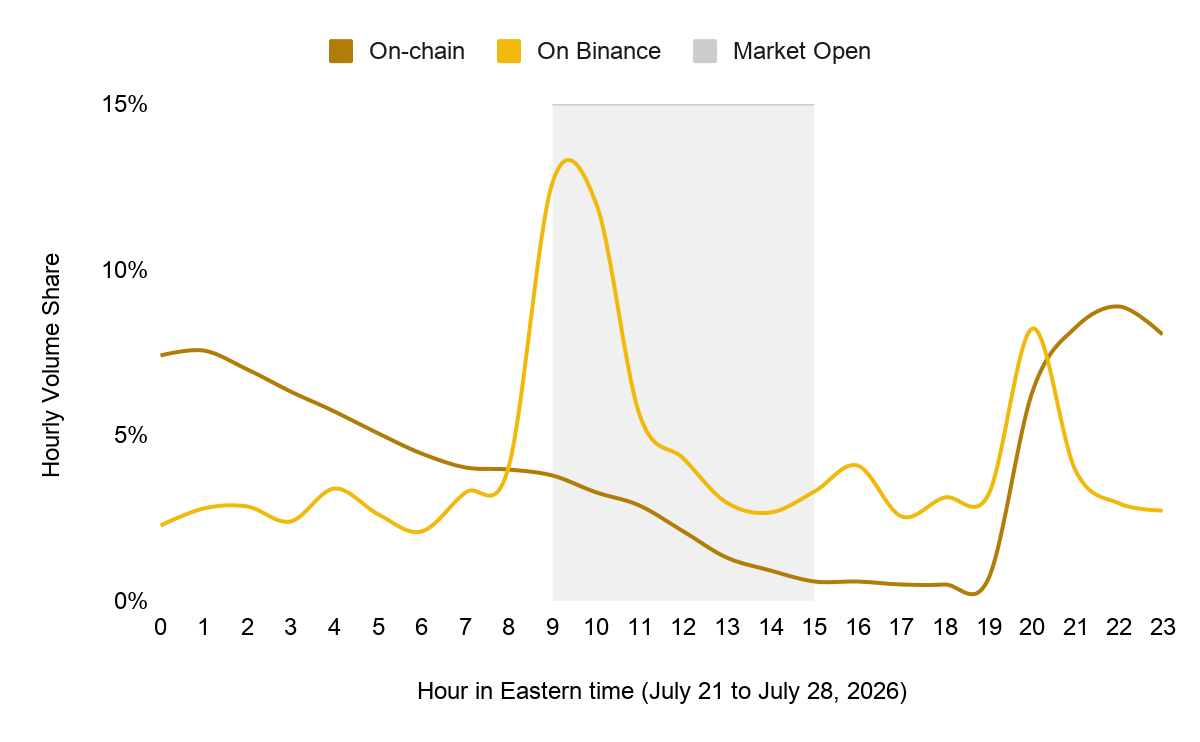
Transaction distribution of on-chain bStocks versus Binance by timestamps
Source: Dune, Binance Research "Stock Price Discovery Moves On-Chain"
Transactions on Binance are concentrated before and after the opening of US stocks, while on-chain transactions peak starting at 8 PM Eastern Time and remain active during the Asian trading session. For users in Asian markets like Hong Kong and Singapore, exposure to US stock risks transitions from overnight trading to being manageable during the day.
From June 14 to August 2, the trading volume on Binance across bStocks, xStocks, and Ondo Global Markets accounted for, on average, 69% during the opening of the US markets, rising to 82% during the closure period, and reaching 94.4% over the weekend. After the conversion is complete, bStocks can be traded directly on Binance order books and BNB Smart Chain. The conversion mechanism adjusts the supply of tokens according to demand; when Nasdaq is closed, order books and on-chain contracts can still match transactions.
During the periods supporting conversion, traditional stock positions can be converted into bStocks at a 1:1 ratio, supplementing supply to the token market; bStocks can also follow the inverse path back to stock positions. When premiums or discounts appear on the order book, asset conversions will transmit trading demand to the number of tokens, allowing weekend liquidity to adjust based on the price gap.
In the same data set, Ondo accounted for 27% of the trading volume on the three platforms during the opening of the US market, decreasing to 15.2% during the closure periods, and further dropping to 3.7% over the weekend. Binance's share rose in the opposite direction. The further from Wall Street's business hours, the easier it is for products that can independently provide order book and on-chain liquidity to accumulate trading.
As of July 28, bStocks had experienced seven complete weekends, with its price anticipating the subsequent Monday opening price gap at a median of 92%, and the average remaining deviation at opening only 0.19%.
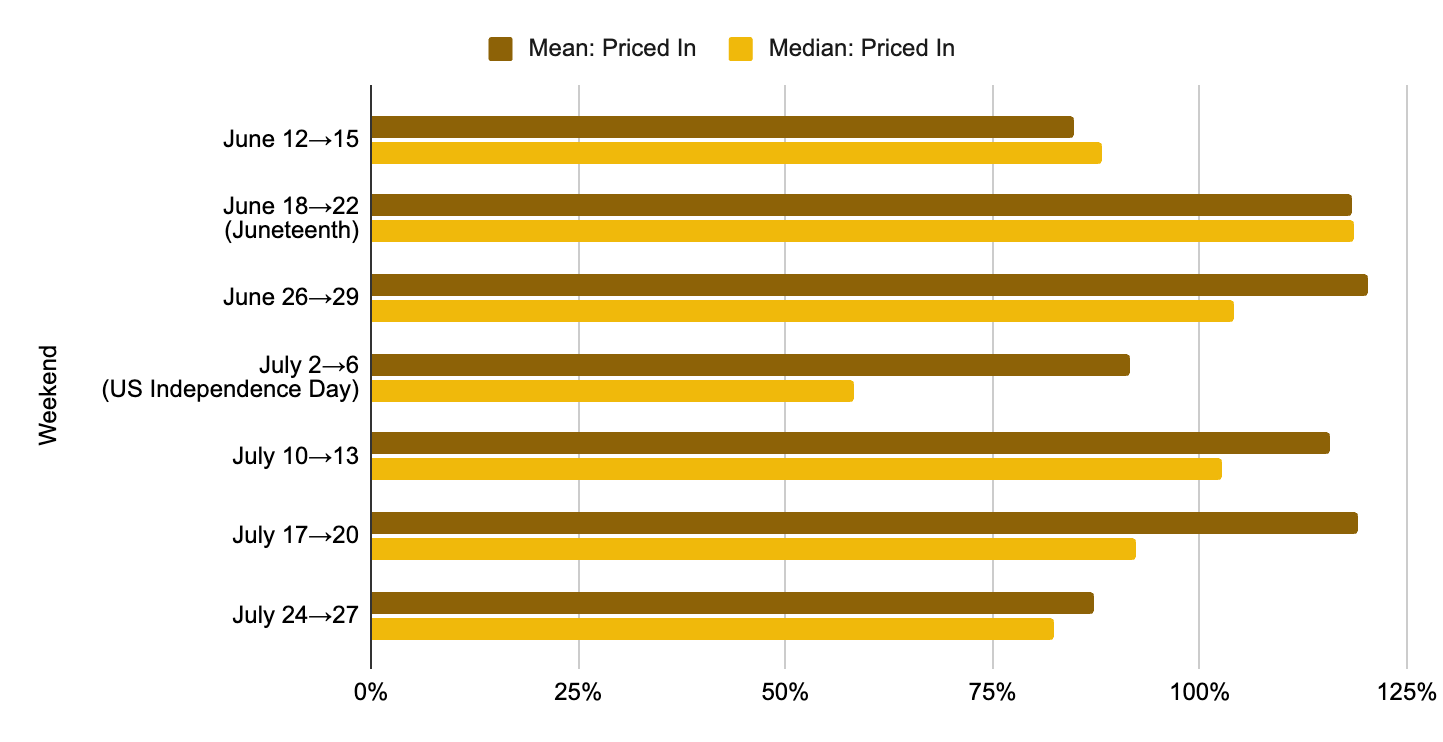
For seven weekends, the average and median values of bStocks' weekend prices anticipating the Monday opening price gap
Source: Binance Research "Stock Price Discovery Moves On-Chain"
When the opening gap of the underlying stock is less than 0.5%, bStocks' directional judgment accuracy is 81%; when the gap is between 0.5% and 1%, accuracy rises to 90%; when the gap is between 1% and 3%, accuracy reaches 97%. All 41 observations with gaps exceeding 3% were aligned in direction, with a median anticipated magnitude of 99.6%. The greater the fluctuation, the clearer the signals provided by weekend prices.
In other words, after Wall Street's closing, bStocks first digests new information through actual orders. When the underlying stocks resume trading, the opening price then closes the gap according to the direction already taken by bStocks. The greater the impact of news on stock prices, the clearer the direction formed by weekend transactions.
When price gaps appear, who brings the two markets back together?
If bStocks rises over the weekend while the underlying stock remains at Friday's closing price until Monday, a temporary price gap will arise. However, the 1:1 two-way conversion supported between bStocks and traditional stock positions on Binance allows this gap to be narrowed through actual transactions.
After the US stock market opens, traders can simultaneously observe both the underlying stocks and bStocks. When there is deviation between the two, reverse trading will increase supply on the high-price side and raise demand on the low-price side. Qualified users can also convert stock positions and bStocks within Binance, driving the trading results into token supply. The expanded price gap attracts more trades, and the new supply and demand drive the narrowing of the gap; this cycle reconnects on-chain prices and the traditional market.
Suppose a stock closes at 100 USD on Friday, and after positive news over the weekend, the corresponding bStocks rise to 103 USD. When the underlying stock resumes trading on Monday, bStocks have already provided a new price reference; the underlying stock opens closer to 103 USD, reducing the price gap accordingly. If there is still a deviation after the opening, reverse trades and asset conversions will continue to adjust supply and demand. The 92% observed over seven weekends is exactly the portion of price changes during the weekend that have already been completed before Monday's opening.
As of July 31, a total of 4,777 user accounts have conducted opposing transactions between bStocks and corresponding traditional stocks in a short period, with related paired transactions approaching 1.25 billion USD.
Among them, 4,076 users completed only one pairing, totaling about 10 million USD in transactions, with a median pairing interval of less than 1 minute. Additionally, 518 systematic participants continuously repeated this type of trading, contributing approximately 1.23 billion USD, accounting for 98.8% of all paired transactions, with a median execution interval of 2 minutes. They collectively achieved approximately 1.7 million USD in gross revenue from price differences.
Since Binance is currently the almost only exchange that supports ordinary users to convert between tokens and stocks at any time, this opens up low-risk arbitrage opportunities that were previously only available to institutions to all ordinary users, and large price corrections are carried out by a small number of accounts with systematic capability; this new trend of structural user change is worthy of attention.
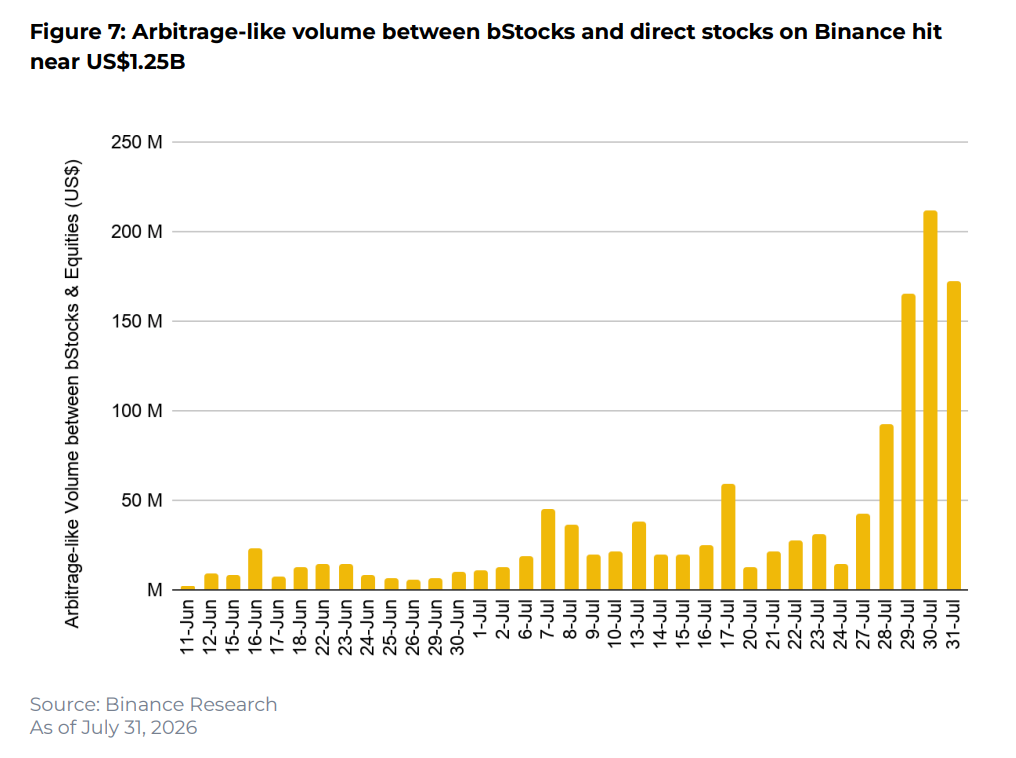
The volume of arbitrage-style matched transactions between bStocks and traditional stocks on Binance rapidly increased by the end of July, approaching 1.25 billion USD
Source: Binance Research "Monthly Market Insights, August 2026"
In the traditional primary market for ETFs, authorized participants (APs) are responsible for connecting fund shares and underlying securities; only APs authorized by the fund can directly use the creation and redemption mechanism. APs and market makers serve two different roles, and some institutions perform both functions simultaneously. Ordinary investors can buy and sell ETF shares but cannot directly deliver a basket of stocks to the fund in exchange for new shares.
bStocks and Binance are the only platform that provides an in-house arbitrage channel. By placing traditional stock trading and bStocks conversion into the same account, eligible ordinary users can also access similar price correction processes without needing AP qualifications; they can complete 1:1 conversions between supported stock positions and bStocks, with zero conversion fees and near-instant processing speed. The product interface lowers the thresholds for accounts, systems, and operational processes, allowing arbitrage opportunities to transition from institutional-led backend processes into accessible trading entrances for ordinary users.
After converting bStocks into on-chain tokens, they can also circulate within DEX and DeFi protocols on BNB Smart Chain, with prices formed over the weekend continuing to trade on Binance and on-chain. After the opening of the US stock market, cross-market trading further drives convergence of price gaps. This allows the same asset to connect centralized order books, underlying stocks, and on-chain markets.
Trading penetration rate expanded 30 times in six weeks, with three-quarters of Gen Z accounts in net accumulation
By July 28, the total trading volume of bStocks on Binance and on-chain markets accounted for 0.3% of the corresponding underlying stock and ETF trading volume. Six weeks ago, this ratio was only 0.01%, and has since expanded about 30 times. Although still far below the volume of traditional stocks, if considering the trading volume of all tokenized stocks, it has reached a ratio of 2.3% when compared to the largest US ETF, SPY, indicating that the tokenized stock market is moving from the periphery to the center stage of global capital markets.
Moreover, Binance Research's study released in August on Gen Z shows that among Gen Z bStocks accounts, 6% have never sold, and 76% are in a net accumulation state, 9 percentage points higher than Millennials. Gen Z trades bStocks an average of 3 times a month, while this same group has an average monthly trading frequency of 8 times for traditional stocks and 13 times for TradFi perpetual contracts. Accounts that only buy and do not sell bStocks have an average trading frequency of 1.63 times a month, with typical accounts having 3.45 times, and high-frequency accounts making up only 0.1% of the former.
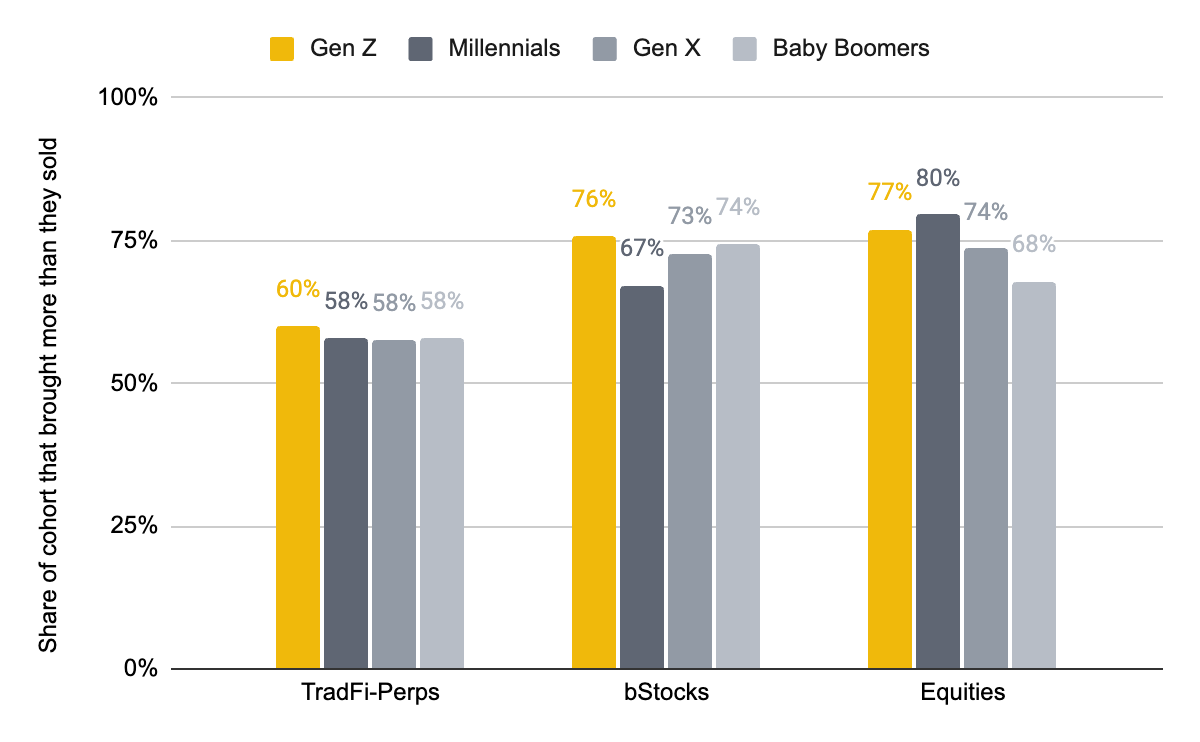
The proportion of accounts with cumulative buying volume exceeding selling volume among different age groups; the ratio for Gen Z in bStocks is 76%.
Source: Binance Research "Gen Z Perspective Rewrite"
The trading frequency of 3 times per month, combined with over three-quarters of accounts in a net accumulation state, makes bStocks resemble a holding and allocation tool. Short-term trading still exists, but does not dominate the account behavior of Gen Z users.
In the same study, the proportion of Gen Z traditional stock accounts that only buy and do not sell is 22%, while for bStocks it is 6% and for TradFi perpetual contracts it is 1%. The differences among products correspond to the holding periods. Stock exposures can accumulate continuously, while perpetual contracts usually involve more frequent openings and closings; bStocks account behavior more closely resembles spot holdings.
At the beginning of August, ETFs accounted for 25% of Gen Z traditional stock trading volume, compared to 14.6% in June; the corresponding ratio for Millennials during the same period was 9.5%. The net inflow of Gen Z stocks obtained through unleveraged ETFs also rose from 18.5% in June to 21.9% in July. These accounts exhibited lower turnover rates and more restrained use of leverage; some funds began to flow into diversified allocation tools.
Summary
Stocks and bStocks within Binance accounts can be converted into each other, still allowing transactions during market closures. Once assets are extracted to on-chain, they can flow into wallets and DeFi. Young users can hold bStocks long-term within the same account, also adjusting positions after the US stock market closes; extracted assets continue to circulate on-chain. The price signals after the US stock market closes are gaining support from both trading and capital.
At the opening of the underlying stocks, the traditional market still serves as the main pricing center; once the closing bell rings, bStocks allow US stock exposures to continue to quote, transact, and circulate. Wall Street still decides where stocks are listed and settled, but the crypto market is starting to determine how long it can trade in a day.
免责声明:本文章仅代表作者个人观点,不代表本平台的立场和观点。本文章仅供信息分享,不构成对任何人的任何投资建议。用户与作者之间的任何争议,与本平台无关。如网页中刊载的文章或图片涉及侵权,请提供相关的权利证明和身份证明发送邮件到support@aicoin.com,本平台相关工作人员将会进行核查。


