Author: Jim, MSX Maitong
Editor: Frank, MSX Maitong
Every year at the end of August, central bank officials, economists, and financial market participants around the world turn their attention to Jackson Hole, Wyoming, in the United States.
This year is no exception, as the Jackson Hole Economic Policy Symposium will soon take place, with the official theme being "Financial Innovation: Implications for Payments and Policy."
However, for the current US stock market, a more pressing issue than payment innovation is: How is the Federal Reserve prepared to face increasingly expensive funding in an environment where inflation remains above target, long-term interest rates remain high, and global capital demand is sharply expanding?
Additionally, this year has a unique aspect — Kevin Walsh will stand on the main stage of Jackson Hole for the first time as the Federal Reserve Chairman.
Since taking office in May this year, Walsh has clearly reduced the forward guidance that the market has grown accustomed to, and rarely hints at what the next FOMC should do, making this speech a crucial window for the market to systemically understand the policy framework of the "Walsh version of the Federal Reserve".
Moreover, he faces a challenging environment. The conflict in the Middle East and the risks in the Strait of Hormuz have not been fully resolved; the yield on the US 30-year Treasury bond recently broke 5.3%, reaching the highest level since 2007; the US Treasury is rarely expanding the scale of long-term Treasury repurchases; AI companies and the US government are entering the bond market for financing at an astonishing pace.
Adding to this week's Nvidia earnings report, what is truly worth listening to at Jackson Hole may be far more complex than just "whether or not to raise interest rates."
1. How does Walsh define this round of inflation after oil prices surpass $90?
First, let's talk about energy.
On August 18, Brent crude oil briefly returned to $90, closing at $91.02 per barrel. Although oil prices had receded to around $86–87 as Iran and Oman reopened discussions on navigation arrangements in the Strait of Hormuz by August 26, the energy shock over the past six months has not truly disappeared.
What is even more noteworthy than crude oil itself is finished oil.
Since the outbreak of the conflict in February, US gasoline prices have cumulatively increased by about 60%, and European diesel prices have risen by more than 70%. This means that the energy shock is no longer limited to crude oil but is further being transmitted to finished oil, transportation, and terminal costs.
This is precisely the type of inflation that the Federal Reserve finds most difficult to handle. If oil prices are just a short-term spike, the Federal Reserve can completely view it as a supply disruption, avoiding excessive tightening due to temporary price shocks.
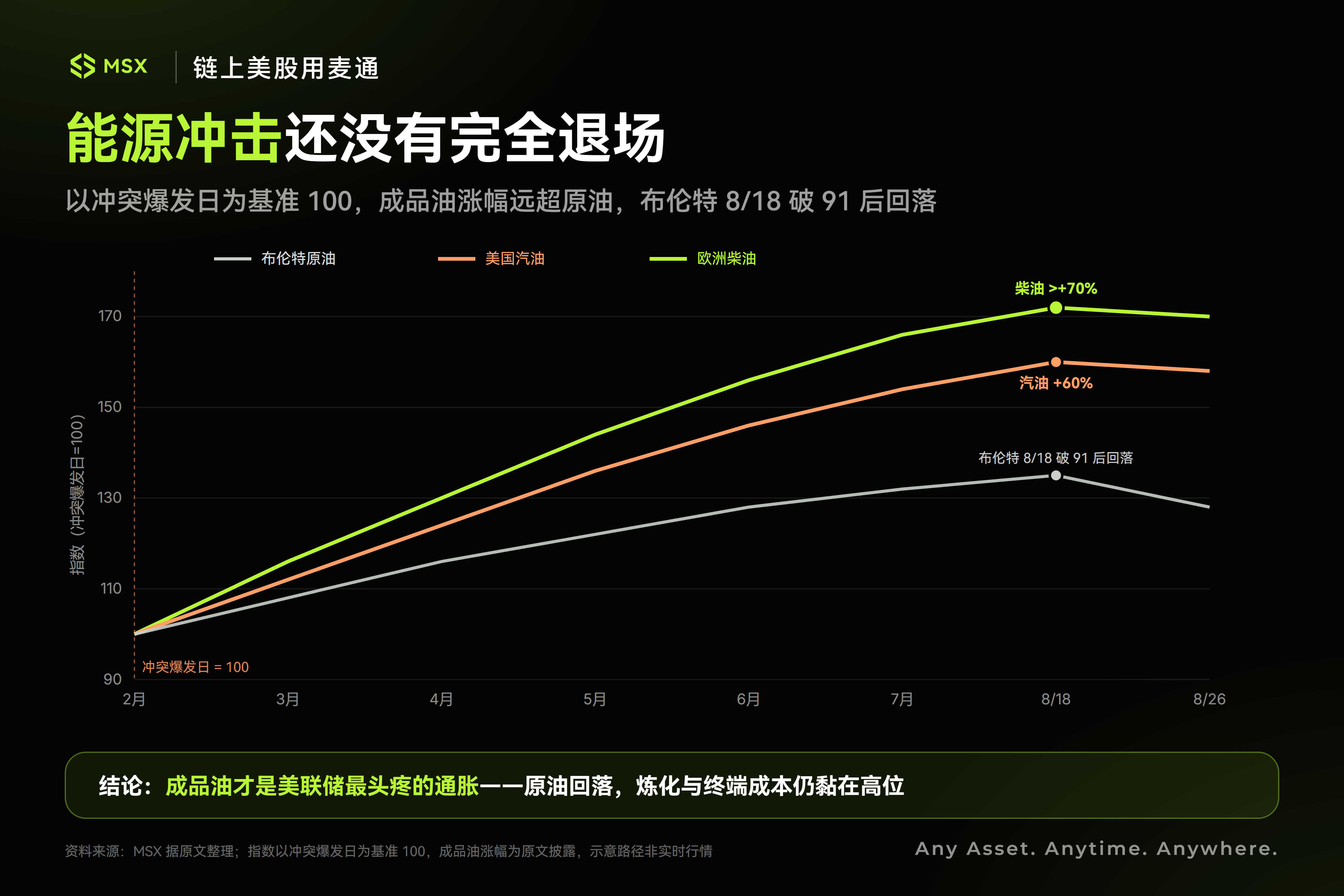
However, if energy prices remain high for a long time, they could continue to transmit through transportation, manufacturing, food, and service costs, ultimately affecting consumer inflation expectations.
Therefore, the first issue most worth watching for Walsh at Jackson Hole is whether the Federal Reserve defines this round of energy inflation as a temporary supply shock or a structural risk that could potentially change the inflation trajectory.
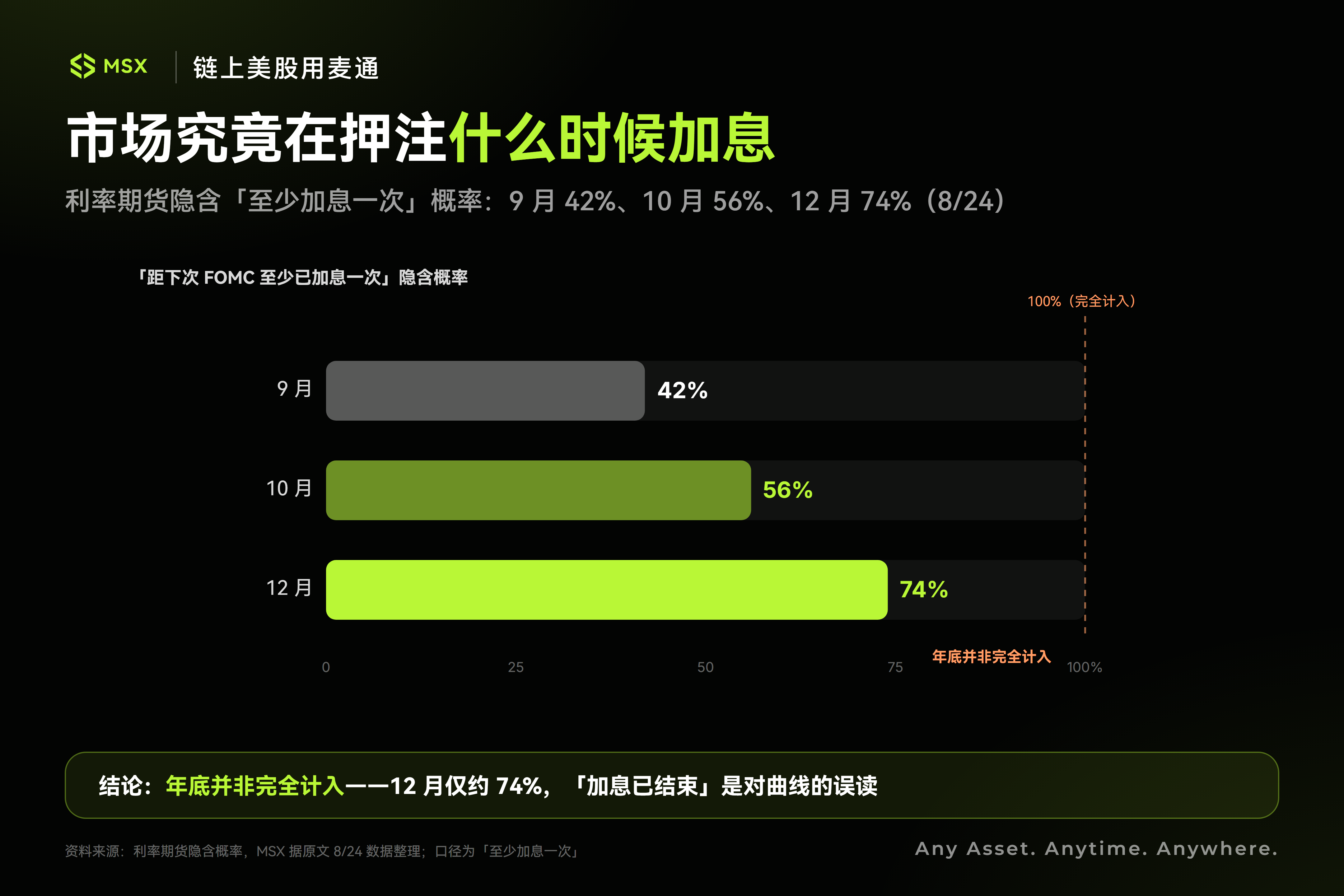
As of August 24, interest rate futures indicate that the market is still relatively cautious about an immediate interest rate hike in September, but the implied probability of at least one rate hike before the end of the year has risen to about three-quarters.
The internal disagreements within the July FOMC meeting were already quite evident.
At that time, the committee decided by a vote of 9-3 to maintain the federal funds rate at 3.50%–3.75%, but three members supported a 25 basis point hike. The subsequently released meeting minutes further showed that "many" participants believed that if inflation does not continue to retreat towards the 2% target, further tightening of monetary policy is likely to be necessary.
Ultimately, what the market really needs to judge is not just whether Walsh will signal an interest rate hike, but rather how high his tolerance for inflation truly is.
2. What is truly putting pressure on tech stocks is the increasingly high long-term US Treasury yields
This is also something I believe the current market is most likely to overlook.
Compared to short-term policy rates, what has recently exerted pressure on tech stocks is actually long-term rates.
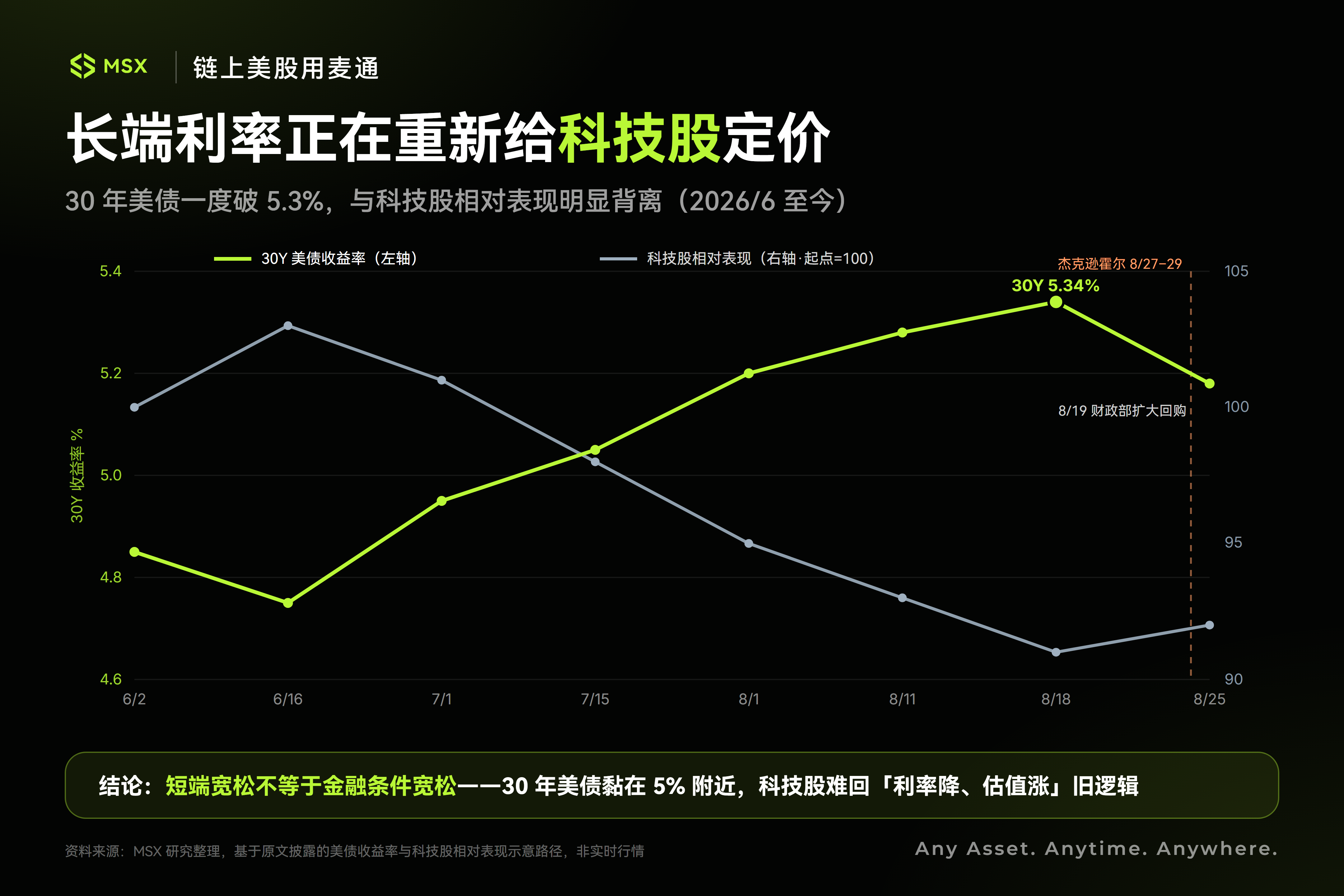
On August 18, the yield on the US 10-year Treasury bond rose to about 4.75%, while the 30-year yield peaked at 5.34%, reaching the highest level since 2007; at the same time, the yield on Japan's 10-year Treasury bond approached 3%, reaching a level rarely seen since the 1990s, and long-term financing costs for major global economies are rising in unison.
This rise in long-term rates, according to the MSX Research Institute, cannot be simply attributed to "the market believes the Federal Reserve will raise interest rates." More fundamentally, there is an increasingly intense competition for long-term capital globally.
Over the past decade, the market has been more familiar with Ben Bernanke's concept of a "Global Savings Glut" — that is, an oversupply of global savings, meaning abundant capital and insufficient investment demand, further compounded by central banks' long-term bond purchases that have kept real interest rates low for a long period.
However, today's environment is changing.
The US government needs to finance its ongoing fiscal deficit; Europe requires defense, energy, and infrastructure investments; an aging population is increasing pressure on public finances; at the same time, AI has initiated a rare cycle of capital expenditures.
Only Alphabet, Amazon, and Meta have already issued nearly $220 billion in bonds since 2026, more than double the $108 billion for the entire year of 2025. The US fiscal deficit is expected to remain around 6% of GDP.
In other words, not only does the government need money now, but AI also starts to require large amounts of capital, which is why this round of rising long-term bonds is increasingly important for tech investors.
Long-term rates influence not only government financing costs but also affect housing loans, corporate bond financing, data center project capital costs, and most importantly — how high the discount rate should be for future cash flows of growth stocks.
For tech stocks that are highly dependent on future earnings for valuation, a 30-year US Treasury yield above 5% contrasts sharply with a long-term interest rate environment of 3%-4%, representing two different valuation systems.

Therefore, after Jackson Hole, even if the market begins to anticipate a more dovish short-term policy stance, if the 30-year US Treasury yield remains firmly around 5%, tech stocks might not be able to revert to the previous simple trading logic of "declining rates and expanding valuations."
Short-term easing does not necessarily mean that financial conditions are lenient, which may be the most important thing to re-recognize in the current US stock market.
3. What will Walsh do after Besant's actions?
Recently, there has been a very rare change in the US Treasury market.
On August 19, the US Treasury Department announced that it would increase the liquidity repurchase scale for 10–30 year Treasury bonds from the previously planned $2 billion each to at least $4 billion, with this arrangement to be implemented from September 9 to November 4.
After the announcement, the yield on the 30-year US Treasury bond rapidly fell from over 5.3% to about 5.18%.
It is worth noting that the Treasury's official reason for this operation is still to improve the liquidity of the long-term bond market, rather than directly controlling yields.
This distinction is very important.
Because regardless of whether the repurchase scale is increased from $2 billion to $4 billion, it remains a small figure in a US Treasury market with over $30 trillion in scale.
It can improve market structure, ease short-term selling pressure, and signal to investors that "the Treasury is paying attention to the long end," but it does not change the deeper issues of rapidly growing fiscal deficits, debt supply, and long-term capital demand.
The US federal debt has already exceeded $40 trillion for the first time in August, and on this basis, the US government also has to compete for the same pool of global long-term funds with the AI giants that are greatly issuing bonds.
This puts Walsh in a policy environment that is much more complex than just "to raise rates or not," so there are three questions that truly need to be clarified at this Jackson Hole.
- Under what circumstances will the Federal Reserve raise rates again: The market no longer needs just a "data dependent" statement; what truly matters is what combination of core inflation, employment, energy prices, and inflation expectations would lead Walsh to consider that policy must tighten further;
- How does Walsh view long-term rates: If he believes that a 30-year yield above 5% is actively tightening financial conditions, then the urgency for the Federal Reserve to raise short-term policy rates may relatively decline. Conversely, if he believes that rising long-term bonds reflect inflation expectations or issues of policy credibility, then the market may receive entirely different answers;
- How will the Federal Reserve deal with the increasingly complex relationship with fiscal policy: The Treasury Department is beginning to manage long bond liquidity more proactively, while the Federal Reserve itself needs to maintain anti-inflation credibility and policy independence; after US debt surpasses $40 trillion, the importance of this question is rapidly increasing;
For Walsh, who has just taken office, this may be the most important task of his first Jackson Hole speech:
He does not need to tell the market in advance the answer for the next FOMC, but he must clarify to the market what type of policy framework he is prepared to establish.
In conclusion
If I had to summarize the two most important things of this week in one sentence, I would understand it as:
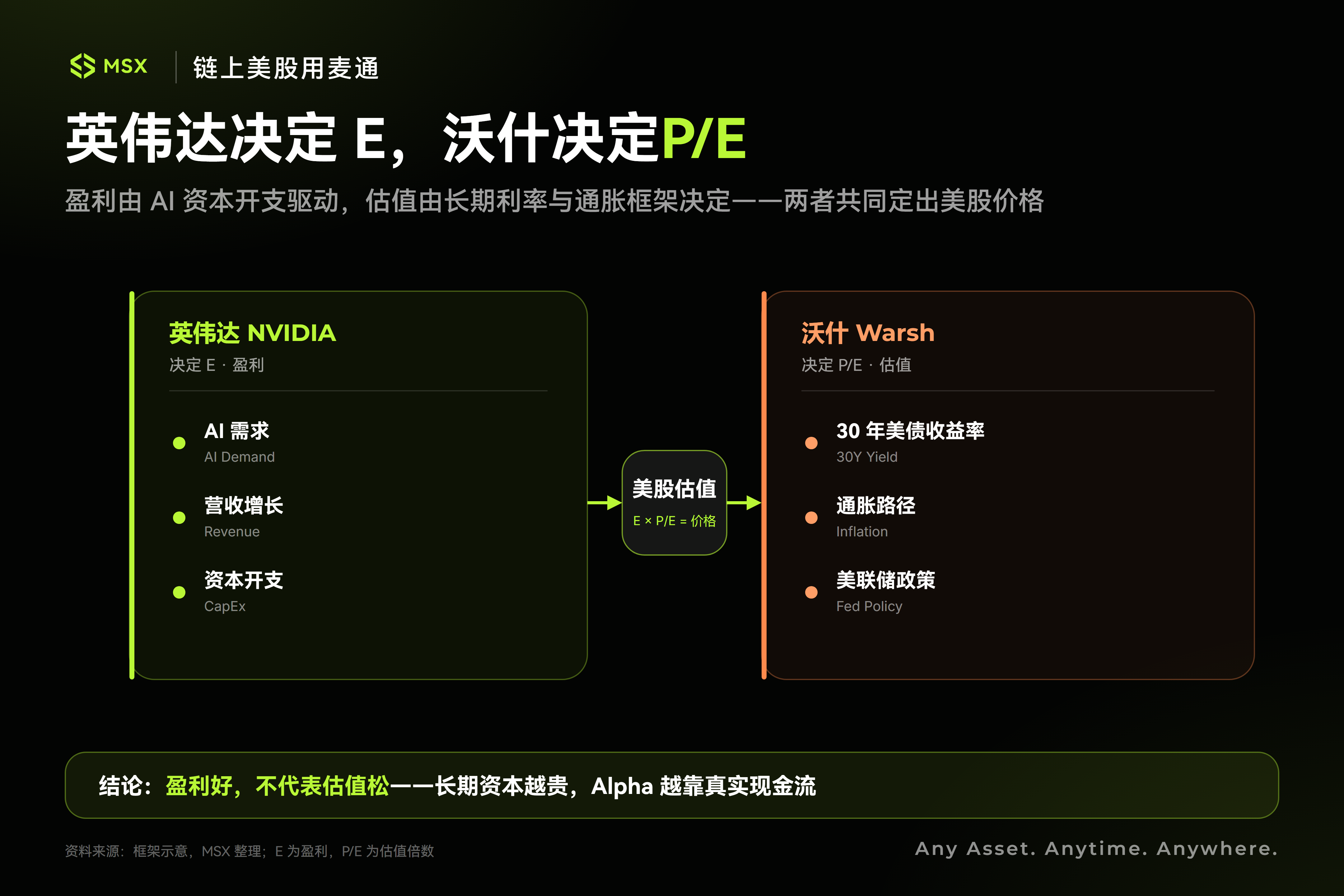
Nvidia decides how much profit can still rise, and Walsh decides how much the market is willing to pay for that profit.
Nvidia addresses whether AI demand, capital expenditures, and corporate profits can continue to rise; Walsh addresses, in an environment where long-term US Treasury yields are close to 5% and inflation remains above target, how much valuation the market is willing to assign to these profits.
One determines profit, and the other influences what multiple the profit receives.
If Nvidia continues to prove strong AI demand, energy prices further ease, and Walsh instills confidence in the market that inflation is under control, then tech stocks still have room to rise.
However, if profits remain robust but long-term capital becomes increasingly expensive, then the US stock market may gradually enter a different phase than in recent years — corporate profits continue to grow, but valuation expansion begins to be constrained, and Alpha increasingly relies on companies that can genuinely deliver cash flow and earnings growth, rather than just benefiting from "overall rises due to falling rates."
Thus, this time at Jackson Hole, what is truly worth listening to is how much the US stock market is valued when the government and AI giants simultaneously compete for capital and long-term rates rise to new heights.
免责声明:本文章仅代表作者个人观点,不代表本平台的立场和观点。本文章仅供信息分享,不构成对任何人的任何投资建议。用户与作者之间的任何争议,与本平台无关。如网页中刊载的文章或图片涉及侵权,请提供相关的权利证明和身份证明发送邮件到support@aicoin.com,本平台相关工作人员将会进行核查。


