Original Title: Kevin Warsh's Jackson Hole Speech Puts Bond Yields on Notice
Original Author: Michael J. Kramer
Translation: Peggy
Editor's Note: On August 28 (this Friday), according to the schedule released by the Federal Reserve, Chairman Kevin Warsh will deliver his first speech at Jackson Hole since taking office. Investors are concerned not only about whether he will hint at the next direction for interest rates but also whether he will continue to reduce forward guidance, allowing the market to form interest rate expectations on its own.
Note: The Jackson Hole Global Central Bank Annual Conference is hosted annually by the Kansas City Fed and serves as an important meeting for central bank officials to discuss economic and monetary policy. It is also a key window for the market to observe signals from the Federal Reserve.
Michael J. Kramer presents a more controversial interpretation in this article: Warsh may not intend to actively suppress long-term interest rates as the Federal Reserve did in the past, but instead hopes to allow the yield curve to steepen, tightening financial conditions through a higher term premium and bond volatility. According to this framework, even if the Federal Reserve does not raise the policy interest rate, it may suppress demand through the pressures on mortgage, corporate financing costs, and stock valuations.
This remains the author's speculation on Warsh's policy intentions, not a confirmed policy arrangement by the Federal Reserve. What truly deserves attention is that if the Federal Reserve reduces its management of market expectations, long-term interest rates may no longer passively reflect the path of rate hikes, but instead become an independent variable influencing financial conditions. The speech on Friday will provide the first important validation for this judgment.
The following is the translated content:
In the first half of this week, the market's attention was primarily focused on Nvidia's earnings report; after Wednesday, the focus will shift to the Jackson Hole Global Central Bank Annual Conference.
Federal Reserve Chairman Kevin Warsh is scheduled to deliver a keynote speech on August 28. This will be his first appearance at Jackson Hole since assuming the chairmanship and an important window for the market to observe his monetary policy framework. The schedule released by the Federal Reserve and the Kansas City Fed indicates that the speech will begin at 10 AM EST.
Investors will focus on whether Warsh has changed his stance on reducing forward guidance. Forward guidance is a policy tool used by central banks to influence market expectations regarding future interest rate paths through public communication. According to the article's author, Michael J. Kramer, it is highly likely that Warsh will not change direction: the Federal Reserve will reduce its "hand-holding guidance" to allow economic data and market prices to take on a more significant price-setting role.
The resulting impact may not be limited to policy communication. Kramer predicts that Warsh may allow long-term yields and bond volatility to rise, thereby tightening financial conditions and reducing the necessity for immediate rate hikes.
Term Premium Returns, Will 10-Year U.S. Treasuries Return to 5%?
The author observes that the term premium for U.S. Treasuries has begun to rise. The term premium is the additional return that investors require for holding long-term bonds rather than rolling over short-term bonds continuously, primarily used to compensate for future interest rate, inflation, and policy uncertainties.
This article utilizes the ACM term premium model published by the New York Fed. ACM stands for the estimation framework established by Tobias Adrian, Richard Crump, and Emanuel Moench, used to decompose long-term government bond yields into expected short-term rates and term premiums. It should be noted that the term premium cannot be directly observed, and different models may yield different results.
According to the data cited by the author, the 10-year U.S. Treasury ACM term premium is approximately 82 basis points, still below the average level of about 150 basis points from the decades before QE was implemented. If the term premium rises to this historical average, combined with the author's assumption of a neutral rate slightly above 4%, the 10-year Treasury yield could rise above 5%.
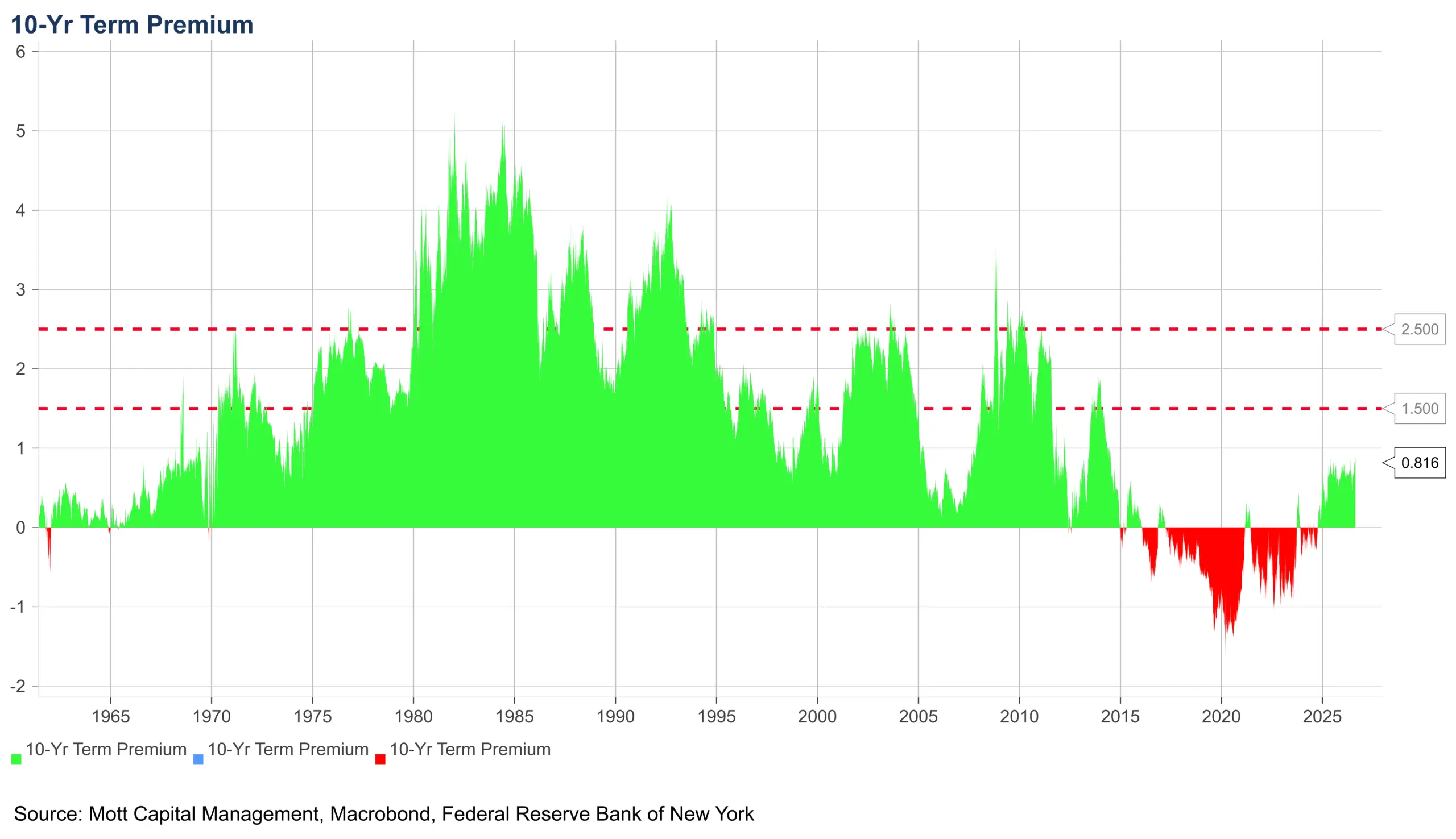
The 10-year U.S. Treasury ACM term premium has risen, but is still below the long-term average prior to QE, according to the author's classification.
This calculation is closer to a scenario projection and is not a definitive prediction of the 10-year yield. It relies on two key assumptions: that the term premium continues to rise and that the long-term neutral rate remains at a high level. If either condition changes, the results could be significantly different.
However, what the author is truly concerned about is not the specific level of 5%, but rather the pricing logic of long-term rates: if the Federal Reserve no longer actively reduces policy uncertainty, investors may demand higher term compensation.
No Rate Hikes Can Still Increase Bond Volatility
Reducing forward guidance may also push up the implied volatility in the bond market.
Despite the recent rise in long-term yields, the MOVE index, which measures the implied volatility of U.S. Treasury options, remains at a relatively low level. The author interprets this as the market still believing it can roughly predict the Fed's upcoming policy path.
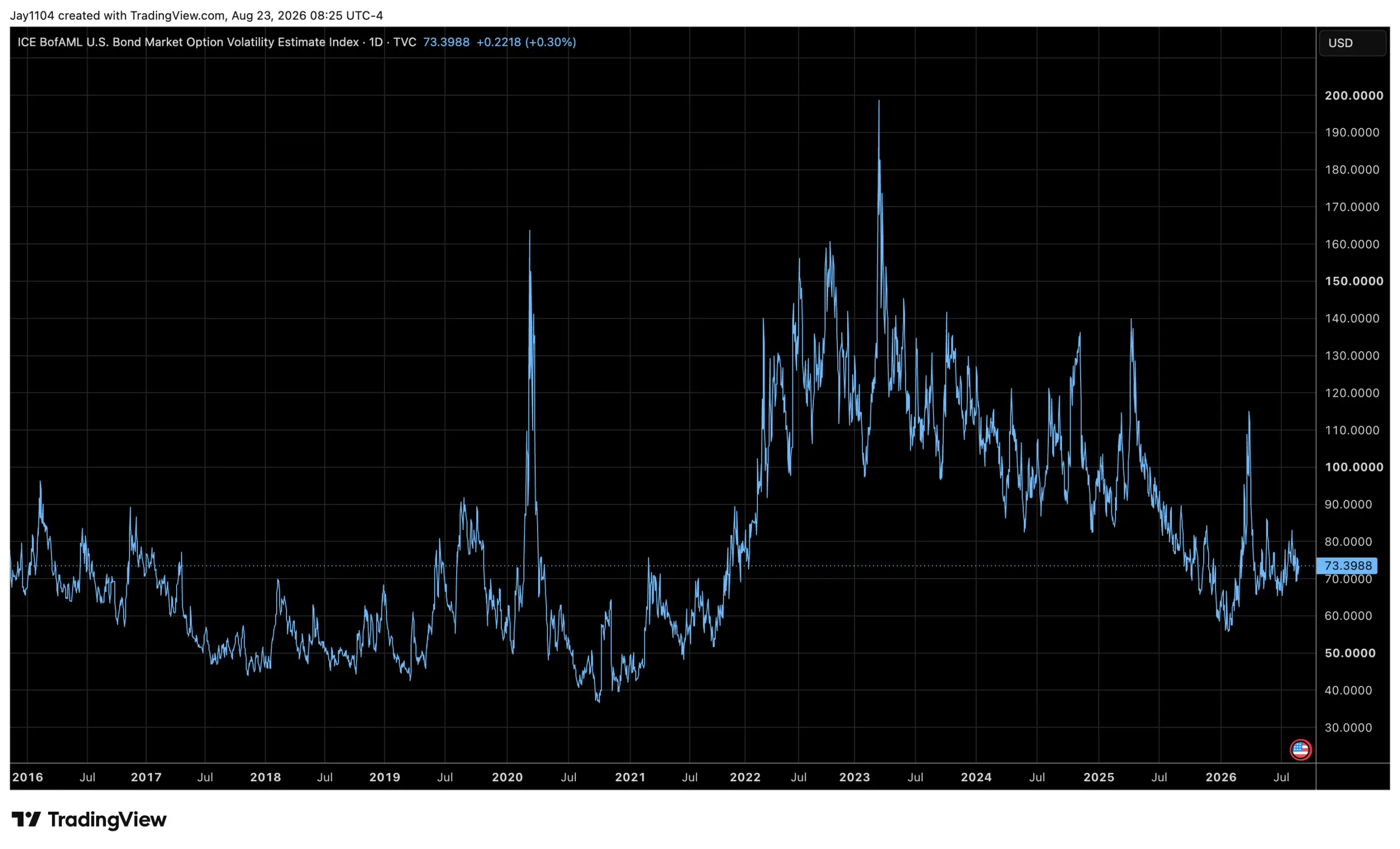
Long-term yields have risen, but implied volatility of U.S. Treasury options has not yet been substantially reassessed. The author believes that reducing forward guidance may change this state.
If this certainty disappears, every monetary policy meeting could become an "open event": investors would not be able to rule out the possibility of rate hikes, cuts, or continued pauses in advance, and bond prices would become more sensitive to economic data and policy statements. Without actually adjusting rates, U.S. Treasury volatility could undergo a structural reassessment.
The author believes that this change in itself can tighten financial conditions. Higher 10-year yields would translate into mortgage and corporate long-term financing costs, lowering the valuations of long-duration assets like stocks; higher interest rate volatility could also widen credit spreads, increasing corporate borrowing costs.
It is essential to downgrade the understanding that the federal funds rate remains the core tool of the Federal Reserve's monetary policy and should not be simplistically considered "unimportant" for short-term rates. The author presents another layer of market interpretation: in addition to the policy rate, long-term yields and bond volatility can also influence the real economy, and their transmission may be more direct.
Let the Long End Tighten, Then Create Room for Short End Rate Cuts
In the policy framework envisioned by Kramer, the Federal Reserve may allow the yield curve to continue to steepen, letting long-term rates bear the tightening function that has not been fully realized in the past.
Specifically, the Federal Reserve could reduce forward guidance and no longer strive to eliminate uncertainties at every policy meeting. In an environment where supply, inflation, and fiscal risks still exist, investors would demand higher term premiums, driving up long-term yields and bond volatility, allowing the market to complete part of the tightening.
If this process can lower demand and push inflation to continue declining, the Federal Reserve may then lower the short-term policy rate. At that point, the yield curve may表现为 long-term rates remaining relatively high, while short-term rates gradually decline.
In other words, the path envisioned by the author is not the traditional "raise rates first, then cut rates," but rather letting the long end tighten financial conditions first, then creating space for short-term rate cuts.
However, this framework carries obvious risks. The rise in long-term yields is not entirely under the control of the Federal Reserve. If the term premium rises too much, mortgage, corporate financing, and fiscal interest burdens may come under pressure simultaneously; if the market interprets the reduction in communication as a lack of clarity in the policy framework, the increase in volatility may damage the Fed's credibility rather than help it complete an orderly tightening.
Therefore, it cannot yet be confirmed whether the rise in long-term rates is indeed the policy channel that Warsh hopes to utilize or an additional compensation required by the market for inflation, fiscal, and policy uncertainty.
Japan's Interest Rate Normalization Adds Pressure to Global Long Bonds
In addition to the changes in U.S. policy, the author also views Japan as another driving factor for global interest rate increases.
According to the Bank of Japan's latest policy, the target for Japan's uncollateralized overnight lending rate is currently about 1%. Meanwhile, the 10-year breakeven inflation rate in Japan is approaching 2%. The breakeven inflation rate is the difference between nominal government bond yields and yields of inflation-linked bonds of the same maturity, commonly seen as the market's estimate of future inflation, but it also includes liquidity and risk premiums.
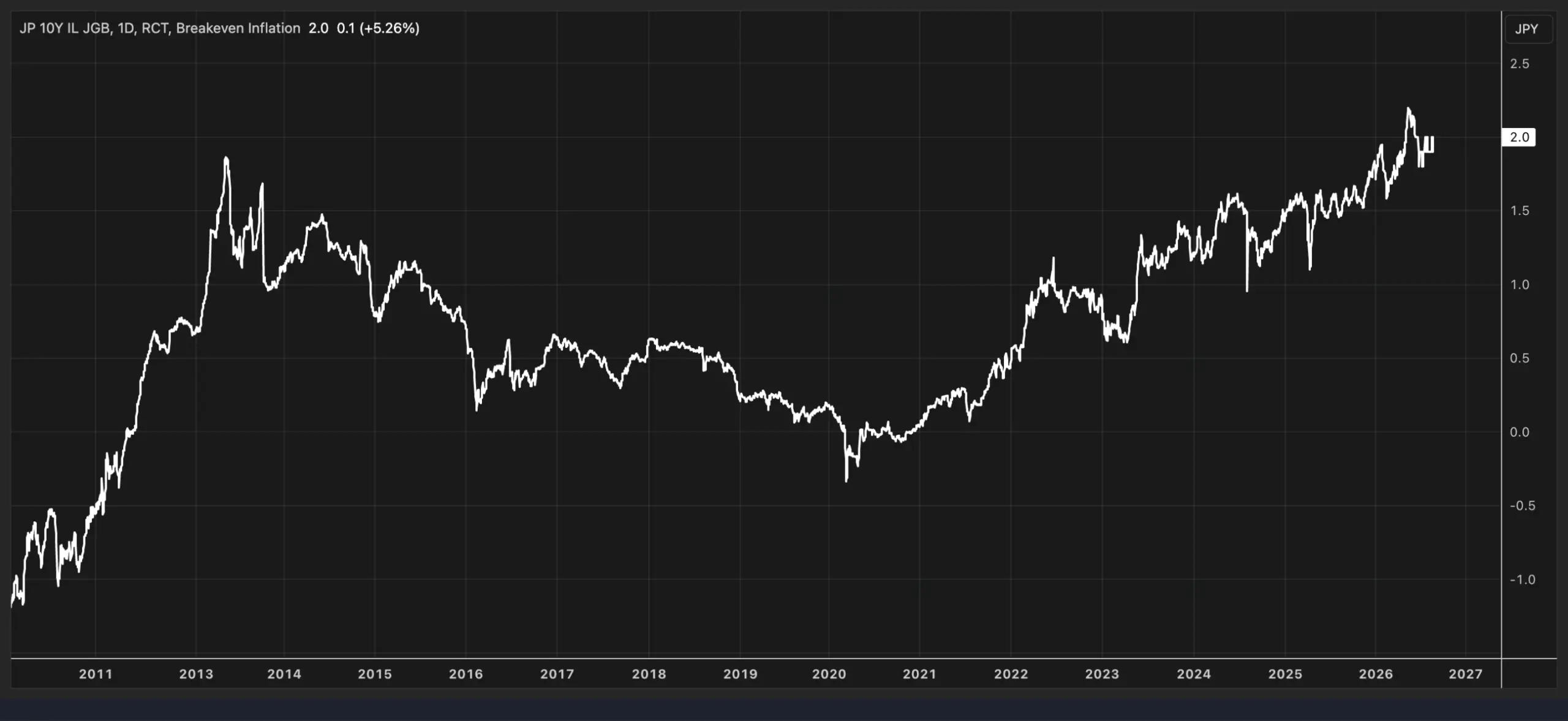
The 10-year breakeven inflation rate in Japan has risen to about 2%, and the market's expectations for further normalization of monetary policy by the Bank of Japan have increased accordingly.
The author believes the rise in inflation expectations in Japan indicates that the market is preparing for further normalization of monetary policy by the Bank of Japan. According to the TONAR futures pricing cited by the author, the market-implied rates are approximately 1.19% in September, 1.41% in December, and 1.6% in March of the following year. These figures reflect the market pricing at the time of the article's publication and will continue to change with economic data and policy expectations; they do not represent the interest rate path that the Bank of Japan has confirmed.
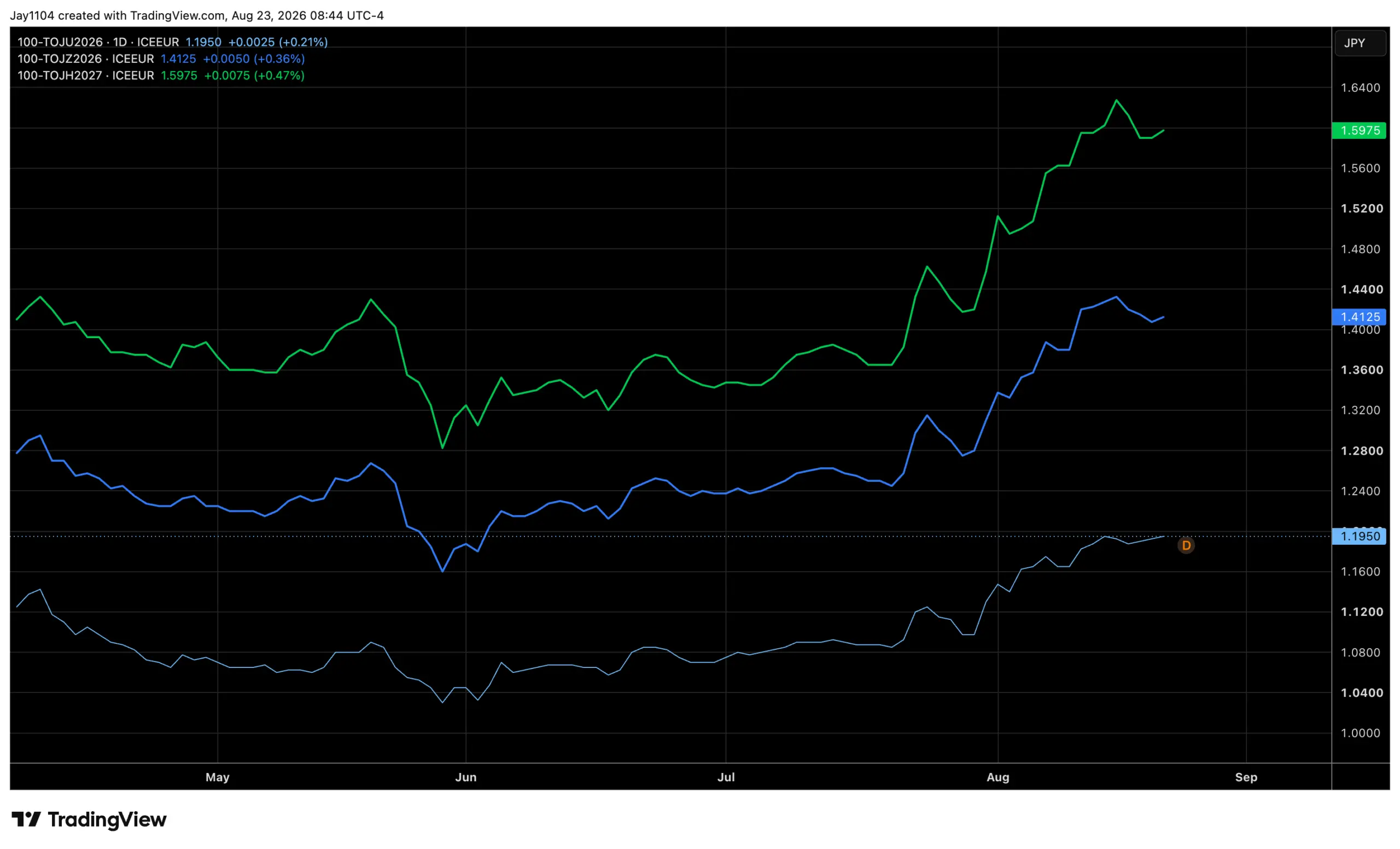
The TONAR futures pricing at the time of publication indicates that the market is factoring in the possibility of continuing rises in Japan's short-term rates. Futures prices will change with data and policy expectations and do not represent the interest rate path that the Bank of Japan has confirmed.
If Japanese rates continue to rise, global demand for low-yield overseas bonds may marginally weaken, and global long-term interest rates may face more upward pressure. In such an environment, even if Warsh does not issue a clear signal for rate hikes, long-term U.S. Treasuries may not easily decline.
What needs to be observed on Friday is how Warsh describes the rise in long-term yields: does he view it as having already completed part of the tightening for the Federal Reserve, or does he believe that higher term premiums are bringing uncontrollable financial risks? Will he continue to reduce forward guidance, and will he explain how the Federal Reserve hopes the market will understand its policy response function?
Only with clearer answers to these questions can we determine whether "letting the long end do the Fed's tightening" is indeed a policy framework that Warsh might adopt or a narrative that the market has filled in on its own based on his silence.
免责声明:本文章仅代表作者个人观点,不代表本平台的立场和观点。本文章仅供信息分享,不构成对任何人的任何投资建议。用户与作者之间的任何争议,与本平台无关。如网页中刊载的文章或图片涉及侵权,请提供相关的权利证明和身份证明发送邮件到support@aicoin.com,本平台相关工作人员将会进行核查。


