Author: Claude, ShenChao TechFlow
ShenChao Overview: On August 16, Bloomberg and TechCrunch confirmed from dual sources that Stripe has acquired the AI model routing platform OpenRouter for over $7 billion. Just three months ago, this company was valued at $1.3 billion in its B round. OpenRouter serves as the most commonly used "single interface for all models" transit layer for developers and is widely recognized in the AI community as a symbol of "neutrality." Now it belongs to a payment company that earns money through transaction fees, giving the developers' favored neutrality a clear price tag for the first time.
On August 16, Bloomberg reported, citing informed sources, that Stripe has reached an agreement to acquire OpenRouter for over $7 billion. TechCrunch followed up with confirmation, stating that a Stripe spokesperson responded with "no comments on rumors or speculation." If completed, this deal will be one of the largest acquisitions in the AI infrastructure sector by financial amount, with both parties going from "service provider and client" to "acquirer and acquiree" in just a quarter.
Valuation multiplies by 5 in three months: $1.3 billion B round, $7 billion transaction price
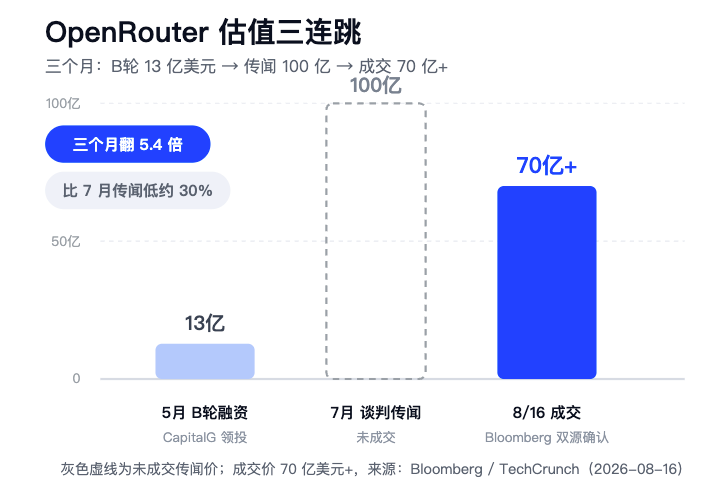
On May 28 of this year, OpenRouter announced the completion of its $113 million B round financing, with a post-investment valuation of approximately $1.3 billion. The leading investor was Alphabet's growth fund CapitalG, with existing shareholders such as Sequoia, a16z, and Menlo Ventures continuing to increase their stakes. Today, three months later, the transaction price exceeds $7 billion, more than a fivefold increase on paper.
What is even more interesting is the direction of the price change.
In late July, The Wall Street Journal and Axios reported that negotiations were centered around a price of about $10 billion, which dropped to just above $7 billion three weeks later, approximately 30% lower than rumored.
Analysts attribute the price reduction to a fact: throughout the summer, model prices have been declining, and buyers have increasingly strong bargaining chips.
Once calling itself "the Stripe of the AI world," it has now truly been acquired by Stripe
OpenRouter began operations in early 2023, and its founder and CEO, Alex Atallah, is from Stanford and Palantir. In 2017, he co-founded the NFT trading platform OpenSea with Devin Finzer and served as CTO, making him one of the people in Silicon Valley most familiar with the business of "market aggregation."
What OpenRouter does is essentially aggregate the fragmented model market into a unified entry point: developers only need to integrate an API key compatible with OpenAI's interface to access hundreds of models, handling routing, failover, usage statistics, and billing, all without rewriting code to switch models.
According to its own claims, it currently has over 10 million global users and provides access to over 500 models from more than 80 providers, processing over 200 trillion tokens per month (according to self-reported numbers).
Its fee model is simple and straightforward: it charges a 5.5% platform fee for usage-based payment scenarios, with model inference prices passed through unchanged. Atallah has repeatedly referred to it as "the Stripe of the AI field": providing developers with a single access point to avoid being locked into any specific model vendor.
Now, this analogy has a straightforward conclusion: a company that called itself Stripe has been bought by Stripe.
Stripe has already been keeping accounts for OpenRouter, transitioning from service provider to owner
The groundwork for this deal runs deeper than what is visible to the outside world. Stripe has always been OpenRouter's payment service provider. In Stripe's official client case studies, OpenRouter uses it for invoicing, tax calculation, local payment acceptance, and anti-fraud measures, even linking changes in model costs with billing based on usage.
This means that Stripe has always been able to see every income entry on OpenRouter's books. Transitioning from being a supplier to an acquirer, it understands better than any external buyer what the cash flow of this intermediary looks like.
Moreover, strategic positioning is crucial. At Stripe's developer conference in April, the company released a group of AI payment products: stream payment billing by token, wallets for agents, and micro-payment pathways between machines. Their official statement was that "tokens are becoming interchangeable with currency." After acquiring OpenRouter, Stripe holds two core assets: OpenRouter decides which model to send a single inference request to and records its value, while Stripe handles the money collection, settlement, and recording. Measurement and collection have finally been integrated into the same company.
Neutrality is the entire selling point; now it belongs to a fee-collecting entity
For developers, the most subtle change lies here. OpenRouter's fundamental principle is one word: neutrality. It does not sell its own models; it only does scheduling and billing, so developers are willing to hand over traffic to it, betting that it will not favor any model vendor.
Now this guarantor of "neutrality" has become a fee-collecting payment company. Some developers have pointed out directly: "OpenRouter was already using Stripe for payments; this acquisition can help Stripe reduce costs and increase revenue."
Others have cited a more eye-catching statistic: "All of the companies in Forbes AI 50 that have commercialized are using Stripe for payments, which is a bit unsettling." The intermediary's business naturally tends to consolidate, with a single API key facing a fragmented ecosystem and charging a convenience fee. This time, the entity acquiring this business model is the one that collects the most tolls.
Another layer of risk is technical. The routing layer is a typical single point of failure: if it fails, all model providers behind it will suffer. In February of this year, OpenRouter experienced two outages, with one instance seeing 80% to 90% of API requests fail. Handing over the freedom of "who to choose" to a neutral scheduler and handing it to a payment giant are two completely different forms of trust.
A clearinghouse for both dollars and tokens; Stripe wants to take it all
Zooming out, OpenRouter may just be a piece on Stripe's chessboard. In the same week, on August 14, The Wall Street Journal reported that Stripe is in talks with private equity giant Advent to acquire PayPal, with a bid of $60.5 per share made in July valued at approximately $53 billion, which was rejected by PayPal, but negotiations are ongoing. If completed, Stripe's annual transaction volume would reach the level of $37 trillion.
On one side is a giant in existing dollar payments, and on the other side is a gateway for incremental token payments. What Stripe wants is not just a routing layer but the very act of "money flowing through me," whether it's fiat currency or tokens, and whether the recipient is a human or an agent. OpenRouter once claimed to keep the model market fully competitive; now the meters and tolls of this market have been consolidated within the same company. For the developers adjusting models on OpenRouter daily, the interface remains unchanged, but the ownership of every toll along this road has shifted.
免责声明:本文章仅代表作者个人观点,不代表本平台的立场和观点。本文章仅供信息分享,不构成对任何人的任何投资建议。用户与作者之间的任何争议,与本平台无关。如网页中刊载的文章或图片涉及侵权,请提供相关的权利证明和身份证明发送邮件到support@aicoin.com,本平台相关工作人员将会进行核查。