Last night, the U.S. July PPI was announced.
The data wasn't bad, it could even be said to be quite friendly: month-on-month 0.0%, lower than the expected 0.2%; year-on-year 4.7%, significantly down from June's 5.5%.
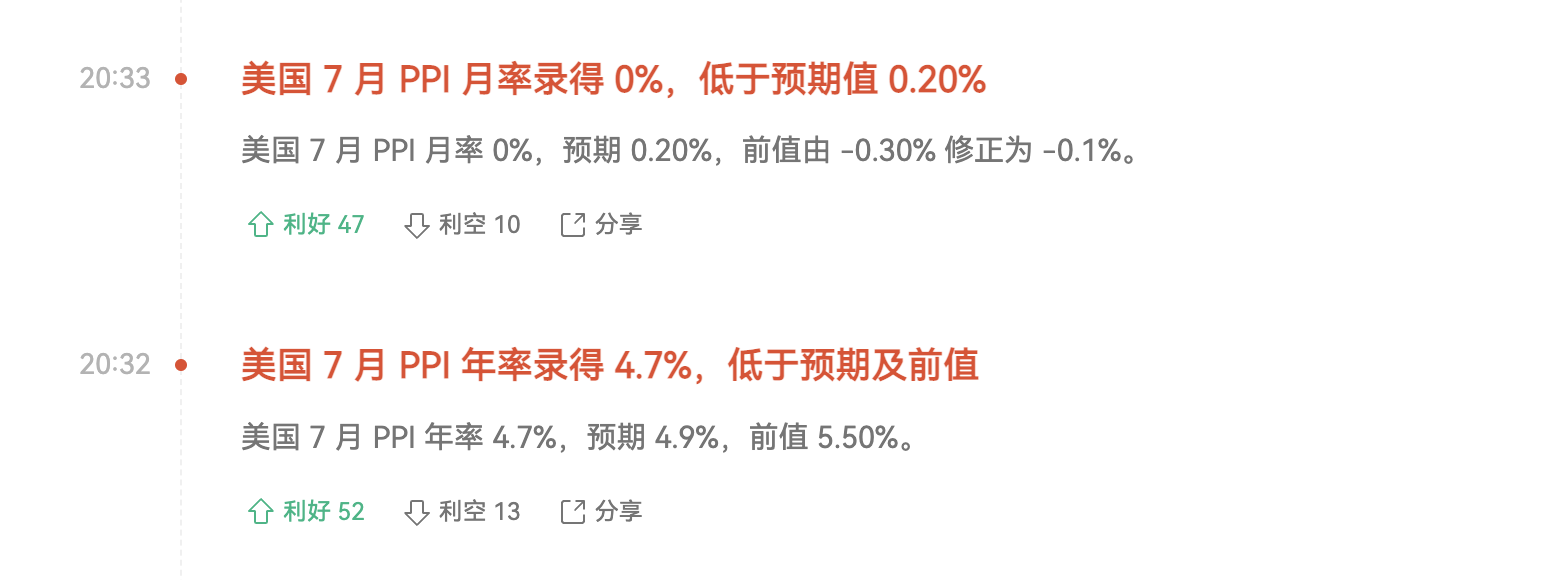
Upstream price pressure is cooling, and this is the second consecutive inflation data that has not warmed up again after the CPI. Concerns in the market about the Fed continuing to raise interest rates have significantly decreased, and the expectation of a rate hike in September has also fallen. U.S. stocks are strengthening simultaneously, with the S&P 500 setting a new intraday high.
Based on past trading logic, this should have been good news for BTC.
But here comes the problem: BTC did not really rise.
01 | The data is good, why is the market not buying it?
After the PPI was announced, BTC did indeed respond quickly. The price surged from around $63,500 to a high of nearly $64,000, and then quickly gave back the gains, falling back to around $62,800.
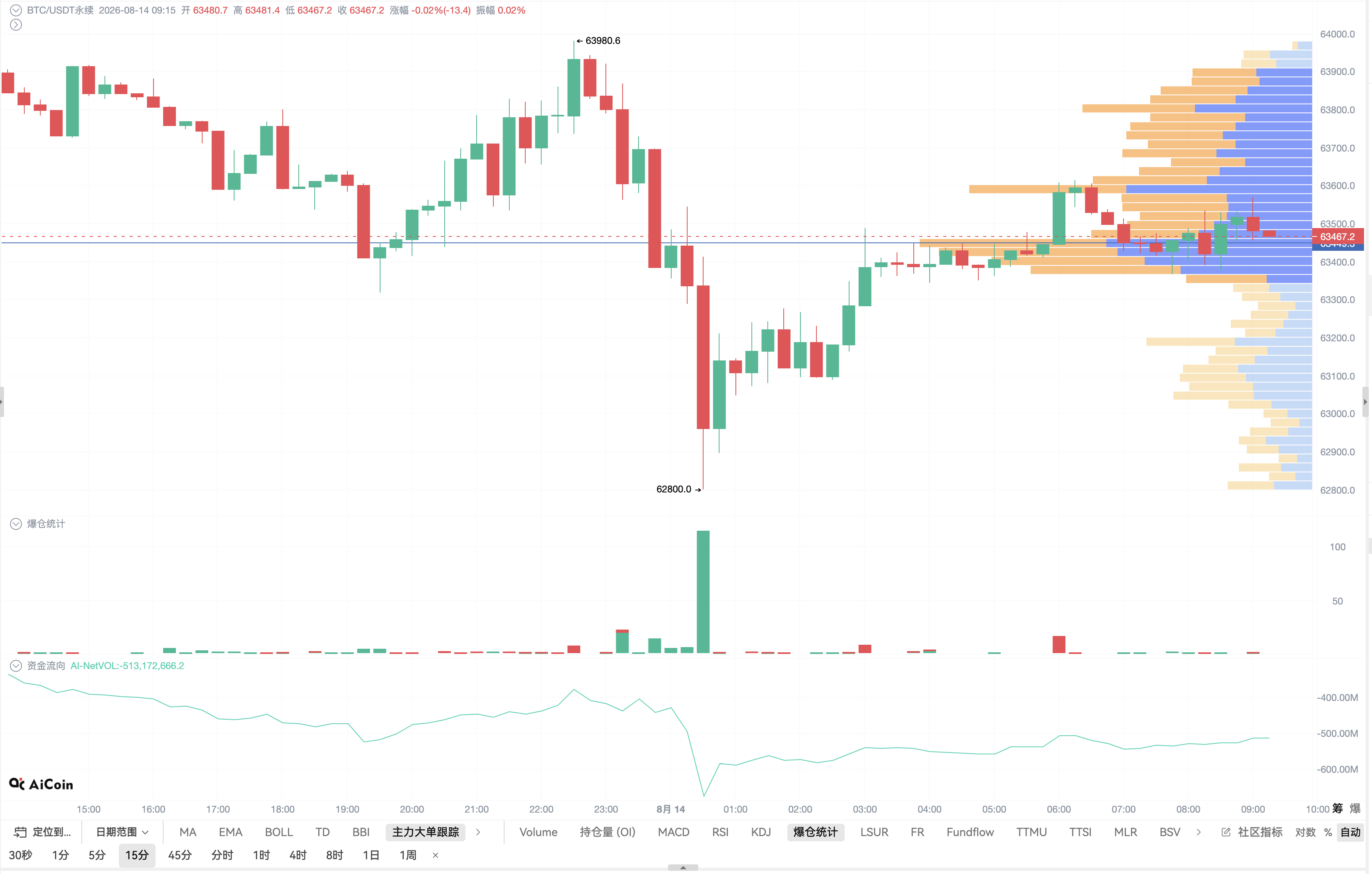
(The figure shows data analysis for AiCoin members)
The data has come out, volatility has occurred, but the trend has not emerged.
This is more worth paying attention to than simply looking at the ups and downs.
The macro logical chain itself is not wrong: PPI cooling → Inflation pressure decreasing → Rate hike expectations weakening → Liquidity expectations improving → Risk assets benefiting. The problem is that the market has long known this chain. Yesterday's PPI was not a black swan, but a piece of data that had been traded repeatedly before its announcement.
What really determines whether BTC can continue to rise is no longer just “Is the data good?” but “Is there new capital willing to pay for this data?”
This is the key to the current market.
02 | BTC is becoming 'desensitized' to macro data
Recently, after several CPI and PPI announcements, a similar phenomenon can be observed: pre-announcement trading of expectations, short-term volatility after the announcement, followed by profit-taking and prices returning to the original range.
This is typical of buy the expectation, sell the fact. But now it's even further than that—BTC is showing an obvious marginal dulling to macro data.
The reason is simple: the market is not lacking in “good data.” CPI has not significantly deteriorated, PPI is starting to cool, and the pressure for the Fed to continue raising rates is decreasing. However, if this information does not lead to actual capital inflow, it will ultimately remain at the emotional level.
For BTC, without capital, good news is just news.
This is also why the U.S. stock market was significantly stronger yesterday, while BTC still hovered around $63,000-$64,000. Traditional risk assets have started trading on “cooling inflation,” while the crypto market is still waiting for its incremental capital.
03 | The real issue is not the rate cut, but whether the rate cut expectation can turn into capital
Many people are used to equating “rate cut expectation ↑ = BTC ↑.” Actual trading is not that simple.
An improvement in rate cut expectations only indicates that the macro environment is not so tight. To really drive BTC's sustained rise, increased liquidity, ETF capital inflow, a rebound in risk appetite, and active capital within the crypto market are needed. Missing any one of these could cause the market to stall.
So when seeing a decrease in the PPI, it cannot simply be understood as “inflation has fallen, BTC will rise.” A more accurate understanding is: the macro environment has temporarily not created new pressure on BTC, but it has also not provided sufficient upward momentum.
These two statements may seem similar, but the trading results are completely different. The former makes it easy for people to chase the rise, while the latter is much closer to the current market situation.
04 | BTC now seems to be waiting for the 'second variable'
If we consider the PPI to be the first variable, the market is truly waiting for the second variable: capital.
This is also why the current price structure is more important than individual economic data. BTC is still stuck in a relatively clear consolidation range:
Looking below at around $62,800. If this area continues to hold, it indicates that the bulls can at least maintain the current structure.
Looking above at $64,000-$64,500. Only a real volume breakout, accompanied by capital following, can prove that this macro good news is beginning to transform from emotion into trend.
Otherwise, even if one or two more dovish data points come, it may just spike, lock in profits, and return to the range. This is typical stock game.
05 | After PPI, what should we really focus on?
I would not be too concerned about whether the next data is good or bad. What is more worth observing next are three things:
First, watch for volume when BTC breaks through. A breakthrough without accompanying trading volume is likely to be a false move.
Second, see if there is sustained inflow of ETF and market capital. Ultimately, macro good news must be reflected through capital entering asset prices.
Third, observe employment and subsequent inflation data. The Fed is not merely facing the question of “Is inflation high or not,” but how to balance inflation, employment, and economic growth.
If subsequent data continues to show cooling inflation, while employment shows no significant deterioration, the macro environment for risk assets will become increasingly comfortable. But if inflation rises again, or if employment deteriorates suddenly, the market's trading logic may switch from “rate cuts” to “recession.”
The PPI is just one variable, not the answer.
Finally
The greatest significance of this PPI may not be to tell us whether BTC is about to rise or fall. Instead, it verifies something more important: BTC can no longer rely on single macro data to drive trends.
Data can create volatility, but to create a trend, capital is necessary.
So if BTC continues to consolidate next, I would not be surprised. What is truly worth being cautious or excited about is not the moment a particular economic data is announced, but whether there is capital willing to follow after BTC finally breaks out of this range.
Until then, macro good news can be observed, but there is no need to treat each one as a signal for market initiation. What the market now lacks may not be a better PPI, but a real increment of capital.
By the way, there has been a lot of discussion recently on Binance regarding macro data and capital flow, if you're interested, you can register on Binance and conveniently follow real-time market and capital trends. Here is the link:
👉 https://jump.do/zh-Hans/xlink-proxy?id=3
(Invitation code: aicoin668, enjoy a 10% rebate)
Join our community, let's discuss and become stronger together!
Official Telegram community: t.me/aicoincn
AiCoin Chinese Twitter: https://x.com/AiCoinzh
Binance benefits group:
https://www.aicoin.com/link/chat?cid=gmLgwvKD1
Risk warning: The content is merely a market observation share and does not constitute investment advice. The cryptocurrency market is highly volatile; please participate within your own risk tolerance.
免责声明:本文章仅代表作者个人观点,不代表本平台的立场和观点。本文章仅供信息分享,不构成对任何人的任何投资建议。用户与作者之间的任何争议,与本平台无关。如网页中刊载的文章或图片涉及侵权,请提供相关的权利证明和身份证明发送邮件到support@aicoin.com,本平台相关工作人员将会进行核查。