
Author: Sam, Schubert, Blockworks
Translation: AididiaoJP, Foresight News
Today we focus on a core question: How did Aptos transform from a public chain that "continuously caused holders to lose money" to one of the very few mainstream general-purpose L1s where the overall net income of holders exceeds the operator's costs.
The core indicator is Token Holder Net Income (THNI). Meanwhile, quickly scanning the current market: the crypto stocks group is leading the way with a surge driven by Circle, while BTC and most token sectors are under pressure ahead of the July CPI release.
Market Overview: Circle's Solo Act
Yesterday, the market was overall flat. Crypto stocks (+2.9%) stood out as the only highlight, with BTC down by 0.4%, and the S&P 500 down by 0.2%.
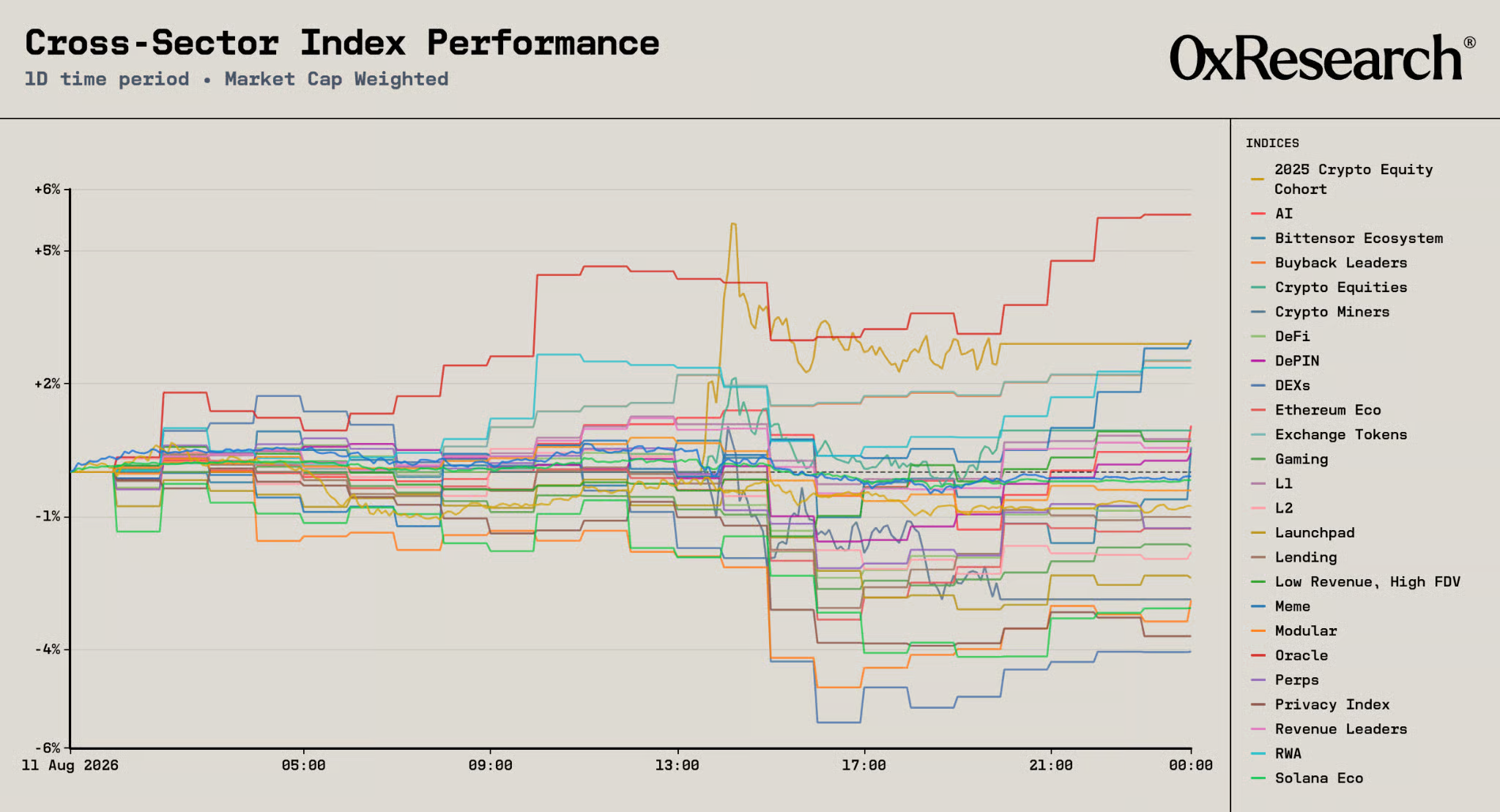
Sector differentiation was obvious: Oracle (+5.8%) led the gains, followed closely by Meme coins (+3.0%), exchange tokens (+2.5%), and RWA (+2.4%); DEX (-4.1%), privacy sectors (-3.7%), and the Solana ecosystem (-3.1%) significantly underperformed.
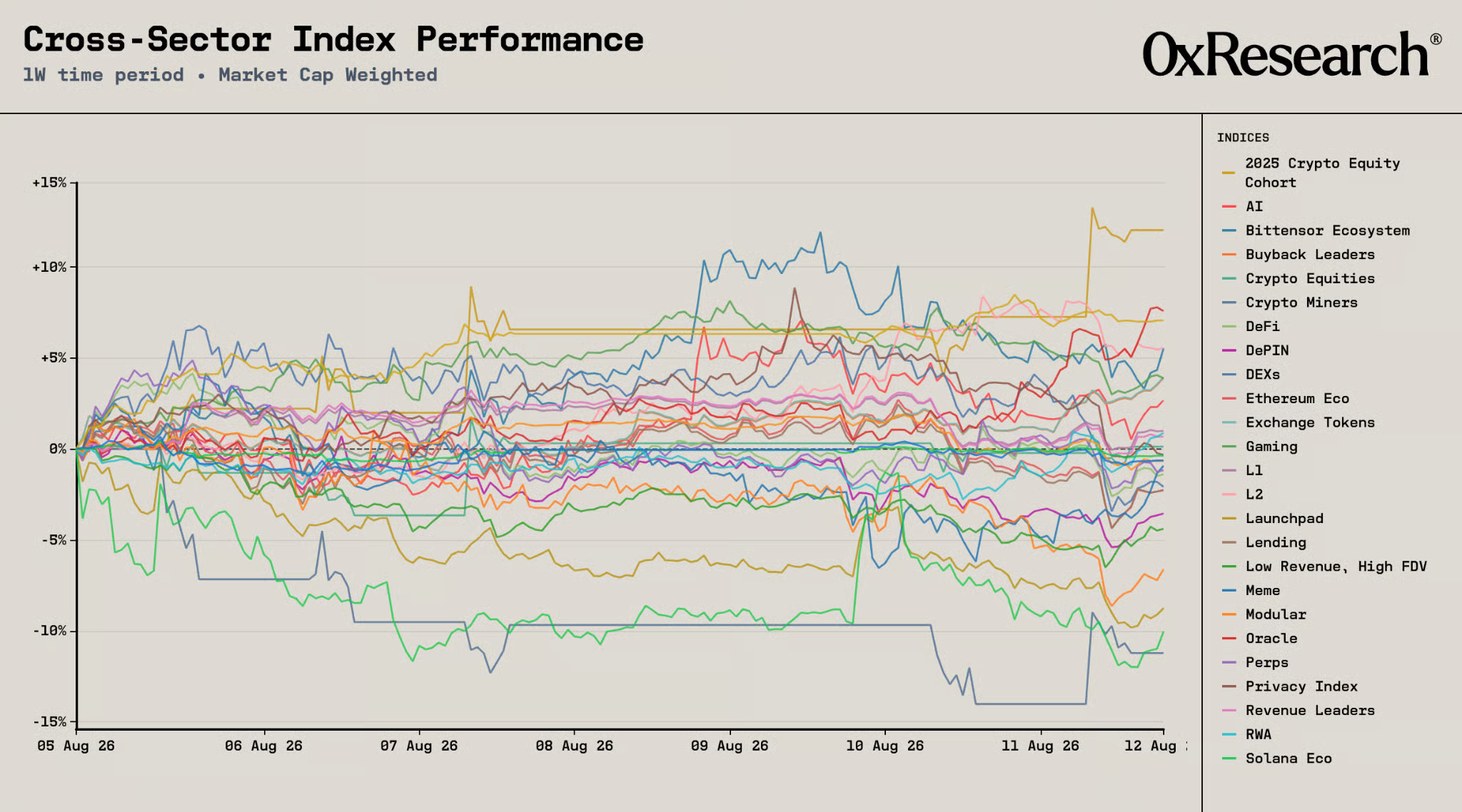
When extended to a weekly view, the pattern becomes clearer. The crypto stocks group crushed all assets with a +12.0% surge, surpassing Oracle (+7.6%) and gold (+7.1%). BTC fell by 0.7% for the week, the S&P 500 fell by 0.4%, with the vast majority of token sectors closing down. The Solana ecosystem (-10.0%) and crypto miners (-11.2%) were at the bottom.
The rise in gold was driven by macro factors: non-farm employment in July actually decreased by 23,000, far below the expected increase of 80,000, which directly weakened the likelihood of a Fed rate hike in September.
Crypto Stocks: Essentially Circle's Solo Act
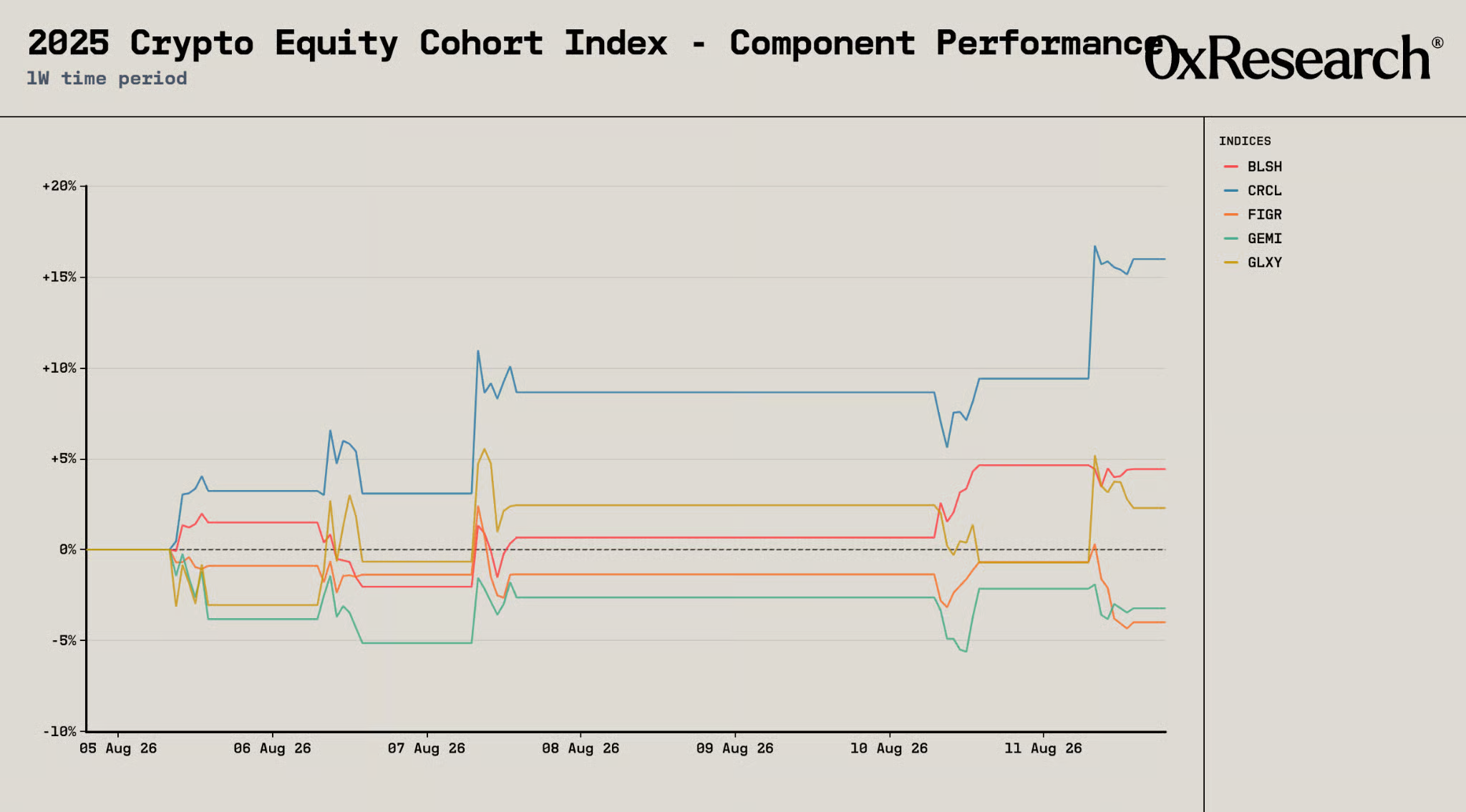
CRCL surged by 16.0% this week, with BLSH (+4.4%) and GLXY (+2.3%) contributing slight increases, while FIGR (-4.0%) and GEMI (-3.2%) completely lagged. The broader crypto stock index only saw a slight increase of 0.1%.
Circle released its Q2 2026 financial report on August 5: total revenue and reserve income amounted to $701 million (up 7% year-on-year), adjusted EBITDA of $143 million, USDC circulation reached $73.3 billion (up 19% year-on-year), with total on-chain transfers reaching $14.8 trillion (up 151% year-on-year).
Interestingly, the market reaction was not a spike on the earnings report day, but a slow warming. On the day of the CRCL earnings report, it only rose by 3.2%, but by last Friday, the cumulative increase expanded to 8.7%, closing yesterday at around $71, having cumulatively risen by 16.0% since before the earnings report.
Behind this are two forward-looking catalysts continuing to ferment:
- Arc Mainnet: Officially launching on September 16, heavyweight institutions such as BlackRock, Visa, and DTCC will participate as founding validators.
- Federal Bank License: Circle National Trust has been approved by federal regulators, becoming one of the first stablecoin issuers to obtain a federal banking license.
Once these two events are realized, Circle's narrative potential and business ceiling will significantly open up.
Aptos Value Capture: A Complete Turnaround from Huge Losses to Net Gains
Aptos is now one of the very few mainstream general-purpose L1s that allows holders to earn more overall than they pay to the operators.
Core Indicator: THNI
Token Holder Net Income (THNI) measures the real net income of "holders as a whole"—total network revenue minus the fees paid to validators. Staking rewards are considered internal redistribution among holders and are not included in expenditures.
By this measure, Aptos officially turned positive in May 2026 and has continued to maintain a positive status. During the same period, Ethereum, Solana, and Sui remained in the negative range.
The true turning point occurred after the protocol-level reforms from February to March this year.
Ranking Completely Reversed
Data from January 2025 (annualized contribution per $10,000 FDV):
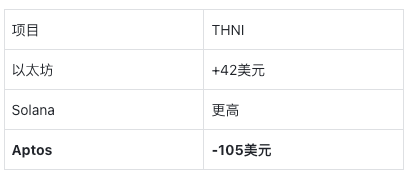
July 2026:
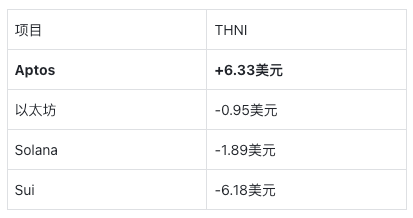
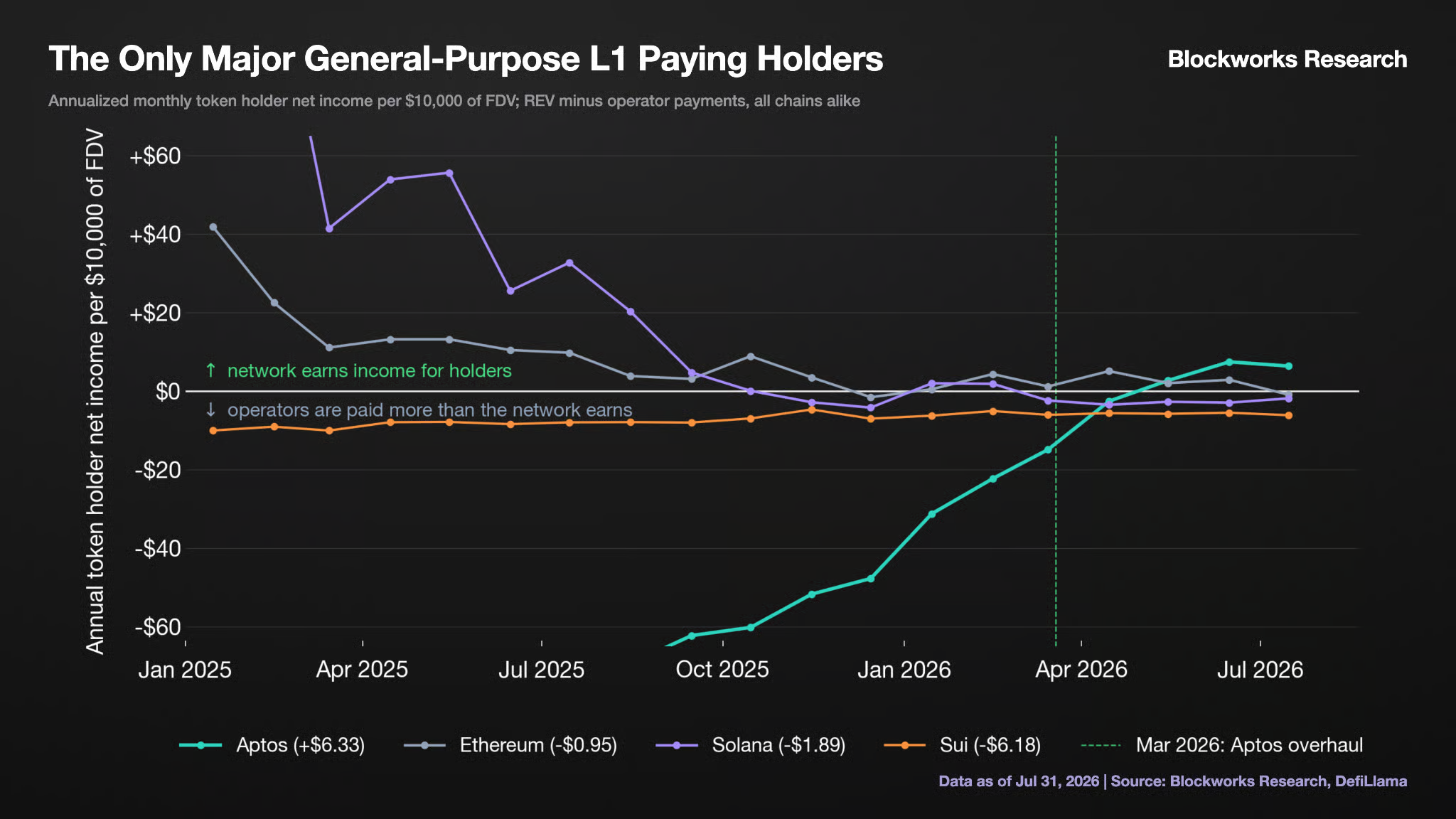
Aptos has reversed from the bottom to the top, with a turnaround exceeding $110.
Comparison scope explanation: Limited to truly universal platform public chains. Hyperliquid is essentially an application chain, BNB is deeply tied to Binance, TRON is more like a stablecoin-specific chain, and Avalanche has a multi-subnet architecture rather than a single execution environment—excluding these allows for a clean comparison of Aptos with Ethereum, Solana, Sui, and other similar projects.
Four Reforms, One Turning Point
From February 19 to March 19, Aptos implemented four core changes:
- Gas prices directly increased by 10 times.
- Staking rewards halved, fixed at 2.6%.
- Total supply hard cap locked at 2.1 billion tokens.
- 2.1 million tokens permanently locked.
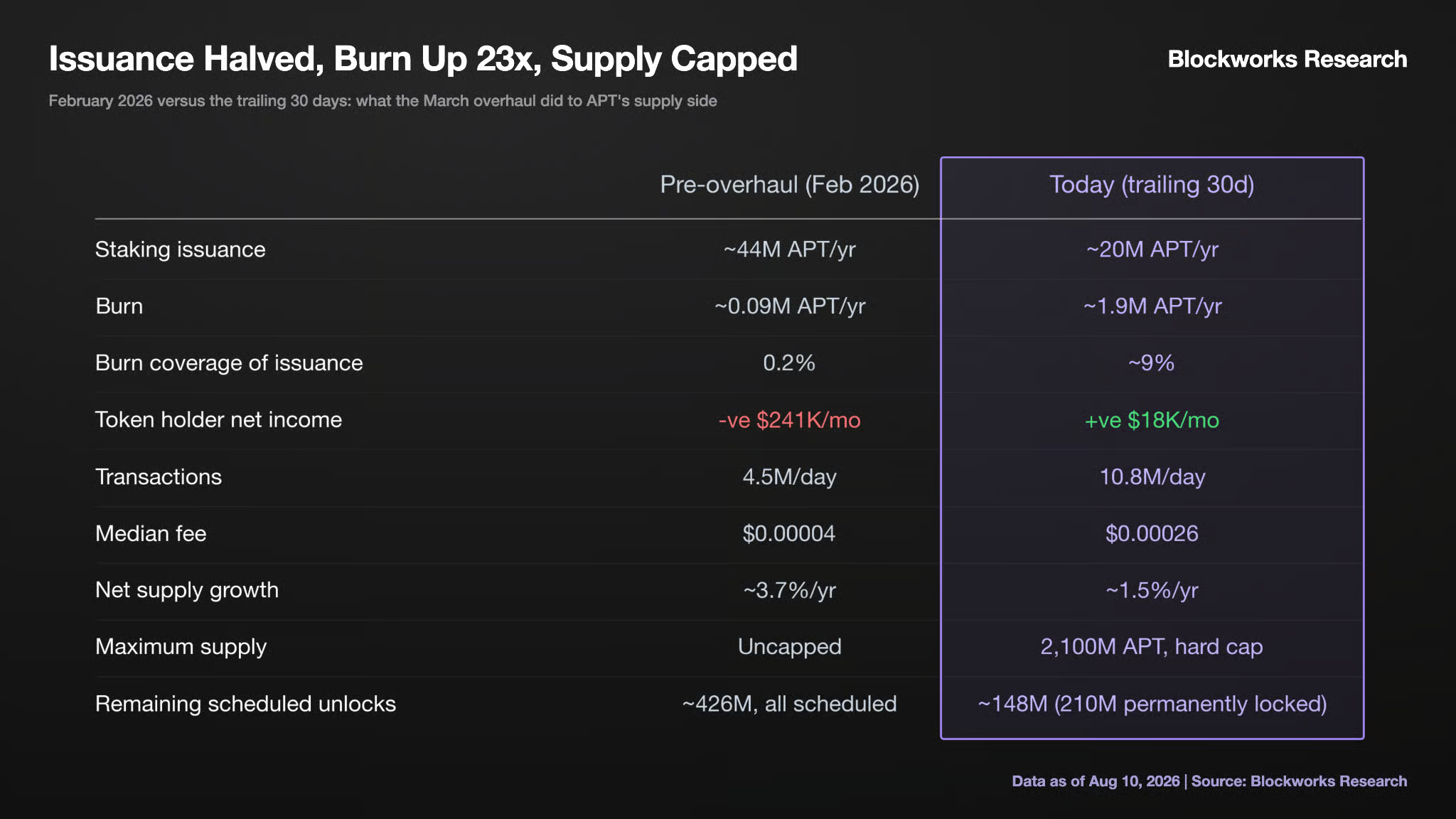
The results were very direct:
- Network revenue surged approximately 16 times.
- Operator commissions were halved simultaneously.
- Both income and expenditure sides improved concurrently.
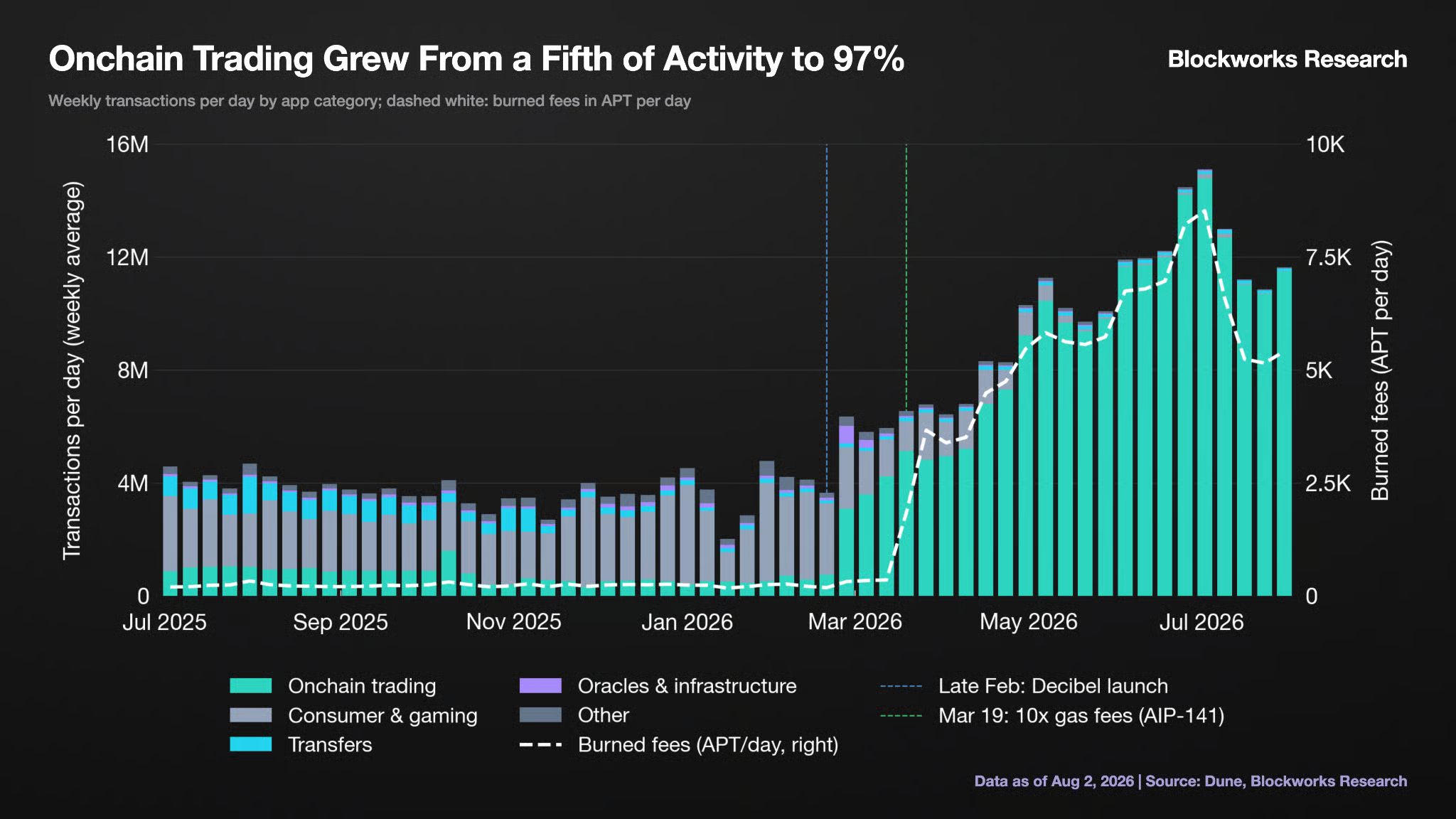
More notably, demand did not shrink due to price increases—rather, it continued to grow. Daily transaction volume climbed from about 4.5 million to over 12 million, with transaction fees now 10 times the original amount.
The Real Burning Engine: Decibel
Decibel—a full-chain perpetual contract order book—contributed to the vast majority of transaction numbers on the Aptos chain.
Key mechanism: Conducting $1 worth of trades through the full-chain order book burns about 50 times more APT compared to exchanging $1 in a standard liquidity pool. The reason is simple—every quote, cancellation, and execution is an independent transaction that requires Gas fees.
Because of this, Decibel contributes to over half of Aptos's transaction value but accounts for 97% of transaction numbers. A full-chain CLOB (central limit order book) is only economically viable at the current fee levels and throughput of Aptos.
Next Indicator: Burn / Issue Ratio
Besides THNI turning positive, a more noteworthy long-term tracking metric is the "proportion of burn to issuance."
- January this year: 0.2%
- Now: Nearly 10%
This number is crucial because token issuance itself leads to ongoing selling pressure—validators may sell rewards to cover operational costs, and the foundation may also sell rewards to realize profits.
Now that the reward rate has been fixed, large-scale unlocking pressure will significantly decrease after October, while Decibel's product roadmap continues to expand. On-chain activity is expected to continue to amplify, and value capture will further strengthen.
免责声明:本文章仅代表作者个人观点,不代表本平台的立场和观点。本文章仅供信息分享,不构成对任何人的任何投资建议。用户与作者之间的任何争议,与本平台无关。如网页中刊载的文章或图片涉及侵权,请提供相关的权利证明和身份证明发送邮件到support@aicoin.com,本平台相关工作人员将会进行核查。


