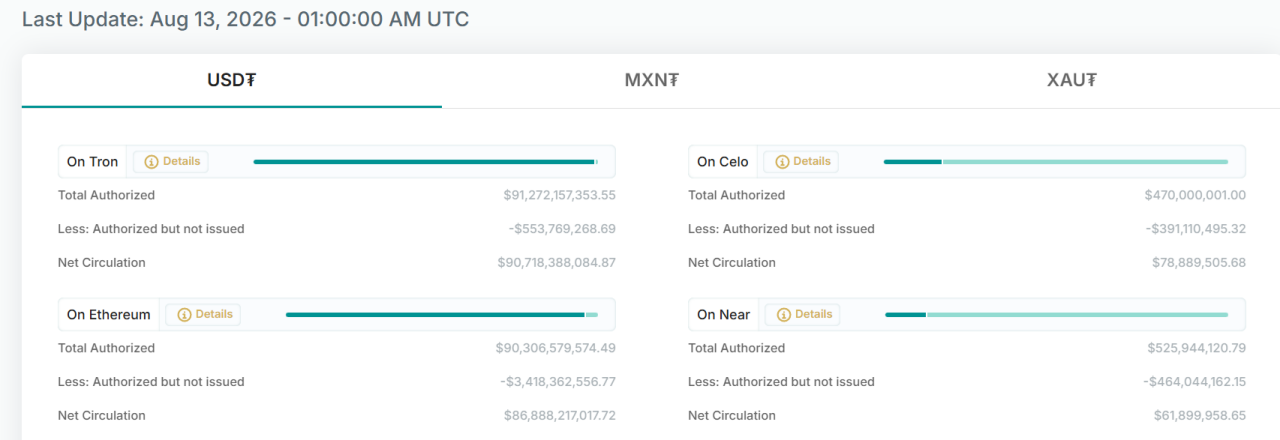
According to official data from Tether, as of August 13, 2026, the TRON network saw an additional issuance of 1 billion USD in USDT, reaching a total of 91.2 billion USD. The issuance once again surpassed the USDT issuance on the Ethereum network (90.3 billion USD), maintaining the top position across all blockchain networks. This historic milestone further solidifies TRON's dominance in the stablecoin space and reaffirms the continuous attraction of low-cost, high-efficiency settlement networks for global stablecoin funds.
From trading assets to settlement tools, the use cases of TRC20-USDT are continuously expanding
The growth of USDT on the TRON chain primarily stems from sustainable real usage demand. As of August 2026, the issuance of TRC20-USDT on the TRON network officially broke 91.2 billion USD, setting a historical record with an increase of approximately 10 billion USDT within the year, and the number of holding accounts has reached about 75.47 million. This scale allows TRON to long-term hold half of the global USDT issuance, accounting for around 50%.
In terms of usage structure, the real payment attributes of TRON are becoming increasingly clear. According to CoinDesk Research data, in the first quarter of 2026, the average daily active accounts on the TRON network rose to about 3.2 million, setting a new quarterly high. At the same time, among retail USDT transfers under 1,000 USD, TRON's share is about 50%, maintaining a dominant position in the range of 1,000 to 100,000 USD, continually reinforcing its "friendly" public chain positioning for retail and small to medium-sized settlements. This indicates that one of the primary uses of USDT on TRON is the actual value transfer between wallets.
Observing over a longer period, the on-chain transfer and settlement scale corroborate this judgement. Research report from Messari indicates that in the first quarter of 2026, the USDT transfer amount processed by the TRON network reached approximately 2.04 trillion USD, with a total of about 950 million transactions across the network. Daily transactions increased from about 10.2 million in the previous quarter to approximately 10.9 million, also setting a new quarterly record; since 2026, TRON has led all public chains with an annual USDT transfer volume of about 4.2 trillion USD.
What it depicts is not a ledger within a single trading platform but a scenario where massive wallets complete value transfers directly on a public blockchain.
Specifically, an overseas worker can send USDT to their family's wallet, which can be exchanged for local currency by the recipient; a cross-border e-commerce merchant can settle with suppliers using USDT, reducing the impact of bank operating hours and intermediary processes; freelancers can receive payouts from overseas clients and confirm on-chain arrival within minutes; digital asset service providers can allocate liquidity between exchanges, custodial wallets, and market-making accounts. The amounts and purposes of different cases vary, but the common demand is for quick arrival, transparent fees, and 24/7 operation.
Additionally, in a market environment with significant fluctuations in network fees, cost stability is especially important. Since TRON reduced the energy price by about 60% through Governance Proposal No. 104 in August 2025, the costs for on-chain transfers have further decreased.
Ecological access and security collaboration advance, continuously improving stablecoin infrastructure
The long-term development of stablecoin networks depends not only on issuance volume but also on entry coverage, liquidity depth, developer support, and risk governance capability. TRON is synchronously building infrastructure from these directions.
In terms of application entry, the extensive support for TRC20-USDT from wallets, trading platforms, payment service providers, and DeFi protocols enables users to conveniently recharge, withdraw, transfer, exchange, and interact on-chain. As new stablecoins such as USDD enter the TRON ecosystem, the types of stablecoin assets are further enriched; protocols such as JustLend DAO extend the use of stablecoins to collateral and lending scenarios. Stablecoins are gradually transitioning from a single transfer tool to the foundational assets of on-chain financial activities.
In terms of user experience, mechanisms like GasFree attempt to address a common pain point: while new users may hold USDT in their wallet, they may be unable to initiate transactions due to the lack of native tokens. By supporting the payment of related network fees using stablecoins, such solutions help simplify the first-time user process. For merchants, wallets, and payment applications, reducing the understanding bandwidth of users regarding energy and native Gas tokens also facilitates stablecoin services entering broader consumer scenarios.
More importantly, scaling requires synchronization with security governance capability. In September 2024, TRON, Tether, and TRM Labs jointly established the T3 Financial Crime Unit (T3 FCU), combining the visibility of the TRON network, TRM Labs' on-chain intelligence capabilities, and Tether's issuer freezing capabilities, directly collaborating with law enforcement agencies in multiple locations. The typical process is: once law enforcement identifies wallets related to illegal activities, TRM Labs tracks the flow of funds, TRON provides information about capital movement at the network level, and Tether implements freezing at the issuer level.
As of May 2026, the T3 FCU announced it had frozen over 450 million USD in illegal assets globally, covering 23 jurisdictions across five continents. TRM Labs disclosed that this mechanism can complete related disposals within 24 hours of receiving a law enforcement request. The above results reflect that the combination of the transparency of public blockchains and public-private collaboration models can enhance the identification and response efficiency of suspicious funds.
While continuing to lead in the stablecoin settlement field, TRON is accelerating its investment in the new track of artificial intelligence. Launched in April this year, B.AI (Chinese brand name "白 B.AI"), is positioned as "the underlying financial infrastructure of the AI Agent era." This layout, consistent with TRON's deep stablecoin depth and high-frequency, low-cost payment advantages, marks TRON's transition from "the largest stablecoin settlement network in the world" to "the underlying infrastructure of the AI intelligent economy," firmly betting on the long-term trend of AI and Web3 integration.
From leading issuance scale, to continually expanding payment settlement advantages, gradually improving security mechanisms, and actively laying out in the AI field, the competitiveness of USDT on the TRON chain is transitioning from "quantity accumulation" to "quality enhancement."
TRON will continue to optimize network performance and user experience around stablecoin infrastructure, deepen collaboration with issuers, wallets, payment institutions, and security analysis institutions, providing global users with more efficient, safer, and more inclusive digital value circulation services.
免责声明:本文章仅代表作者个人观点,不代表本平台的立场和观点。本文章仅供信息分享,不构成对任何人的任何投资建议。用户与作者之间的任何争议,与本平台无关。如网页中刊载的文章或图片涉及侵权,请提供相关的权利证明和身份证明发送邮件到support@aicoin.com,本平台相关工作人员将会进行核查。


