
Author: Nancy, PANews
In the bear market, most crypto projects are struggling to find growth space, with some even forced to exit the market, but Fomo has already climbed into the ranks of leading crypto printing machines.
A small team of only 17 people has raised a total of $94 million over the course of more than a year, transforming a social trading product into a new on-chain trading entry point, even competing with Pump.fun for users. Without the benefits of a bull market, what kind of product-market fit (PMF) has Fomo found, and how is it able to carve out a reverse growth curve in a bear market?
Trading volume surges in weeks, Fomo becomes a new on-chain printing machine
While others are busy preparing for winter, Fomo is speeding up against the trend in the bear market, becoming one of the few new printing machines still rapidly capturing trading revenue, and gradually growing into a new on-chain trading entry point.
Data from Dune shows that as of August 12, Fomo has accumulated about 28.644 million transactions, with a total trading volume exceeding $4.69 billion, generating more than $31.79 million in trading fees.
Looking at the timeline, Fomo's real growth inflection point appeared at the end of the second quarter of 2026, with explosive growth almost completed within weeks. Prior to this, its weekly trading volume was mainly maintained at millions to tens of millions of dollars; after entering July of this year, trading volume began to significantly increase, quickly jumping to hundreds of millions of dollars. In the latest trading week, Fomo's weekly trading volume has exceeded $550 million, once again setting a historic high.
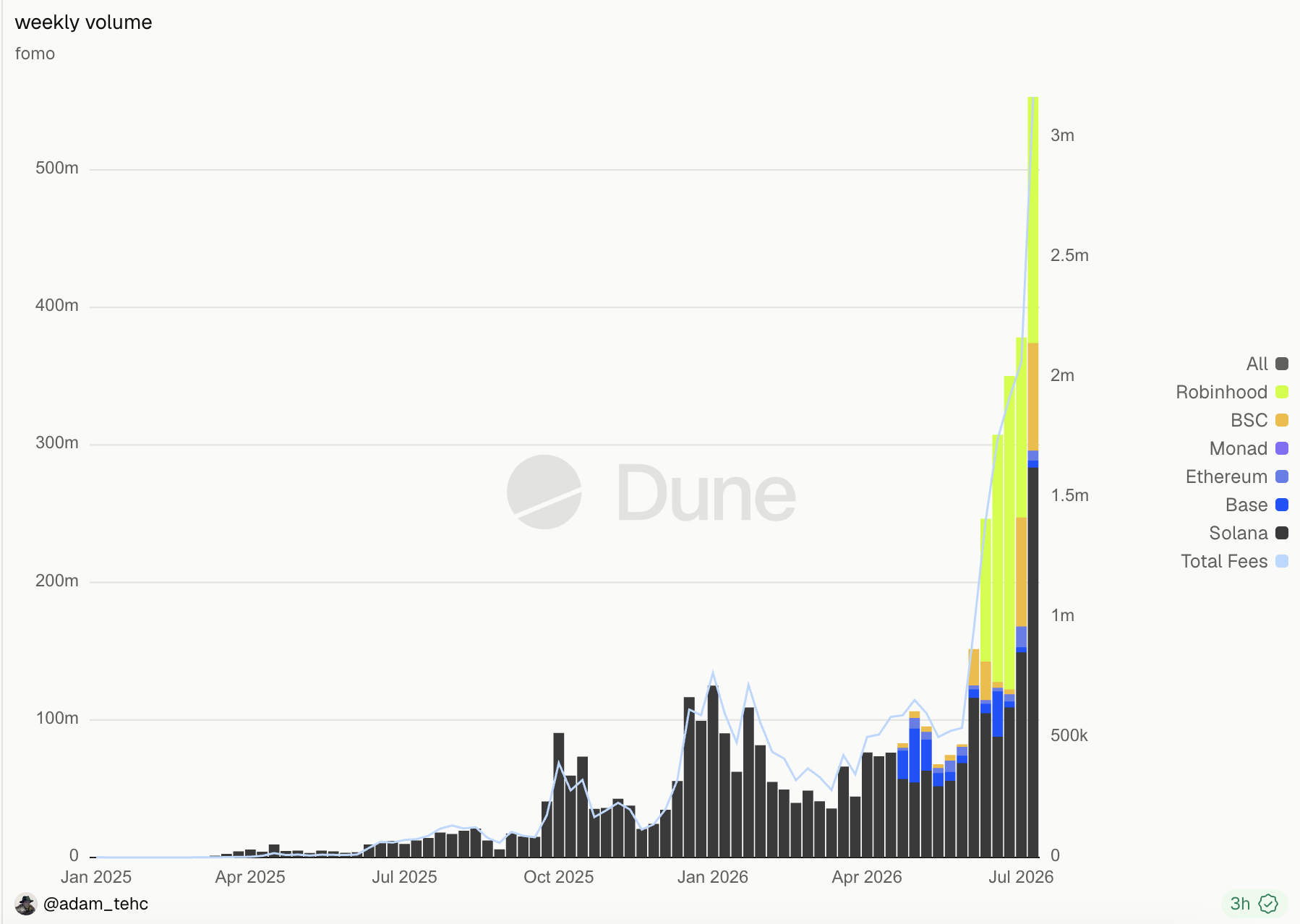
This round of growth did not come solely from trading activities on a single chain. Before May 2026, Solana almost supported all of Fomo's trading volume; afterward, Fomo's trading activities gradually expanded to networks like Base, BNB Chain, and Ethereum, but these chains made relatively limited contributions to overall trading volume increases.
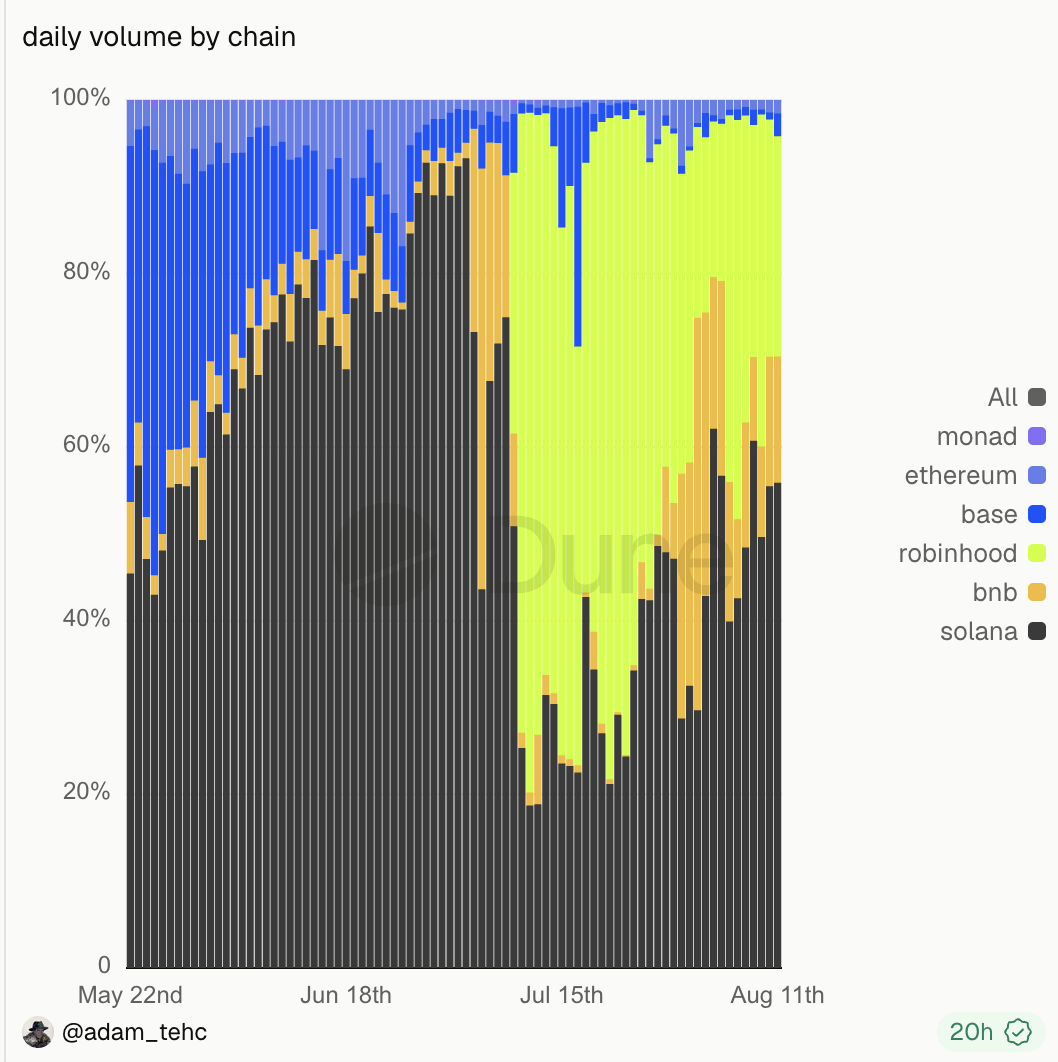
What truly drove Fomo's explosive growth was the rapid influx of new trading traffic following the launch of the Robinhood Chain mainnet, which became the main force pushing the platform's trading volume to break historical highs. "On the Robinhood Chain, one in every two active wallets comes from Fomo,” revealed Fomo co-founder Se Yong Park. In just the latest week, the Robinhood Chain contributed about 32.4% of the trading volume, reaching as high as 64.8% at one point.
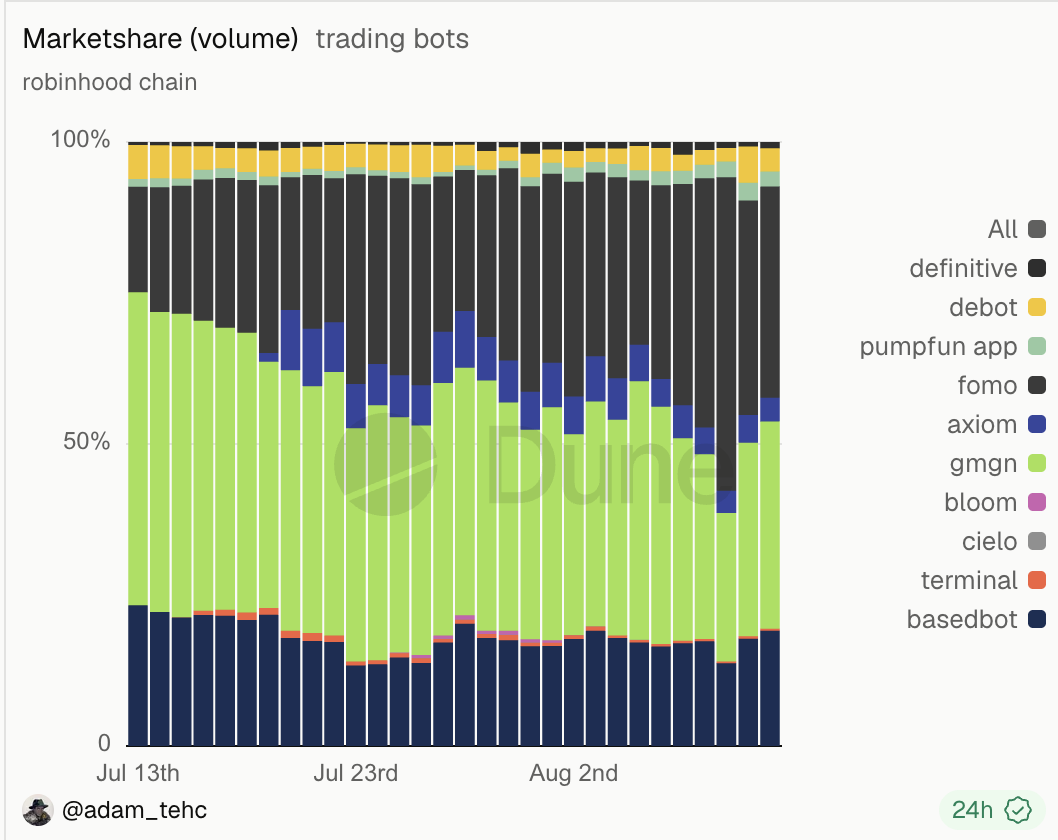
It is also worth noting that within the Robinhood Chain ecosystem, Fomo's traffic advantage is even more pronounced. Data from Dune shows that as of August 11, Fomo's trading volume share among all trading Bots on the Robinhood Chain reached 35%, and it is also the platform with the highest number of daily active wallets, accounting for over 92.9% of the entire Robinhood Chain.
However, Solana has recently made a comeback to become Fomo's largest traffic platform, now contributing about 51.2% of the trading volume. Interestingly, within the Solana ecosystem, Fomo has also grown to be the largest competitor to the biggest Meme launch platform, Pump.fun. Recently, the two parties have even started a more direct "commercial war," with Pump.fun reportedly offering high prices to compete for Fomo users and attempting to lock in traffic through exclusive agreements, while launching social trading-related features similar to Fomo. This indirectly indicates that Fomo is no longer just a simple trading tool, but has become a competitive on-chain trading entry point.
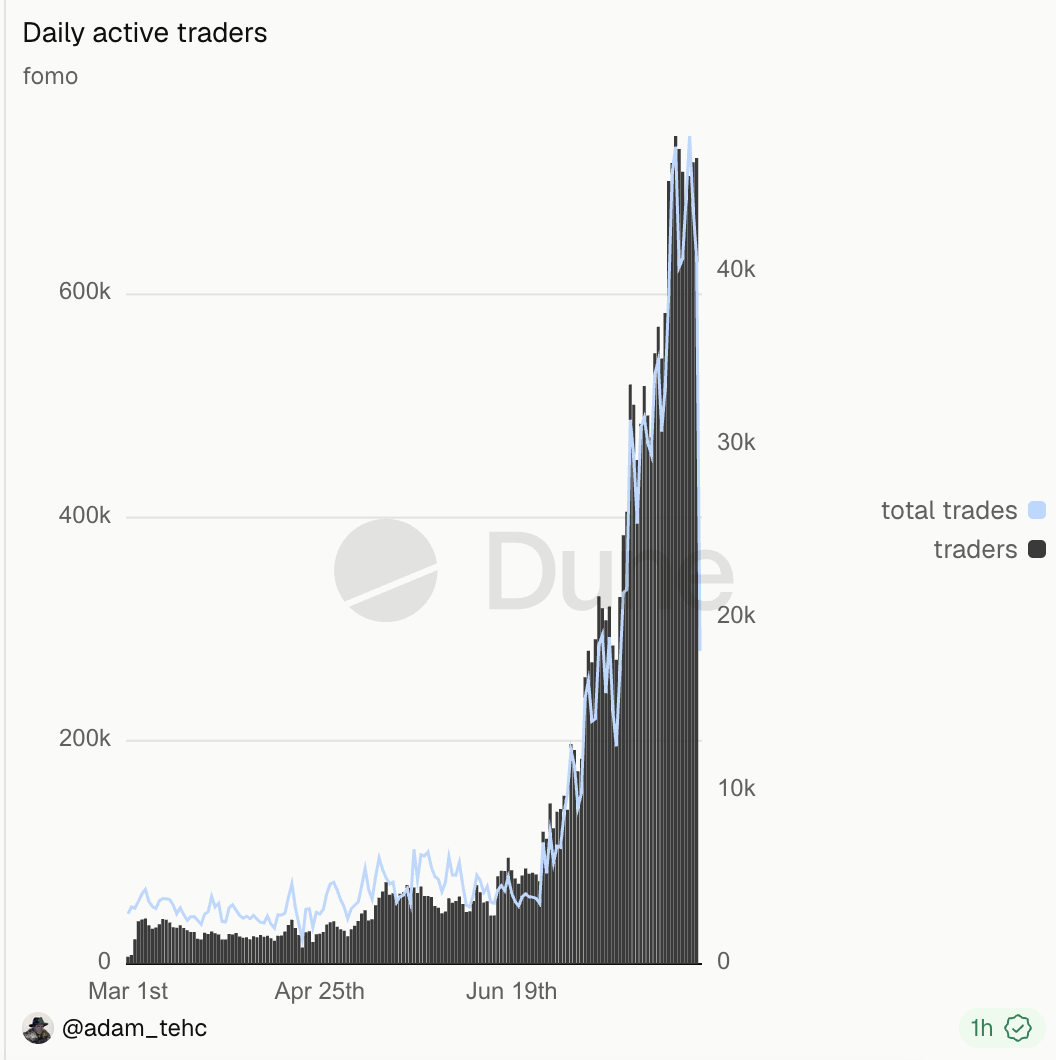
Beyond trading volume, Fomo's user growth has also been rapid, with the number of weekly traders increasing tenfold over the past few months. Data from Dune shows that before July of this year, Fomo's daily active traders remained at a scale of thousands, with relatively slow growth; but with the launch of the Robinhood Chain mainnet, user activity quickly entered an explosive phase, with daily active traders rapidly climbing to tens of thousands, with a daily peak nearing 48,000.
After the surge in on-chain activity, Fomo's total fees have also risen correspondingly. Before the second quarter of 2026, Fomo's weekly fees were mostly in the tens to hundreds of thousands of dollars range. As trading volume skyrocketed in July, fee income quickly surged to millions of dollars, reaching approximately $3.17 million in the latest trading week. Recently, Fomo has even entered the top 10 in protocol revenue across the network, surpassing revenue levels of crypto protocols like Hyperliquid, Axiom Pro, and Pump.fun.
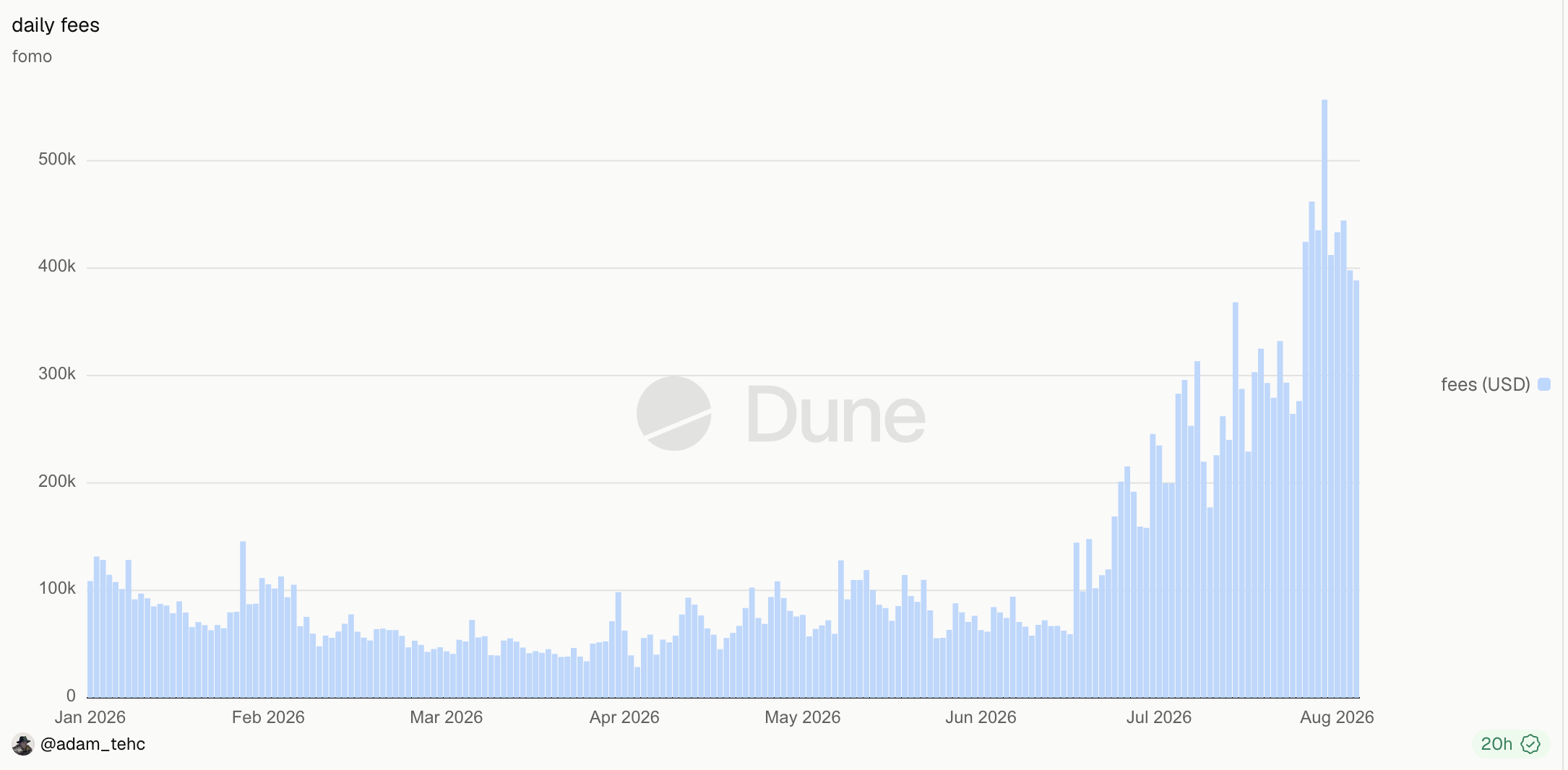
It can be said that Fomo's data explosion comes from leveraging the new ecological cold start traffic brought by the launch of the Robinhood Chain mainnet, while also capturing the sustained high-frequency trading demand of the mature Meme ecology of Solana.
Bear market tests PMF, how does Fomo achieve reverse growth?
In the bear market, hard data often better demonstrate a company's true PMF. In just over a year, Fomo has risen against the tide in a depressed crypto market, not only securing significant financing and rapidly increasing its valuation but also generating growth curves in user growth and product expansion.
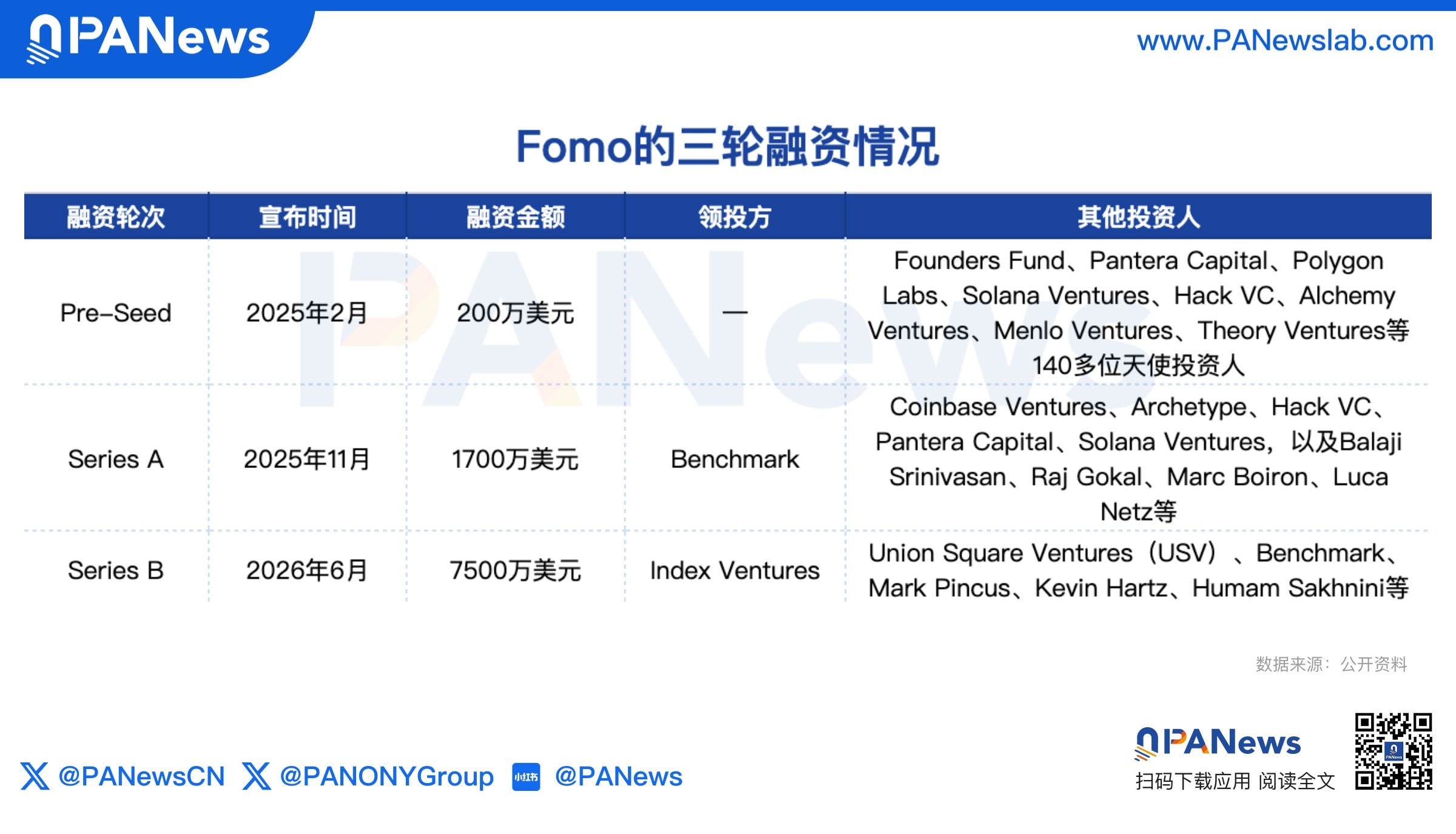
In June of this year, Fomo secured $75 million in Series B funding led by Index Ventures, with participation from Union Square Ventures (USV), Benchmark, and Zynga co-founder Mark Pincus, Discord CEO Humam Sakhnini, Eventbrite co-founder Kevin Hartz, among others. The company's valuation rose to $550 million.
For a crypto consumer startup that has been established for just over a year, this scale of financing alone is already noteworthy. But what is more worth studying is why Fomo is able to expand in a bear market.
Fomo's reverse growth comes first from a team that is highly familiar with trading products and possesses strong execution efficiency. The three co-founders, Paul Erlanger, Se Yong Park, and Prashan Dharmasena, all come from PERP DEX pioneer dYdX. Their past experiences have made them familiar with on-chain trading products and have long observed trader behavior, forming a complementary skill set in product, growth, and engineering capability. More importantly, the team's efficiency in resource use is notable; currently, the Fomo team consists of about 17 people, and in the first eight months after establishment, core members almost did not take salaries while providing non-founder engineers with equity shares usually only available to founding team members, ranging from 2% to 3%. Before the product was fully validated, Fomo did not rely on large-scale investments for growth but instead advanced the product quickly with a small team and low costs, along with incentive mechanisms tied to value, making this capital efficiency a significant advantage for entrepreneurship in the bear market.
However, the real value of dYdX's experience to Fomo lies not only in the halo of team credentials, but in their practical experiences observing that while on-chain assets and transactions are becoming increasingly enriched, user experience remains rooted in the crypto-native era. In the past, users entering on-chain trading often had to manage wallets, private keys, and mnemonic phrases, and were faced with cross-chain bridges, gas fees, and liquidity fragmentation between multiple chains. For crypto users, these are merely tools to learn, but for mainstream consumers, they represent substantial barriers to entry. Therefore, Fomo did not design the product as a tool for users to learn more about blockchain knowledge, but rather to hide the complexity of blockchain as much as possible in the backend, allowing the trading experience to approach that of a regular consumer app.
Users can register directly using Google or Apple ID, without needing a mnemonic phrase or paying gas fees, and it supports deposits via Apple Pay, debit card, or cryptocurrency, lowering the entry barrier. Se Yong also explained in an interview that to avoid creating a sense of unfamiliarity for users, the platform does not use SOL, ETH, or other crypto assets as account valuation units, but instead displays directly in cash balance in USD. “If a regular person sees $100 becoming $98.52 (due to fluctuations in the base token price), they might directly think the platform stole their money.” In his view, once users have doubts about their fund safety, trust is hard to rebuild.
This decryption-focused product design has indeed led to the conversion of users from outside the crypto sphere. Data disclosed in June 2026 indicates that over 68,000 users have completed their first crypto purchases through Apple Pay. Index Ventures partner Julia Andre has also admitted that investing in Fomo was not because it is a crypto company, but because "on-chain trading is simply too difficult." This explains why Fomo has still been able to find opportunities in a bear market.
However, lowering the trading barrier only addresses how users enter. For a consumer-grade product, the real difficulty lies in why users choose to stay and why they are willing to actively share the product with others. Fomo's answer is to turn the transaction itself into a form of social content.
The team believes that trading is essentially a social behavior, and there is severe fragmentation in the information within existing communities and signal sources, with quality varying widely. Se Yong revealed in a recent interview that Fomo's core vision is to become the social graph of finance, thus the product must be seamless, social, and engaging.
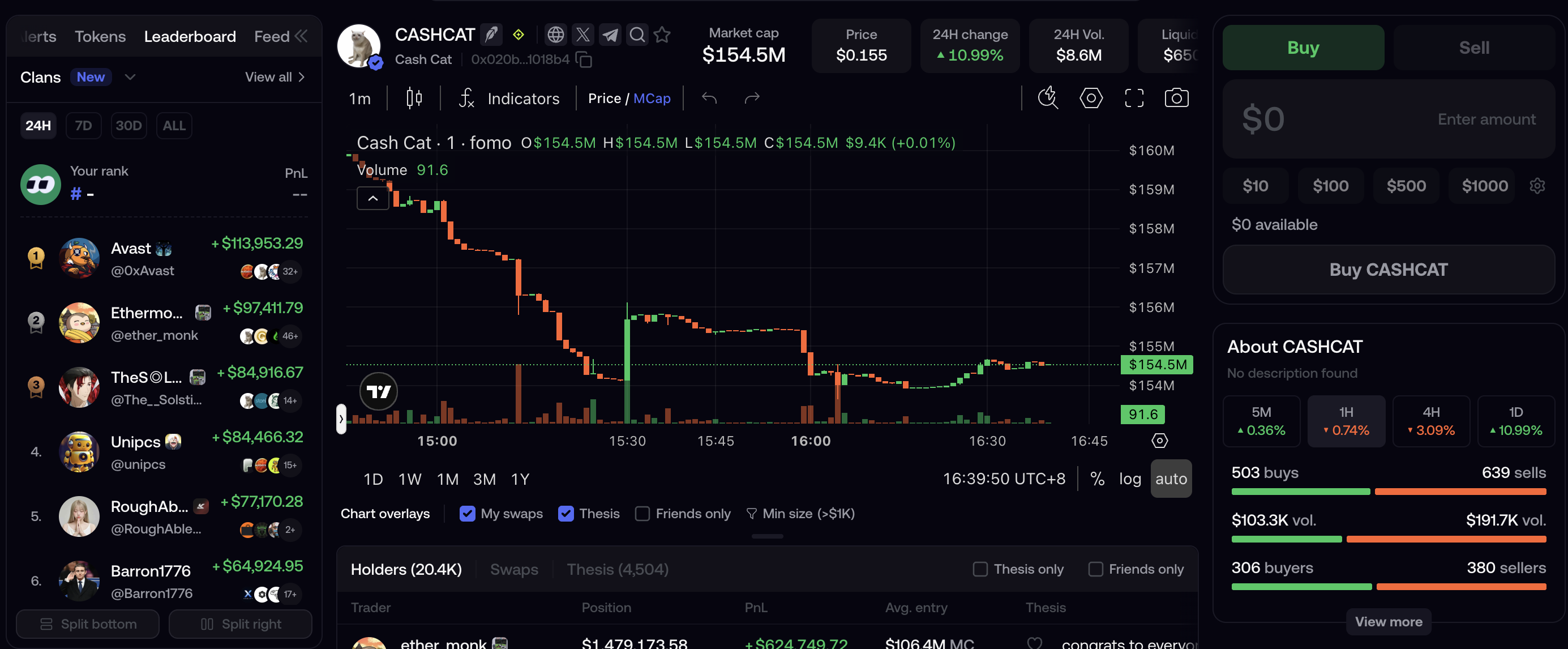
Fomo transforms the monotonous trading experience into scrollable, followable, and discussable social content within the product, which includes real-time feeds displaying others' buy and sell actions and profits and losses, leaderboards showcasing top traders on a periodic basis, and the ability to follow and receive real-time notifications, with personal profiles transparently displaying holdings and history, along with charts overlaying buy and sell points for viewing trading logic. When trading itself becomes content with viral spread potential, it inherently generates FOMO emotions and the desire to share, providing a lower-cost entry point for acquiring new users, especially novices.
However, the hardest part of consumer-grade products is often not just creating the product but achieving a successful cold start. Fomo realized that relying solely on advertisements or traditional channels to acquire users could be extremely costly for a consumer-grade product that has not yet formed a network effect. Therefore, it designed community financing itself as part of its cold start strategy. Paul Erlanger has made it clear that the team hopes to use fundraising to "solve cold start problems and create distribution channels."
In the first round of financing, Fomo laid out a “dream investor list” of about 200 people, leveraging the connections built during their time at dYdX, ultimately securing participation from over 140 angel investors, raising a total of $2 million. These investors are not merely traditional funders; they include founders and executives of top protocols, well-known VCs, professional traders, market makers, and industry operators, providing Fomo with a potential user and distribution network.
During the A round funding of $17 million, Fomo continued this strategy, with Benchmark as the only institutional investor, while the rest still came from existing and newly added angel investors. For a consumer-grade product that needs to quickly establish network effects, an investor who understands the product, is willing to use it, and proactively disseminates it is often more valuable than just an extra source of funding.
Furthermore, Fomo's ability to find growth space in a bear market has a practical reason: when the vast majority of crypto assets lose heat collectively and trading willingness decreases, Meme coins still maintain high activity and virality. Such assets are also highly dependent on attention, social consensus, and instantaneous emotions, making them naturally suitable for Fomo's social discovery model, thus opening up independent growth spaces. However, Fomo's ambition does not stop there; its products have expanded to perpetual contracts (Perps) and plan to continue covering stocks, derivatives, prediction markets, and more assets.
Bull markets can amplify stories, but bear markets can better test a product's integrity. Fomo is proving with tangible reverse growth that even in the absence of overall market momentum, there are still opportunities to find growth spaces by genuinely lowering user barriers, improving trading experiences, and expanding trading scenarios.
Of course, this round of growth was not achieved overnight. After the first round of financing was completed, Fomo experienced several months of silence, with user numbers failing to break through 140. Se Yong revealed that the turning point came from a group of early users who used the product almost daily and continuously provided feedback to the team, helping to iterate the product continuously. This also made the team realize that instead of rushing for user scale, it is better to properly serve the early small group of users and genuinely listen to their real needs.
However, whether this rapid growth can be sustained, and whether Fomo can convert short-term traffic into long-term users and stable revenue still requires time to verify.
免责声明:本文章仅代表作者个人观点,不代表本平台的立场和观点。本文章仅供信息分享,不构成对任何人的任何投资建议。用户与作者之间的任何争议,与本平台无关。如网页中刊载的文章或图片涉及侵权,请提供相关的权利证明和身份证明发送邮件到support@aicoin.com,本平台相关工作人员将会进行核查。


