Author: Observations from the Details
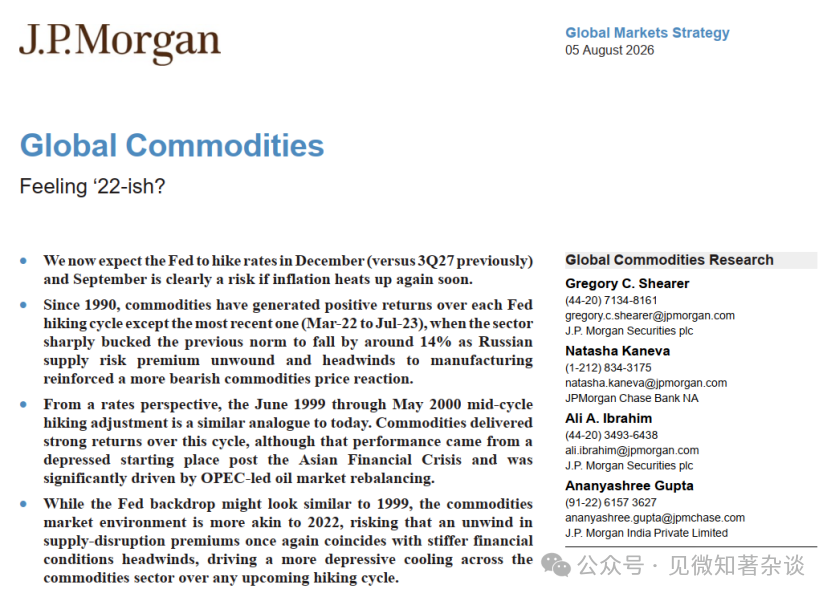
Currently, Morgan Stanley expects the Federal Reserve to raise interest rates in December (previously anticipated in Q3 2027). If inflation quickly heats up again, there is clearly a risk of rate hikes in September.
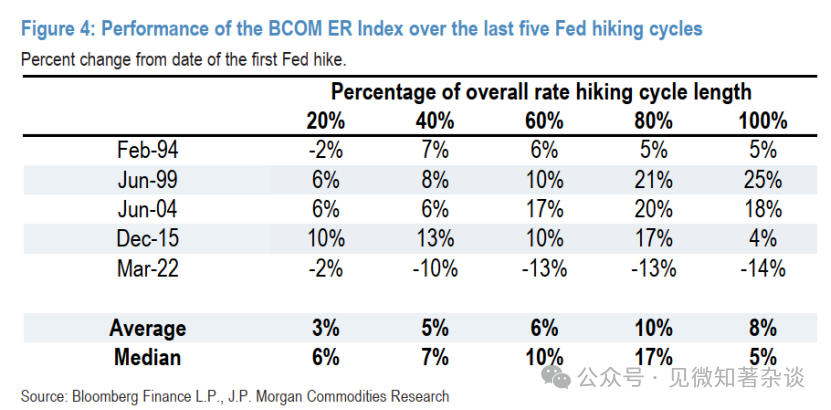
Since 1990, commodities have produced positive returns in every Fed rate hiking cycle, except for the most recent one (from March 2022 to July 2023).
During that cycle, the sector significantly deviated from the previous norm, dropping by about 14%, due to the easing of the risk premium from Russian supply disruptions and increasing negative factors facing manufacturing that exacerbated the bearish response in commodity prices.
From an interest rate perspective, the mid-cycle rate hike adjustment from June 1999 to May 2000 is similar to the current situation.
Commodities performed strongly during this cycle, despite that performance starting from a low point after the Asian financial crisis, propelled mainly by a rebalancing of the oil market dominated by OPEC.
While the Fed's backdrop may seem like it was in 1999, the commodity market environment is more akin to 2022, underlining the risks faced:
The re-easing of supply disruption premiums may again coincide with harsher negative factors in the financial environment, thus driving the commodity sector into a more subdued cooling during any upcoming rate hike cycles.
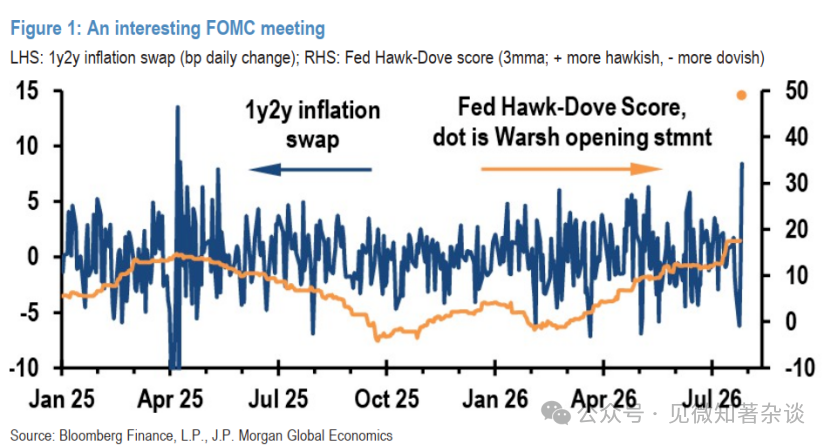
An Interesting FOMC Meeting.
Last Wednesday, the FOMC kept interest rates unchanged, aligning with our economists' expectations, although three hawkish members dissenting, one more than anticipated, with Kashkari's vote against being a moderate surprise.
Although in our natural language processing (NLP), Chairman Warsh's prepared remarks were somewhat hawkish, he failed to endorse a clear target, which undermined his credibility in combating inflation (Figure 1).
This, coupled with comments regarding the Fed's tools for fighting inflation, accelerated the steepening of distortions in the U.S. Treasury curve, while the mid-term inflation breakeven rates rose sharply, which is an unusual situation after the FOMC meeting.
Figure 1: An Interesting FOMC Meeting
The first Fed rate hike is currently expected in 2026. Overall, as the committee tends to be more hawkish, the FOMC may now face market pressure, reflecting doubts about whether Warsh's tough inflation rhetoric will translate into action.
This adds urgency for other committee members to take action to fulfill their mission and reinforces our economists' view that the Fed is moving towards rate hikes, with the risk of advance action also increasing.
Consequently, they have shifted their expectations for the next rate hike from the second half of 2027 to December of this year, emphasizing that if inflation quickly heats up again, there is evidently a risk in September. This adjustment reflects, rather than market "pressure" on the Fed, another challenge prompting the Fed to act to maintain its credibility.
Commodities Have Delivered Strong Returns in Previous Rate Hike Cycles... Until 2022
Since 1990, the Fed has initiated five rate hiking cycles (February 1994, June 1999, June 2004, December 2015, and March 2022), each lasting approximately one to three years (Figure 2).
Commodities have produced positive returns during these Fed rate hiking cycles, except for the most recent one (from March 2022 to July 2023), where the sector significantly contradicted previous norms by dropping about 14% during the duration of the rate hike cycle (Figures 3 and 4).
Nonetheless, even during the last rate hike cycle, the BCOM ER index followed the previous pattern of rising relatively early during the rate hike cycle, after which its performance diverged significantly from history.
Figure 2: Bloomberg Commodity (BCOM) ER Index vs. U.S. Federal Funds Target Rate (Upper Bound)
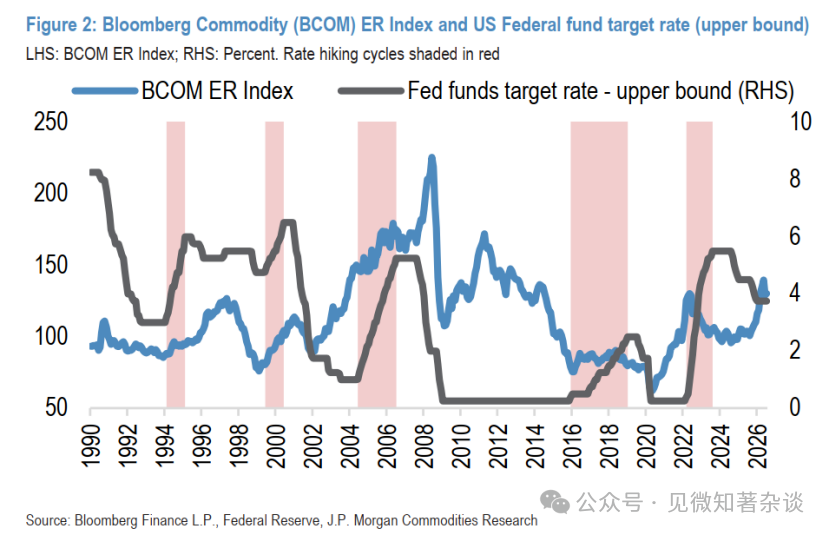
Figure 3: Performance of BCOM ER Index in the Last Five Fed Rate Hike Cycles
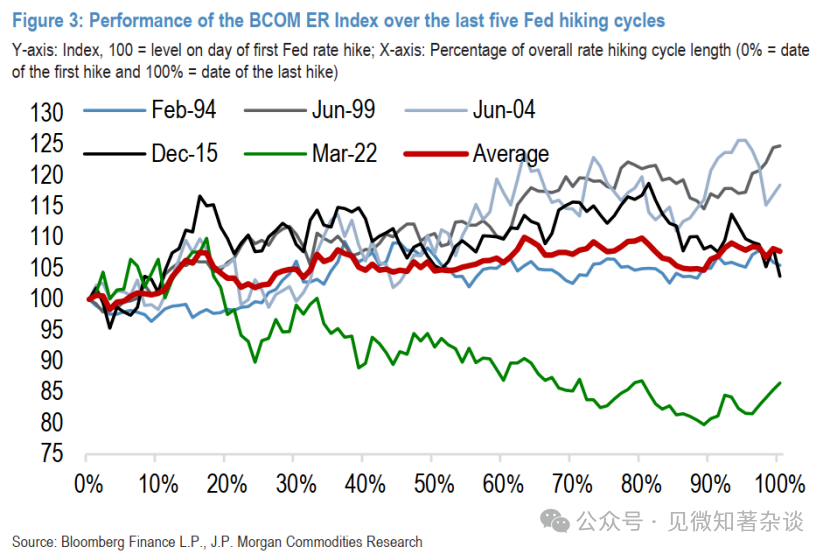
Figure 4: Performance of BCOM ER Index in the Last Five Fed Rate Hike Cycles
How to Explain the Divergence in Performance in 2022/23?
In past analyses, we inferred that the strong ongoing returns for commodities during Fed rate hiking cycles may have been driven by supportive macroeconomic fundamentals that simultaneously affected the Fed's rate policy.
In other words, the Fed typically begins rate hiking cycles during periods of sustained, strong economic growth, leading to a return of inflationary pressures and a drop in unemployment rates, macro factors that also coincide with robust demand for commodities, where supply struggles to keep up, leading to inventory drawdowns to low levels.
However, the rate hiking cycle of 2022/23 is different.
Arriving relatively early after the recession triggered by COVID-19, the Fed found itself far behind the curve due to initial inflation pressures from pandemic-related supply chain disruptions and crisis-driven fiscal and monetary stimulus measures, which were exacerbated by soaring energy, fertilizer, and food prices following Russia's invasion of Ukraine in early 2022.
As a result, supply-side pressures played an outsized role in prompting the Fed to raise rates rapidly by more than five percentage points.
This also meant that the commodities sector entered this most recent rate hike cycle from abnormally high levels.
Concerns about disruptions to Russian commodity shipping due to sanctions drove the BCOM ER index up 25% in Q1 2022.
However, overall, supply chains proved to be more resilient than initially feared, and by mid-2022 (even earlier for certain commodities), this supply risk premium began to erode significantly.
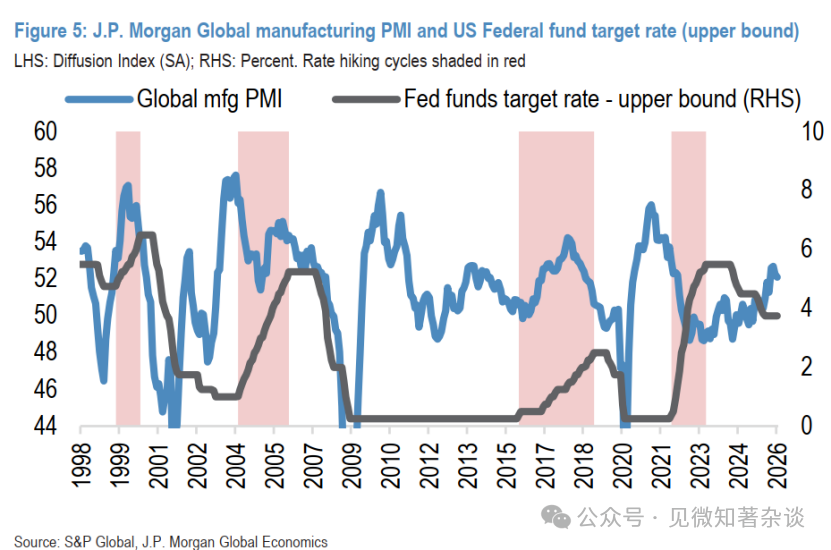
Since then, although the fears of recession indicated by the inverted Treasury curve never materialized, global manufacturing PMI did drop below 50 in September 2022 (and remained in contraction territory throughout 2023), dragging broader industrial demand lower and exacerbating the more bearish commodity price trends during the 2022/23 rate hike cycle (Figure 5).
Figure 5: J.P. Morgan Global Manufacturing PMI vs. U.S. Federal Funds Target Rate (Upper Bound)
While the rate hiking cycle may seem like 1999, the commodity response risks replaying the 2022 script
As reflected by last week's hawkish dissent, given the tightening labor market and resilient inflation, Fed members have questioned the restrictiveness of the current policy stance.
According to our U.S. rates strategist, various measures of the actual neutral rate indicate that in the absence of reduced inflation, a 50-100 basis point tightening of the policy rate is needed for mid-cycle adjustments to re-establish a restrictive stance.
In their view, this makes the mid-cycle rate hiking adjustment from June 1999 to May 2000 (particularly the tightening phase from November 1999 to May 2000) a relevant analogy to the current situation.
1999/2000 Saw Strong Commodity Returns, But the Commodity Market Setup Looks Very Different.
The 1999/2000 rate hiking cycle yielded the strongest cumulative commodity returns in our admittedly small sample, as the BCOM ER rose by 25% during the rate hiking cycle, driven by a significant increase of over 70% in the BCOM energy sub-index.
However, context is important.
First, the broad commodity sector was severely depressed as it entered this rate hiking cycle.
In the first half of 1999, following the demand and risk sentiment hits from the Asian financial crisis/Russian financial crisis/Long-Term Capital Management (LTCM) collapse, the BCOM stabilized at a level about 35-40% lower than its peak in 1997.
Second, and equally significant, the oversupply and depressed prices led OPEC and participating non-OPEC countries to commit to significant output cuts in early 1998 and 1999.
This substantial outperformance of commodities (mainly driven by the rebound in energy prices) can largely be attributed to a substantial rebalancing of the oil market under stronger supply discipline.
With this historical context, while the Fed's backdrop may appear like 1999, the commodity market environment is more similar to 2022.
The current renewed inflation pressure coincides with significant supply chain disruptions, as shipping through the Strait of Hormuz remains impeded.
Thus, with rising energy prices and production costs across the entire sector, the BCOM index overall remains close to historical highs from Q1 2022, rather than entering this rate hike cycle from a depressed starting point.
Therefore, while any upcoming rate hiking cycle may be much smaller in magnitude than that of 2022/23 (when rates moved initially by 5 percentage points from the lower bound), the risks remain:
The re-easing of supply disruption premiums may again intersect with harsher negative factors in the financial environment, thus driving the commodity sector into a more constrained cooling during any upcoming rate hike cycles.
In this context, the micro fundamentals and the specific sensitivities of each sector to interest rates will be critical for the remainder of 2026:
· Energy:
The flow through the Strait of Hormuz and Chinese oil import demand may outweigh the impacts of interest rates.
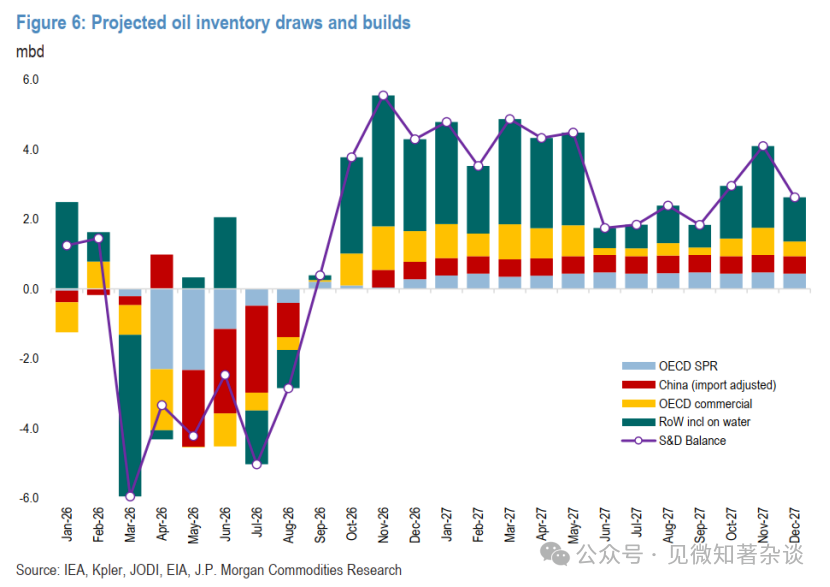
Our bearish baseline forecast for oil over the next 12 months assumes that Middle Eastern supply gradually recovers during the remainder of 2026, with Brent crude prices averaging $80/barrel in Q4 2026, before prices fall to an average of $63/barrel when oversupply returns in 2027.
That said, this forecast is highly dependent on the recovery rate of Strait of Hormuz flows and eventual inventory normalization (Figure 6).
Even in the event of sluggish Chinese imports, for each additional month the conflict extends and the Strait's flow is below expectations, the fair value for Brent crude rises by about $7-8/barrel; if disruptions extend to three months, the monthly average price would rise to about $114/barrel.
Figure 6: Projected Oil Inventory Drawdown and Accumulation
· Precious Metals:
Most exposed to bearish expectations regarding further Fed action.
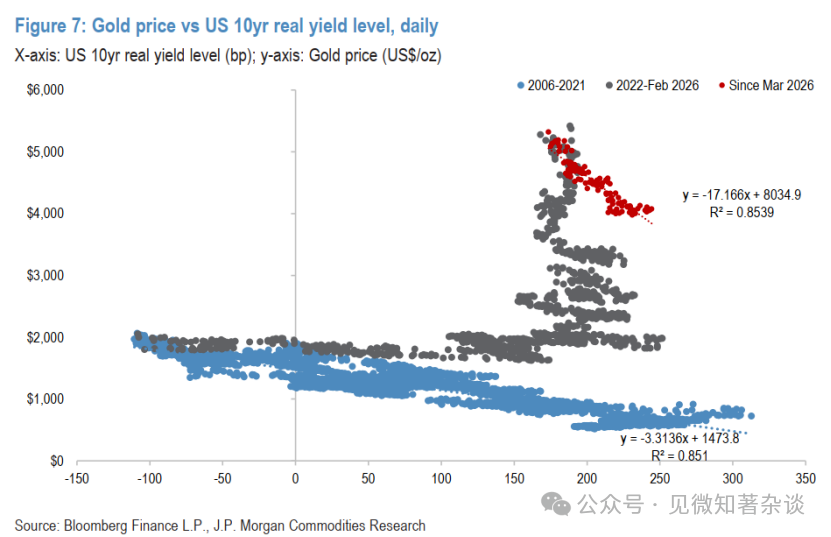
Gold prices currently fluctuate between $4000-4200/ounce, about 25% lower than the peak in January 2026, and have felt significant pressure from higher real yields and shifts towards Fed interest rate hike expectations.
While the sector underperformed during the 2022/23 rate hiking cycle, the final damage was unexpectedly mild considering the aggressiveness of the rate hikes.
However, during that time, prices were significantly supported by emerging, emerging market-driven central bank purchases of gold, which offset ETF outflows sensitive to interest rates, causing a decoupling of gold prices from real yields.
The concern now is that a broader freeze in other demand sectors (with central bank purchases narrowing significantly, retail interest pivoting elsewhere, and weak private bank and physical demand in Asia) has again placed interest rate sensitive ETF demand back in the driver’s seat for gold prices.
Thus, a more abrupt market shift to price in nearly two additional rate hikes that exceed what has been anticipated in the OIS forwards could drive gold prices significantly below $4000/ounce, triggering further technical breakdowns, suggesting potential declines in gold prices to $3500-3600/ounce.
Figure 7: Gold Prices vs. U.S. 10-Year Real Yield Levels, Daily
· Base Metals:
Currently appears robust, but PMI needs to be monitored. While still below the war-induced highs reached earlier this year, industrial metals are near their highest levels since 2022 as we enter the upcoming rate hiking cycle.
This feels reasonable right now.
Global manufacturing PMI climbed above 52 since March, indicating that global manufacturing expansion is currently strong, although there were slight slowdowns in June and July.
On a micro level, LME-registered copper inventories have now dropped below 100,000 tons amid ongoing competition for refined copper between the U.S. and China, and our analysis shows that historically, price behavior below this level has been asymmetrically bullish.
Our baseline forecast for industrial metals in the second half of 2026 remains bullish, with the highest confidence in copper, driven by tight mining supply, low inventories outside the U.S., and bipolar competition for copper units suggest that fundamentals lean upward, pointing towards $15,000/ton.
That said, overall, the Fed's more aggressive rate hiking cycle risks could resonate in a manner similar to 2022 for this sector early next year, particularly if we see supportive manufacturing trends fade as a result, along with the ongoing negative impacts from a potentially strong dollar.
免责声明:本文章仅代表作者个人观点,不代表本平台的立场和观点。本文章仅供信息分享,不构成对任何人的任何投资建议。用户与作者之间的任何争议,与本平台无关。如网页中刊载的文章或图片涉及侵权,请提供相关的权利证明和身份证明发送邮件到support@aicoin.com,本平台相关工作人员将会进行核查。


