In multinational companies with business layouts in Southeast Asia, Europe, and North America, the finance manager's Monday morning typically starts like this: before making any business decisions, she needs to manually log into the backends to confirm balances across 6 currencies and 11 local bank accounts; verify settlement data from 3 payment gateways over the past week; and continue to track a cross-border remittance that has been stuck in the correspondent bank's clearing network for 4 days. Subsequently, she also needs to estimate whether the liquidity of the Singapore entity is sufficient to pay this week's supplier invoices or if funds need to be allocated from the Hong Kong account first.
This is her daily routine, repeating every week. The finance teams of most globalized enterprises silently accept this as the inevitable cost of expanding into international markets. However, this predicament fundamentally stems from a lack of strategic planning in financial infrastructure while expanding into a single market step by step—it creates a vast but fragmented financial landscape without a guiding navigation map.
The "Invisible Tax" of Global Expansion: The Real Cost of a Fragmented Funding Structure
As companies turn towards internationalization, each decision at the moment seems extremely rational: opening local bank accounts to receive local funds, connecting regional payment gateways to serve local customers, binding e-wallets to handle payment transactions. Viewed in isolation, each decision is flawless, but their negative effects accumulate over time.
When businesses cross three or four markets, the finance team no longer manages a smoothly operating funding center but rather a patchwork of accounts. This fragmented structure incurs three types of hidden costs that rarely appear as independent accounting items but continuously erode the company's gross margins and decision-making efficiency—these are the three most fatal blind spots on the uncharted map:
- Visibility Gap: When funds are scattered across different financial institutions, currencies, and platforms, no one in the organization can confidently say at any point in time, “How much money do we have right now? Where exactly is it?” Financial reports are always lagging, forcing companies to make “today’s decisions” based on “yesterday’s data.”
- Liquidity Trap: Funds without real-time monitoring and routing become idle capital. Balances sitting in Malaysian Ringgit accounts cannot directly offset funding gaps in U.S. dollars. Without a proactive gathering and routing mechanism, even if a company appears to be capital ample on paper, its actual capital efficiency remains low.
- FX Friction: Every unnecessary currency conversion consumes profits. When U.S. dollars collected from a U.S. platform are automatically converted to Hong Kong dollars, then to Singapore dollars, and finally exchanged back to U.S. dollars to pay suppliers, the layering of exchange rate differences and fees compounds. Once scaled, this is no longer a minor decimal error but a structural drag on the company’s profit margin.
Why Existing Tools Can't Remedy the Pain Points?
The DNA of traditional Enterprise Resource Planning (ERP) systems is "accounting" rather than "funding dispatch." They can only tell you "what happened in the past" but cannot present "what is happening now." Meanwhile, traditional cash management platforms are custom-tailored for Fortune 500 giants, requiring large deployment teams and implementation cycles lasting several years, completely failing to meet the needs of growing overseas enterprises that need to be agile and quickly expand into markets.
Blindly adding more accounts, tools, or tool chains will only exacerbate the fragmentation problem. What these companies truly need is not an 11th bank account, but a "unified control layer" that can span and connect all existing infrastructures.
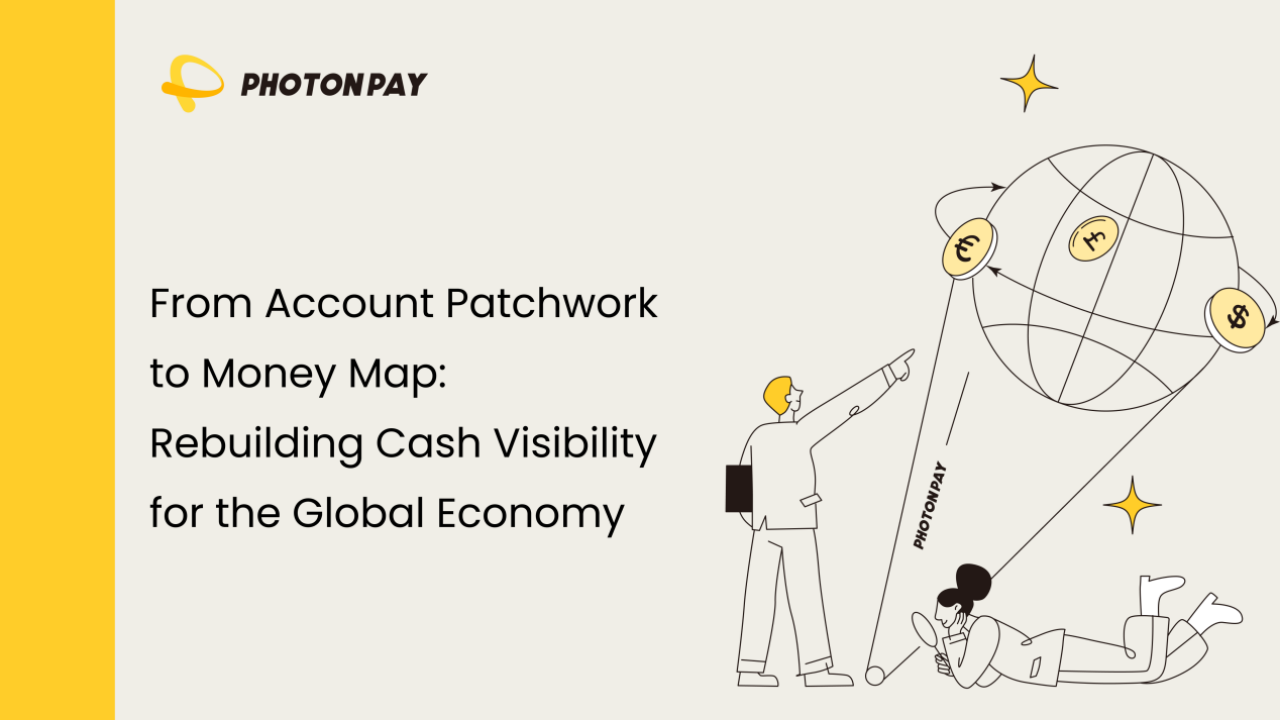
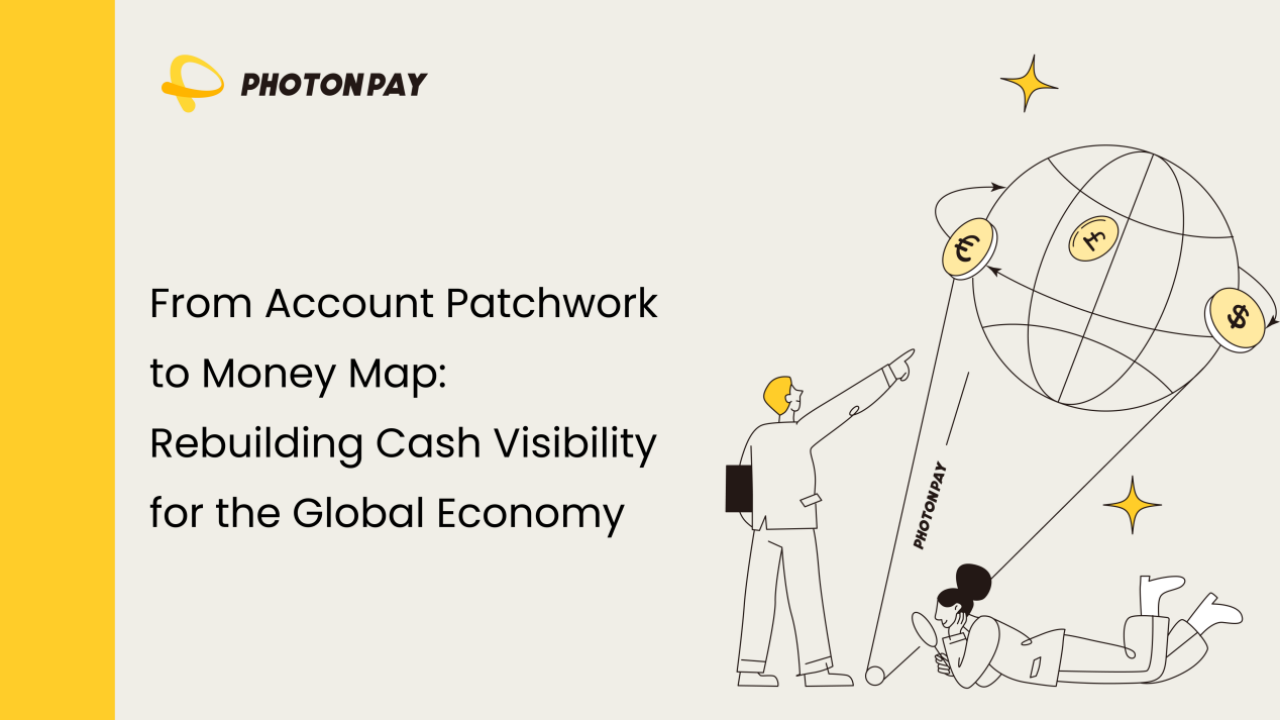
Funding Map: A Single Control Layer Across All Existing Accounts
PhotonPay's core paradigm shift lies in changing the visibility and operational capacity of finance teams within a single control center.
The cornerstone of this control tower is based on building real-time visibility capability that covers all accounts, currencies, and payment tracks—this is not just a reporting function but a baseline standard for enterprise operations. When asset management teams can view a comprehensive balance covering over 60 fiat currencies and major stablecoins on the same dashboard in real-time, the essence of financial work changes: manual reconciliation transforms from a painful weekly tug-of-war into ongoing automation; funding positions are no longer based on estimates but accurately grasped.
With visibility comes proactive control. Automated fund gathering can precisely route surplus funds to where there are funding gaps without human intervention; target exchange rate transactions can be executed automatically when the market reaches preset conditions, eliminating the need for dedicated personnel to monitor constantly; payment routing logic only needs to be configured once and can be strictly applied to every transaction, bidding farewell to the randomness of relying on manual bulk processing in the past.
At the bottom of all this lies an innovative track that traditional cash management platforms have never designed: using stablecoin infrastructure as a payment and settlement track.
This is by no means a flashy concept chasing cryptocurrencies, but a practical solution addressing the shortcomings of traditional banking systems—such as cutoff times, correspondent banking delays, and insufficient coverage of emerging overseas markets. The stablecoin track operates 24/7, 365 days a year, reaching areas where traditional wire transfer infrastructures are costly and slow, such as Southeast Asia, the Middle East, and Latin America.
On the PhotonPay platform, conversions between fiat and stablecoins can be seamlessly completed within the same system, without finance teams needing deep blockchain technical knowledge. For companies needing to make frequent payments to overseas creators, suppliers, or local entities, this is not a novelty, but a substantial reduction in settlement friction.
Real-World Comparison: The Genuine Transformation of Finance Team Workflow
Imagine an operations manager managing five market creator marketing projects. Each month, the finance team needs to pay hundreds of creators in Indonesia, the UAE, Brazil, and the United States, each with different preferred currencies, payment channels, and requirements for payment timeliness.
In the old fragmented model: This is a high-intensity physical job. Financial personnel need to frequently switch between multiple bank backends, manually export and import batch files, accept any bank exchange rate for the day, and spend several days afterward in lengthy manual reconciliations.
Under the unified funding control layer: The same process flows automatically within a single interface. The system automatically selects the most cost-effective track according to the rules pre-set by the team, whether local bank transfers, e-wallets, or stablecoins; foreign exchange transactions are executed accurately at preset target rates; every transaction is automatically aligned with the corresponding projects and cost centers in the real-time system. The finance team is not replaced by the system but elevates from tedious execution to high-value supervision and strategy.
The most successful companies in global expansion often share a common trait: their financial infrastructures perfectly match their business landscapes. They do not have a finance team that acts faster, but rather a system architecture that can automatically eliminate bottlenecks.
The decentralization and chaos of accounts are not a badge of honor for business growth but a signal that business growth has outstripped the carrying capacity of the infrastructure. Eliminating this gap does not require a "brutal overhaul" of existing banking relationships but rather a new operational layer that links everything together, making it clear, precise, and programmable for the first time.
This is precisely the "funding map" that PhotonPay is committed to drawing—we are not here to replace existing financial resources of enterprises, but to reconnect the scattered fragments into a clear, smooth, and efficient global funding operational system.
AboutPhotonPay光子易
PhotonPay is a stablecoin-driven global financial infrastructure operating system. Tailored for modern enterprises and global platforms, PhotonPay empowers businesses to seamlessly receive and disburse funds, exchange, and settle between fiat and stablecoin dual tracks through a single, compliance-first interface. PhotonPay's service network covers over 200 countries and regions globally, holding relevant financial licenses in key markets, aiming to reshape the efficiency boundaries of global payroll and payments in the era of digital assets.
For more information, please visit [www.photonpay.com]。
This article aims to introduce services provided by Photon Dance (Hong Kong) Limited or other PhotonPay entities located outside mainland China. This document is not intended for users within mainland China and does not constitute an offer to sell or purchase any products in mainland China, nor does it represent a commitment to conduct or solicit business.This material is for general informational reference only and does not constitute any legal, regulatory, tax, accounting, or investment advice, nor does it represent an offer or invitation to offer for any products or services. The availability, functional features, and regulatory treatment of PhotonPay products and services may vary depending on the user's geographical location, business model, and applicable laws and regulations. Any description in the text regarding functionalities, performance, efficiency, cost savings, or compliance support (including but not limited to terms such as "real-time," "24/7," "efficient," or "compliant" solutions) is a forward-looking or aspirational statement. Actual results may differ due to changes in market conditions, technological limitations, and regulatory policies, and PhotonPay makes no express or implied representations regarding the achievement of specific results.
免责声明:本文章仅代表作者个人观点,不代表本平台的立场和观点。本文章仅供信息分享,不构成对任何人的任何投资建议。用户与作者之间的任何争议,与本平台无关。如网页中刊载的文章或图片涉及侵权,请提供相关的权利证明和身份证明发送邮件到support@aicoin.com,本平台相关工作人员将会进行核查。


