Privacy is becoming an increasingly prominent issue in the AI field. Every prompt sent to centralized AI service providers is like depositing a sum of money into someone else's vault: research data, business logic, and creative ideas flow into a system that the sender cannot control, with terms not set by themselves. The most straightforward solution would be to run AI models on one's own hardware, but this method has previously been out of reach for the vast majority of people: high-end GPU systems cost tens of thousands of dollars, supply is tight, and operation requires space and professional maintenance.
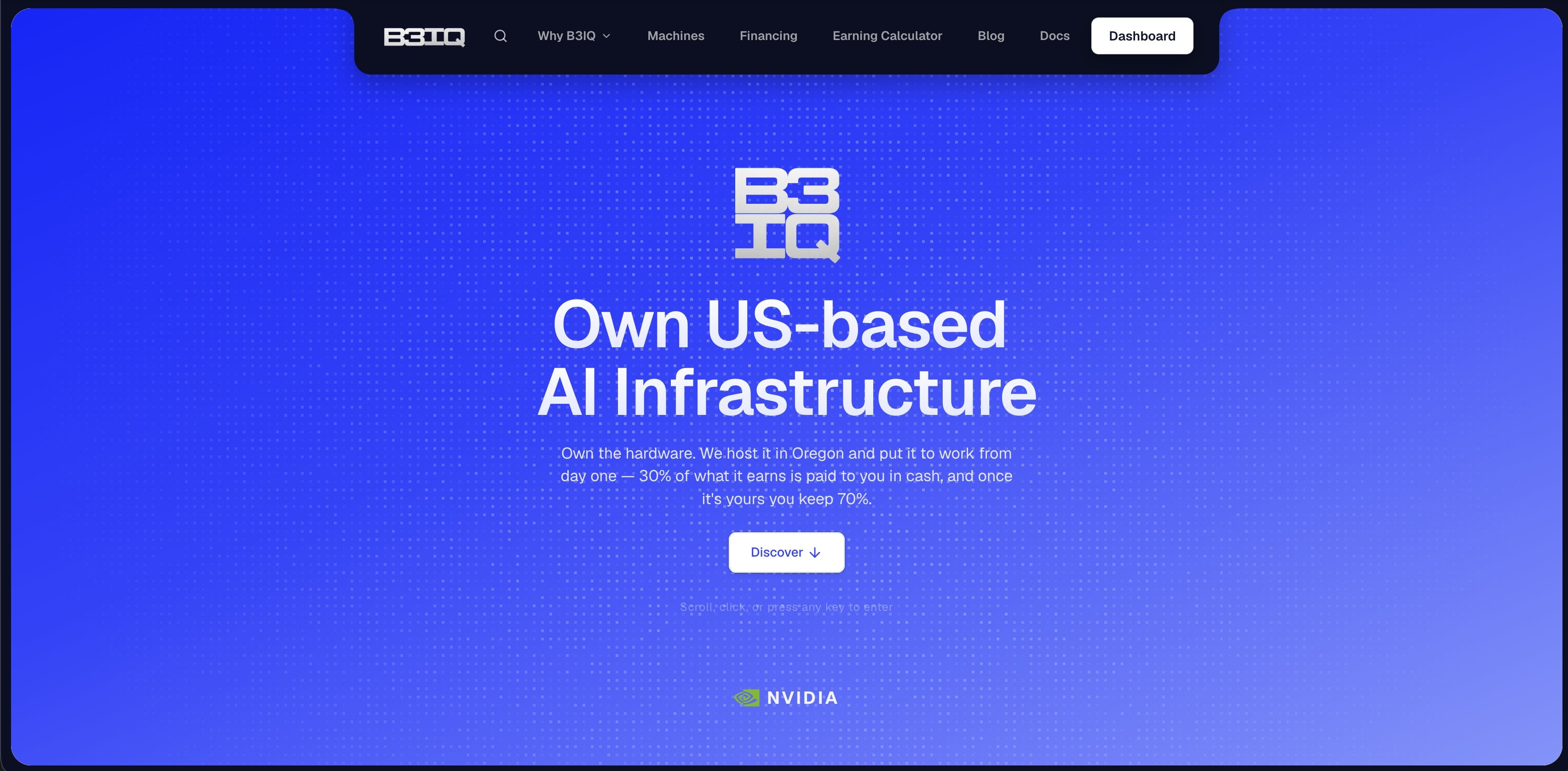
Today, B3 Labs has filled this gap with the launch of B3IQ: B3IQ is a pioneering AI infrastructure service designed to give universities, businesses, and professional users greater control over the hardware, models, and data that their AI workloads depend on.
Prior to this, organizations needing AI computing power had only two imperfect options: the first was to rent from cloud providers, meaning prices could fluctuate at any time, ownership was absent, and supply could be limited when GPUs were scarce; the second was to purchase whole systems outright, which required bearing all upfront costs, plus electricity, cooling, and maintenance burdens. B3IQ offers a third model that combines the advantages of both: economically it is “ownership”: the assets and profits belong to you; operationally it is “managed”: the data center and maintenance are handled by the platform.
B3IQ users can purchase dedicated NVIDIA GPU systems through installment payments: manufactured in the U.S. by AI system manufacturer Andromeda, funded by B3 Labs, and hosted in Oregon. Through the B3IQ dashboard, system owners can match idle computing power with demand, turning it into revenue that can be used to offset remaining purchase costs or kept as income. After paying in full, system owners can choose to continue having B3IQ manage it or arrange for physical delivery of the hardware.
Early users of B3IQ include faculty, AI researchers, and student teams from New York University, Dartmouth College, the University of Hawaii at Manoa, and Stanford University. For this group, the budget pressure from GPU shortages is particularly real:
“B3IQ's ‘owner control’ model is a viable path between renting and buying, which is exactly why we decided to partner with B3IQ. Research funding is fixed and pre-allocated, while cloud computing costs are fluctuating and can quietly consume an entire budget line mid-project. Making computing power a predictable, budgetable cost makes planning easier and reporting to project leaders or funding management departments simpler,” said Pavel Bushuyeu, an AI researcher at the University of Hawaii. “Owning our computing power also protects us from the impacts of the ‘computing power crisis’. When GPU supply is tight, centralized service providers limit allocations, with academic users often placed behind paying corporate clients. With our own node, when we need to run tasks, we don’t have to queue and scramble. Additionally, when the system is idle, using some of its idle power revenue to offset acquisition costs also helps amortize this investment.”
For researchers and organizations that cannot share sensitive data with third-party model service providers like Anthropic or OpenAI, this presents a significantly large market. Pavel Bushuyeu and other B3IQ pilot users at the University of Hawaii are running proprietary models for cancer research and robotics training on the platform, as this sensitive data cannot be shared externally. Additionally, AI service providers often directly block specific keywords and topics, potentially preventing entire areas of study from progressing: within the Ethical Tech CoLab laboratory at NYU, under Professor Yorke E. Rhodes III, master's students are constructing frameworks and simulations based on data from conflict zone evacuations to model and simulate national-level diplomatic negotiations. Such work triggers commercial model content filtering, requiring it to run on the team’s own infrastructure.
B3 Labs believes this model is now viable due to the rapid advancement of open-source models: today’s downloadable and deployable models are sufficiently powerful that organizations no longer have to call upon centralized vendors like OpenAI, provided they own their machines to run them. This is precisely the gap that B3IQ fills.
“Organizations want better control over where AI runs, how data is processed, and the costs associated with computing power,” said B3 Labs CTO Sean Geng. “B3IQ brings all these decisions into one system: running private workloads on dedicated hardware, while leveraging a network that can be voluntarily joined to create value from idle GPU power.”
Whether you want to purchase GPUs, rent out idle computing power, or directly rent computing power from the network, you can find more details at b3iq.org.
About B3 Labs
B3 Labs builds software and hardware for enterprise-level AI. Founded in 2024, the founding team comes from Coinbase, having secured over $21 million in investments from institutions such as Pantera Capital and Coinbase Ventures. B3 Labs operates two product lines: B3OS is the enterprise AI execution engine that allows AI entities to perform tasks stably and controllably within enterprise systems; B3IQ is fully owned by clients, deployed on GPU infrastructure within the U.S. For more information, please visit B3OS.org and B3IQ.org.
免责声明:本文章仅代表作者个人观点,不代表本平台的立场和观点。本文章仅供信息分享,不构成对任何人的任何投资建议。用户与作者之间的任何争议,与本平台无关。如网页中刊载的文章或图片涉及侵权,请提供相关的权利证明和身份证明发送邮件到support@aicoin.com,本平台相关工作人员将会进行核查。


