Author: Deep Tide TechFlow
In the past two weeks, the US stock market has entered the busiest time of the year.
Apple, Microsoft, Meta, Amazon… almost every day at dawn, there are heavyweight earnings reports released.
For global traders, this means the most concentrated opportunity window of the year.
For those traders who are not satisfied with "being right but not making profits," compared to traditional brokers, Crypto US stock trading, which offers more flexible trading hours, higher execution efficiency, and lower configuration thresholds, is gradually becoming a better choice.
As major crypto platforms have successively launched US stock trading services, all vying for this piece of cake, a more intriguing question arises:
Everyone is doing it, so what is the core capital for winning user choice?
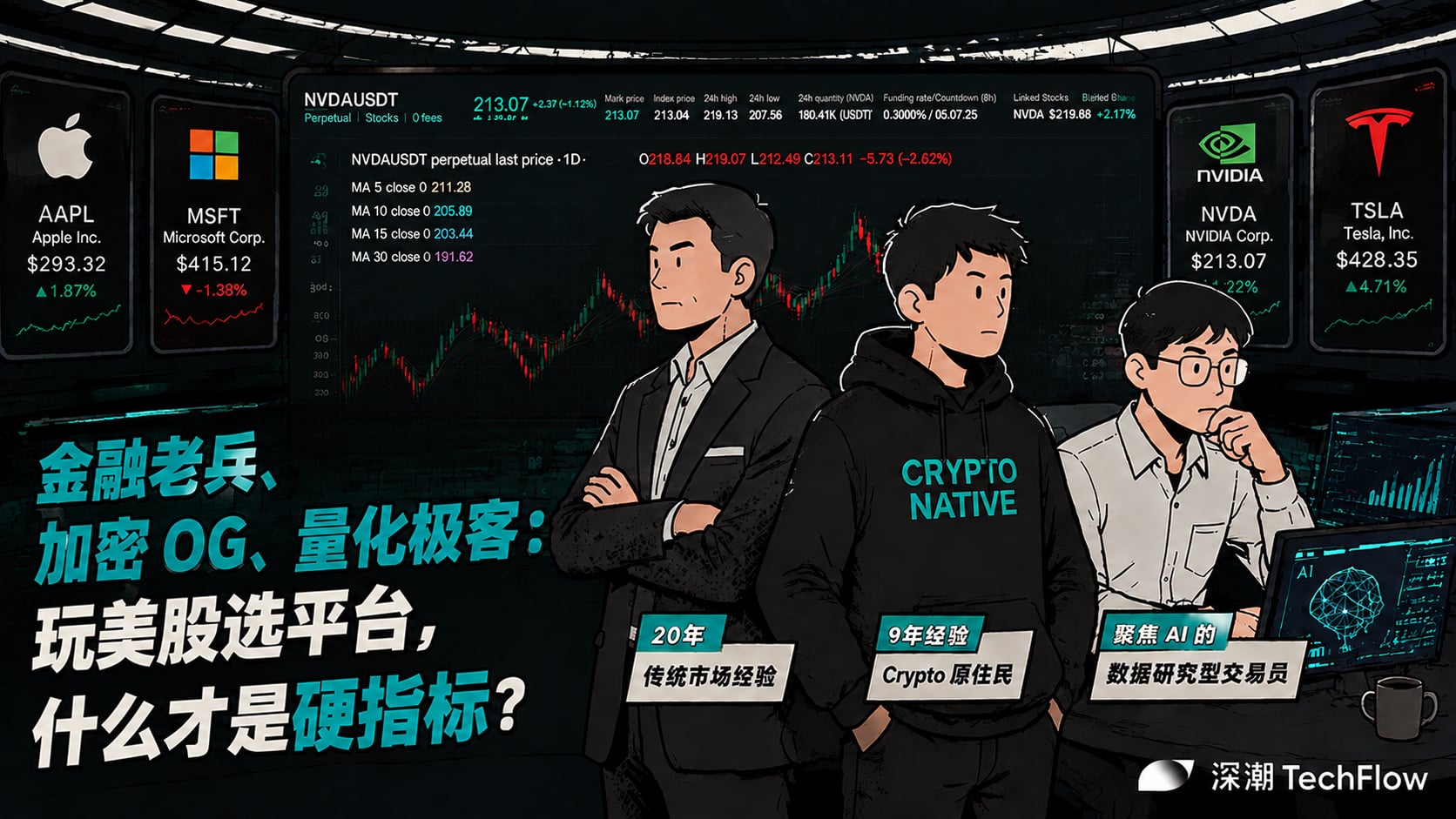
In light of this question, we had a detailed conversation with three senior trading KOLs: @BroBean88, @xiadadhaida, and @Rocky_Bitcoin.
Trading US stocks on CEX is evolving from "trying it out" to "everyday routine"
If you are active in the Crypto US stock trading community, you have most likely heard these three names.
Rocky (X: @Rocky_Bitcoin), a Crypto native who entered the space in 2017, focuses on long-term and multi-asset allocation fundamental strategies, paying attention to on-chain asset forms, composability, and global asset allocation methods in the next generation of financial infrastructure.
Brother Bean (X: @BroBean88), a technology enthusiast with a long-term focus on AI, blends quantitative trading backgrounds into his trading decisions, starting by breaking down earnings reports and scanning indicators; each result he obtains is a re-validation of his data analysis model.
In contrast, with 20 years of experience in traditional financial markets, and being one of the earliest market makers in Crypto, Brother Xiadahaida (X: @xiadadhaida) has a more cross-sector perspective: he often shares market sentiment and trading opportunities under macro variables and sudden events.
The three experienced traders each pointed out a common trend regarding US stocks:
On one hand, there is the increasing weight of US stocks. Rocky mentioned that his asset allocation follows the "4321" logic: 40% stocks, 30% crypto assets, 20% fixed income, and 10% cash. Compared to a year ago, while the stock proportion still remains stable around 40%, as the overall investment volume increases, funds allocated to stocks are also continuously rising, and within this 40%, US stocks have become the absolute main character.
On the other hand, trading US stocks on CEX is evolving from "trying it out" to "everyday routine." Brother Xiadahaida stated that before May 2026, most of his US stock trading was conducted on traditional platforms, and he has now fully transitioned to crypto platforms, especially on Binance, Bitget, and Hyperliquid.
As US stock trading in Crypto continues to grow, which platform's US stock trading service understands traders best? This has become the core issue in this new and old transition.
As for the answer, the three traders, with three different trading logics, have distinct starting points and focal points, but also converge on overlapping options.
From old logic to new system: An upgrade in "time, capital, and information" efficiency

As a data logic breakdown enthusiast, Brother Bean has extended this methodology to the selection of US stock trading platforms.
In his view, an excellent US stock trading platform must be tested against three core indicators:
- Transaction speed: when stocks experience sharp rises or falls, faster transaction speeds directly correspond to better execution prices;
- Liquidity: the depth of the order book determines the extent to which the actual realized prices are eroded;
- Trading costs: the sum of explicit commissions and implicit spreads constitutes the true rate burden.
Using this assessment system to evaluate current CEX US stock trading:
On the execution side, top platforms such as Binance, OKX, Bitget, Bybit, and Kraken have matching engines designed specifically for high concurrent trading, with core matching delays ranging from a few milliseconds to even lower,
In terms of liquidity, a recent report from DeFiLlama conducted a horizontal assessment of liquidity performance for mainstream platforms including Binance, Bitget, Kraken, Bybit, Gate, Hyperliquid, and Ondo Finance, revealing that in the liquidity benchmark tests concerning five stocks in the spot market (MSTR, SPY, QQQ, CRCL, and NVDA), Bitget achieved the narrowest spreads on rNVDA, rSPY, and rMSTR, and holds the deepest order flow across all sample markets. Among the other two assets, Gate's xStock had the smallest spread on QQQ, while Binance's bStock had the smallest spread in the CRCL market.
Beyond indicators, Brother Bean, a "data-sensitive" trader who believes that "details determine success or failure," has made additional observations on the information tools provided by various platforms. In this regard, Brother Bean explained:
Some AI market movements are often triggered by specific news, for example, if Gemini launches a powerful new model, it can lead to an unexpected surge in Google's stock price, and such information is crucial for investors.
Therefore, in the US stock trading services offered by Crypto platforms, many products are designed to break down information barriers, leading Brother Bean to think: those developing the products are not just following the market; they must have genuine experience trading US stocks because they truly understand the decision-making logic of AI traders.
Taking Bitget's millisecond-level real-time quotes and vast information as an example, Brother Bean shared: besides using his own built information scraping and analysis tools, he frequently uses Bitget for information aggregation and strategy formulation.

On July 22, 2026, Tesla released its earnings report after the market closed, reporting second-quarter operating profits lower than market expectations, and within two days, Tesla's stock price fell nearly 30%. Meanwhile, Brother Xiadahaida, who was well-prepared, completed a short position on Bitget immediately after the earnings report was released (July 23, Beijing time), perfectly avoiding losses.
In the past two weeks of earnings season, such cases have occurred almost daily in his account.
In Brother Xiadahaida's view, US stocks are easier to trade than A-shares because the market reacts more sensitively to news; the key lies in how quickly you can respond to signals when market data conveys them.
Thus, Brother Xiadahaida admitted that his initial attraction to trading US stocks on crypto platforms was convenience, with USDT directly entering the market, avoiding the friction brought by complicated registration and fiat currency exchanges typical of traditional finance, but the more flexible trading hours are the core reason for his complete shift to crypto platforms:
With rising tensions in the Middle East, earnings releases, and Trump's late-night tweets… signals occur during off-market hours, and he knows he can't wait a second longer.
Most platforms, including Binance, Bybit, and Bitget, typically support tokenized US stocks for 24/7 trading, while real US stocks cover regular hours + pre-market and after-hours + overnight trading, which helps traders to act on sudden signals without waiting for the next bell to ring.
This experience is not unique to Brother Xiadahaida: according to official data from Binance, in July, over 62% of trading volume for Binance's bStocks occurred outside traditional trading hours, and Bitget's rToken demonstrated a similar trend, with more than a third of trading occurring during traditional US stock market closures, reflecting strong demand for US stock trading from users outside regular trading periods.
On this basis, Brother Xiadahaida's other focus is on the breadth of the asset coverage: everyone's watching the popular US stocks, but opportunities don't always arise from just a few select assets.
This indirectly makes Bitget one of the most frequently used US stock trading platforms for Brother Xiadahaida: compared to Binance, which supports over 7,000 US stocks and ETFs, Bitget supports over 10,000 US stocks and ETFs in real stocks, along with 600+ mainstream US stocks/ETFs for its tokenized stocks, rToken, providing more diverse options for traders like Brother Xiadahaida who have varied investment needs.
Apart from functional needs, retaining Brother Xiadahaida also involves some emotional dependency.
The current crypto US stocks, whether in terms of scale or product forms, are still in the early stages, and encountering problems during trading is inevitable; the timely response from the Bitget team ensures that traders will receive feedback no matter what time they face any issue, especially with old friend, Bitget's Greater China head, Xie Jiayin, who remains consistently active in community engagement, listening to traders' demands, and driving product optimization upgrades.
Regarding this, Brother Xiadahaida expressed: it makes me feel that building a "warm" trading platform is not just a superficial slogan for Bitget.

As an experienced trader who has almost experienced the US stock trading services of each CEX, Rocky's expectations for crypto US stocks go beyond the minimal threshold of "being able to buy and sell," but rather focus more on capital efficiency: how many times can the same amount of money work for him.
Most of the time, traditional financial stocks can only lie idle in accounts, whereas tokenized US stocks can be chained once truly entered, functioning like DeFi Lego, allowing for both staking and lending. When composability is fully unlocked, the multiple efficiencies of a single asset is one of the most promising narratives about tokenized US stocks in Rocky's eyes.
This more Crypto perspective keeps Rocky closely observing tokenized solutions beyond just real stocks.
Among the currently mainstream tokenized US stock solutions, Binance's bStocks can be considered one of those first batch of market concerns, with its BEP-20 token design allowing bStocks to smoothly integrate into the BNB Chain DeFi ecosystem, theoretically opening up possibilities for composability. However, how to actually implement it still requires more collaboration between DeFi and traders, and at present, bStocks only covers 50+ assets, which seems thin for most traders.
Recently, the Bitget rToken, which has sparked discussions about efficiency on social media, appears to Rocky as a different answer. According to official introductions, rToken currently covers 600+ mainstream US stocks and ETFs, and unlike bStocks' limited support in margin and lending scenarios, rToken can serve as margin and collateral while also earning yield, achieving triple efficiency from a single asset.
This "multiple uses for one capital" attractiveness has made Rocky, who is already highly focused on capital efficiency, one of the earliest users of rToken, quickly integrating it with his trading habits to develop a mature efficiency amplification strategy.
For Rocky, who usually engages less in contracts, lending is a more familiar battlefield, and he shared:
The current lending rate for rToken is around 2.2%, borrowing 100 USDT can lend out about 78 USDT, and both of these metrics are very appealing;
Utilizing a low-volatility asset as the underlying collateral, such as the S&P 500 index, which has averaged an annualized return of about 11% over the past 15 years, can fully cover the 2.2% lending rate; even if he is genuinely worried about risks, doing spot trading to chase event-driven trading opportunities can yield good returns.
After running through this process, Rocky gave a straightforward conclusion: among all the CEX US stock trading services he has experienced so far, Binance's advantage lies in the integration of the chain ecosystem based on BNB Chain, while Bitget stands out as the best in terms of capital efficiency within the exchange.
What can we look forward to in US stock trading?
As the discussion drew to a close, we did not delve into specific products but rather looked at the broader future of the industry.
Currently, the total scale of tokenized US stocks is approximately $2.5 billion, and although it has shown noticeable growth compared to the beginning of the year, in the eyes of the three experienced traders, this figure is just the starting point.
Rocky clearly calculated a sum during the discussion:
The global stock market's total market capitalization is about $125 trillion, and in Rocky's view, the penetration rate of tokenized stocks can reach at least 10% in the next three years, which amounts to $12.5 trillion; regarding user count, there are currently about 710,000 unique addresses holding on-chain tokenized US stocks, and with the development of CEX US stock business, this could grow to 50 million in three years.
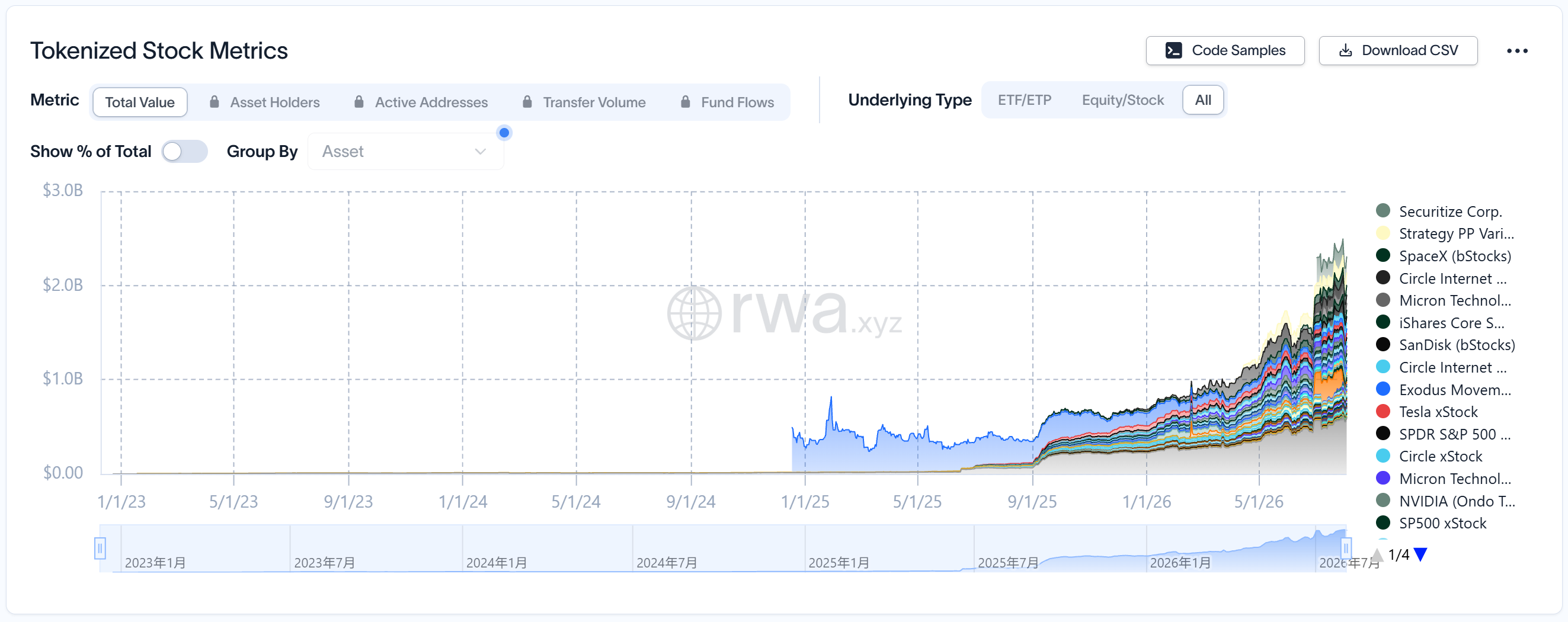
From $2.5 billion to $12.5 trillion, it can be said to be substantial growth potential. So what will be the core driving force pushing tokenized US stocks from a "niche option" to a "mainstream choice"?
Both Rocky and Brother Bean unanimously see compliance as the primary factor:
Brother Bean believes that compliance addresses the fundamental trust issue; only after truly gaining compliance recognition can large funds dare to invest, thereby amplifying the time, cost, and efficiency advantages of on-chain US stocks.
Rocky adds another dimension: besides compliance, more passive income plays stemming from the explosion of DeFi composability will attract more participants.
After discussing industry judgments, the three traders also expressed their specific expectations for the future evolution of crypto US stock products from their trading needs.
Brother Xiadahaida is focused on the coverage range of trades: he hopes the platform will further expand US stock offerings in the future, while also exploring more IPO prime-related plays.
In Brother Bean's eyes, the more transparent the assets, the more confidence traders have, hence he is more concerned about asset transparency, hoping to gain clearer insights into the real stock backing behind each token.
In his opinion, many current projects adopt a "self-reported" model for tokenized US stock reserve proof, lacking external supervision; although Bitget rToken has improved transparency through collaboration with an American auditing agency to provide daily third-party audit reports, there is still room for enhancement, such as further refining the transparency disclosures of rToken, for instance, each rToken having an independent transparency page displaying underlying custodial assets, token issuance volume, latest audit dates, dividend schemes, etc.
Rocky's expectations focus on two aspects:
On one hand, Rocky believes that there are many hedging strategies in the traditional US stock market, but there are still too few on-chain, and he suggests considering bringing many established, quality plays that have already been validated in traditional markets onto the chain. Based on this, Rocky is surprised by the recent launch of US stock options by Bitget, considering it a significant highlight and potentially a major trend in the future.
On the other hand, Rocky also expresses great anticipation for the combination of tokenized US stock assets and AI Agent intelligent trading. He believes that within the next five years, AGI will arrive, and at that point, no one will personally operate US stock accounts; AI will unify asset allocation. Whoever integrates these capabilities first and offers quality strategies to users will have more potential to capture users.
Coincidentally, these expectations have almost already appeared in the roadmaps announced by various Crypto platforms:
Under the core strategy of the "Super Financial App," Binance primarily focuses on expanding stock offerings and promoting deeper integration of bStocks within its ecosystem, while relying on frameworks such as ADGM to refine issuance and custody structures, enhance collateral transparency, and institutional usability;
OKX is focusing on compliance pathways and has previously announced a partnership with the parent company of the New York Stock Exchange, ICE, to establish a joint venture, each side holding 50% of the shares, and plans to launch tokenized NYSE stocks and ICE futures products in the second half of 2026, allowing OKX users to trade regulated tokenized US stocks directly;
Bitget, while continuing to launch support for more US stock offerings, will also continuously optimize the trading experience, including opening API interfaces for US stock spot trading, meeting the needs of professional traders and quantitative teams, as well as supporting direct trading of tokenized US stocks through Web3 wallets like Bitget Wallet.
At the same time, with AI becoming a key focus for Bitget, in the future, around core AI products like GetAgent, GetAgent Playbook, and Agent Hub, Bitget will continue to build a complete AI trading ecosystem, helping users upgrade from "watching the market + manually placing orders" to "AI screening + strategy deployment + automatic execution."
Conclusion
When we shift the perspective back to Rocky's prediction of a 10% penetration rate for crypto US stocks over the next three years, with the scale leaping from $2.5 billion to $12.5 trillion, it first signifies that the current competition in crypto US stocks is still in the early stages of an undecided layout.
The early players within this landscape, although they have established early advantages in various dimensions, seem far from forming invulnerable barriers, with rapid iterations in products, concepts, and experiences still occurring, and the existing landscape could be disrupted by the next innovation: who can execute a millisecond faster, who can add another asset to the covered offerings, who can offer a smoother one-stop experience, and who can take the lead in the compliance framework… these slight differences will be amplified over the next three years, becoming critical factors determining market share allocation.
However, the opportunities are also clear:
While traditional finance continues to adhere to fixed trading hours, segmented account systems, and lengthy capital flows from last century's operational rules, crypto platforms are redefining the trading methods for US stocks with unified accounts, 24×7 functionality, and multi-efficient assets. Whether looking at the over 140% growth in the active market capitalization of tokenized stocks since the beginning of the year or the fact that over 52% of Bitget's 120 million users hold both crypto assets and US stocks simultaneously, these data all point to a trend: trading is migrating from the old system to the new system, and there seems to be no possibility of going back.
More notably, from Binance's Super Financial App to Coinbase's Everything Exchange and Bitget's UEX Panorama Exchange, in a time when almost every crypto platform is blurring the boundaries between crypto and traditional finance, from this perspective, US stocks appear to be the most representative pioneers in this financial migration.
Because US stocks are the most mature and also the most complex type of asset in traditional finance.
And once a US stock has achieved real holdings, on-chain circulation, unified margins, and all-weather trading in crypto, what can be verified by crypto is not just the "US stocks" alone but possesses the capability to open the door to all asset plays.
Through this door, peeking into the reconstruction of the financial world behind it is something that every person unsatisfied with the old system should keep looking forward to.
免责声明:本文章仅代表作者个人观点,不代表本平台的立场和观点。本文章仅供信息分享,不构成对任何人的任何投资建议。用户与作者之间的任何争议,与本平台无关。如网页中刊载的文章或图片涉及侵权,请提供相关的权利证明和身份证明发送邮件到support@aicoin.com,本平台相关工作人员将会进行核查。


