Written by: ponyo_fp, Four Pillars
Translated by: AididiaoJP, Foresight News
Key Points
- Funding rates, basis spreads, and unlocking discounts are essentially “taxes” on crypto speculation. Because of this, when demand for stablecoins surges, the actual yields of synthetic dollars are often compressed.
- The supply rhythm of locked stocks depends on the IPO schedule and insider liquidity arrangements, having no relation to the crypto market cycle.
- The daily trading volume of perpetual contracts for stocks has skyrocketed from $84 million to $5.5 billion, enabling cryptocurrency asset managers for the first time to genuinely hedge stock exposure.
- A typical locked stock trade can yield about 20.5 percentage points over a six-month holding period—of which 15 percentage points come from entry discounts, and 5.5 percentage points come from funding rate holding income, without relying on the price fluctuations of the stock itself.
- The pool of eligible locked stocks is 4.5 times the scale of the filtered crypto unlocking size.
- Going forward, any market that can cultivate liquidity shorting tools—be it commodities, interest rates, or the next tokenized asset—will adopt the same trading logic.
Neutrl is exploring the extension of its delta-neutral strategy to tokenized stocks and pre-IPO shares. Below, we break down the logic behind this, how much a representative trade can earn, why the opportunity is substantial, and why the market willing to buy is still in its early stages.
Note: Neutrl is an on-chain market neutral synthetic dollar protocol. It issues NUSD (circulating, composable synthetic dollars) and sNUSD (yield-bearing version after staking). The core gameplay is to package delta-neutral strategies such as OTC arbitrage, locking token discounts, and basis/funding rate arbitrage, which were originally only available to institutions and hedge funds, onto the chain, allowing ordinary users to achieve relatively stable non-directional yields. It is similar to synthetic dollars like Ethena but focuses more on structural opportunities surrounding OTC locked token discounts. It is currently also exploring extending strategies into tokenized stocks and pre-IPO shares.
Structural Mismatch in Returns
Synthetic dollars inherently exhibit structural mismatches: when the crypto market cools down, funds tend to flow into stablecoins, seeking low-volatility havens; however, it is precisely at that time that the yields of synthetic dollars are shrinking. The reason lies in the fact that funding rates, basis spreads, and unlocking discounts essentially stem from crypto speculation. Until recently, there were almost no hedgeable targets outside the crypto cycle, thus leaving this mismatch unresolved for a long time. However, this year, a second timeframe has begun to emerge.
In the first half of 2026, the 30-day average trading volume of the top 30 altcoin perpetual contracts dropped from $8.4 billion to $5.9 billion, shrinking by 30%. As trading volume contracts, the space supporting funding rates and basis spreads also narrows. Delta-neutral strategies that are entirely based on crypto native price differences often yield best returns during market quietude and least returns during market exuberance. Even switching trading targets does not change this fact, as these price differences tend to breathe with the same crypto cycle.
However, the supply of locked stocks follows a different rhythm. IPO schedules, employee unlocking windows, and shares locked during fund lock-up periods are progressively released according to their own calendars. When the IPO schedule is full, and funds are nearing distribution deadlines, insiders need liquidity based on plans set years ago—none of this is related to Bitcoin. Such discounts have existed in the private secondary market for years; the barrier has never been a lack of supply but rather the absence of hedging tools. Discounts without hedging do not count as returns; they're just open positions with accompanying stories.
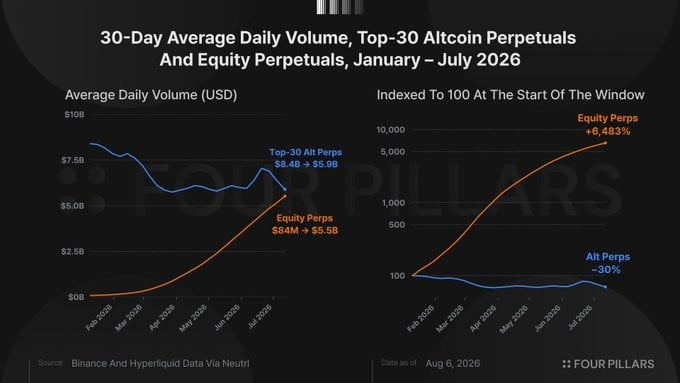
For a market to become genuinely investable, it must be shortable. The number of holders of tokenized stocks has grown from about 70,000 in September last year to over 670,000 by July this year. Meanwhile, the daily trading volume of stock perpetual contracts surged from $84 million to $5.5 billion within six months. Crossing this threshold has transformed the asset class of locked discounted stocks from “visible” to “investable.”
This is precisely where Neutrl's logic of attention lies—not layering a strategy onto existing logic but seeking a revenue channel driven entirely independently from the crypto cycle.
Approximately 20 Percentage Points of Steady Returns
The most straightforward way is to look at a representative trade currently being assessed by Neutrl (specific targets have not yet been disclosed, still in discussion). The trading desk plans to buy shares of a late-stage private company at a price discounted by 15% relative to a reference price, locking them for about six months (corresponding to the pre-and post-IPO window). This 15% is not the market average nor a fixed rate; it is merely an indicative term currently under assessment, and the discount will vary with the lock-up duration, transfer restrictions, and the seller's liquidity needs.
On the hedging side, the same nominal amount of the stock perpetual contracts is shorted. From day one, delta is close to zero; profit and loss no longer depend on stock price fluctuations but solely on whether the discount converges after the lock-up period and the returns generated during the holding period by the hedging side.
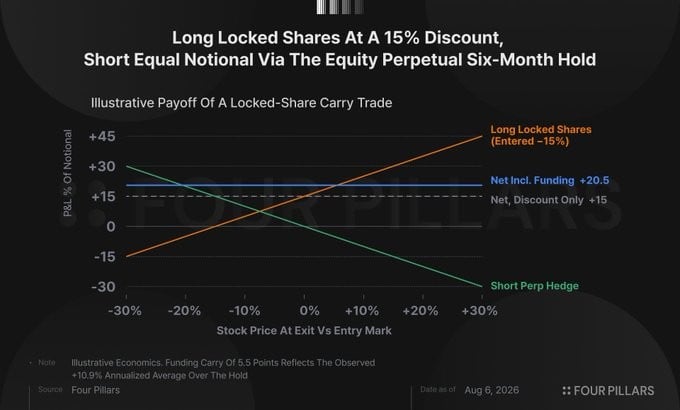
Moreover, the hedging side itself will generate returns. In the actual observation window from late May to mid-July, the annualized funding rate for the short side of stock perpetual contracts averaged 10.9%, with fluctuations ranging from about -35% to +55%. Such severe volatility is very common in the young funding rate market, where professional funds haven't flattened the spreads yet. Based on a six-month holding period, this contribution is estimated to be about 5.5 percentage points, combined with the 15 percentage points discount at entry, resulting in an overall return of approximately 20.5 percentage points, with directional exposure fully hedged. The final outcome is a stable return line—regardless of whether the stocks ultimately go up or down, they run about 20 percentage points above zero.
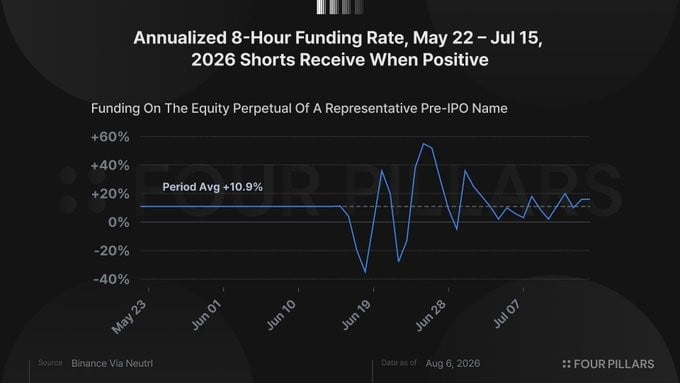
Why is the market willing to pay such high rates for short positions? Because the demand is unilateral. Those buying stock perpetual contracts are traders hoping to gain leveraged stock exposure around the clock and bypass traditional trading hours and brokerage restrictions. Their numbers far exceed those of professional funds willing to sit on the other side. Young perpetual markets traditionally provide short sellers with hefty returns until sufficient arbitrage capital flows in, compressing spreads to lower levels. The stock perpetual market is at the starting point of this curve, and its underlying pool is also quite large. Excluding the largest single target, the size of eligible locked stocks is approximately $48.2 billion, which is about 4.5 times the filtered crypto unlocking pipeline; if this target is included, the estimated size will rise to $17.4 trillion. Spreads are most lucrative when the market is born—this is not a flaw in the argument but the argument itself.
A Trading Framework Covering All Shortable Assets
For stakers, the real change lies in independence. The cash flow from the IPO calendar and the expiration of lock-ups will continue to pay out even when native crypto markets tend to be calm—which is precisely when stablecoin holders most need returns.
The stocks market is the first outside of crypto to cultivate liquidity shorting tools but will not be the last. Commodities will follow, then interest rates, and then the next tokenized asset. Every newly opened perpetual market will introduce a layer of previously visible yet inaccessible spreads. Expansion itself is the very essence of this business model. Neutrl's approach is to buy locked assets and short liquid assets; as long as both coexist, the profit from the spread is earned. This opportunity set will compound in growth alongside the tokenization process.
免责声明:本文章仅代表作者个人观点,不代表本平台的立场和观点。本文章仅供信息分享,不构成对任何人的任何投资建议。用户与作者之间的任何争议,与本平台无关。如网页中刊载的文章或图片涉及侵权,请提供相关的权利证明和身份证明发送邮件到support@aicoin.com,本平台相关工作人员将会进行核查。


