Author: KarenZ, Foresight News
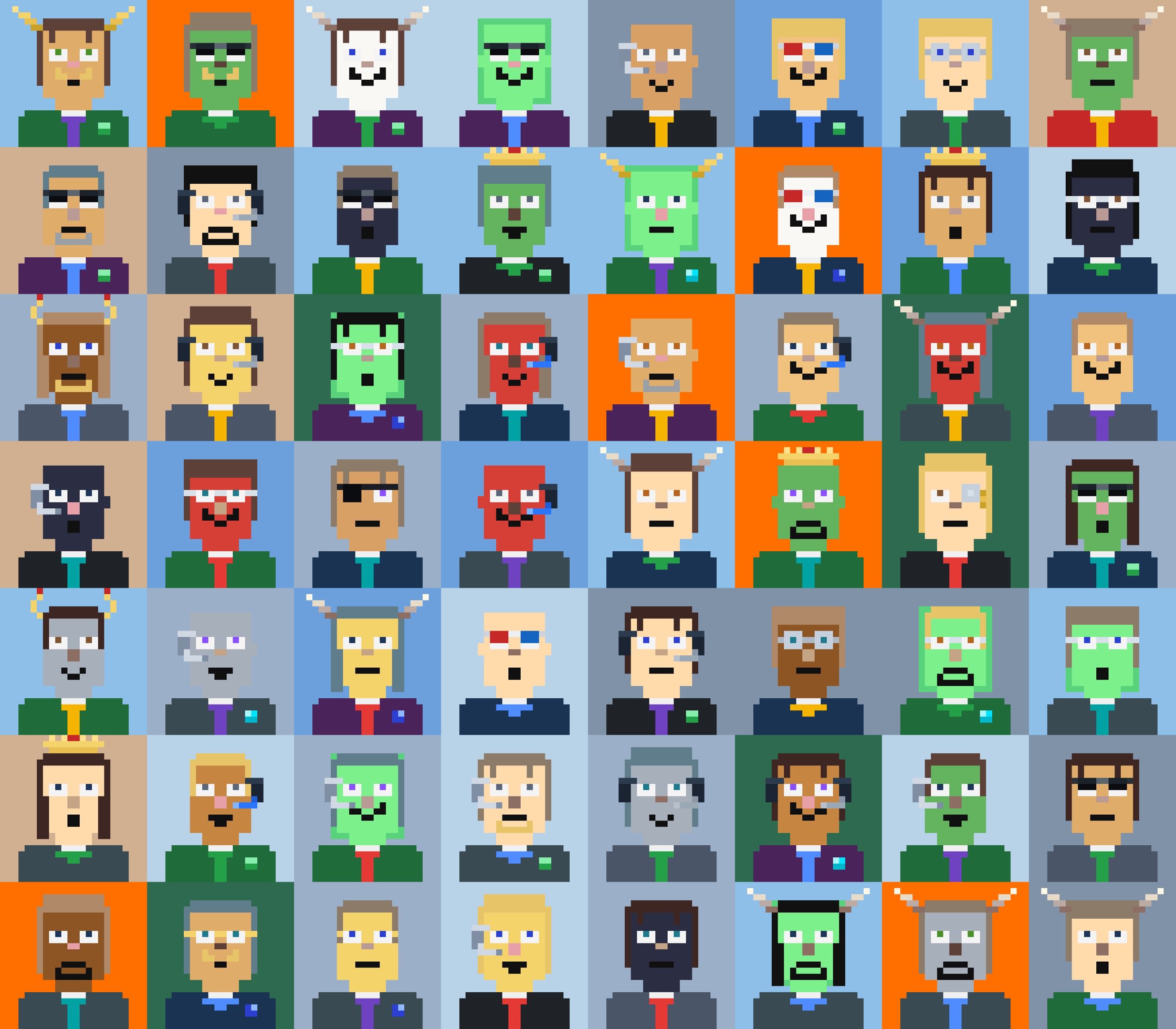
A month ago, 4444 StonkBrokers pixel brokers made their on-chain debut. Today, the price of a single NFT has reached 13 ETH.
If we roughly calculate the "floor valuation" of the entire set of NFTs by multiplying the floor price of 13 ETH by the total number of 4444, it amounts to over 100 million dollars. However, this is not the actual market value, as the algorithm assumes that all NFTs can be sold at the current floor price, making it more suitable for observing market enthusiasm rather than measuring the real value that can be realized.
The STONKBROKER token, which is part of the same product system as NFTs, is also on the rise. According to GMGN data, its valuation once approached 100 million dollars.
The market is pricing not only the 4444 pixel avatars but also the next layer of products that StonkBrokers is attempting to extend to— the token launch platform Stonk Launcher and the trading protocol.
The Next Step for StonkBrokers: Stonk Launcher
I previously introduced StonkBrokers in my July 21 article titled Can NFTs Earn Stock Tokens? What Exactly Are StonkBrokers?. StonkBrokers is a set of NFTs, tokens, and DeFi products launched by Clutch Markets on the Robinhood Chain. Its core assets include a total of 4444 StonkBroker NFTs and the ERC-20 token STONKBROKER, which can be transferred and traded. (Related reading: Daily Trading Volume Soars, Reviewing Seven Popular NFTs on Robinhood Chain)
Each StonkBroker NFT is associated with an ERC-6551 Token-Bound Account, or token-bound account. In simple terms, this NFT comes with an on-chain wallet that can hold stock tokens and other on-chain assets. When the ownership of the NFT changes, the bound account remains at the original address, but the control of the account will transfer to the new NFT holder.
The NFT initially receives a stock token endowment at the time of minting. After that, the holder can pay STONKBROKER to activate the NFT and participate in the Clock In rewards distributed according to tier weights. The entire process can be simplified as:
In Anvil, trading NFTs incurs ETH fees → 70% of fees enter StockBooster → Community users call Clock In → ETH is exchanged for stock tokens → Stock tokens enter the activated NFT's bound account.
What StonkBrokers initially attempted to resolve was whether an NFT could carry a wallet, receive token rewards, and further enter trading and lending markets. The soon-to-launch Stonk Launcher attempts to extend this system into a token issuance and liquidity infrastructure aimed at other projects.
How Does Stonk Launcher Operate?
According to the project page, Stonk Launcher will open at 8 PM on August 11 Eastern Time, corresponding to 8 AM on August 12 Beijing Time.
Stonk Launcher is essentially a token launch platform on the Robinhood Chain, allowing creators to deploy ERC-20 tokens and configure sales methods. The current documentation lists three main issuance models:
- Fixed Price: Tokens are sold at a pre-set price during the sales phase.
- Joint Curve: Token prices change according to joint curve rules, shifting with buy and sell actions and curve states.
- Custom Issuance: Creators can further adjust parameters such as token supply and distribution.
Creating an issuance requires a fee of 0.00042069 ETH. Tokens can choose to pair with ETH, STONKBROKER, or Robinhood stock tokens.
The project documentation sets the default "graduation" threshold at 4 units of paired assets, but this number does not necessarily equal 4 ETH: If the issuance chooses other paired assets, the threshold will be based on the corresponding asset, and specific parameters may also be adjusted in custom issuance.
The complete process for Stonk Launcher can be summarized as:
Create ERC-20 tokens and set sales parameters → Users purchase during the sales period → Conditions are met → Issuance enters the Finalize phase → Create Uniswap V3 liquidity pools, LP positions, fee allocation contracts, and token pledge vaults.
Each completed issuance token will also have its own pledge vault. According to the current design, token holders can deposit the corresponding tokens into the vault and share LP fees imported by the fee allocation contract based on their proportion. However, the public documentation has yet to list the specific distribution ratio of all fees, and actual income also depends on trading volume, liquidity scale, and LP position operation, so it cannot be understood as a fixed income.
Stonk Launcher also plans to connect with the yet-to-launch Stonk Exchange. Tokens that have completed issuance can apply to trade on this vDEX. The Stonk Exchange is currently scheduled to open at 8 PM on August 29 Eastern Time, primarily using Uniswap V3 architecture, with participation from STONKBROKER holders determining the direction of some fees and liquidity incentives.
Before Stonk Launcher officially opens, on August 11, Clutch Markets introduced the native (3,3) trading and liquidity layer up on the Robinhood Chain and listed it as the latest "Special Projects" partner. According to the plan announced on August 11, up will provide trading and liquidity infrastructure for Stonk Launcher and Stonk Exchange; tokens issued through the Launcher will by default enter up's liquidity pool and trade on the front end of StonkBrokers.
Opening Bell: Redirecting Some Trading Fees Back to the Market
The most distinctive design of Stonk Launcher is the Opening Bell Buybacks, initiated by joint curve trading fees to drive random market buy-ins.
According to project documentation, each joint curve trade will pay a Launcher fee, with part of it entering an on-chain fund pool called Buyback Bar. Once the fund pool meets the conditions, the project uses a VRNG random mechanism to determine two outcomes: when to trigger the Opening Bell and which token currently in the joint curve phase will be bought.
However, Opening Bell applies only to tokens using the joint curve model that have not yet graduated. Projects that have entered the Uniswap V3 liquidity pool, as well as tokens using fixed prices or other issuance models, are not included in this random selection range.
The probability of different tokens being selected is related to their contribution to the Buyback Bar in fees. The more active the trading, and the more fees contributed, the theoretically higher the chance of being selected, but every token still running in the curve has a chance to be chosen.
When the Opening Bell enters a triggerable state, any user can pay Gas to call Clock In. The protocol will use assets from the fund pool to make a one-time purchase of the selected token on the joint curve, and the trigger will receive a prompt reward.
This design aims to redirect a portion of trading fees back to the token market in the Launcher, rather than letting all fees leave the issuance system directly. However, the term "buybacks" does not imply that the project commits to supporting token prices: funds will only execute market buys after meeting conditions and being selected by random mechanisms, making it neither a fixed-frequency buyback nor equal support for all tokens.
The current documentation does not disclose the specific percentage of each joint curve trade that enters the Buyback Bar. Therefore, whether Opening Bell can generate a significant buying scale with lasting impact depends on the finalized contract parameters and the actual trading volume of the Launcher.
Who Will Enter After DERP and MANCER?
Although Stonk Launcher has not yet opened to the public, its page has already displayed the projects DERP and MANCER. This is because both have been listed as "Special Projects" of StonkBrokers, meaning they are pre-accessed independent incubation cooperation projects.
The project page specifically notes, that DERP and MANCER are independently developed and operated by their respective teams, have independent tokens, and bear independent risks, and should not be regarded as self-operated products of Clutch Markets.
DERP corresponds to the product name StonkPit, a system that connects StonkBroker NFTs, PitBoy NFTs (MineBoy cross-chain from ApeChain via LayerZero), and browser proof-of-work mining, along with on-chain entropy and Verifiable Random Number Generation (VRNG).
Unlike regular token mining, DERP is designed not only to reward tokens but also as an economic tool to support on-chain randomness services.
Users activate StonkBrokers and PitBoy NFTs, and can perform SHA-256 hash calculations through their browsers and submit proofs; once valid proofs are verified by the contract, participants receive DERP, and relevant results are fed into The Ticker's public entropy system. The Conductor is responsible for handling entropy requests from external applications and supplying generated random results to on-chain games or other contracts requiring random numbers.
Thus, DERP is designed not just as a computational reward but also as an economic tool linking mining, entropy demand, and random number services. The project sets up two mining zones: StonkBrokers participate in the green zone, while bridged PitBoys participate in the blue zone; the maximum supply of DERP is 4.444 billion, with 75% allocated to the green zone, 15% to the blue zone, and the remaining portion for partners, liquidity, and gaming funds.
MANCER corresponds to the Mancer trading protocol, MANCER token, and Chain Mancers NFT. According to the Mancer whitepaper, the team plans to build a decentralized trading protocol on the Robinhood Chain that supports token exchanges, limit orders, and periodic purchases. Users do not need to deposit all funds into the protocol’s vault when placing orders, but instead sign an EIP-712 order; funds remain in the user's own wallet, and only when orders are actually executed does the settlement contract withdraw the necessary assets for that transaction.
Mancer has also planned a total of 5000 Chain Mancers NFTs, with a current floor price of 1.3 ETH. According to the whitepaper design, Mancer will initially be managed by licensed executors who handle orders, collecting a protocol fee of 10 basis points, or 0.1%, per transaction, and paying executors a 5 basis points, or 0.05%, tip. If the Keeper network goes online in the future, already activated Chain Mancers will gain order execution eligibility: completed transactions by the Keeper will earn a 5 basis points execution tip, while the 10 basis points protocol fee is planned to be distributed to already activated NFTs after conversion.
Besides DERP and MANCER, other projects confirmed to issue through Stonk Launcher include Clock In.
Clock In defines itself as a "thematic token" derived from the community culture of StonkBrokers, while emphasizing its status as an independent, community-operated brand. The project plans to create trading pools for ETH, STONKBROKER, APE, as well as stock tokens for TSLA, NFLX, and AMZN.
CLOCKIN itself does not set token trading taxes; its economic mechanism mainly relies on fees generated from LP positions permanently locked by the project. According to the announced plan, of the associated LP fees, 20% is planned to be allocated to participating StockBooster brokers, 20% for subsequent development, and 60% for purchasing and destroying CLOCKIN on the public market.
In addition, CLOCKIN plans to reserve 2% of the total supply, or 20 million tokens, distributed in four rounds to reward already activated StonkBroker NFTs. The four rounds correspond to the conditions of CLOCKIN's market capitalization reaching and maintaining 1 million, 3 million, 5 million, and 7 million dollars, with each round distributing 5 million tokens. Besides the first round, subsequent rewards also require that holders possess a certain number of CLOCKIN for each participating NFT.
TickerYard needs to be handled separately. Its technical design document does not clearly state that YARD will be issued through Stonk Launcher, but plans to establish a market composed of 3333 Yardkeeper NFTs and YARD tokens using Anvil.
TickerYard aims to build a cross-chain asset routing interface: users specify the original asset, target network, and desired asset, and the system seeks available paths from external cross-chain protocols and liquidity channels, displaying costs, time, and security assumptions. The project prioritizes tokenized stocks as its first focus, later proposing to lock qualifying assets in its native network through standardized vaults and generate corresponding asset representations on other supported networks.
Yardkeeper NFTs are designed as transferable protocol participation seats. Current holders are only likely to qualify for participation in specific protocol tasks when they reach a specified Anvil activation level, complete Keeper Enrollment (which can be understood as Keeper task executors registration), and bind the local Runner.
Conclusion
StonkBrokers is attempting to complete a product boundary expansion: transitioning from a set of NFTs that carry wallets and can receive "stock token rewards" to a product system that includes token issuance, ecological incubation, and trading protocols.
If Stonk Launcher can be delivered as planned, the utility of STONKBROKER will also extend from NFT exchange and activation to token pairing, platform curation, and subsequent vDEX ecology. However, before the product is truly launched and operates for a period, all judgments regarding trading volume, fee income, and ecological flywheels can only remain at the mechanism level.
Meanwhile, the Robinhood Chain ecology is still in its early stages, and StonkBrokers NFT, STONKBROKER, and tokens created through the Launcher may face risks of inadequate liquidity, price volatility, and smart contract vulnerabilities. Collaborative projects like DERP, MANCER, CLOCKIN, etc., are operated by independent teams, and StonkBrokers' display or incubation relationships do not guarantee their security, liquidity, or token value. Participants need to verify project information themselves and carefully assess risks.
免责声明:本文章仅代表作者个人观点,不代表本平台的立场和观点。本文章仅供信息分享,不构成对任何人的任何投资建议。用户与作者之间的任何争议,与本平台无关。如网页中刊载的文章或图片涉及侵权,请提供相关的权利证明和身份证明发送邮件到support@aicoin.com,本平台相关工作人员将会进行核查。


