The growth of Perp DEX largely benefits from token incentives.
Cold starts require incentives; traders, liquidity providers, and order flow channels create value for the market and should receive returns. The real discussion should not be about whether to offer incentives, but rather in what form the incentives should occur and whether the returns correspond to the actual contributions.
Before the Token Generation Event (TGE), platforms typically attract current trading volume and liquidity using future token expectations through points, airdrops, and trading mining. Such mechanisms can quickly acquire customers, but the fees paid by users are real, and the returns obtained still depend on the future token distribution and market pricing. After the TGE, transaction fees begin to be used for buybacks, destruction, and staking rewards, gradually returning value to the ecosystem, but primarily still through the platform token for carrying and distribution.
Thus, the problem lies not in the incentives themselves, but in whether the incentives overly rely on future expectations. Traders create trading demand and fee income; liquidity providers provide depth and execution; wallets, trading terminals, and communities bring continuous order flow. However, existing mechanisms reward more for point acquisition abilities and token holdings rather than for those who truly drive the market.
This was also a key discussion point for Foresight Ventures during the investment and incubation process of PopDEX: Can the platform establish a more direct and sustainable value return path, allowing returns to be closer to real market contributions?
1. Early Growth and Demand Validation under Token Incentives
1. Why Tokens Became the Default Tool
The cold start of Perp DEX needs to acquire traders, liquidity, and distribution channels simultaneously, and early platforms typically lack stable income and find it difficult to sustain high cash subsidies in the long term.
Tokens provide a more efficient coordination method: platforms can unify the contributions of traders, market makers, and early participants into future equity, using future value to exchange current trading volume, liquidity, and market attention.
dYdX represents an early comprehensive token incentive model. In its initial token supply, 25% is used for trading rewards, 7.5% is allocated to historical users, and 7.5% is used for liquidity rewards. Trading rewards are calculated based on fee contributions and open interest, while liquidity rewards assess quoting online rates, bilateral depth, bid-ask spreads, and market coverage. Customer acquisition, market-making subsidies, and early ownership distribution are thus incorporated into the same token system.
Subsequent platforms made different adjustments on this framework:
- Hyperliquid combines points, referrals, and HLP, respectively used to attract traders, expand order flow, and establish protocol liquidity;
- Aster: Adopts multi-season trading mining, maintaining trading participation and user activity through continuous point cycles and periodic token distribution.
- Lighter lowers the trading threshold through zero fees and sets retail points and market-making points separately, distinguishing trading activity from liquidity quality;
These platforms do not solely rely on tokens, but tokens remain the core coordination tool in the cold start system. Its advantage lies not only in "distributing rewards" but also in unifying contributions from different participants into future equity, deferring most customer acquisition and liquidity costs to the TGE. The specific mechanisms vary, but the exchange relationship is fundamentally consistent: The platform first exchanges future equity and early subsidies for current trading volume, liquidity, and market attention.
2. Points Attracting Users Are Not Necessarily Long-term Traders
Point airdrops not only change whether users enter the platform but also change why users trade.
Under normal circumstances, when traders choose a platform, they will focus on liquidity, execution stability, fees, asset coverage, and risk management. However, once point airdrops are introduced, these criteria do not disappear, but the decision-making weight shifts: in addition to the trading experience itself, users will also calculate how many points they can earn per unit trading cost, whether potential airdrops can cover fees and capital occupation, and when rewards will be realized.
This does not mean that users participating in points are not professional traders. On the contrary, many professional traders will rationally evaluate point returns. The issue lies in when points become significant variables in trading decisions, the trading volume acquired by the platform no longer reflects only product competitiveness, but also includes users' pricing of future rewards.
Both categories of trading behaviors can contribute to trading volume, but their retention logic differs.
One category arises from sustained product demand: users stay because the platform's liquidity, execution, cost, and asset coverage can meet trading needs. The other category stems more from reward expectations: whether users continue to trade depends on whether points still hold value, whether airdrops still have imaginative potential, and whether the input-output remains valid.
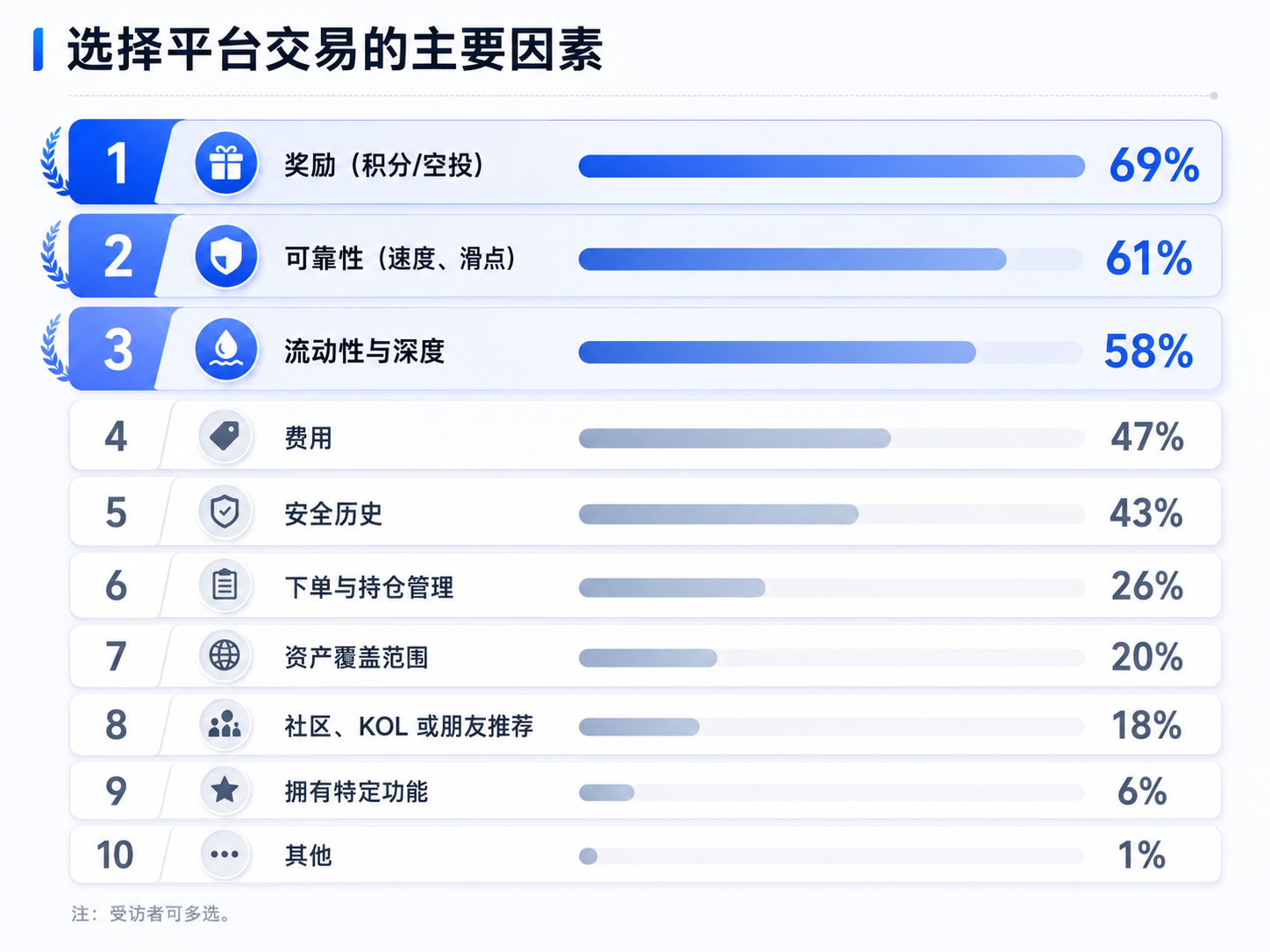
In the retail survey conducted by Foresight Ventures on Perp DEX, 69% of respondents listed points or airdrops as an important factor in choosing a trading platform, surpassing reliability (61%), liquidity and depth (58%), and fees (47%). Points and airdrops are no longer merely additional rewards outside the product, but compete directly with reliability, liquidity, and fees, becoming core variables for users in choosing a platform.
This will change the nature of how platforms acquire order flow. When users first enter based on reward expectations, what the platform establishes is not a high switching cost based on product habits, but a trading relationship that requires continuous subsidies. While rewards can lower the threshold for users to enter the platform, they also lower the threshold for users to leave the platform.
3. The TGE is the First Stress Test of Trading Demand
During the point cycle, platforms gain not only trading volume, but also users' anticipation of future equity. As long as airdrops still have imaginative potential, users are willing to trade, pay fees, occupy capital, and accept a product experience that is not yet fully mature.
However, the data during the points period is not pure. A single transaction may stem from real market demand or from expectations of airdrops; a new user may form a long-term order flow or may stop trading after completing tasks.
From surface data, they all belong to growth.
When these different motives are placed into the same token and points system, it becomes difficult for the platform to determine what exactly was ultimately gained. Therefore, the data after TGE should not only look at price rises and falls, but more importantly, three things:
- Is the trading volume remaining after rewards exit, or is it maintained by a new round of incentives;
- Is market share increased, rather than just following overall Perp DEX market fluctuations;
- Has the platform entered a natural retention phase, or is it still in a new incentive cycle.
| Platform | TGE Date | Average Daily Trading Volume 30 Days Before TGE | Average Daily Trading Volume 30 Days After TGE | Market Share Change |
| Hyperliquid | November 29, 2024 | Approximately $2.41 billion | Approximately $5.08 billion | +18.6% |
| Lighter | December 30, 2025 | Approximately $6.64 billion | Approximately $3.72 billion | −7.5% |
| edgeX | March 31, 2026 | Approximately $2.55 billion | Approximately $1.70 billion | −2.9% |
Note: The table only includes platforms that can obtain unified TGE pre- and post-30-day trading volume and market share metrics. Aster is excluded from this comparison due to incomplete public data metrics.
The real focus of this data set is not which platform has a higher trading volume after TGE, but which platform can convert the attention brought by airdrops into a sustained trading relationship.
If there is still a new round of points, mining, or subsidies after TGE, the trading volume still contains incentive components and cannot simply be equated with demand accumulation. The true watershed moment is when the marginal attraction of reward expectations declines, whether users are still willing to continue trading based on the platform itself.
In other words, the validation before TGE is whether the platform can attract users to enter; the validation after TGE is whether the platform can retain users. The former can be accomplished by incentives, while the latter ultimately depends on product capability and value distribution mechanisms.
2. Value Begins to Return, but Still Revolves Around Platform Tokens
1. From Token Distribution to Token Support
After TGE, incentive mechanisms usually shift from "distributing tokens" to "supporting tokens." Platforms typically use fee income for buybacks, destruction, staking rewards, and discounts for holding tokens. Value begins to return, but the distribution basis shifts from trading contributions to token holdings.
This means that traders first create income through trading and then qualify for sharing income through purchasing or staking platform tokens. As a result, platforms need to maintain two markets simultaneously: the trading market and the platform token market.
The two can reinforce each other, but are not always in alignment. Professional traders may contribute fees long-term but may be unwilling to bear the risks associated with platform tokens. Thus, the rewards offered are gradually not only for trading itself but also for users' capital investment in platform tokens.
This shift is realized differently across platforms. What is truly worth comparing is not just whether buybacks occur, but how much income enters the token system, how the tokens are handled post-buyback, and who ultimately receives this portion of value.
| Platform | Handling of Fee Income | Buyback Ratio | Use After Buyback | Main Value Bearer |
| Hyperliquid | Fees go into Assistance Fund and are used to buy HYPE | Approximately 99% | Buy back and then destroy | HYPE holders benefit indirectly through supply contraction |
| Aster | Most platform fees are used to buy back ASTER | 99% | Processed according to token economic mechanism | ASTER holders and ecosystem incentive participants |
| Lighter | Platform trading fee income is used for programmatic buyback of LIT | Approximately 97% | Permanently destroyed after buyback | LIT holders benefit indirectly through supply contraction |
2. Platform Tokens Broaden Participation, but Do Not Equate to Trading Demand
Platform tokens can expand ecological participation, but the address growth they bring may not necessarily translate into contract trading demand. To observe this difference, we conducted a cross-analysis of HYPE holding addresses, financial management user addresses, and contract trading user addresses for Hyperliquid.
The results show that among the three types of user concentration, HYPE holding addresses account for 89%, financial management users account for 27%, and contract users only account for 20%; users participating in holding tokens, financial management, and contract trading only account for 5% of the total.
Further breakdown reveals:
- Among contract users, 62% hold HYPE, but over 70% do not participate in financial management;
- Among HYPE holding users, 86% have never engaged in contract trading;
- Among financial management users, 85% hold HYPE, but the proportion participating in contract trading is only 19%.
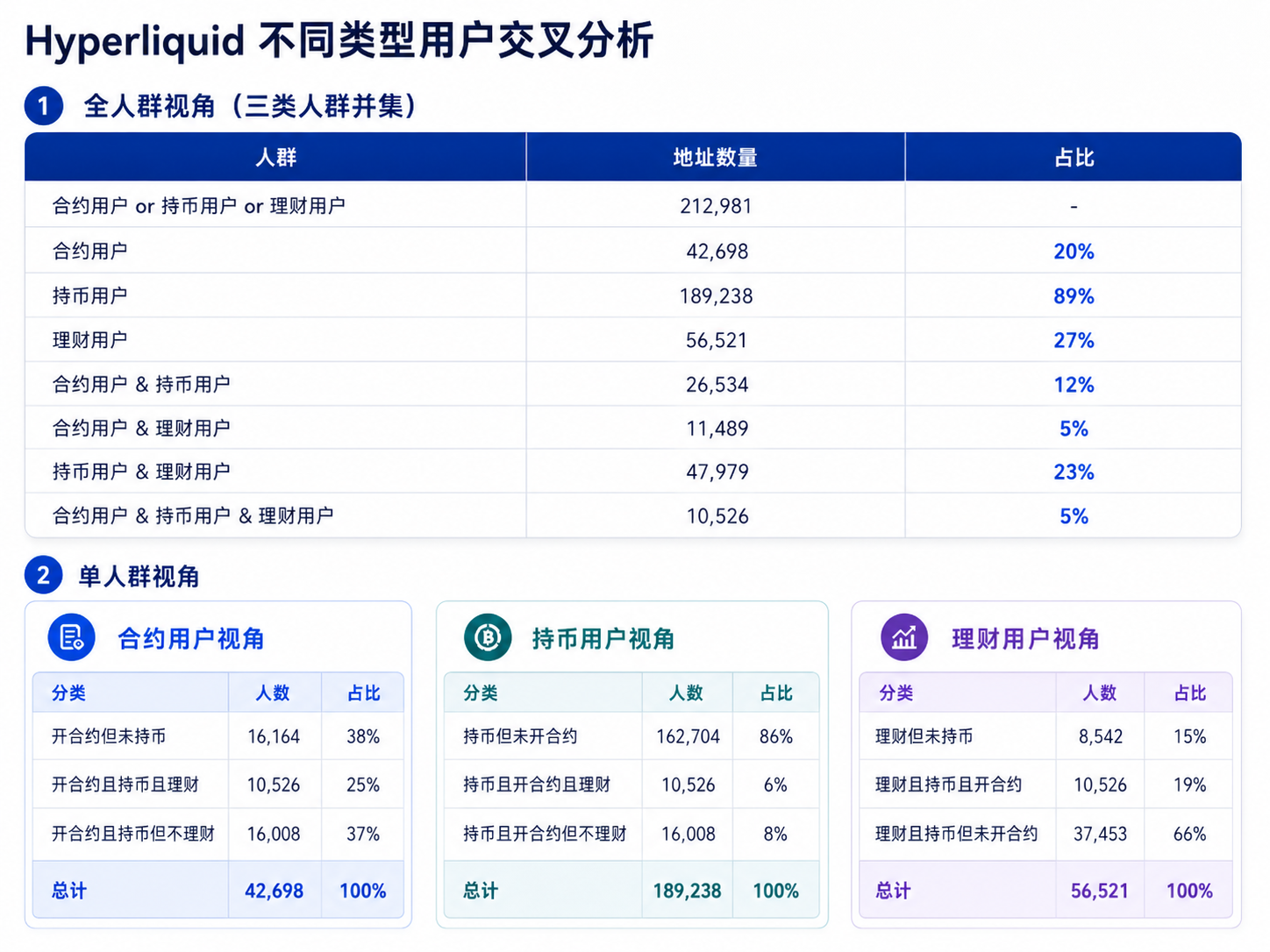
This set of data illustrates that while platform tokens can bring about broader asset holdings and ecological participation, holding tokens, financial management, and trading do not correspond to the same demand. Holding tokens may come from asset allocation and price expectations, financial management relates more to yield strategies, while contract trading directly reflects trading demand and order flow.
When holding addresses, asset scales, and financial management users are all counted in ecological growth, capital participation can easily be misunderstood as trading market growth. However, for Perp DEX, what truly determines market quality remains sustained trading, effective liquidity, and real fee income.
Platform tokens can expand ecological participation, but cannot replace trading demand itself.
3. One Platform, Two Sets of Growth Objectives
When income distribution, fee discounts, and product privileges are all linked to platform tokens, Perp DEX essentially needs to operate two markets simultaneously: the trading market and the token market. This leads to a fundamental tension: Whom does the platform prioritize serving, the trading product itself, or the value cycle established around the platform tokens?
These two sets of goals do not always align. The trading market is focused on execution quality, liquidity, and cost, relying on long-term product capabilities; the token market concerns itself with demand, scarcity, and price expectations, relying on continuously creating reasons for holding tokens.
As a result, the risk arises not only from resource dispersion but also from a shift in evaluation criteria. Trading volume, fees, and user growth are no longer solely used to measure the health of trading products, but also start to serve the narrative of supporting tokens. What the platform pursues may no longer be just more real trading, but more data that can strengthen token demand.
4. PopDEX: Another Answer to Incentive Mechanisms
From the investment perspective of Foresight Ventures, what makes PopDEX noteworthy is not merely the discussion of whether platform tokens exist, but the team has not set token expectations as the starting point for growth, nor made holding tokens a necessary prerequisite for trading rights. Instead of aggregating platform value into platform tokens first and reallocating it through platform tokens, PopDEX directly starts from real market contributions: Who creates value should have the value return to them.
Based on this idea, PopDEX has established a 100% value return system.
This 100% refers to the allocatable value created by trading fees, rather than returning each fee directly to traders. Its core lies in that the allocatable value formed from trading fees is no longer primarily used to support platform tokens, but enters a return framework designed around real contributions.
Within this framework, PopDEX's value return will cover two types of participants: ecological contributors and genuine trading users. The former includes referral, affiliate, trading activities, joint campaigns, and other ecological roles that continuously bring users, order flow, and market attention; the latter explores more direct, periodic, transparent, and verifiable ways of value return based on real trading contributions.
As for how this portion of value will ultimately be allocated, PopDEX will gradually disclose this in subsequent product phases.
For PopDEX, this is not a denial of the existing model, but a different attempt at incentive mechanisms: incentives can not only be used to achieve growth but can also become a way for platforms to continuously give back to the ecosystem.
How the incentive mechanism should evolve does not have a standard answer, and the market will ultimately make its own judgments. But we believe that as the Perp DEX industry continues to mature, its incentive mechanisms should not follow a single path and deserve to present more answers.
免责声明:本文章仅代表作者个人观点,不代表本平台的立场和观点。本文章仅供信息分享,不构成对任何人的任何投资建议。用户与作者之间的任何争议,与本平台无关。如网页中刊载的文章或图片涉及侵权,请提供相关的权利证明和身份证明发送邮件到[email protected],本平台相关工作人员将会进行核查。