Author: Arthur Hayes (Co-founder of BitMEX)
Translation: TechFlow
TechFlow Synopsis: The yen is brewing a "quake." Arthur Hayes believes that the yen is the most underestimated currency globally, and the Japanese and US authorities have chosen an "official plan" to strengthen the yen: the Japanese Ministry of Finance is using its $1.373 trillion worth of US treasuries as collateral through the Federal Reserve's FIMA repo facility to exchange for US dollars, then go to the foreign exchange market to purchase yen. This operation doesn’t sell assets and doesn’t disturb the market, yet it is equivalent to the Fed quietly printing money to expand its balance sheet. Once implemented, the global liquidity of the dollar will flood the market again, and historical experiences tell us: Fed balance sheet expansion = Bitcoin and gold take off. Hayes has since heavily invested in Bitcoin, gold, and gold mining stocks and has given his next judgments on Ethereum and Ethena (ENA). This article dissects the "exchange rate backdoor" ignored by the mainstream and its true implications for the crypto market.
A Quake and the Yen's "Return Home"
In early March 2011, I was sitting at the trading desk of Deutsche Bank in Hong Kong for a basket of ETFs in the Hong Kong and Singapore exchanges. Suddenly, someone shouted out that there was a massive earthquake in Japan. The office's TV switched to a live broadcast from Tokyo, the footage was shaking; shortly afterward, the news showed a tsunami sweeping across the northeastern coast of Honshu. Fukushima was also smoking. The scene was just insane.
The Nikkei Index plunged nearly 20% in intraday trading. At the same time, the dollar-yen exchange rate plummeted to 70, with the yen spiking to one of its strongest levels since World War II. I personally disliked a strong yen — the previous winter, I discovered Niseko, but at an exchange rate of 80 yen to the dollar, it was absurdly expensive.
The pile of MSCI Japan ETFs I held was naturally exposed to the yen. The yen rose rapidly and violently, leaving me no time to hedge the forex risk. Forget it, I might as well hold onto the long position in dollar-yen — as traders were hitting my buy orders, my ETF position got longer and longer. A seasoned trader once said: whenever Japan encounters a natural disaster (being on the Pacific Ring of Fire makes it more frequent), domestic institutions, especially insurance companies, will rush to repatriate overseas capital. This means selling overseas stocks and bonds, primarily those in the US — this point is crucial in the following text: when the yen "returns home," the currency strengthens.
The next day, the Nikkei opened lower again, and the market feared a Chernobyl-like nuclear panic. The yen was still strengthening. I was profiting from my forex bets and spread quotes. Later, the market rebounded, and I forgot why exactly — in short, the situation calmed down. To rebuild the nation and financial markets, Shinzo Abe introduced the "Abenomics" named after him in 2012, with the explicit goal of weakening the yen: to allow the Bank of Japan to buy unlimited amounts of government bonds under a YCC (Yield Curve Control) framework, engage in aggressive fiscal expansion, and eventually change the management of Japan’s largest pension fund, GPIF, to increase holdings of overseas stocks and bonds while lowering domestic security positions. The result — this consequence continues to haunt the world:
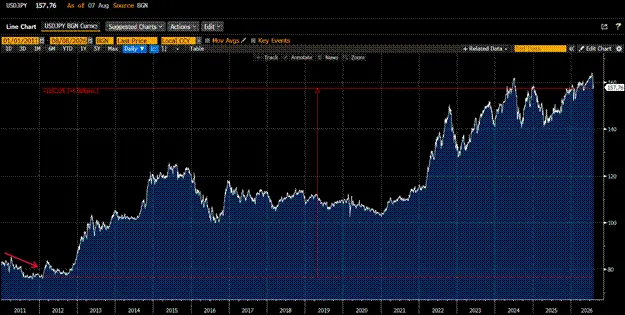
The yen depreciated by more than half.
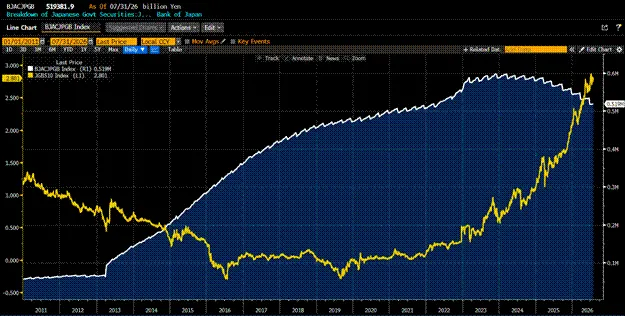
Figure: The government bonds held by the Bank of Japan (in white) show a vertical upward trend, which suppresses the yield on 10-year government bonds (in gold).
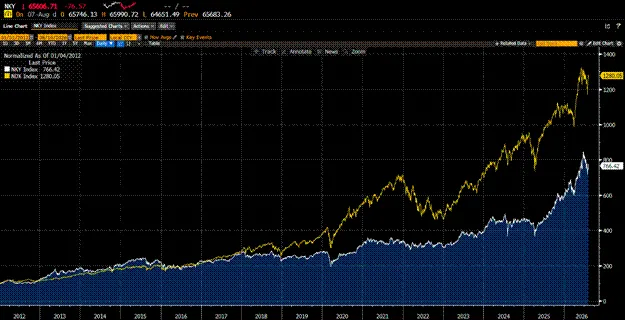
The collapse of the yen's international purchasing power is undoubtedly a huge success for global asset markets, as the yen has essentially become the financing currency for corporations and speculators. However, this also brings consequences. One of them is public anger. Although there is no direct link, when you destroy the dignity of laborers through monetary distortion, some strange things will happen. The Japanese appear to be docile and obedient on the surface, but in 2022, an attacker armed with a homemade gun coldly murdered the Prime Minister Shinzo Abe, who had initiated the yen's depreciation frenzy, at a campaign rally. This is the inflation version of "try me."
Devaluation has also fostered xenophobia. Last winter season, at the ski resort where I often went backcountry skiing, a Japanese guy yelled at me, saying I couldn't "skin" uphill on the ski slopes without a lift ticket. He had no idea the resort was actually owned by a Chinese consortium — ironic, right? He yelled at the foreign skiers while I did see many Americans in Hokkaido because at an exchange rate of 160 yen to the dollar, skiing in Japan is much cheaper than in North America, even accounting for international flight costs.
For more than a decade, a weak, weaker, and weakest yen has pushed global assets to rise; yet for the wealthy holding significant financial assets, good things inevitably come to an end. The yen is the most underestimated currency globally and a thorn in the hearts of both the US and China, even among ordinary Japanese voters. There are three routes to cut this "Gordian Knot," but the US Treasury and Japanese politicians only favor one.
I will first clarify the mechanism that strengthens the yen, then explain why the authorities prefer the third; next, I will discuss how this third means can politically land; finally — and this is why you are reading my "human language" — I will detail why, as US dollar liquidity soars, Bitcoin and crypto will take off.
The Knot of Three Cords: Three Plans to Strengthen the Yen
- The Bank of Japan aggressively raises interest rates, eliminating the interest differential between the dollar and yen (at least at the short end).
- The government encourages GPIF and other domestic and public institutions to amend investment authorizations to sell overseas and buy domestic assets.
- [Official Favorite] The Ministry of Finance uses its holdings of US treasuries for \"repo\" to the Federal Reserve to obtain dollars and then sell dollars to buy yen in the foreign exchange market.
Before diving into details, crypto traders might wonder: why talk about the yen strengthening now? For decades, countless people have shouted that "now is the time for the yen to appreciate, and global carry trades should be unwound." Two weeks ago, the Japanese and US monetary authorities did a joint currency manipulation, elegantly termed "intervention." When you are an ordinary citizen, this is called collusion and conspiracy; when you are a state, just change the terminology. US Treasury Secretary Bessent (nicknamed Buffalo Bill Bessent) claimed he wants the Fed to raise the counterparty limit of FIMA repo to allow the Ministry of Finance to defend the yen using its massive asset reserves. The Ministry of Finance also stated it is working with the Americans to push the dollar-yen rate down. The authorities have plainly told us: they have boarded the ship of global currency relationship changes, so we must listen.
Plan One: Bank of Japan Raises Rates (Dead End)
Currencies trade on interest differentials; the dollar yields 2.75% more than the yen. Borrowing yen, converting to dollars, and buying US treasuries is a positive carry. Hence, the no-arbitrage principle dictates that the dollar-yen exchange rate should rise, meaning the yen weakens against the dollar to compensate for this interest differential. The simplest way to make the yen appreciate against the dollar is for the Bank of Japan to raise rates to the same level as other major central banks (which have all raised them post-pandemic).
But to understand the difficulties of the Bank of Japan raising rates, remember: due to over a decade of YCC, the Bank of Japan is the largest holder of those "crappy JGBs" — they print yen to buy bonds and cap the yield on 10-year government bonds. If rates rise, bond prices fall; the greater the fall in bond prices, the larger the Bank of Japan's unrealized losses. Unlike readers like me, the Bank of Japan can infinitely lose yen because it can print freely. However, at some critical point, the world could lose confidence in the yen due to massive money printing and refuse to accept yen for purchasing oil, food, and medicine. We are not at that point yet, but the Bank of Japan must confront this disastrous future. It is this fear of recognizing losses that makes them hesitate, only raising rates slightly, while watching the market offload long-dated JGBs. The yen continues to weaken, and the inflation of imported energy tears apart the social structure.
Politicians also do not want the Bank of Japan to raise rates because they rely on issuing JGBs to fill budget deficits. When rates rise, the cost of interest payments increases, weakening their ability to buy votes with consumer tax cuts and other government giveaways.
Finally, if the Bank of Japan were to rapidly raise rates causing the yen to strengthen, increasing the volatility of the dollar-yen exchange rate would force everyone who leveraged global stocks and bonds with yen to unwind their positions. Remember July 2024? The yen suddenly soared from 160 yen to 140 yen against the dollar within a few days. I wrote two articles, "Spirited Away" (August 6, 2024) and "Water, Water, Everywhere" (August 12). The newly appointed Governor of the Bank of Japan, Kazuo Ueda, unexpectedly raised rates and hinted at more increases, causing the market to panic, leading those shorting the yen and going long on other assets to collectively unwind. At that time, there were rumors that several hedge fund pod PMs were "tapped on the shoulder" to leave — similar to how Kenny G took out Leopold, just here "tapped on the shoulder" equals professional death penalty. The yen touched 140, and the Nasdaq 100 and Nikkei both fell over 10%. The Bank of Japan panicked and, by August 12, when announcing an evaluation of the path for future rate increases, stated it would "consider market conditions," effectively pausing rate hikes. After this statement, the yen weakened, the stock market hit bottom, and resumed an "only up, no down" trajectory.
The Bank of Japan lacks the courage to bear the acute market pressure brought by aggressive rate hikes — compared to other major central banks, its normalization pace is far too slow.
Plan Two: Japanese Corporations Repatriating Overseas Assets (Also Not Feasible)
I define "Japan Inc." as the companies and public sectors holding financial assets. Albert Alethehauser mentioned a humorous story in "Nomura House": After the stock market crash of 1987, the Ministry of Finance instructed Nomura to buy US stocks to stabilize the market. Nomura, being a private entity, had no obligation to comply, but Japan is a conformist society where "acting together" prevails. Many times, shareholder returns are not the highest corporate goal; full employment and national glory are. If the government suggests that private enterprises and individuals should sell their overseas assets (mainly US stocks and bonds) and repatriate dollars back home, Japan Inc. will comply.
The clearest signal to send the message "it's time to bring money home" is the movement of the national pension fund, GPIF. GPIF is managed by a board of bureaucrats appointed from various ministries. In 2014, to sustain the money printing frenzy of Abenomics, the Prime Minister spent years replacing GPIF Trustees with his own people to ensure they would vote to increase holdings of overseas stocks and bonds. This is crucial because GPIF manages a portfolio of $1 to $2 trillion. As soon as its authorization was changed in October 2014, it set off an unstoppable train: they used yen to buy dollars and purchased US stocks and bonds. This created a structural yen seller, allowing speculators to safely leverage any financial asset with cheap yen without fear of the yen strengthening when rolling over or repaying.
I bring up GPIF because the head of the Ministry of Finance, Kitayama, recently publicly stated that he believes it's time to amend GPIF's authorization to favor domestic over foreign securities. GPIF's bureaucratic officials disagree and publicly state they are only accountable to their insured members. Clearly, as believers in Abenomics, they will not support changing the authorization to favor Japanese securities. Just as Abe manipulated the chessboard between 2012 and 2014, Prime Minister Takagi must follow. For us investors, the roadmap is clear: GPIF's authorization will change, forcing it to sell thousands of billions of dollars' worth of overseas securities, and the repatriated capital will push up the yen. This will continue for several years, but it worries Bessent — because Japan Inc., as one of the largest holders of US Treasury bonds, will turn from buyer to seller, destroying the stock and bond markets that Pax Americana relies on to finance the empire. And precisely because Pax Americana underpins Japan's national security, Japan Inc. cannot sell its US assets.
None of the above is news. Everyone agrees the yen is cheap. Both the US and Japan want the dollar to strengthen relative to the yen. But neither side dares to take the losses from the dollar-yen rate dropping from 160 to 90 (approximately 90 based on purchasing power parity). Plan Three, which was greenlit when Trump's buddy "Warsh the Weasel" (doesn't he look like one? acts double-faced too) took over as Fed chairman, is alive and well. The "Treasury-Fed Accord" of 2026 is doing fine; aside from using RMP and policy rates below nominal growth rates to directly finance short-term issuance for Bessent, Warsh also has the authority to implement Plan Three, tying the dollar-yen at the levels needed to restructure the global economy permanently.
Plan Three: "Repo" US Treasuries to the Federal Reserve (Official Favorite)
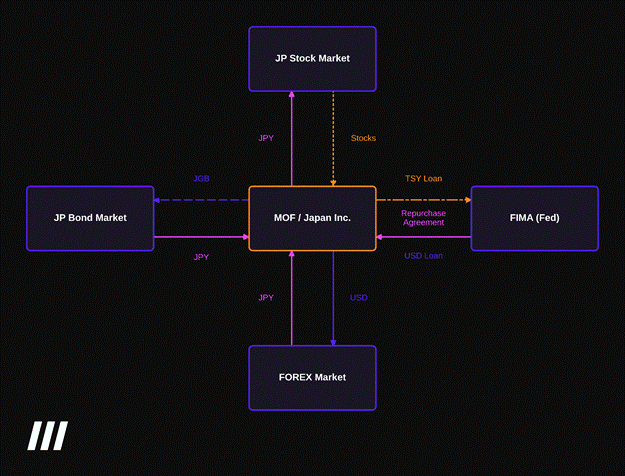
Figure: A "box and arrow" diagram indicating the flow of funds in Plan Three
When Bessent speaks, you'd better perk your ears up and listen so you don’t end up soaked again. And don’t argue.
Bessent clearly states: the Ministry of Finance and Japan Inc. should not sell US Treasuries to raise money to prop up the yen but should use the FIMA plan to "repo" US Treasuries to the Federal Reserve, obtain dollar loans, and then use these dollars to buy yen. There is a small hitch in the plan, which I will discuss later, but the box and arrow diagram above is precisely what this matter entails.
Let’s go through the process again:
- The Ministry of Finance "repos" a set of US treasuries, obtaining dollar loans through the Fed's FIMA plan.
- The Ministry of Finance sells dollars in the forex market and buys yen.
- The Ministry of Finance takes the yen back home to buy JGBs and stocks for reinvestment.
The implications of this policy:
- The Fed prints money creating the dollars that go out through FIMA. Its balance sheet will expand in line with the size of the outstanding FIMA repos.
- The dollar-yen rate decreases, thus strengthening the yen.
- The yield on Japanese bonds decreases due to bond purchases.
- Japanese stocks rise due to equity purchases.
Who are the suckers?
- Japan owes money to American taxpayers and will never pay it back for political reasons. This is pure money printing, which will lead to inflation in both financial and commodity markets. The US cannot force it to repay loans on the front line against China and Russia in the Asia-Pacific, weakening its rearmament capabilities.
- Everyone who shorted the yen. As soon as the direction clarifies, they must unwind immediately. This isn't a big issue because the volatility of the dollar-yen exchange rate will decrease, allowing carry trades to unwind in an orderly manner over several years.
So why hasn’t it happened yet?
The current FIMA facility has a cap of $60 billion per counterparty for outstanding loans. The recent currency manipulation between the US and Japan used over $100 billion but only pushed the yen up 5%, with a half-life of just a few trading days. In order to use FIMA, they need to completely remove the cap and expand eligible counterparties to include large Japanese corporations and semi-public investment vehicles (like GPIF). Who oversees FIMA?
During the pandemic, the FOMC delegated the power to change FIMA's rules to the "Foreign Exchange Subcommittee." The voting members are Warsh (FOMC Chair), Williams (FOMC Vice Chair and New York Fed President), and Jefferson (Vice Chair of the Board). The committee can convene at any time, does not publish minutes, and does not make voting records public; we only hear about the decisions made. Does the subcommittee listen to Bessent?
Of course. Trump and Warsh are in frequent contact. Given that Bessent has laid the necessary cards for restructuring the dollar-yen relationship clearly, Trump will certainly side with him. Thus, Trump and Bessent will instruct Warsh. Warsh has already proven himself to be a two-faced and a paper tiger. The balance sheet continues to expand under RMP (managed by Williams' New York Fed). Warsh says when formulating policy he "listens to the market" — the market is clearly demanding interest rate hikes now, as the two-year yield is over 0.5% higher than the effective federal funds rate; yet at the July meeting, he rejected a rate hike and instead set up five working groups to "research" how the Fed should change. Before these working groups made any suggestions, God arrived first. Thus, in a very short time, Warsh showed himself to be just another party pawn who will act according to the boss's demands, like his predecessor beta coward Powell, and the one before him, garden gnome Janet Yellen (who has become the bad girl after her promotion to Treasury Secretary).
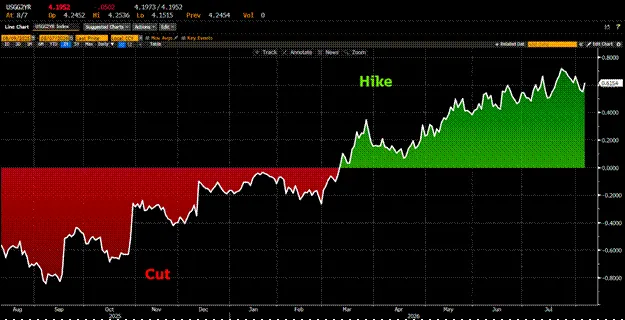
Figure: The 2-year US Treasury yield minus the effective federal funds rate
I don’t know when Warsh will convene the subcommittee and announce the modification of FIMA to enable unlimited money printing to push the dollar-yen rate down. But I wouldn't bet against it happening. In fact, I bet it will happen, and I will continue to increase my positions in assets that reflect the Fed's balance sheet expansion again. These assets are Bitcoin, physical gold, and gold mining stocks.
How Big? $1.373 Trillion
The more it prints, the higher Bitcoin goes. So does this FIMA trick have enough juice to pour trillions of "fake currency" into our positions?
Right now, we only care about US Treasury holdings because only US Treasuries are FIMA-eligible collateral. This may change in the future, but for now, let’s stick to the current assets. The two entities holding the most US Treasuries are the Japanese government and GPIF.
US Treasuries purchased by the Japanese government: $1.143 trillion
US Treasuries held by GPIF: $230 billion
Total: $1.373 trillion
This number is not off. As a reference, the Fed printed around $4 trillion during the pandemic, and the expansion of its balance sheet from 2020 to the end of 2021 is proof of this.
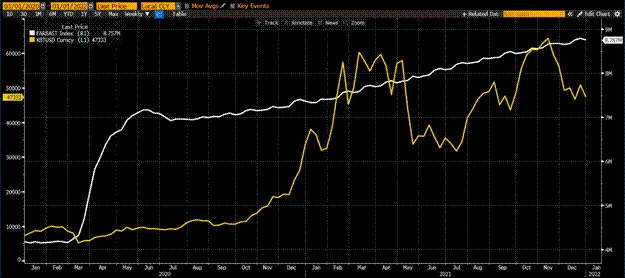
There is a very clear correlation between the growth of the Fed's balance sheet (white line) and the rise in Bitcoin's price (gold line). In my previous article, I hypothesized that AI infrastructure is entering a "capital waste" phase. This is crucial because the Trump administration wants this liquidity to feed US capital expenditures on AI rather than pump crypto. But my point is: lending money to those AI companies with positive capital returns — can you point out one big company making money by throwing cash in, or one US AI lab making profit at the token prices in China? — is a waste, while the rise of Bitcoin will reflect this inefficient capital usage. Gold's recent surge from local lows tells me that the market prefers to funnel the impending tsunami of dollar fiat into monetary financial assets rather than give money to Sam Altman's "burn machine" OpenAI or Musk's mythical space data centers.
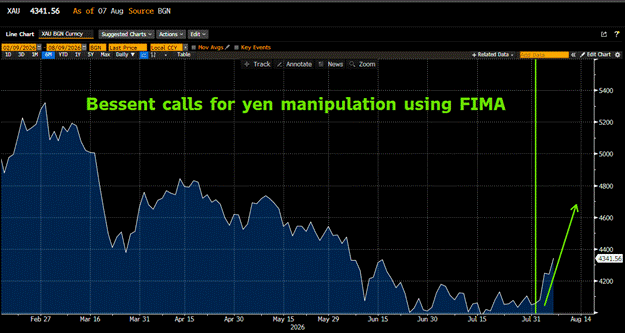
Figure: The strong correlation between the Fed's balance sheet (white line) and Bitcoin's price (gold line)
Shitcoin Season: Where Should the Money Go?
I know you just want to know what Maelstrom is doing. But the background determines whether you dare to take a position. As mentioned before, I listen when Bessent speaks. If there's anything he excels at, it’s currency manipulation. Go search for his glorious resume alongside Soros — the one who took down the Bank of England in the pound forex market. Doing this currency trick doesn’t require approval from elected politicians nor approval from those whose terms are about to end and need to pass Senate hearings. Just convene that sleepy Foreign Exchange Subcommittee to change the rules, and you can unleash a flood of printed dollars.
Upon seeing the headline about Bessent calling for FIMA reforms, I immediately felt a bullish sentiment. Every macro analyst I follow believes this signals a significant turning point for the dollar-yen direction. You must position in advance because these people are serious about it. Money printing is a political decision to address tricky economic realities. Politics is dirty, but this time the Trump administration aims to get you to log in to your brokerage and buy financial assets. So Bessent clearly pointed out to anyone willing to listen from where the printed money will come. I am listening and will do my part… buy financial assets.
We are already heavily invested in Bitcoin, so the next question is: which horse will run fastest? This isn’t an AI stock investment blog, but if you are into it, beat your war drum hard. Leopold’s low point gave you an excellent opportunity to get on all AI assets. Turning to crypto, what’s undervalued in the market is Ethereum (Ether). Its narrative is: a few mainstream altcoins that won’t create new historical highs in 2025; furthermore, Ethereum will become the settlement layer for RWA. That’s top-notch.
The next is the altcoin that has hit rock bottom but can easily rise 5-10 times, which is Ethena (code: ENA). Ethena's only flaw is the lack of buyback; however, I am willing to overlook this because it is still the sixth largest stablecoin measured by circulating dollars. The issue with ENA is that the price drop has led to the disappearance of Bitcoin basis profits, and holding USDe yields only a bit more than US treasuries. Holding a synthetic dollar with CEX counterparty risks and smart contract risks doesn’t add up. That's why the circulating supply declined by 75% and ENA's price fell over 90%. Even a mild increase in dollar liquidity leading to a Bitcoin pump would push basis profits up, triggering a massive inflow into USDe. It doesn’t take much to lift ENA out of the mire, so it's my small gamble for a quick 5x in the coming months.
I haven’t "emptied the nest" and pressed my dollar balances to a minimum. We must wait for Warsh to convene the subcommittee and amend the FIMA rules. Stay alert; it could happen when no one is watching. But gold and the dollar-yen should start moving before any official announcement. Even without any other reason, there will always be someone who has solid connections with the Trump administration and a heavy position who will race ahead. This has happened with every asset class, so why should gold and forex be any different?
The days of the cheap yen are over. Good. Too many foreigners have treaded on my snow path in that magical Hokkaido volcano. And you guys skiing, screw you, get your split boards when coming to the backcountry.
免责声明:本文章仅代表作者个人观点,不代表本平台的立场和观点。本文章仅供信息分享,不构成对任何人的任何投资建议。用户与作者之间的任何争议,与本平台无关。如网页中刊载的文章或图片涉及侵权,请提供相关的权利证明和身份证明发送邮件到support@aicoin.com,本平台相关工作人员将会进行核查。


