
Written by: imToken
Recently, the crypto industry seems to have entered a period of intense farewells.
From BitMEX, which operated for 11 years and once defined perpetual contract trading in crypto, to Satori Finance, which received investment from top institutions like Polychain and Coinbase Ventures, one familiar name after another has ceased operations, officially reaching the end, spanning various directions including trading platforms, DeFi, wallets, NFTs, and infrastructure.
Among them, the exit of POAP is undoubtedly especially poignant.
If one has experienced the last round of the crypto cycle, especially attending Devcon, ETHDenver, hackathons, DAO community events, or various online and offline meetups, many people's wallets probably contain a few POAPs. They might come from a conference, an online sharing, or perhaps just a community event that has faded from memory.
Most of these POAPs are worth little, but precisely because of this, they may be closer to the original meaning of "collectible" than many previously expensive NFTs.
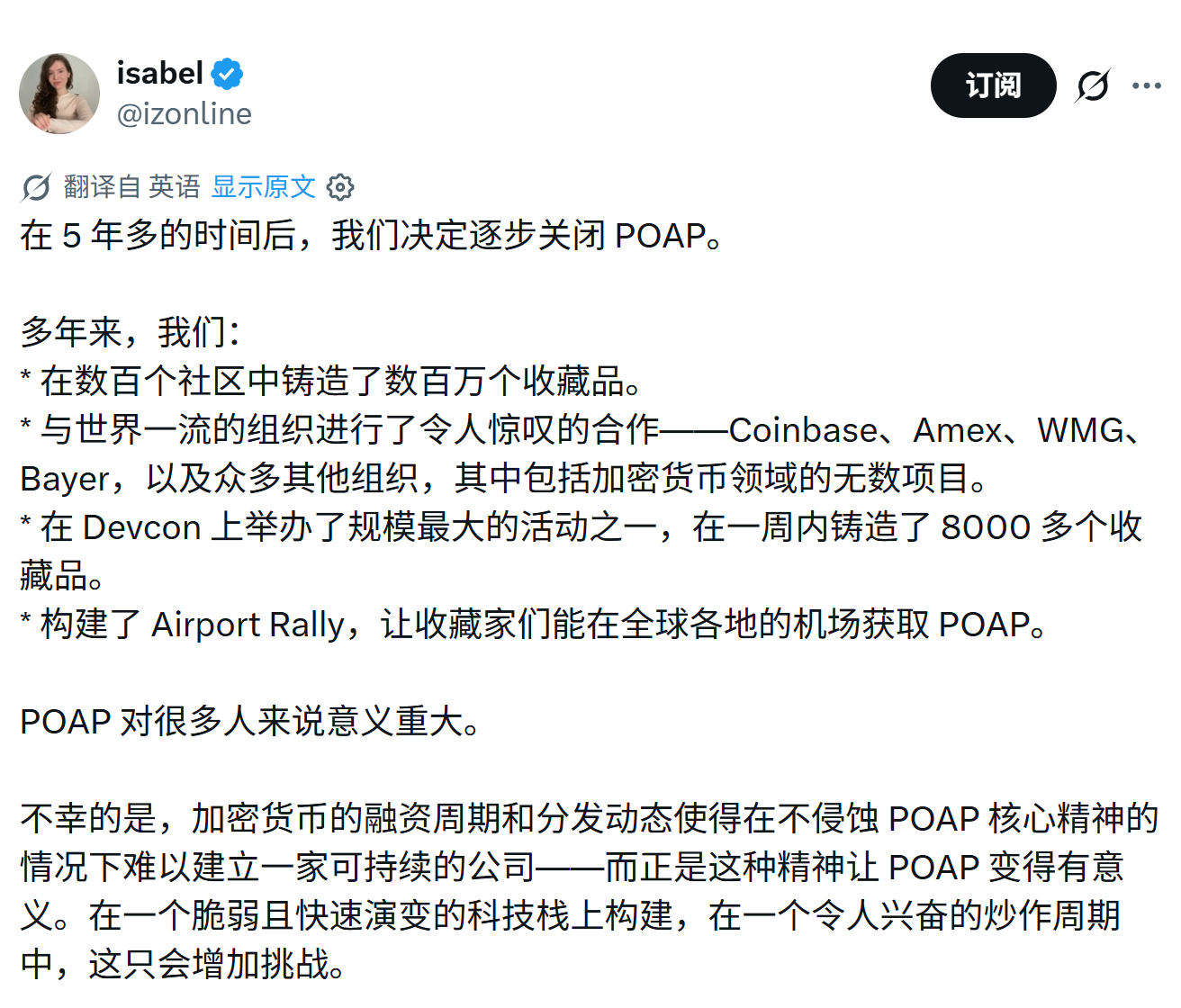
Therefore, the farewell of POAP feels particularly representative.
It did not suddenly drop to zero due to a hacker attack, nor did an anonymous team abscond with funds. It didn't even issue a native token needing constant price maintenance; instead, it had real users, clear scenarios, and sufficient brand recognition, but ultimately still failed to find a business model capable of sustainably supporting the company in the long term.
This is precisely the change occurring in today's crypto industry.
In the past, we were more accustomed to discussing how a project was born; moving forward, we may need to adapt to discussing how a project dies.
And this may not be a bad thing. But as ordinary users, we must know how to avoid being affected by the aftershocks of a bear market.
1. A New Wave of Shutdowns Sweeping Web3
In the last round of expansion in the crypto industry, a project had it easy to prove itself "established."
Securing financing, launching a mainnet, issuing tokens/airdrops, paired with some liquidity incentives, was enough to attract the first batch of users. TVL, number of addresses, and transaction volume could quickly rise, and for a considerable period, whether a project had revenue wasn't the most urgent question.
But when the cycle reverses and token prices and liquidity can no longer support financing functions, this model reveals a simple question: if no new money comes in, can the project sustain itself?
The shutdown of projects in 2026 is worth paying attention to.
Many of the disappearing projects were not initially empty projects with no products but had already secured financing, gone live, had real users, and even operated technically well.
For example, on July 23, BitMEX announced it would officially shut down its trading platform on September 23, 2026.
This trading platform, established in 2014, was once one of the most representative companies in the entire crypto derivatives market, with perpetual contracts, 100x leverage, and a set of trading products widely adopted by the industry closely related to BitMEX's early development.
It even emphasized in its official shutdown announcement, "In over 11 years of operation, BitMEX has never caused user fund losses due to hacking," but this did not make it a permanent operating infrastructure.
Similar stories happened in the DeFi and infrastructure space.
Botanix, a Bitcoin L2 project built over nearly four years, maintained 100% normal operation and zero security incidents since its mainnet launch, according to its own disclosed data. It has processed around 25 million transactions, 200,000 wallet addresses, and had tens of millions of dollars of assets enter its network, connecting to infrastructure and DeFi products like Chainlink and Morpho.
Looking purely at traditional Crypto KPIs, it was difficult to label it as a "failed" project— the chain was built, the product was usable, users had come, and funds had flowed in, but ultimately Botanix decided to shut down the network and reflected that the actual trading demand was not enough to generate sufficient fee income to cover the infrastructure costs necessary for a standalone network to operate long-term.
Ultimately, the crypto sector has been too accustomed to measuring an ecosystem by TVL, address count, and transaction volume, seldom questioning the final issue: how much real revenue these users actually generated?
As the industry enters a more mature stage, projects that lack real usage, have had long-term no revenue, and face ongoing maintenance costs gradually exit, resembling a structural clearing rather than the entire industry suddenly losing value.
One could even say that when a project confirms it cannot continue, it is often more responsible to proactively stop new business, announce a timeline, and provide users with a window for asset migration, rather than losing development capability while pretending to still be operational.
2. What Should Ordinary Users Pay Attention to Under "Chronic Death"?
This raises a question that can easily be overlooked.
A long-standing security principle in the crypto industry states: "Not your keys, not your coins," so many people naturally assume that as long as assets are held in a wallet where they control the private key, the core security issue is resolved.
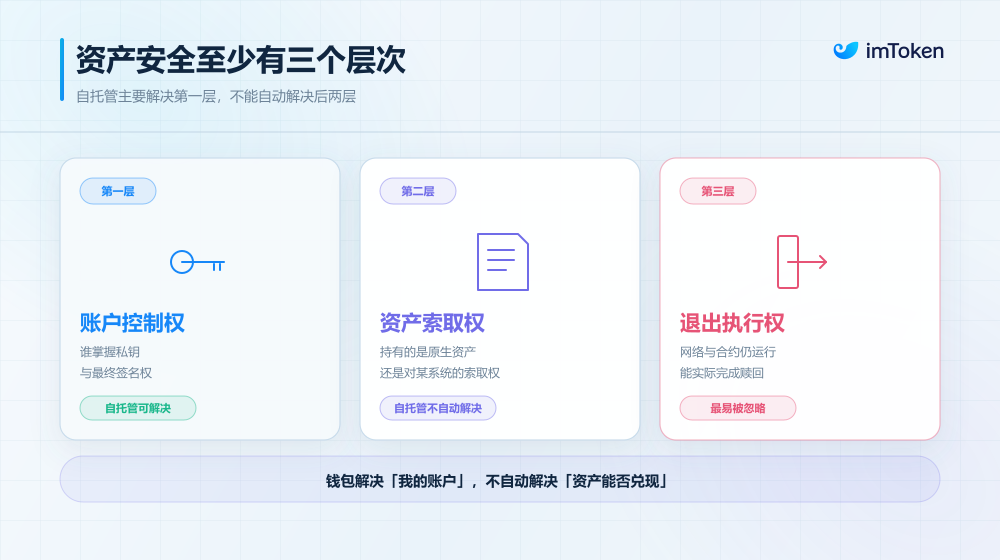
This statement is certainly not wrong, but it only solves half of the problem because holding your private key addresses account control but does not automatically guarantee that the assets themselves always maintain redeemability and exit options.
The reason is simple; the "assets" displayed in the wallet could be entirely different things. Take, for example, assets worth $10,000 in a wallet:
- One is native ETH on Ethereum;
- One is a deposit certificate from a lending protocol;
- One is an LP Token;
- One is a BTC-mapped asset minted through a cross-chain bridge;
They all appear in your wallet and require your private key signature to transfer, but if the protocol behind them or even the underlying network stops operating, the results could be completely different.
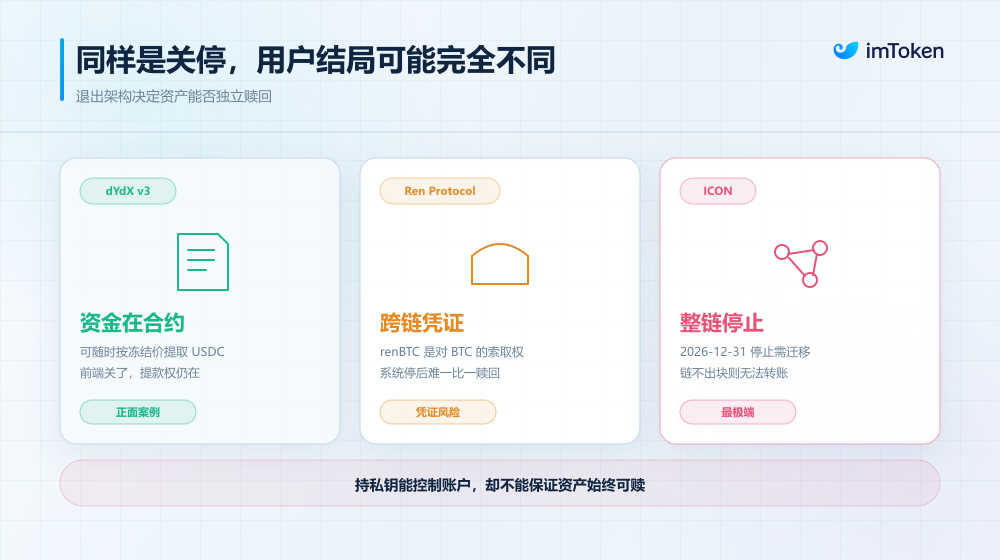
First Scenario: Project Stops Service, but Users Can Still Exit from the Contract
The shutdown of dYdX v3 is a relatively ideal example.
In 2024, dYdX decided to terminate v3, shifting its development focus to the new dYdX Chain. dYdX subsequently required users to close positions and withdraw USDC ahead of time, and after the product ceased operations, while the associated contracts entered a frozen state, they still retained exit options for users who had not withdrawn their funds.
This case showcases a nearly perfect "walkaway test" example— the team can stop providing the product, but the users' rights to withdraw funds do not entirely depend on the team continuing to operate.
This also serves as a real standard to measure just how "non-custodial" a DeFi protocol is: whether ordinary users can rely on the on-chain contracts to withdraw their funds when one day the development team stops maintaining the product.
Second Scenario: Coins Are in Your Wallet, but They Are Just "Certificates" for Another Type of Asset
The story of Ren Protocol illustrates another side.
Those who participated in the last DeFi round should be familiar with it; Ren was a crucial BTC cross-chain infrastructure. Users moved BTC to Ethereum via Ren and received wrapped tokens renBTC, enabling them to use it as collateral for yield farming or lending in Ethereum's DeFi protocols.
Theoretically, renBTC can be kept in one's wallet, where the user controls the private key, and the blockchain indeed records this renBTC.
But the problem is that renBTC itself is not BTC on the Bitcoin network; it represents an exchange right for the BTC behind the Ren cross-chain system.
Thus, when Alameda Research collapsed in 2022 and caused Ren to lose critical funding support, the Ren 1.0 network began shutting down. Subsequently, projects including BadgerDAO urgently reminded users to exit renBTC exposure because once Ren 1.0 stopped operating, holders of renBTC would no longer be able to exchange the assets back to Bitcoin mainnet BTC via the original bridging system.
In other words, although you may still have renBTC in your wallet and no one can destroy or move it, you cannot solely leverage your private key to make the already non-operational Ren network bridge back to real BTC for you.
The same reasoning applies to a plethora of cross-chain assets, wrapped assets, LP Tokens, lending certificates, and some staking derivatives.
Users control this "certificate," but whether the certificate can eventually be redeemed for the underlying asset depends on whether the underlying smart contracts, reserve assets, oracles, cross-chain validators, liquidity, and redemption systems are still functioning normally.
Third Scenario: If the Underlying Network Shuts Down, Even a Private Key Cannot Keep a Chain Producing Blocks
Going further down, the issues become more direct.
Some chains will shut down or become nearly abandoned (making stable block production difficult). For example, networks like Eclipse and AO experienced by the author can stop operating entirely. Users may retain their private keys or keep historical blocks recording how many tokens they owned, but they may not be able to freely send assets as they once did.
Thus, if we dissect "asset control" more comprehensively, it actually encompasses at least three layers:
- The first layer is account control: who holds the private keys and mnemonic phrases;
- The second layer is asset claim rights: whether the wallet holds native assets or a certificate issued by a protocol, cross-chain bridge, custodian, or asset pool;
- The third layer is the right to execute an exit: when a user truly decides to leave, does the underlying network, smart contract, liquidity, and necessary infrastructure still permit the asset to be redeemed and migrated;
"Not your keys, not your coins" chiefly addresses the first layer.
When a project begins to decline, stop maintenance, or even move toward closure, the real problems often lie in these next two layers. This is why, when facing an ongoing structural clearing in the industry, we should pay closer attention to: If this project shuts down tomorrow, will I still be able to take my assets with me today?
3. A Comprehensive and Accurate Understanding of the Meaning of "Self-Custody"
In fact, most projects do not suddenly jump from "completely normal" to "utterly dead" on a single day.
True decline usually lasts a long time.
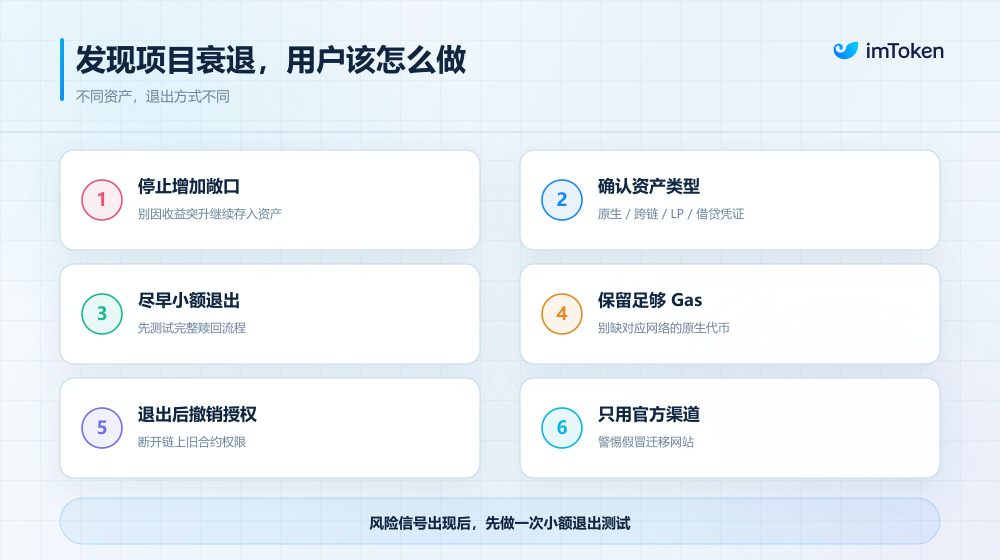
A relatively practical judgment criterion is to not just focus on tokens but also observe people, money, code, and exit channels.
- First, look at the money, particularly whether there is still real demand after liquidity incentives and subsidies are removed. After all, a higher TVL doesn't necessarily mean greater safety, and more transactions don't always equate to more value. The key is how many people continue to use it after token rewards are removed, and whether protocol revenue can cover team maintenance and other costs.
- Next, examine the people, especially whether the project has only social media updates left. Many projects do not officially announce that they have lost development personnel (many officially announced projects mentioned earlier can be considered ethical). A more common state is GitHub recording no core code updates for six months, serious bugs going unaddressed for an extended period, timelines repeatedly delayed, and communities left unmanaged.
- Finally, consider the exit channels, a step that ordinary users often overlook but might be the most valuable. For a significant on-chain asset, one should at least know which chain it resides on, what the contract address is, whether the wallet displays native assets or certificates, how to exchange back to the most basic assets, and if the official front-end goes down, whether alternative interaction methods exist;
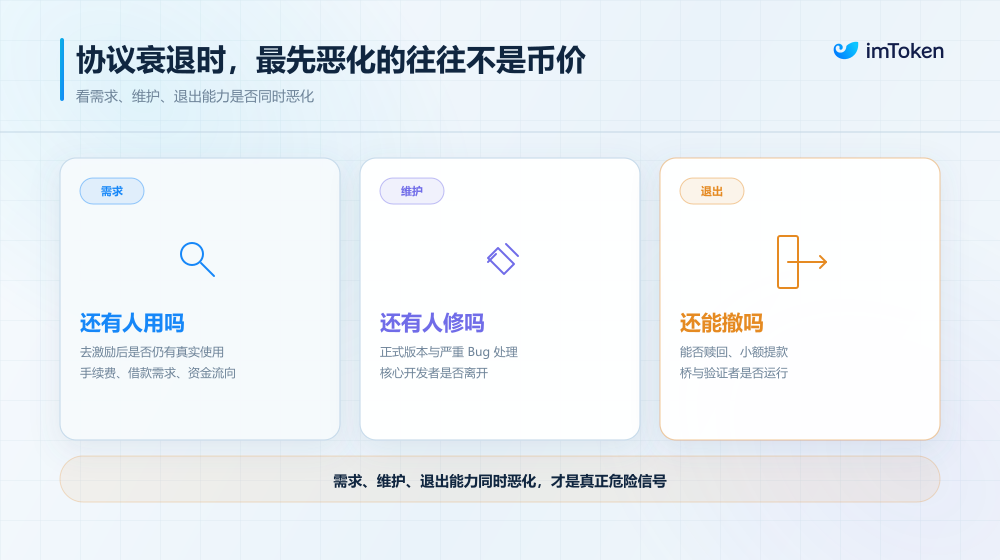
Therefore, as the industry begins to experience more structural clearing, the concept of "self-custody" also needs to be understood more completely. For long-term held underlying assets, keeping them in wallets where you control the private key remains one of the most crucial security lines.
However, after engaging in DeFi, cross-chain, staking, and other on-chain products, it's necessary to ask one more question: where exactly did my assets go?
Depositing ETH into a protocol and receiving a token in your wallet does not imply that the ETH is still resting in its original address; crossing BTC and seeing a BTC L2 does not mean that what you hold is still true BTC; moving assets into an LP, Vault, or lending market and seeing a balance also does not guarantee that when you exit, you'll be able to retrieve the original amount as shown on the screen.
In Closing
The farewell of POAP evokes strong feelings among many long-time users because it serves again as a reminder for Web3 participants that a product can exist without a token, without a massive financial game, and even genuinely be liked by many, yet still possibly come to an end.
This is not an anomaly in the blockchain world.
On the contrary, it might signify that the crypto industry has finally started to resemble a normal industry more and more, with products having a lifecycle, teams being replaced, and failing business models exiting, while limited developers, funds, and users continue to flow toward more efficient places.
In the coming years, such farewells are likely to recur.
Some projects will leave on-chain memories that belong to an era, just like POAP; some protocols will orderly shut down like dYdX v3, allowing users to continue withdrawing through contracts; while others, like renBTC, will lead people to only realize what they held in their wallet when the infrastructure was about to shut down.
Protocols will disappear, projects will fail, and a chain may even reach its end.
But the underlying logic of crypto asset security should not change with this, which is to never tie your ultimate control to whether a project can continue operating forever.
Let’s strive together.
免责声明:本文章仅代表作者个人观点,不代表本平台的立场和观点。本文章仅供信息分享,不构成对任何人的任何投资建议。用户与作者之间的任何争议,与本平台无关。如网页中刊载的文章或图片涉及侵权,请提供相关的权利证明和身份证明发送邮件到support@aicoin.com,本平台相关工作人员将会进行核查。


