Written by: @G_Gyeomm (Four Pillars)
Translated by: AididiaoJP, Foresight News
Key Points
Gold is an asset worth over $30 trillion but generates no cash flow. The traditional ways to generate returns from gold are limited to two: lending it out, or selling its volatility (call options). The call strategy is well-tested but the returns are only accessible to institutions and asset management companies, which have to absorb a range of costs, such as management fees, issuer credit risk, fixed strike prices, and pricing opacity.
On-chain gold has already surpassed off-chain in terms of custody and liquidity, but lags in returns. Borrowing demand is thin, and AMM LP will erode the upside exposure of gold due to impermanent loss.
Enhanced is a universal structured product infrastructure. For volatility returns, it executes the selling of call options through competitive RFQ auctions among institutional market makers, transforming the asset's inherent volatility into a continuous premium income.
The PAXG volatility earning vault is the first product in Enhanced's "Thesis Vaults" series. This type of strategy vault is created by the Enhanced team, using options (with plans to incorporate binary event positions in the future) to express a clear earning or outcome. For the volatility earning vault, the goal is to generate income from an asset that originally produced none.
Gold is just the starting point. The same engine will expand to tokenized stocks, commodities, and broader RWA fields, marking the beginning of a new generation of on-chain structured products: bundling clear outcomes into one-click vaults.
How has gold operated historically?
Gold has always been the heaviest, laziest, and least efficient asset. Physically heavy, also heavy in liquidity, with high storage costs. Gold does not generate cash flow like bonds or stocks. The result is that an asset class over $30 trillion has mainly served as a store of value for centuries, and holding it long-term means permanently enduring opportunity costs.

Two Ways to Make Gold Productive
Of course, there are honest ways to earn returns on gold: one is to lend it out, another is to sell its price volatility. The lending market came first, with the market for selling volatility gradually deepening later.
Leasing: The Gold Lending Market
Like the London gold market, which has a history of about 300 years, gold leasing is one of the oldest practices in finance. Today, central banks and large holders lend gold to precious metals banks, which then supply this gold to industrial users like refiners, jewelry manufacturers, and mining companies who have hedging needs.
The logic of borrowing gold is simple: borrow with gold, repay with gold, to hedge raw material price risks. Companies borrow the gold itself instead of purchasing it with cash, and when repaying, only need to return the same weight of gold plus the rental fee. Because liabilities are priced by weight of gold, when gold prices rise, product prices also rise, reducing repayment pressure; when gold prices fall, firms can buy gold at a cheaper price to repay.
However, this path has a natural ceiling on earnings. Gold lending income fully depends on the demand from borrowers. With thin and cyclical demand for borrowing gold, leasing rates rarely exceed 1-2%, and during the zero interest period from 2009-2011, even dropped to negative values, forcing lenders to pay to lend out gold.
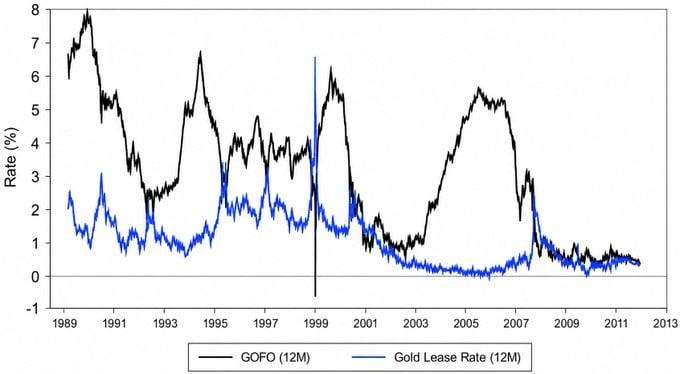
Moreover, pricing for these earnings is difficult to observe from outside the market. Outsiders can only track indirectly through limited benchmarks like GOFO. After the LBMA stopped GOFO, the public window for tracking gold forward and leasing rates basically disappeared. Ultimately, the gold lending market remains trapped by two major bottlenecks: thin borrower demand and opaque price discovery.
Selling Volatility: From Forward Sales to Selling Call Options
Since gold itself generates no cash flow, the only things left to be financialized are price and volatility. The second approach is to sell this price volatility. Mining companies sell their expected output at a fixed future price, securing revenue even if gold prices fall at delivery, at the cost of losing the opportunity to sell at higher prices when gold prices rise.
This approach is well-tested, but the problem arises when the volume pre-sold by producers exceeds the actual gold they can deliver. If gold prices rise, they must directly bear the difference between the contract price and the market price.
In 1999, Ashanti Goldfields established a large-scale forward sales position, and when the European Central Bank reached a sales restriction agreement that year which caused gold prices to soar, its hedging book suffered losses exceeding $500 million and could not meet margin calls, nearly going bankrupt. Ultimately, the strategy that survived and became the industry standard was selling call options.
Selling Calls and Its Limitations
What is selling calls?
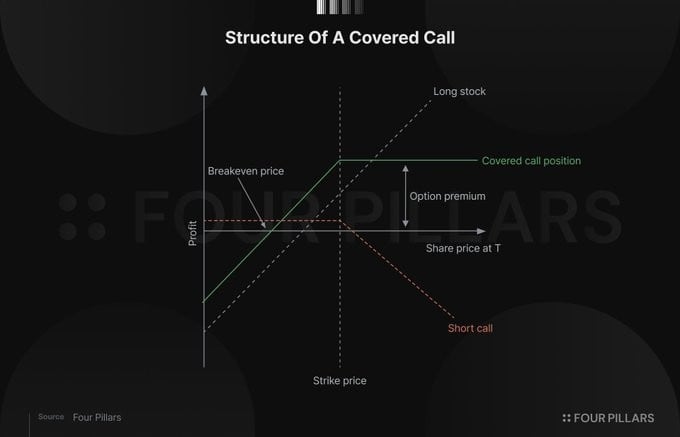
Selling call options is giving up part of the upside potential of an asset you already own in exchange for a premium. The difference from naked forward sales is simple: you only sell the amount you already hold. You are not pre-selling gold you don’t have, nor are you hedging the excess capacity; you’re merely allowing the market to take part of the price ceiling for the gold you already hold.
For example: a gold holder gives up a right — if gold prices exceed the current level by more than 4% within two weeks, the counterparty has the right to buy at that price — and then receives the price of this right (the premium) in cash. The outcomes then split into two possibilities:
Below 4%: if the price does not rise beyond 4% after two weeks, the option expires worthless, and all the received premium belongs to you.
Above 4%: if it exceeds 4%, you must deliver gold at the agreed price. Even so, you still retain the premium and the portion of the rise up to 4%, only giving up the part exceeding 4%.
In either case, you are selling within the ceiling of your own holding, so even if gold prices surge and you give up excess gains, your losses won't exceed your holdings and won't evolve into margin calls. If naked forward sales are a bet with empty hands, selling calls is more like temporarily borrowing out the price ceiling of your own asset for a rent payment.
Traditional finance has packaged this safer form into products. GLDI, listed on Nasdaq in 2013, was one of the early products for selling calls on gold, structured to sell call options on gold ETFs monthly, paying premiums as floating coupons. The first year's annualized returns ranged from 9% to 26%. Demand remains strong to this day. The gold earnings ETF IAUI, launched in 2025, managed assets of nearly $500 million within a year; over 60 new options earnings ETFs were launched in 2025 alone.
Limitations of Selling Calls
The demand and historical record for selling calls have been well validated. Vaults holding gold, institutions holding stocks, and wealth management firms layering options strategies on client portfolios all depend on the same principle. However, selling calls is not perfect, because investors must first bear quite a bit of cost and structural constraints before they reap premium returns:
Management Fees: The GLDI annual fee rate is 0.65%, deducted before the premium reaches investors. Coupled with additional access costs such as brokerage accounts, KYC, custodial fees, and exchange business hours, earnings are further eroded.
Issuer Credit Risk: GLDI is not technically an ETF, but an unsecured note (ETN) issued by the Swiss financial group UBS. Investors do not directly hold gold but have a right to receive payouts promised by UBS. Even if gold prices and options strategies operate normally, issuer credit issues could lead to losses in the debt itself.
Simple Strategies: Selling call products repeatedly sell call options on a fixed schedule. This can generate stable income, but in phases of rapid asset price increases, the upside potential is repeatedly cut off. More tricky is that most traditional financial strategies of this kind have monthly durations. This inflexibility often severely reduces upside earnings. The representative stock selling call ETF PBP has had an annualized return of 7.2% over the past decade, while the S&P 500 had an annualized return of 15.7% during the same period. The gap arises from setting strike prices close to the underlying price and fixing the term to monthly. Even small increases cut off excess earnings, and if there’s a sudden surge, positions are very hard to adjust midway.
Opaque Price Discovery: The strike price, duration, and other conditions are set by the managers, making it nearly impossible for investors to verify where and at what price the options are actually sold in the market. Investors can see the final distribution but find it hard to know how the premiums were formed through competition, or how much leakage turned into costs during operations.
In short, the path to capture gold volatility indeed exists. Yet that path is only open to institutions and asset management companies, riddled with constraints of fees, issuer credit, fixed strike prices, and pricing opacity. Earnings exist, but the entire journey to earnings is mediated.
Thus, finance naturally moves towards disintermediation. On-chain is precisely offering a compelling blueprint at this point. However, upon examining the existing sources of on-chain earnings, at least in terms of returns, on-chain gold lags behind off-chain gold.
On-chain Gold Lags Behind Off-chain in Returns
What was promised on-chain versus reality
Initially, on-chain promised a lot: trading assets without intermediaries, every settlement verifiable on-chain, most importantly composability—like Lego, combining assets and other financial products together. This promised a future without issuer credit, opaque price discovery, and distribution costs. But this promise has only been partially fulfilled.
Take the most representative tokenized asset, gold, as an example. The on-chain gold market has exceeded $5 billion, with tokenized gold spot trading volume exceeding $90 billion in the first quarter of 2026. Now, anyone with a wallet can trade gold 24/7, buying in fractional amounts for just a few dollars, without needing a brokerage account. Just in terms of custody and liquidity, on-chain gold clearly provides a better alternative.
But once viewed from the perspective of returns, the story flips. Off-chain gold holders can obtain double-digit returns from selling calls with products like GLDI. In contrast, those holding the same gold on-chain have much fewer options. Consider the two most common on-chain sources of earnings: lending and AMM LP.
Lending
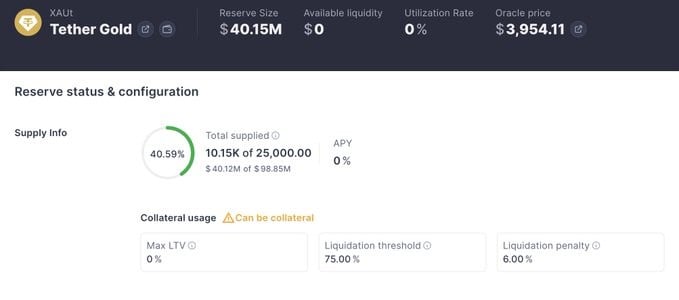
There is a path to lend out tokenized gold for earnings, but actual options are very limited. Looking at Aave's XAUt market, the supply scale is about $40 million, but the borrowable liquidity of XAUt is 0, with maximum LTV also at 0. Due to risk management considerations, it is closer to a state that allows deposits but prohibits lending and collateral use.
The reason is primarily due to liquidation risks. The order book depth of tokenized gold is shallower than that of ETH or USDC, and oracle updates are less frequent, making it difficult to ensure seamless processing during large-scale liquidations without slippage. Therefore, Aave has chosen to use XAUt only as isolated collateral, accepting it only under conservative parameters.
More fundamentally, the demand for borrowing gold itself is thin. ETH has staking returns, leverage demand, and serves multiple roles as DeFi base collateral, naturally generating borrowing demand. Gold, on the other hand, is more akin to a hedging and store of value asset, with an annualized volatility of about 10%. Very few are willing to pay interest and take liquidation risks to borrow it. Ultimately, lending has yet to turn tokenized gold into a productive asset.
AMM LP
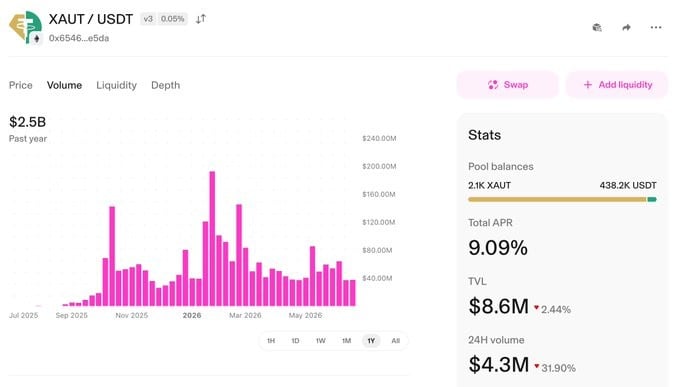
Another method is to pool tokenized gold and USDT together to earn transaction fees. The Uniswap XAUt/USDT pool shows an APR of about 9%. However, this number is far from what the LP actually receives. The displayed APR is just the annualized trading fees recently received, before accounting for impermanent losses.
LP splits funds into gold and USDT, providing liquidity on both sides. AMM adjusts the pool's weights by selling the appreciating asset and buying the relatively less appreciating asset. When gold prices rise, the pool supplies the appreciating gold to the market in exchange for USDT. The result is that the upside that one would normally enjoy by simply holding gold gets diluted into impermanent loss within the LP position.
Thus, LP earnings shouldn’t just be viewed through the displayed APR. When spot gold rose over 60% in 2025, the XAUt/USDT LP earned about 9% in fees, but holders were nearly unable to fully capture the price appreciation. Ultimately, the types of people applicable for this approach are very limited. For those who want to hold gold as a store of value, the burdens of impermanent loss and management ranges are unsuitable. LP is more suited for investors willing to exchange part of their gold upside exposure for fee income.
Reimagining Structured Products on-chain
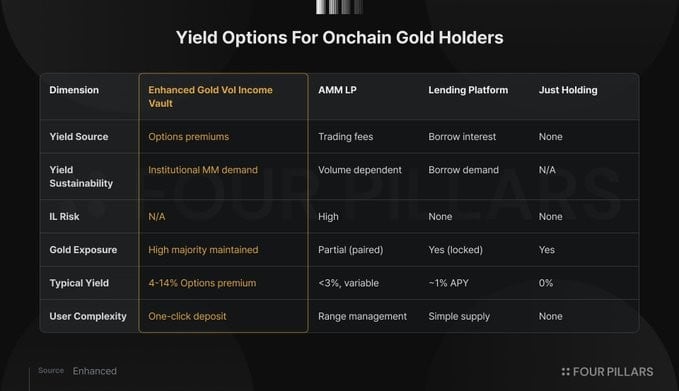
Lending and AMM LP have not been the answers for tokenized gold. One suffers from thin borrowing demand, while the other effectively erodes the exposure gold holders aim to protect. If this missing layer of returns persists, has tokenization really upgraded off-chain assets?
Bringing real-world assets on-chain is not without cost. Issuance, custody, legal structures, reserve management, and contract risks all come with significant costs. If the costs merely translate into atomic settlement and 24/7 trading, it’s hard to say that returns outweigh costs. In other words, returns should not be an added function of tokenized assets; rather, they are the minimum condition for a successful on-chain transformation. Viewed from another angle, this is, in fact, a reimagining of structured products on-chain—moving results that traditional finance has wrapped in fees and intermediaries into open, verifiable vaults.
Moreover, the absence of a returns layer manifests differently across asset classes. Assets with existing cash flows, such as government bonds or private credit, can relatively easily bring coupons onto the chain. In contrast, assets like gold, commodities, and stocks that lack intrinsic cash flows inherently have no coupons to bring, and the existing sources of returns—be it lending, trading volume, or staking—are thin or absent.
Therefore, on-chain assets need a layer different from existing sources of returns. This layer doesn’t have to be an entirely new invention. The call option selling strategy examined earlier is one alternative. Just in time for institutional capital to flow on-chain, the importance of having the infrastructure to execute this strategy, which has been validated in traditional finance, is rising. Enhanced, as a return layer’s infrastructure, is deserving of attention at this point.
Enhanced: A Layer of Structured Products That Can Turn Volatility into Clear Outcomes
Enhanced is an institutional-level structured return infrastructure for on-chain assets. The early task of on-chain finance was to issue and move assets; the next step turns to how to operate these assets efficiently. Enhanced aims to fill this missing return layer with derivative-based strategies, packaging clear payouts into one-click vaults.
Core Engine: RFQ Auction Engine
The core of the return strategy is options. After users deposit assets, Enhanced creates options selling positions using those assets as collateral and sends them to auctions of competing institutional market makers. The market maker offering the best terms buys the option, and the premium returns to the user. This is the structure that converts the asset's volatility into continuous returns.
Every options position in Enhanced begins with an RFQ (Request for Quotation) auction. The process is as follows:
- Taker: The taker (institution, whitelisted holders, or vault) initiates an RFQ, defining the option they wish to sell against their holdings. They specify trading terms, underlying asset, strike price, expiration date, quantity, direction, and collateral, leaving the price blank.
- Market Maker: The market maker quotes for this request. They sign a quote, attaching the premium they are willing to pay to these terms, locking in all the terms with their signature.
- Taker (Confirmation): The taker compares quotes from multiple market makers, selects one, and creates a matching confirmation signature.
- Operator: The backend operator relays the signatures from both parties to the on-chain gateway, where the gateway verifies the signatures, opens the isolated margin vault, writes and sells the options, then routes the premium back.
To ensure the integrity of the auction, Enhanced designs the RFQ as a permissioned market maker collective. Only top-tier institutional market makers, vetted through identification and review, can submit quotes. Each market maker goes through a signature onboarding process and submits quotes with a unique signature key. This way, each quote is bound by a signature and can only be used once. Based on this, the list of active market makers will gradually expand as more partners complete onboarding and risk reviews.
In this view, Enhanced is more like a singular options execution engine rather than a single product. The engine connects institutional market makers and on-chain asset holders through RFQ competitive auctions, over which are layered two interfaces: one manual RFQ interface for institutions and large holders, and one automated vault interface for regular users. Both share the same engine, the same auction, and the same settlement.
Manual RFQ Interface
This is the interface for institutions and large holders to directly access the engine. They can directly sell call options against their holdings and adjust terms such as duration, strike price, quantity, and direction as needed, to build customized structures. After market makers submit quotes, and traders select and sign the desired quotes, trades are executed in a single atomic transaction. Because all terms are pre-signed, the operator cannot arbitrarily change them. Selling puts and buying options will be introduced later.
This manual RFQ interface is designed for parties that need to self-manage their asset exposure. Foundation vaults, seasoned investors, and publicly listed companies with significant crypto asset holdings all have the need to adjust the timing and terms of their sales. For vaults like Metaplanet or Sharplink, which have amassed substantial assets, it has become a customized options execution channel to directly monetize their holdings.
Thus, every term of the transaction is fixed by the signatures of both parties, and the settlement is verified on-chain. The operator cannot change prices or quantities midway, and the assets of the holders will never be moved outside of the signed terms. This is a structure that allows institutions to face the market directly without needing to rely on counterparty or intermediary trust.
Vault Interface
This is the interface for the vaults to call the same options execution engine on behalf of depositors. The vault turns a clear outcome into a one-click product: depositors choose a strategy, and the engine handles the options mechanism at its core.
Enhanced calls these strategy vaults Thesis Vaults—a type of vault created to express a single, clear payout or outcome. Each vault compresses the arguments that a mature trading desk typically constructs manually (like earning from volatility or obtaining payouts when a future event settles in a specific way) into a single deposit. The first generation is built on options, with binary event positions to follow.
For the PAXG volatility earning vault, it subsequently sells call options through RFQ auctions on a fixed schedule and distributes the received premiums to depositors in each epoch.
Each vault is created with fixed parameters covering underlying assets, collateral assets, strike pricing assets, epoch length, deposit limits, minimum deposits, and target strike conditions. Because the vault ID is determined by the hash of this set of parameters, once created, the conditions cannot be arbitrarily changed mid-term. Tokenized gold is the first asset to be applied in this vault mechanism.
PAXG Volatility Earning Vault: How Gold's Volatility Becomes Income
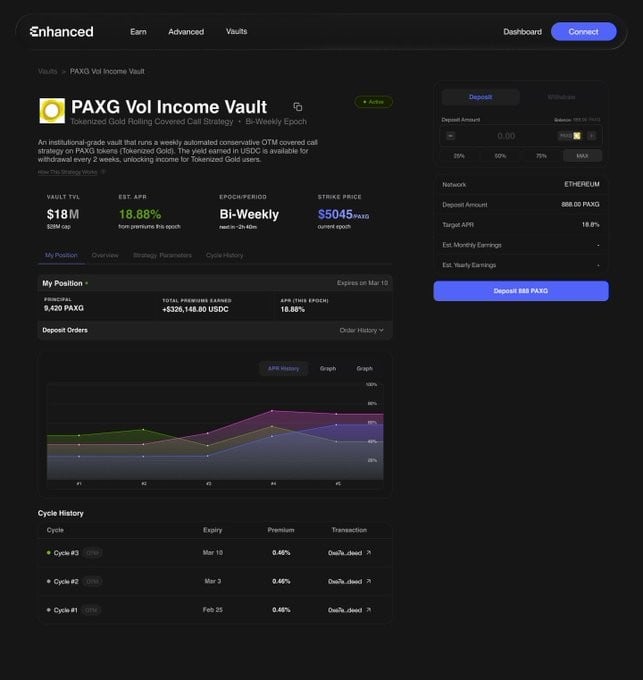
The PAXG volatility earning vault is the first product of Enhanced Thesis Vaults. Of course, gold is just the primary asset for application; the larger market Enhanced is targeting is the structured return layer of all on-chain assets.
However, there are clear reasons for starting with gold. Firstly, the implied volatility of gold in recent times is particularly suitable for selling call yields:
The strong rise from 2024 to 2026 lifted the implied volatility of gold (GVZ) from over 20 to just over 30.
As gold is an inflation-hedging asset, its long-term trends are relatively moderate. The combination of high premiums and controllable price actions is the most effective environment for selling call returns.
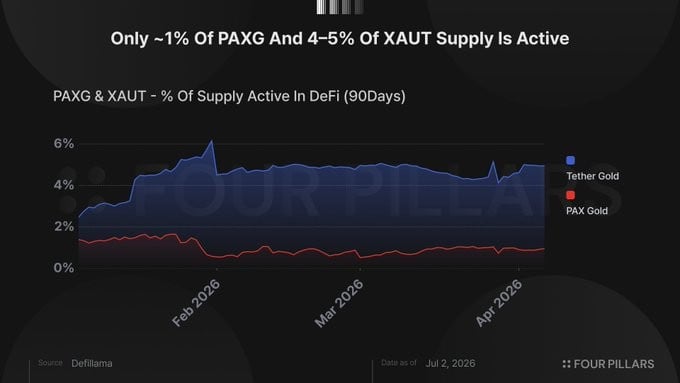
Another reason is that it is the asset with the emptiest yield space on-chain. According to DeFiLlama, about 96% of PAXG and XAUT are sitting idle. This means that most of the on-chain gold is held passively, not entering any specialized earning strategies.
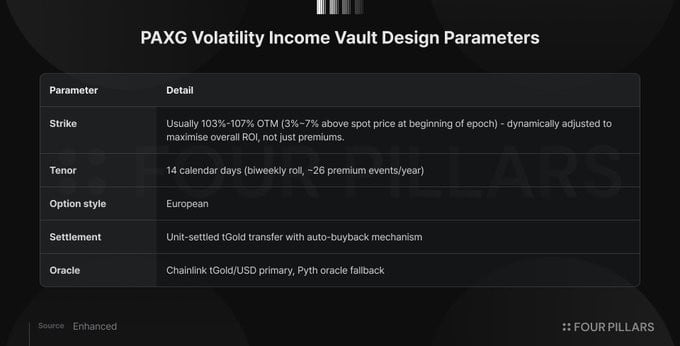
The vault, using deposited PAXG as collateral, sells European-style call options. The strike prices are typically out-of-the-money (OTM), priced 3-7% higher than spot gold, with a duration of two weeks. However, the strike prices and option sizes are not fixed values; they dynamically adjust within the OTM range for each cycle, reflecting market signals and price behavior.
The goal is to dynamically adjust the OTM range to retain as much gold exposure as possible while still earning sufficient premium. This is where it differs from traditional financial products that operate by fixed monthly rules for exercising options.
More specifically, this earning optimization will switch with market conditions. When gold's implied volatility (GVZ) rises, premiums become thicker, and the strike prices can be pushed further out (higher OTM strike prices), retaining more upside while still capturing sufficient premiums.
Conversely, when volatility is low and prices are stable, premiums thin out, and the strike prices will tighten closer to spot prices to increase the premiums received. In other words, even within the same dual cycle terms, the vault will continually find the balance between premiums and upside to match the current volatility environment.
Once the terms are set, the options immediately enter the auction. Institutional market makers compete for this option in the auction, and the winning premiums are pre-paid to depositors. To illustrate with numbers:
Deposit: Assume when the spot gold is $4000, the user deposits 10 PAXG, worth about $40,000.
Selling Options: Every two weeks, the vault sells a call option against this PAXG collateral. If the strike price for this period is $4160 (4% above spot), the vault would grant the market maker the right—if gold prices exceed $4160 within two weeks, they have the right to purchase at that price—and pre-receives the premium.
Not Exercised: If gold prices do not exceed $4160 after two weeks, the call option expires worthless. The depositor retains all 10 PAXG and takes home the full premium. Most cycles fall here.
Exercised: If gold prices exceed $4160, say rise to $4300, the market maker exercises their right. In this case, the depositor receives the premium and the portion up to $4160 but forfeits the part exceeding that by $140. Because only the difference is settled, the depositor still retains most of their gold position.
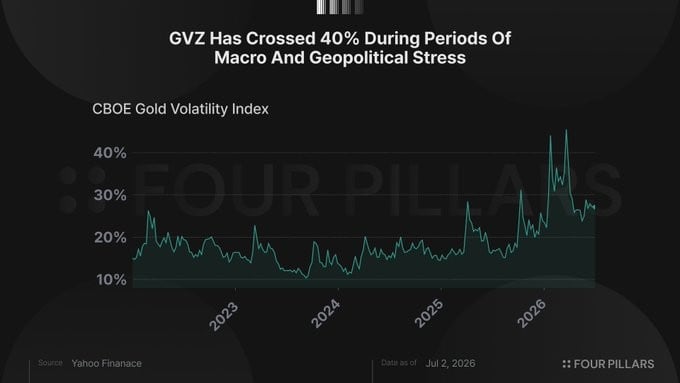
The result is that if the winning premium for a cycle is 0.4% of the deposit, it generates about $160 in earnings on a $40,000 basis. This cycle can roughly repeat 26 times a year. Premiums fluctuate with changes in implied volatility, becoming thicker during phases when implied volatility rises to around 30%. During uncertain periods of escalating geopolitical risks, GVZ has even surpassed 40%. Based on actual operational expectations, the premium returns are approximately in the annualized range of 4-14%.
Compound Model (Default): The premiums are automatically converted to PAXG and added to the next period's principal; if an exercise occurs, the settlement yield will be used to buy back gold to restore the position. Suitable for long-term holders who want to hold gold throughout the entire cycle.
Earning Model (Optional): The premiums accumulate into a separate balance in the form of USDT and can be withdrawn anytime, even midway through the epoch. Suitable for those who want to extract cash flow from their holdings without worrying about exit timing.
Protocol fees are not collected in advance but settled per epoch. The vault charges a protocol fee of 0.019% per epoch against deposited capital, annualizing around 0.5%. Therefore, users do not need to pay upfront but settle in each epoch the vault operates. There are no separate withdrawal fees, and this rate is fixed at the vault's creation and can be verified on-chain.
What Makes Enhanced Different, and What It Accepts
Differences from First-Generation On-Chain Vaults
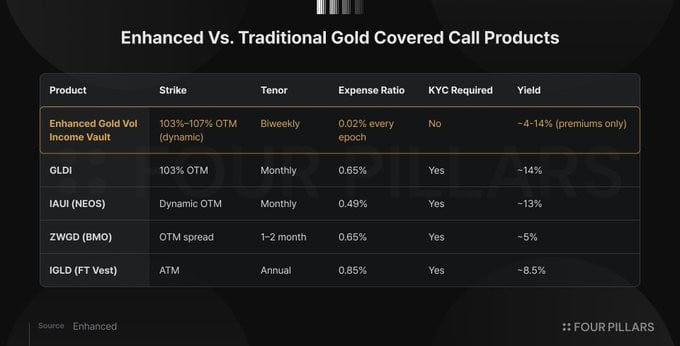
The vaults of Enhanced are reverse-engineered from all currently operational gold selling call ETFs in traditional finance. Its differentiations can be summarized as follows: management fees comparable to or lower than traditional finance, no intermediary distribution layers, global access without KYC, 24/7 operation, dual-cycle terms for quicker capture of theta decay, and every transaction, fee, and maturity is transparently recorded on-chain.
Together, these mark a broader shift: the next wave of on-chain structured products will no longer operate like traditional financial packaging or early crypto vaults. They will focus on clear, explicit results, hiding underlying complexities, and operating with transparent execution.
Enhanced is certainly not the first vault to sell volatility on-chain. In 2021, Ribbon Finance opened this model with its Theta Vault, reaching a TVL of $170 million at one point. The first generation of vaults proved the demand for structured earnings is real, but left clear weaknesses, which Enhanced is designed to address:
Auction-Based Price Discovery: The first-generation vaults repeatedly sold options based on fixed time and rules. Once the process became predictable, market makers could drive implied volatility down before auctions, purchasing options cheaply. Predictable unilateral supply leads to compressed premiums. Enhanced allows multiple market makers to quote for each transaction through competitive RFQ auctions, transforming competition into premium for depositors.
Strike Price Choice Aligned with Holders: The first-generation vaults were weak in bull markets as the strike price was fixed. Rapid price increases sliced off upside potential, forcing holders to repeatedly give up part of their earnings. Enhanced adopts further OTM strike prices and dual-cycle terms, adjusting strike prices and option sizes for each cycle based on market conditions. The goal is to retain as much gold exposure as possible within the strategy.
Assets with the Emptiest Yield Space: The first-generation vaults were limited to BTC and ETH. However, these assets already have competing sources of yield through staking, lending, etc., and as the vaults grew larger, the option selling flow became more predictable. Enhanced starts from the assets with the emptiest yield space in RWA. Gold has neither staking nor a deep lending market, making option premiums the most direct source of returns.
Selling Calls is Not a Free Lunch
Selling calls does not come without trade-offs. It can generate ongoing premiums, but at the cost of trading some risks.
Upside Potential is Capped: If gold prices significantly exceed the strike price within a cycle, depositors receive the premium and the portion up to the strike price but forfeit the part exceeding that. This is an inherent structural cost of all selling call strategies.
No Principal Protection: This vault is not a principal protection product. If gold prices decline, the USD value of the deposited assets follows. Additionally, if prices exceed the strike price significantly and options are exercised, the amount of PAXG held may decrease by the cycle's end. Even if the USD value might be higher than at the start, the number of tokens will change.
Dependent on Volatility: Returns are tied to the implied volatility of gold. If a low-volatility environment persists, options premiums compress, narrowing the yield advantage. The current environment at around 30% GVZ is favorable, but there’s no guarantee that such conditions will last.
Counterparty and Contract Risks: Counterparties are limited to verified institutional market makers using vetted contracts (Opyn Gamma). However, as an on-chain product, risks of contracts, oracles, and settlements still exist. Audits and TVL limits are mechanisms for risk reduction, not elimination.
These features outline the scenarios suitable for this vault. Enhanced does not claim that selling calls strategy will always outperform simply holding spot gold. It is also far from a product for those who want to ride to the top of a bullish market. It focuses on transforming a gold position that originally generates 0% returns into an asset that continues to generate income while retaining most of the underlying exposure.
Ultimately, On-chain Capital Needs Wealth Management
Finally, what market is Enhanced ultimately targeting? In the crypto domain, the narrative of "capital flowing on-chain" is often discussed as a singular event, but this flow has a clear sequence, and the balance size—a crucial metric for this sequence—is often overlooked. Enhanced's goal is also deeply tied to the depth of capital flow.
Today's on-chain activity is mostly concentrated on speculation. Prediction markets, perpetual contracts, meme coins, TCG platforms—all are core to trading. When on-chain balance units are still small, this is natural. If you hold $100, your stronger incentive is to invest this $100 in high-volatility, asymmetric upside trading.
But as the average user balance grows, people will no longer just put all assets into stablecoins, nor throw all into high-risk trades. The focus shifts from "where to earn asymmetric excess returns" to "how to manage the assets you hold," entering the wealth management phase. During this phase, demand for holding spot assets like gold, stocks, and commodities and generating returns while keeping exposure will grow.
Hence, the next mature phase of on-chain is not more trading, but innovative structured products. The problem is that this layer hardly exists today.
Enhanced aims to establish itself as a universal structured product layer in this blank market. Next come the new generation of on-chain structured products centered on clear outcomes. Each will be a Thesis Vault: taking typically institutional-level strategies that only seasoned users can leverage and compressing them into tools for expressing their arguments with one click.
The first application is the recently launched PAXG volatility earning vault. On-chain gold is just the beginning; the same engine is expected to expand to tokenized stocks, commodities, and the broader RWA field. The volatility of gold, which could only be endured before, now for the first time starts to work for holders—this phase is the starting point.
免责声明:本文章仅代表作者个人观点,不代表本平台的立场和观点。本文章仅供信息分享,不构成对任何人的任何投资建议。用户与作者之间的任何争议,与本平台无关。如网页中刊载的文章或图片涉及侵权,请提供相关的权利证明和身份证明发送邮件到support@aicoin.com,本平台相关工作人员将会进行核查。


