Written by: Prathik Desai
Translated by: Saoirse, Foresight News
"When the capital development of a country degenerates into a byproduct of casino trading activities, the venture of capital construction is very likely to fail." - John Maynard Keynes, 1936
The cryptocurrency industry has faced criticism, with many believing it is entirely driven by speculation, and some calling it a casino with no fundamental support. However, many fail to realize that speculation is often a precursor to market evolution. A group of speculators, scorned by the mainstream, come together to create liquidity, and the mature and compliant businesses of the future will be built on this liquidity.
In this article, I will analyze this evolutionary path in light of recent phenomena in the crypto market: a public chain initially intended to serve stock trading launches a Meme coin issuing platform; a perpetual contract trading platform transforms to build commodity trading infrastructure; and a brokerage relies on funds from a frog-themed token to support its on-chain stock trading system.
The story unfolds...
In the crypto field, speculation has many aliases: market noise, bubbles, casinos. But people have rarely acknowledged one point: in the process of industry maturity, speculation can become the cornerstone on which higher-level business forms grow.
However, it must be clarified that not all bubbles can be transformed into a foundation. Bubbles that remain purely speculative for too long will eventually burst quickly. If a bubble can combine with sustainable trading scenarios and continuously generate trading activity, it can become a foundation to support more business initiatives.
This is not a new phenomenon; it has played out repeatedly throughout the long history of financial development.
Let us revisit the grain market in Chicago in the 1840s. The Chicago Mercantile Exchange launched the futures market, originally intended to help farmers, whose harvests were filled with uncertainties, lock in prices in advance to minimize losses. However, every farmer wishing to sell grain for the future needed a counterparty willing to take on the long position and bear the price risk. Speculators filled this gap. The risk transfer market could function precisely because speculative capital actively took on the price risks that farmers wanted to shed.
The birth of the futures market was crucial as it separated "physical grain" from "grain as a trading commodity." American historian William Cronon called this process grain abstraction. Once grain trading was simplified to warehouse receipt notes, ownership could flow freely, allowing speculators to participate in the market en masse. A massive volume of speculative trades generated ample liquidity, enabling farmers to find trading partners at any time. The abundant liquidity ultimately allowed Chicago to grow into a global pricing center for wheat.
Interestingly, at that time, many people resisted and hated such trading. The Grange movement openly criticized exchange speculators, accusing them of profiting off farmers' labor. Yet this mechanism eventually evolved into an indispensable price discovery infrastructure for the global agricultural economy. If it weren’t for speculators acting as trading counterparts in the 1870s, today’s global wheat market would not have a mature pricing system.
Economist John Maynard Keynes's discussions on speculation are well-known, and his complete viewpoint reveals the dual nature of speculation. Keynes categorized market activity into two types: real investment, which anticipates returns generated during the long-term lifespan of assets; and speculation, which involves anticipating the next trading behaviors of the market's collective. He feared that in a market with abundant liquidity, speculative activities could undermine real investments.
A deeper reading of his discussions reveals the dual nature of speculation.
"If speculators are merely bubbles floating on the waves of industrial ventures, they may not cause serious harm. But when real investment becomes a bubble above the whirlpool of speculation, the situation becomes very dangerous. When a country's capital development degenerates into a byproduct of casino activities, the undertaking of capital construction is very likely to fail."
Speculation that exists independently from underlying assets is highly risky; but if speculation is anchored to valuable underlying assets, it can have a positive effect.
As early as the first book on the securities market - *Confusion of Confusions* by Joseph de la Vega in 1688, the author noted that the Amsterdam Stock Exchange simultaneously attracted both investors and gamblers. The vast majority of existing exchanges started this way. However, as time passed, this history gradually faded from people's memory, leading to a stereotype that serious investment needs were the original intention of establishing exchanges. This is not the case.
Looking Back
On August 5, the largest decentralized exchange in the crypto industry, Uniswap, launched the Pools issuance platform, allowing users to issue and trade Meme coins on the Robinhood Chain. This blockchain, developed by the brokerage of the same name, was originally aimed at servicing 30 million deposit accounts and facilitating tokenized stock trading.
The story does not end there. Before the official launch of the Pools platform, traders uncovered undisclosed smart contracts and executed trades exceeding $150 million through these contracts. This forced Uniswap to accommodate both the beta and official versions of contracts simultaneously and delay its launch plans. The leading token on the platform, FRONG, named after the filename of a frog video used to promote Uniswap’s product, was minted six days in advance using the same contracts; on the day the platform officially opened, the number of token holders reached 12,141.
Everyone can interpret this incident on their own: a transaction of around $150 million involving a frog-themed token trades on infrastructure that has not yet been officially activated, while this public chain was initially built for stock trading. Now, FRONG has also become the unofficial mascot of the Pools platform. One cannot help but speculate that this was a deliberately orchestrated action aimed at driving traffic for Uniswap’s latest V4 version blockchain. Even if it was not a deliberate arrangement, the on-chain trading volume for Uniswap V4 soared from $86.2 million to $228.3 million in a single day, nearly tripling.
However, as mentioned at the beginning, not all bubbles and speculations can foster sustainable business models. Whether a speculative business can last depends largely on what its underlying targets of speculation are. We can refer to shturl.c.
For many years, shturl.c has centered speculation as its core product and is now the largest Meme coin issuance platform. On this platform, 70% of Meme coins have a lifespan of less than one day, and only a very few survive beyond one month.
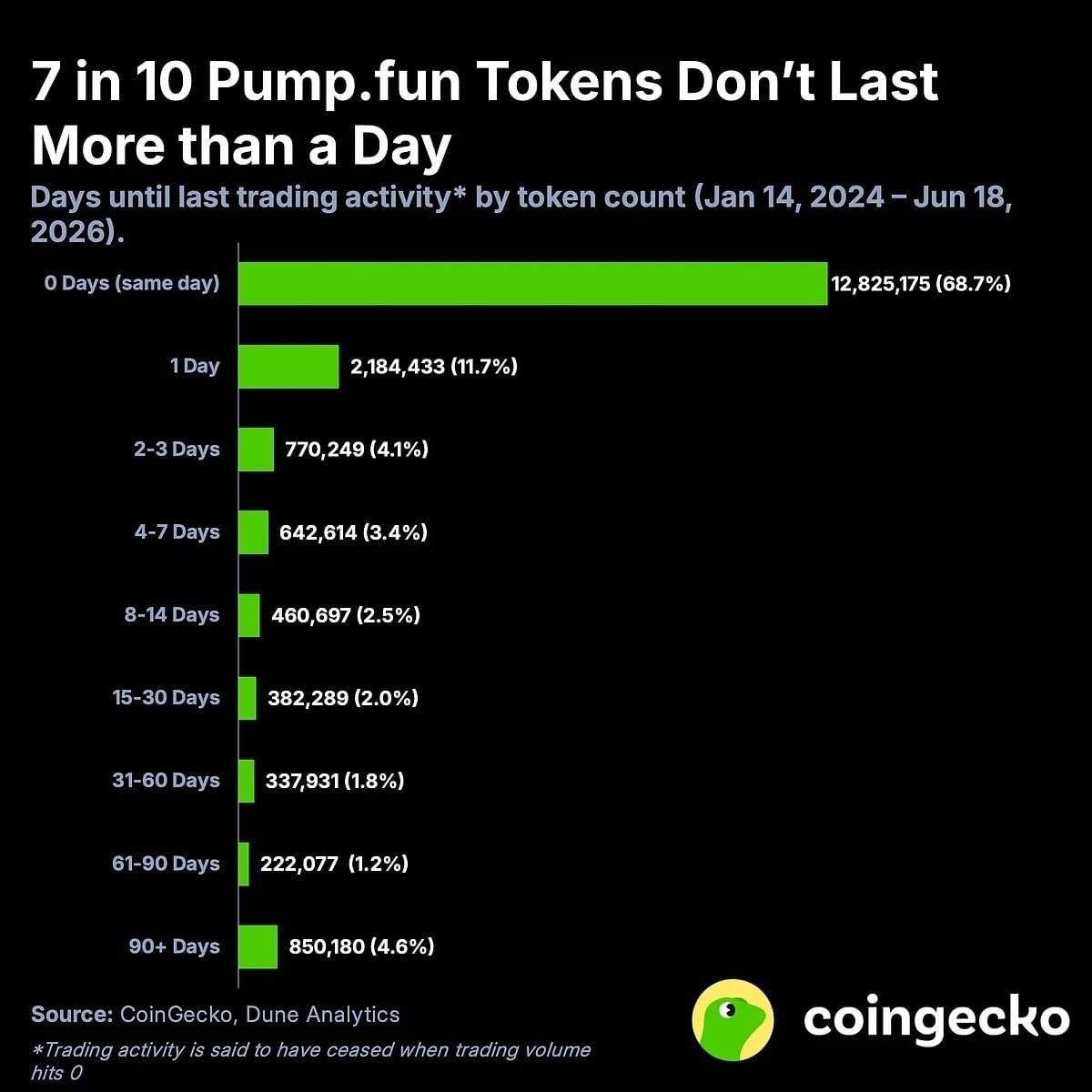
@Coingecko
From January to July 2026, the protocol's fee income compared to the same period last year was nearly halved, totaling only $420 million. Even so, it remains one of the strongest revenue-generating protocols in the crypto industry, with total revenues of $620 million and a net profit of $584 million last year.
Another similar platform is Hyperliquid. The platform initially focused on high-leverage cryptocurrency trading, catering to traders' directional betting needs. Later, it expanded its leverage trading model to various all-weather trading and non-crypto assets. Relying on the HIP-3 governance framework, the platform has now launched perpetual contracts for assets such as Nvidia, Tesla, Nasdaq tracking stocks, gold, crude oil, silver, and stock indices. Whenever there are breaking news about oil on Sundays, traders can immediately establish positions, while traditional markets have to wait until Monday to open.
In early July, the trading volume of perpetual contracts for real assets surpassed that of cryptocurrency trading for the first time in history, accounting for 52% of total transaction volume.
Although Hyperliquid's overall trading volume has shrunk nearly half from its peak in 2025, the growth in trading scale for real assets has offset the decline in crypto trading pairs. This is precisely the value that speculation can create: Hyperliquid is migrating the leveraged speculative model that attracts native crypto users to categories like gold, pre-IPO corporate equity, stock indices, establishing an all-weather pricing layer, a model that many traditional trading platforms are now imitating.
Robinhood Chain is currently replicating this development path in real-time.
Although the team positions this public chain as an underlying infrastructure for on-chain stock trading, CEO Vlad Tenev is very pleased with the traffic brought in by Meme coin traders.
"We are building Robinhood Chain to become the optimal public chain for trading real assets... but it's also excellent for trading Meme coins."
Leveraging the surge in Meme coin trading, this public chain surpassed the Base chain in daily active users just three weeks after its launch. The traffic and funds brought by Meme coin trading are the seed capital for the future development of the on-chain stock trading system.
Of course, this does not mean that speculation will inevitably upgrade to mature business. Whether it can complete this transformation depends on the platform's own choices.
Robinhood has 30 million deposit users and multiple business lines, with its strong distribution capability expected to convert the traffic brought by Meme coin trading into a user base for on-chain securities trading. We can see that its projected market revenue for the second quarter is expected to increase more than tenfold year-on-year, reaching $156 million, accounting for 20% of the platform's total trading revenue.
The Nature of Speculation
Many people have difficulty understanding speculation. Speculation itself is not inherently good or bad. Stripped of all additional labels, speculation is simply one of humanity's oldest instincts.
When people convert their views into financial bets, speculation naturally arises.
From its most primitive form, speculation is the liquidity that seeks pricing targets everywhere; wherever the liquidity flows, it determines the pricing of that target. The target can be a bag of wheat, Nvidia stock, a frog video named frong.mp4, the outcome of a soccer match, or the probability of a presidential candidate winning.
The inherent attributes of the underlying assets determine the direction and boundaries of speculation. Once valuable underlying support is lost, the same amount of capital that generates speculation will ultimately struggle to yield long-term and valuable results. This principle runs through the history of financial development, and the cryptocurrency industry is following the same path.
Hyperliquid has bound leveraged trading to assets like gold and built a new pricing system in just two years; Robinhood, via the unexpected traffic generated by Meme coin speculation, is simultaneously constructing the underlying channel for on-chain securities trading.
What kind of system speculation can ultimately build depends on how much value the underlying targets can carry.
免责声明:本文章仅代表作者个人观点,不代表本平台的立场和观点。本文章仅供信息分享,不构成对任何人的任何投资建议。用户与作者之间的任何争议,与本平台无关。如网页中刊载的文章或图片涉及侵权,请提供相关的权利证明和身份证明发送邮件到support@aicoin.com,本平台相关工作人员将会进行核查。


