Author: GSR (Spencer Hallarn)
Translation: Deep Tide TechFlow
Deep Tide Guide: The deadly flaw in DAO treasury management is becoming apparent—most assets are concentrated in native tokens, and once the market turns, the protocol has to simultaneously endure the triple hit of a plummeting coin price, sharply reduced income, and a collapse in on-chain activity. GSR Global Market Head Spencer Hallarn dissects the survival rules after the bull market tide recedes, which is extremely important for anyone holding DAO tokens or participating in protocol governance.
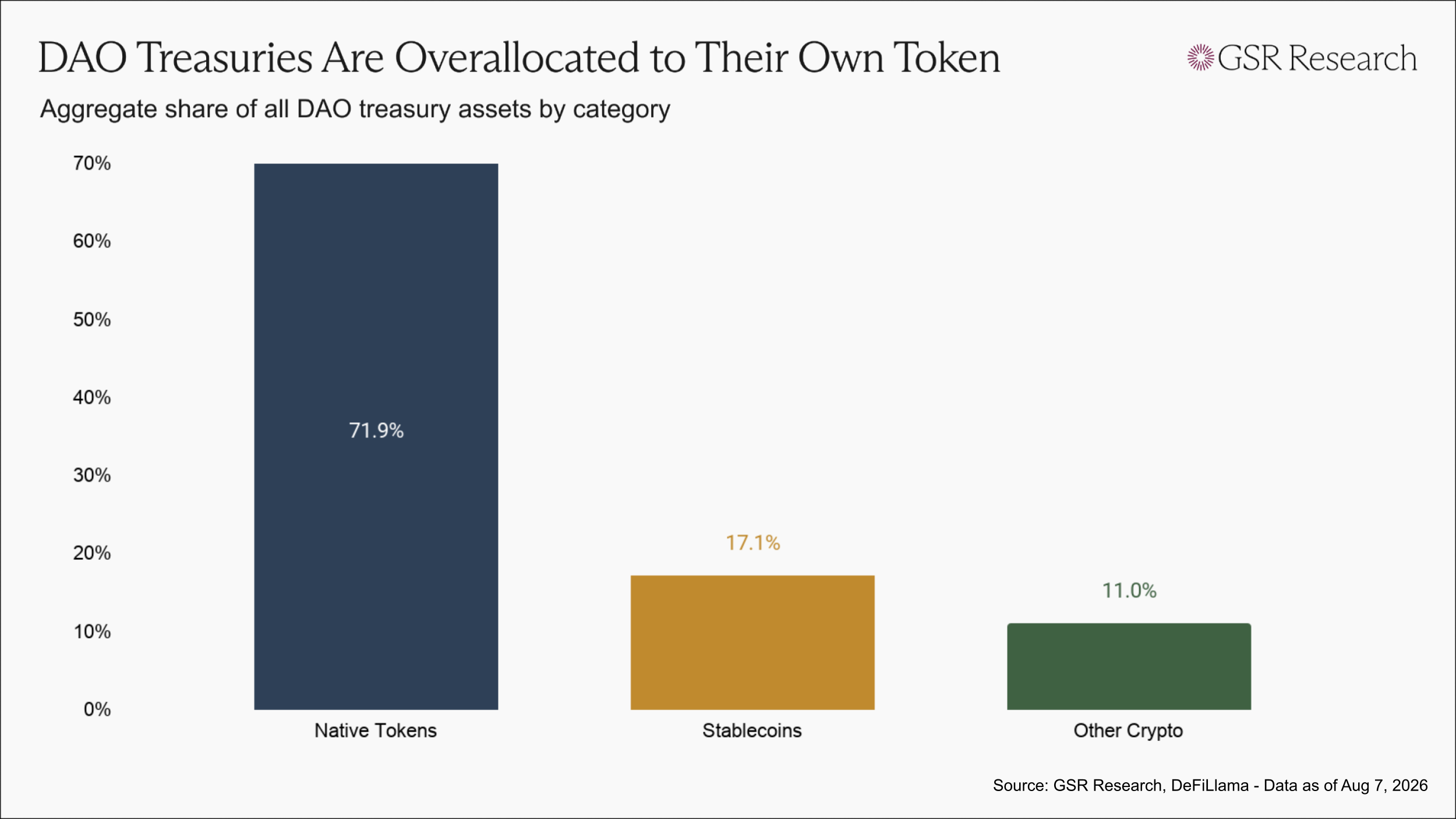
Nearly 70% of DAO treasury assets are still concentrated in native tokens, which structurally exposes the protocol to the simultaneous decline of treasury value, income, and on-chain activity.
Key Points
- The industry remains highly concentrated. Nearly 70% of DAO treasury assets are held in native tokens, leading many projects to face a single source of risk during downturns.
- Crypto treasuries are structurally pro-cyclical. Most projects keep the majority of their reserves in their own tokens, causing their treasury value, protocol income, and market activity to decline in tandem.
- Projects always hedge too late. Our OTC desk has observed a surge in demand for downside protection after price declines, during which period option premiums have already risen, and any floor price set by projects is far below the token's starting point.
- Protection does not require selling. Collar strategies provide downside protection by sacrificing part of the upside rather than consuming stablecoins, allowing projects to retain both positions and operational reserves.
- Treasury structure is more important than timing. Separating operational reserves from long-term holdings before market deterioration and establishing risk management policies can extend operational runway.
- GSR is an active participant in the crypto treasury and risk management markets. Our activities include providing OTC execution, block trades, and structured derivatives, including collar strategies and other hedging structures for foundations, protocols, and other market participants.
At GSR, we witness the same story repeating itself in every market cycle.
Crypto treasuries are structurally pro-cyclical because most DAO treasuries remain highly concentrated in their own tokens. Overall, over 70% of treasury assets are held in the project's own tokens, with a relatively low proportion allocated to stable assets or diversified reserves.
We can see the consequences of this configuration during each downturn.
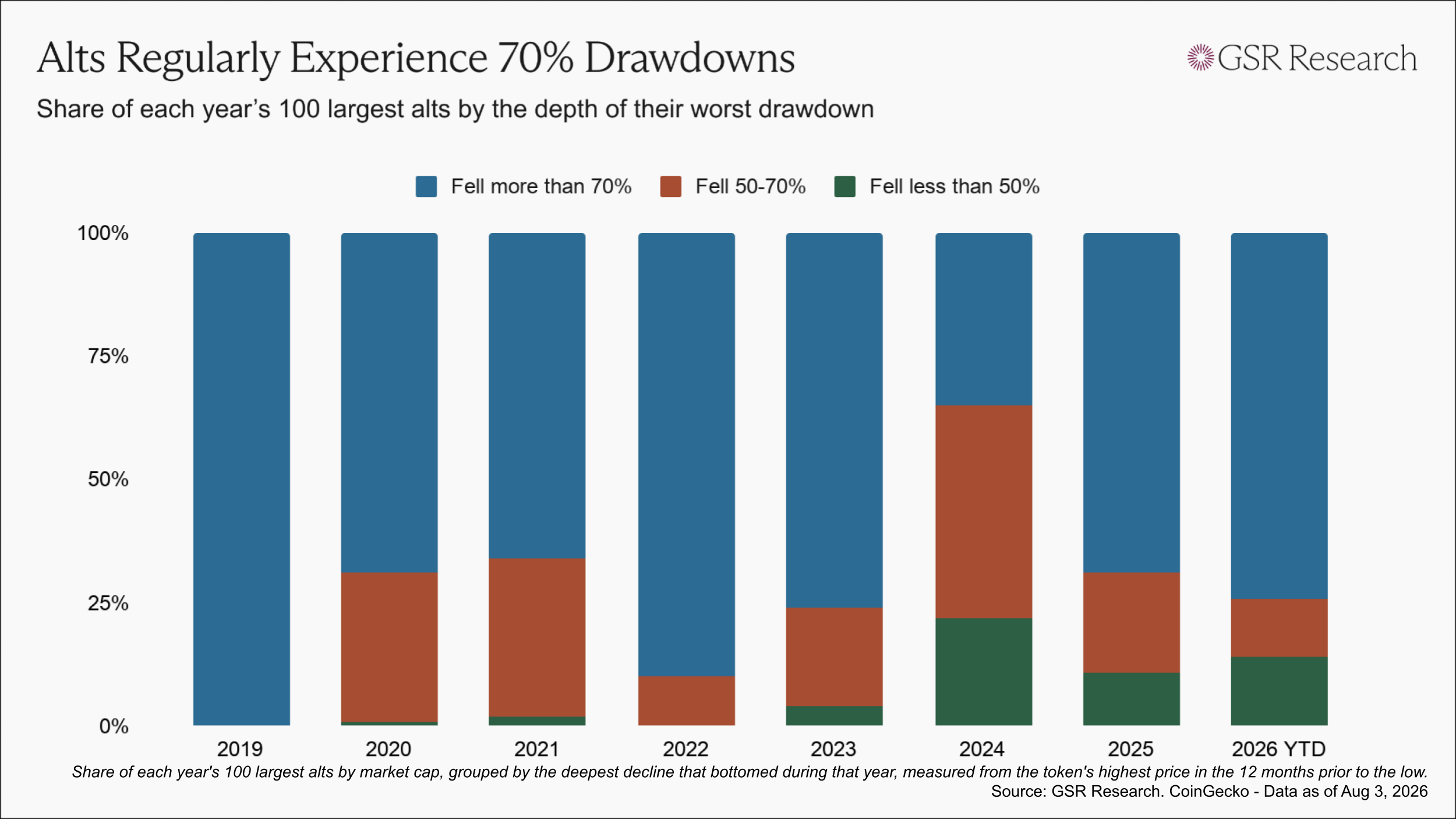
When the cycle reverses and token prices fall, the treasury that was originally intended to fund the roadmap suddenly becomes the largest risk source for projects.
Considering the current environment, such communications with our clients are more frequent than ever. Clients not only suddenly ask when the market will recover but also whether the projects have enough operational runway to continue building until the market recovers.
Activity Shrinks with Price Decline
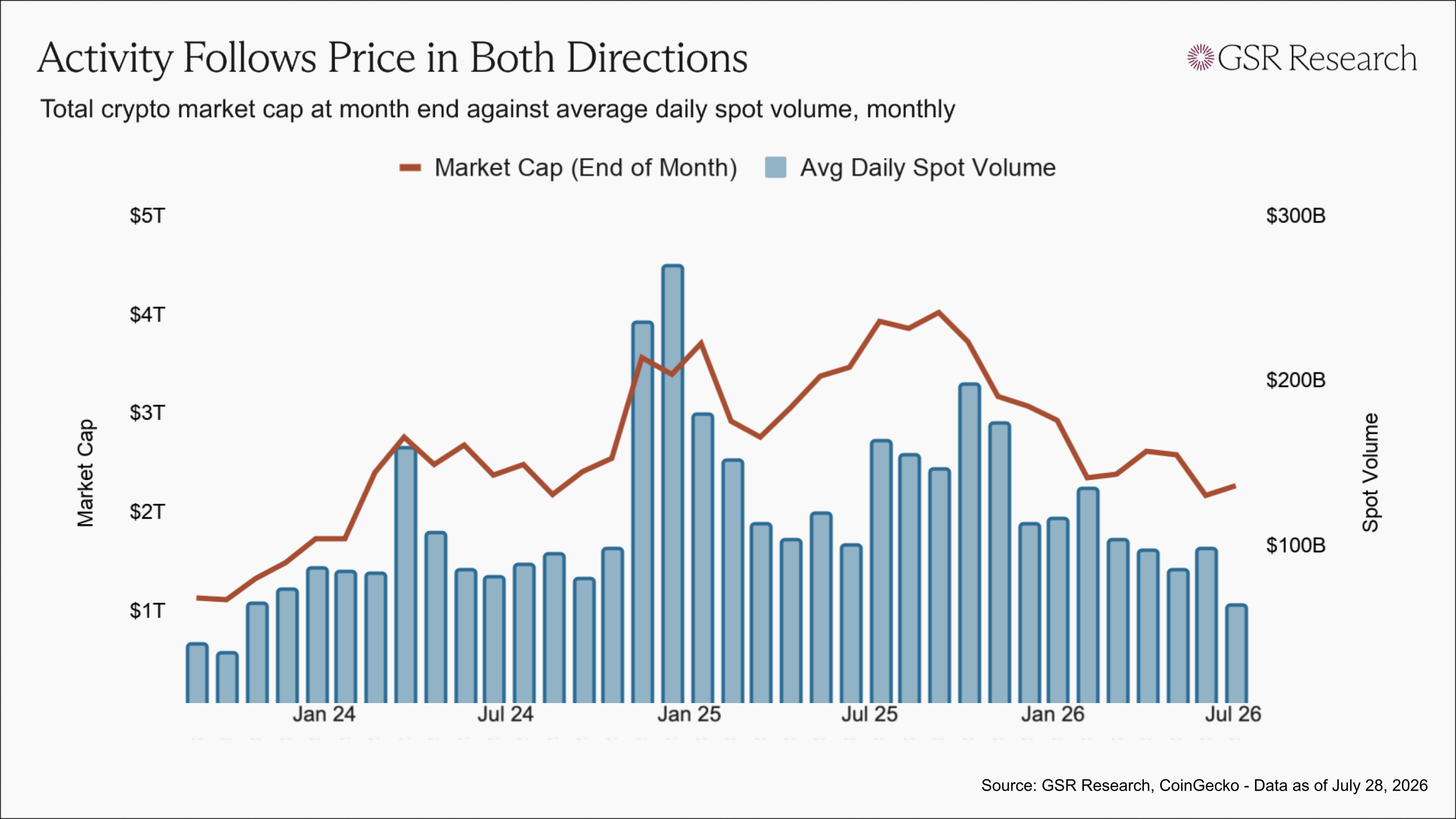
The second challenge is structural.
As treasury value declines, protocol activity weakens, fee generation slows, and liquidity deteriorates simultaneously. The treasury becomes the least valuable precisely when it is most needed.
We have seen this across cycles. Teams believe they have a treasury that can sustain them in a challenging market, but both sides of the balance sheet are exposed to the same underlying risks.
Costs do not decline with the token price. Salaries, audits, infrastructure, and grants are all denominated in USD, so projects that finance by selling tokens must sell more tokens to raise the same amount. Selling more supply in a weak market further depresses price, which increases the number of tokens needed for the next quarter. The burn rate of the treasury is much faster than a simple drawdown would suggest.
This is the first question we ask every client: If the market drops another 12 months, can your treasury still fund the roadmap?
Protection is Cheapest Before It’s Needed
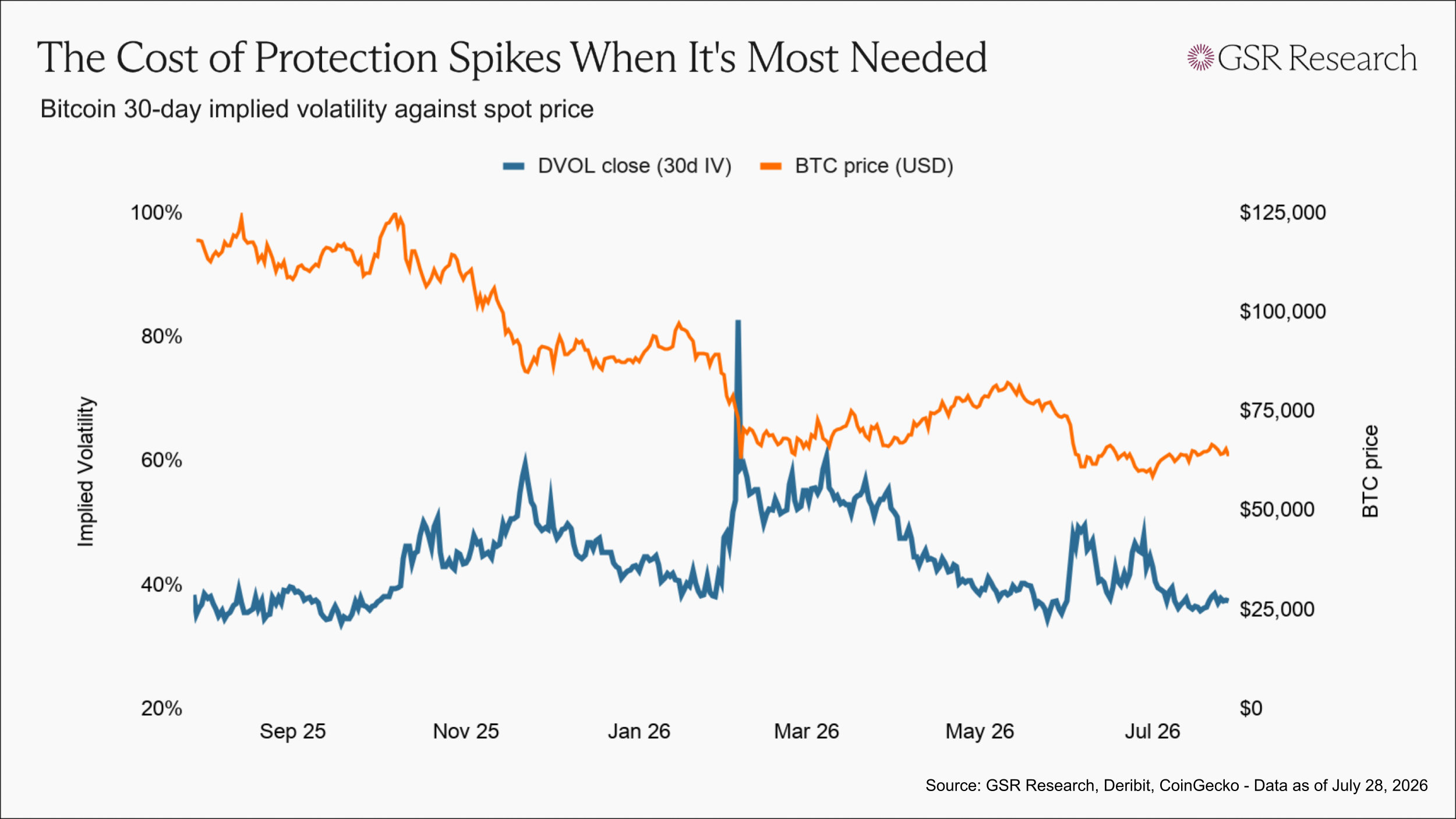
This is a clear pattern we have observed at our OTC desk.
During a bull market, very few projects are willing to hedge because paying option premiums feels like sacrificing upside. Then the market sells off, and the conversation almost changes overnight. Suddenly, everyone wants protection.
Unfortunately, that is exactly when protection is the most expensive.
As shown in the figure above, implied volatility usually rises after a market drop, which raises the cost of downside protection, precisely when demand is highest. This is financially equivalent to buying insurance when the storm is already overhead.
We have witnessed this scenario time and again. Every client wishes they had hedged when volatility was low. But no one can go back and do it.
Hedging should be seen as a continuous treasury policy, not a last-minute call out of fear. You do not need to predict the next price movement; just ensure that known liabilities are funded regardless of market fluctuations.
There is more than one way to pay for protection. Due to the typically higher volatility of crypto assets compared to traditional assets, the most commonly executed structure is the collar strategy. Projects sell a call option above the current price and use the received option premium to buy a put option below the current price. Ultimately, this sets a defined range for the project token. The value is protected below the put strike price, in exchange for the project giving up profits above the call strike price. If structured correctly, the two legs can offset each other, allowing the trade to be executed at zero cost. This makes collar strategies the preferred hedging tool for many projects, as directly buying put options consumes the very portion of reserves that hedging is meant to protect.
The collar strategy is not a sale, as the project retains risk exposure within the chosen range. It exchanges foregoing profits above the call strike price for a known floor price. When the dollar cost budget is set a year in advance, a collar strategy can transform a volatile asset into a range that the finance team can plan around.
These do not diminish the reasons for acting early. The collar strategy is a tool that offers protection from the day the token is executed at price. A project that sets a floor price when the token is $10 protects most of its value. A project that waits until the token drops to $4 to act finds its floor price also close to $4. In both cases, the structure is available, but it cannot recover what has already been lost.
Treasury Structure Determines Operational Runway
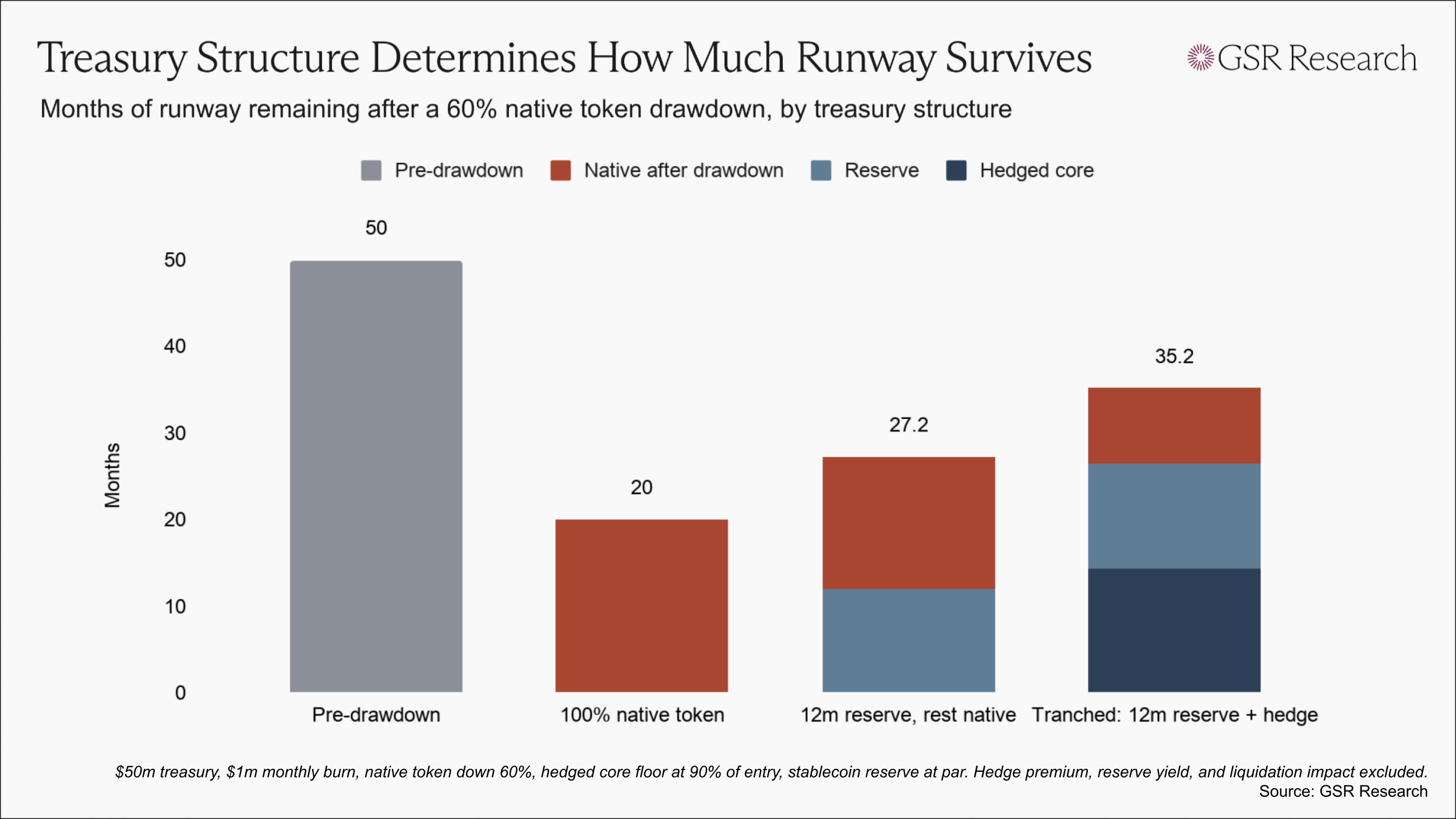
Projects that successfully traverse multiple cycles have treasuries with interdependent parts, each with clear purposes.
Operational reserves are held in cash or stable assets to pay salaries and operating expenses. Longer-term crypto holdings remain invested but are adequately hedged where necessary. Strategic positions remain intact without threatening the organization's survival.
The above figure illustrates the differences. A treasury held entirely in native tokens can lose years of operational runway in a significant drawdown. Separating reserves and protecting long-term holdings can retain much more operational runway even without assuming any market recovery.
Focus on survival before seeking growth.
How GSR Can Help
This is exactly where we dedicate our energy.
Each treasury is different. Liquidity, governance structure, vesting timelines, operational budgets, jurisdictional restrictions, and token concentration all impact how a treasury is constructed and the risks and trade-offs involved.
GSR collaborates with foundations, DAOs, and protocols to provide OTC execution, collar strategies, and other customized derivatives, structured hedging solutions, and block trades. These trades can be used to manage treasury concentration, market risk, and liquidity based on the specific circumstances of each treasury.
GSR's activities in these markets include executing treasury trades and designing structures under different market conditions.
Our industry remains cyclical. The projects that ultimately stand out will be those that never stopped building, as their treasuries were constructed from the beginning to endure the troughs.
This material is provided by GSR ("the Company") for informational purposes only. It does not constitute a recommendation or solicitation to buy, sell, or hold any mentioned investment. Investors should form their own views regarding any proposed investment.
This material is intended for sophisticated institutional investors and does not constitute an offer or invitation to make an offer or commitment, or any recommendation or solicitation to engage in or conclude any transaction (whether on the terms indicated or otherwise), or to provide investment services in any jurisdiction where such offers, invitations or services would be illegal. The Company is not acting in the capacity of an advisor or fiduciary when providing this material.
This material is not an independent research report and has not been prepared in accordance with any legal requirements designed to promote the independence of investment research by any regulatory authority (including the FCA, FINRA, or CFTC).
This material does not represent an independent view that is separate from the Company’s own interests, which may conflict with any counterparty interests. The Company may trade for its own account in the investments discussed in this material, may enter transactions contrary to the views expressed in this material, and may hold positions in other relevant instruments. The Company is not subject to any constraints on trading prior to the dissemination of this material.
The information contained herein is based on sources believed to be reliable but is not guaranteed for accuracy or completeness. Any opinions or estimates expressed in this material reflect the author’s judgment as of the date of publication and are subject to change without notice. The Company does not plan to update this information.
The trading and investment in digital assets involves significant risks, including price volatility and lack of liquidity, which may not be suitable for all investors. The Company is not responsible for any direct or indirect losses incurred through the use of this material. The copyright of this material belongs to GSR. No part of this material or any copy of it may be directly or indirectly obtained, reproduced, or redistributed without the prior written permission of GSR.
For relevant regulatory legal disclaimers regarding the United States, the United Kingdom, and Singapore, please see here.
免责声明:本文章仅代表作者个人观点,不代表本平台的立场和观点。本文章仅供信息分享,不构成对任何人的任何投资建议。用户与作者之间的任何争议,与本平台无关。如网页中刊载的文章或图片涉及侵权,请提供相关的权利证明和身份证明发送邮件到support@aicoin.com,本平台相关工作人员将会进行核查。


