
Author: Nancy, PANews
A Bitcoin soft fork incident initiated in the name of "anti-junk" ultimately ended hastily after only mining two blocks.
On August 9, the previously promoted Bitcoin Improvement Proposal BIP-110 failed to gain sufficient miner support, resulting in the fork starting and stagnating in less than a day, ultimately becoming an ignored minority chain. Additionally, key proponent developer Luke Dashjr faced public criticism and boycotts from the Bitcoin community for allegedly abusing BIP editing privileges.
Only two blocks produced in eight hours, multiple mining pools suspend support
Bitcoin experienced a forking incident again.
On August 9, when the Bitcoin block height reached 961,632, nodes supporting the BIP-110 proposal officially entered the enforcement signaling phase. According to the rule, nodes running BIP-110 will reject blocks that do not contain a support signal, thus splitting off a minority chain from the Bitcoin main chain.
BIP-110 is a temporary soft fork proposal aimed at restricting non-financial data such as Ordinals inscriptions, images, and text from entering Bitcoin transactions. Supporters argue that a large amount of non-financial data can occupy limited block space, raise transaction fees, and deviate from Bitcoin’s original intention as a monetary system.
However, Bitcoin protocol upgrades typically require miners to vote on block signals, and new rules can only be locked and activated after a certain proportion of support is reached. The activation threshold for BIP-110 was set at 55% (well below 95%), meaning that out of the 2016 blocks produced in about two weeks, at least 1109 blocks needed to contain support signals. However, during the last difficulty period before entering the mandatory phase, only 51 blocks emitted support signals, accounting for about 2.53%, far below the proposal's set standard.
For miners, although inscription transactions sparked controversy, they also generated real transaction fee income. Restricting non-financial data from entering Bitcoin transactions means that potential profit space could be compressed. Although emitting a support signal itself involves almost no cost, miners still chose not to participate.
Due to a lack of sufficient miner and hash power support, BIP-110 nodes could only maintain an independently operating minority chain. This chain inherited the current Bitcoin mining difficulty of about 127.48 trillion but attracted only a small amount of SHA-256 hash power, thus failing to maintain Bitcoin's normal block production speed.
After the fork occurred, the BIP-110 chain was only able to produce two blocks by the mining pool Roughnecks in about eight hours before becoming stagnant, while the Bitcoin main chain continued to operate steadily and expand its leading advantage. According to BIP-110 monitoring data, this branch currently remains at block height 961,633, while the Bitcoin main chain has advanced to 961,833, with a difference of about 200 blocks. At the same time, no new BIP-110 support signals appeared in blocks of the forked main chain.
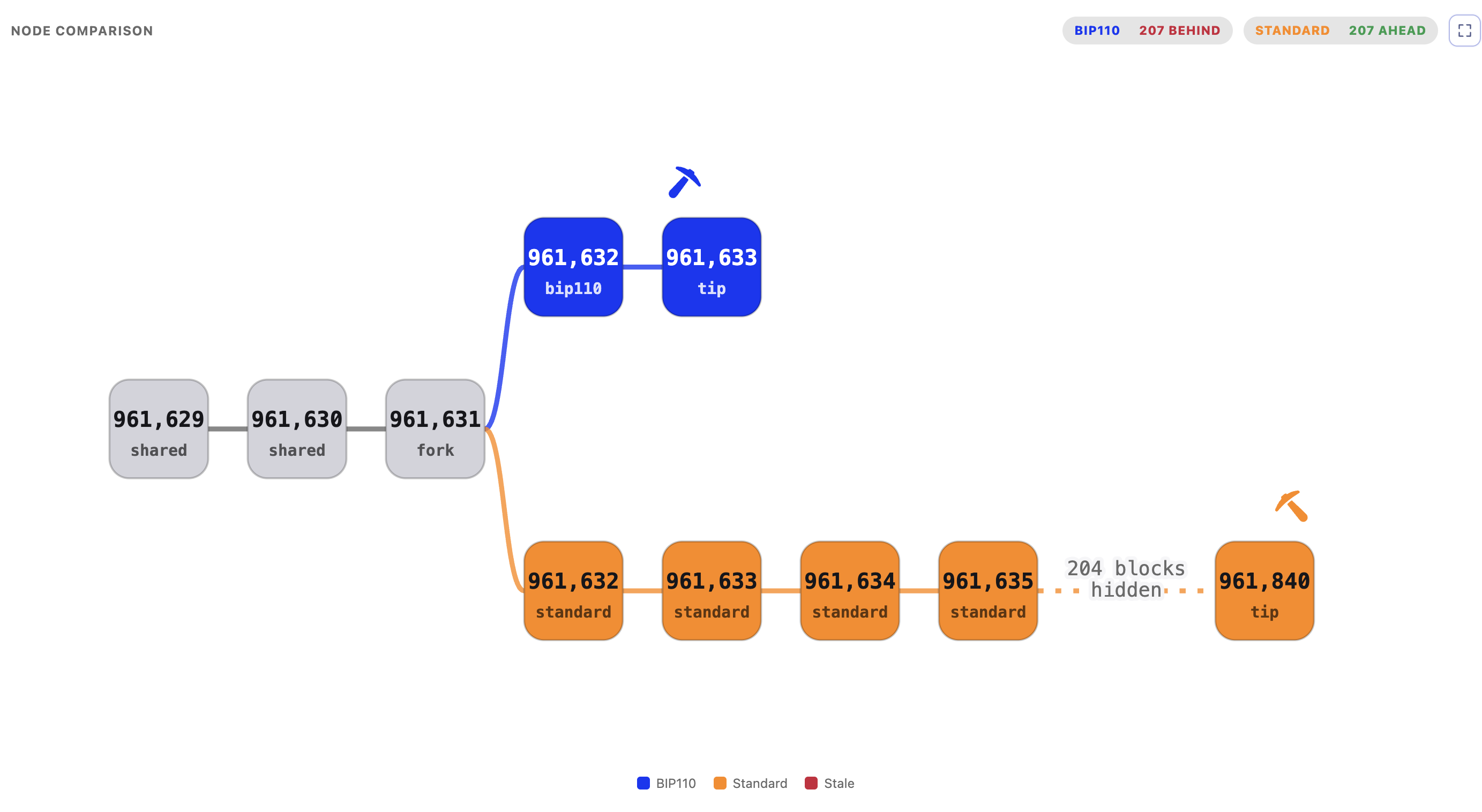
The key to this situation lies in that Bitcoin's mining difficulty does not adjust instantaneously according to hash power changes but is recalculated every 2016 blocks. Under the assumption of inheriting the main chain's difficulty parameters, the BIP-110 chain had only minimal hash power, resulting in a significant decrease in its block production speed. According to the current hash power ratio, this chain may require about 350 days to reach the next difficulty adjustment, while the Bitcoin main chain only needs about two weeks.
From a technical perspective, this forking movement has essentially failed, failing to change Bitcoin’s consensus rules or form a competitive alternative chain.
As hash power support continues to be insufficient, the economic value and operational capacity of the BIP-110 forked chain have rapidly declined, making it difficult to generate actual profits by further investing mining resources. The initially supporting mining pool Roughnecks subsequently announced the suspension of related mining operations. This mining pool stated that, after a team meeting, it decided to cease mining under the name Roughnecks and suggested that miners currently participating in BIP-110 chain mining pause operations until further notice. Another mining pool, PyBLOCK, also announced that it would temporarily stop supporting signals for BIP-110 until further notice.
Moreover, the BIP-110 fork also faces asset security issues. Since this proposal, being a soft fork, did not incorporate replay protection, Bitcoin developer Kevin Loaec warned that users need to proactively complete asset isolation in the early stage of the fork; otherwise, in the absence of replay protection, transactions involving forked coins might accidentally transfer real BTC.
Desiring to change the PoW algorithm, Wang Chun claims Luke is bankrupt financially and reputationally
In the face of the BIP-110 fork chain stagnating, the supporting camp did not acknowledge the proposal’s failure, pointing out that the lack of continuous hash power support for the fork was not due to inadequate community consensus but rather influenced by resistance from large mining pools.
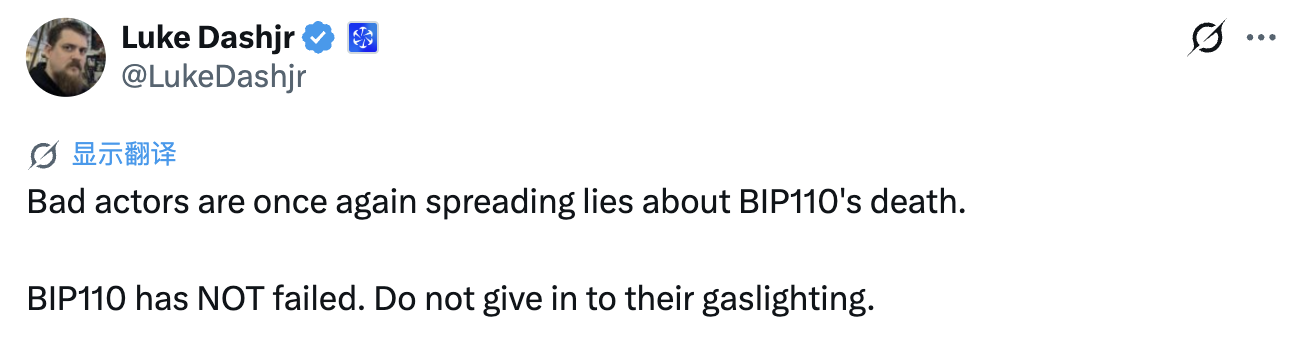
Luke Dashjr, maintainer of Bitcoin Knots and co-founder of the OCEAN mining pool, responded that external claims about the proposal being dead are the “bad actors spreading lies” and “gaslighting.” He believes that this chain split was not caused by BIP-110 itself but by "certain malicious mining pools and miners resisting changes to network rules," emphasizing that “BIP-110 had sufficient support in the past and present, only attacked by a minority force.”
Dathon Ohm, author of the BIP-110 proposal, also believes that large mining pools conspire to turn Bitcoin into a “toxic data dumping ground,” and the community is currently developing a proposal to change the Proof of Work (PoW) algorithm.
It is reported that BIP-110 supporters recently publicly discussed replacing the PoW algorithm to “fire” miners to eliminate reliance on existing Bitcoin miners. Candidate algorithms include RandomX, BLAKE3, Scrypt, Autolykos v2, and Dashjr also proposed using a random algorithm selection mechanism to prevent miners from preparing in advance. Currently, no PoW change proposal has been formally activated or confirmed.
In fact, the BIP-110 proposal has been controversial since its introduction. Opponents argue that as long as transactions pay sufficient fees, the Bitcoin network should not judge the purpose of the transaction, and restricting specific types of data would undermine Bitcoin's long-standing neutrality and censorship resistance.
Recently, Strategy CEO Michael Saylor published as many as 110 reasons opposing BIP-110, citing precedent risks, activation mechanism concerns, and qualitative disputes. Saylor stated that anyone can fork Bitcoin, but without security, practicality, capital, and users, a fork is meaningless; consensus needs to be fought for, not just announced.
Well-known analyst PlanB also openly opposed the Bitcoin BIP-110 proposal, believing that those supporting the fork do not truly understand Bitcoin's decentralization characteristics.
Blockstream co-founder Adam Back raised concerns from a technical perspective. He believes that although BIP-110 is positioned as a temporary solution to restrict "junk data" on-chain, its design could impact Bitcoin's future upgrade capabilities because the proposal would disable the OP_SUCCESS opcode in Tapscript, and these reserved mechanisms are considered essential foundations for future soft fork upgrades. Additionally, BIP-110's restrictions on Taproot control block size might also impact the development of potential Layer 2 technologies like BitVM.
As the controversy continues to escalate, Luke Dashjr himself has become the target of public denunciation from the Bitcoin community.
F2Pool co-founder Wang Chun, after blocking numerous accounts of BIP-110 supporters, stated that Luke Dashjr is not only financially bankrupt but also has a bankrupt personal reputation and sarcastically suggested that Luke might as well try changing the PoW algorithm, but the outcome would be equally poor.
Bitcoin Core contributor Mark Erhardt proposed to remove Luke Dashjr from his position as BIP editor. He indicated that Luke Dashjr participated in BIP-110 and abused editing privileges, including pre-allocating BIP numbers for the proposal and quickly merging updates in recent years despite contributing little to BIP editing work. Furthermore, trust, communication, and coordination between Luke Dashjr and other BIP editors have completely broken down.
Overall, while anyone can fork Bitcoin, without hash power support, economic incentives, and community consensus, a fork merely replicates a piece of code rather than creating a new network.
免责声明:本文章仅代表作者个人观点,不代表本平台的立场和观点。本文章仅供信息分享,不构成对任何人的任何投资建议。用户与作者之间的任何争议,与本平台无关。如网页中刊载的文章或图片涉及侵权,请提供相关的权利证明和身份证明发送邮件到support@aicoin.com,本平台相关工作人员将会进行核查。


