Written by: DWF Labs
Translated by: Luffy, Foresight News
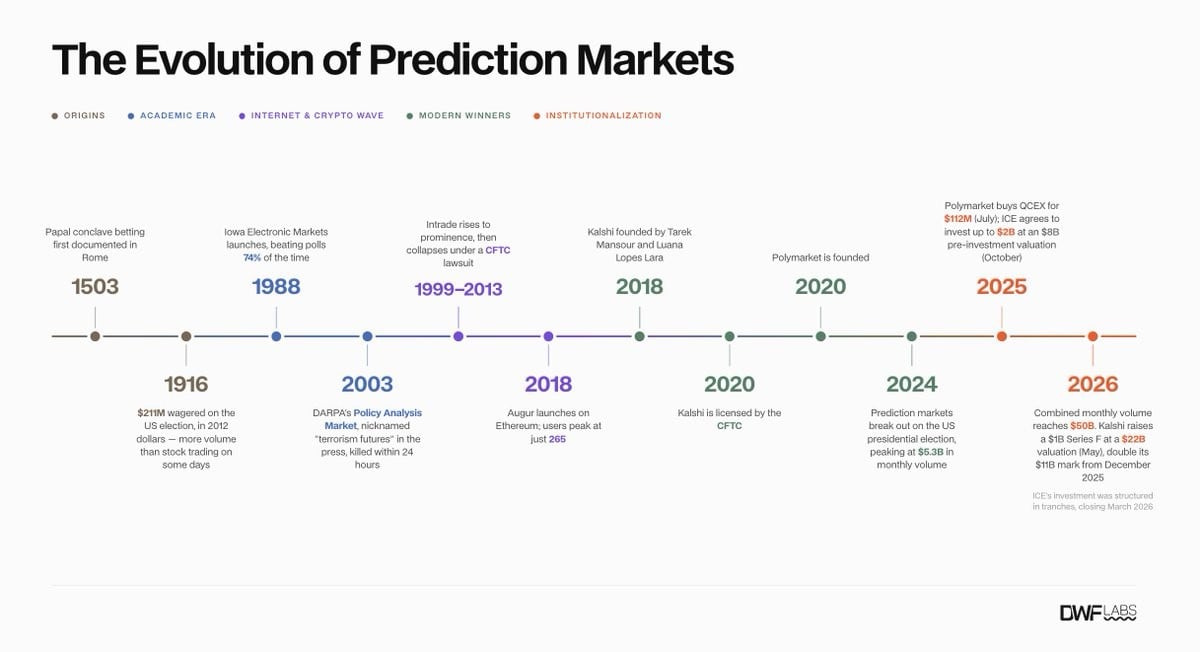
As early as 1503, betting activities regarding the next pope began in Rome. By 1916, adjusting for the 2012 dollar value, Americans placed approximately $211 million in bets solely on the U.S. presidential election, all occurring in the gambling market of New York. On busy trading days, the transaction volume related to election bets even exceeded the stock transactions of Wall Street's over-the-counter markets.
Since the Renaissance, people have started pricing uncertain outcomes with money, and these markets have performed quite well in this respect. So why have mature and viable prediction markets yet to emerge? How did Kalshi and Polymarket ultimately achieve breakthroughs? This article will review the development of prediction markets and explore their future directions.
What are prediction markets?
Prediction markets allow users to trade shares on the outcomes of future events, with trading prices ranging between $0–1, reflecting the market's real-time judgment on the probability of the event occurring. Unlike sports betting, there is no need to hold positions until the event settles. As the market fluctuates and probabilities change, you can open or close positions at any time.
In theory, prediction markets can become comprehensive information markets: you can trade on the probability of Fed rate hikes, how many Grammys Taylor Swift will win, the temperature in Paris on February 18th, and so forth.
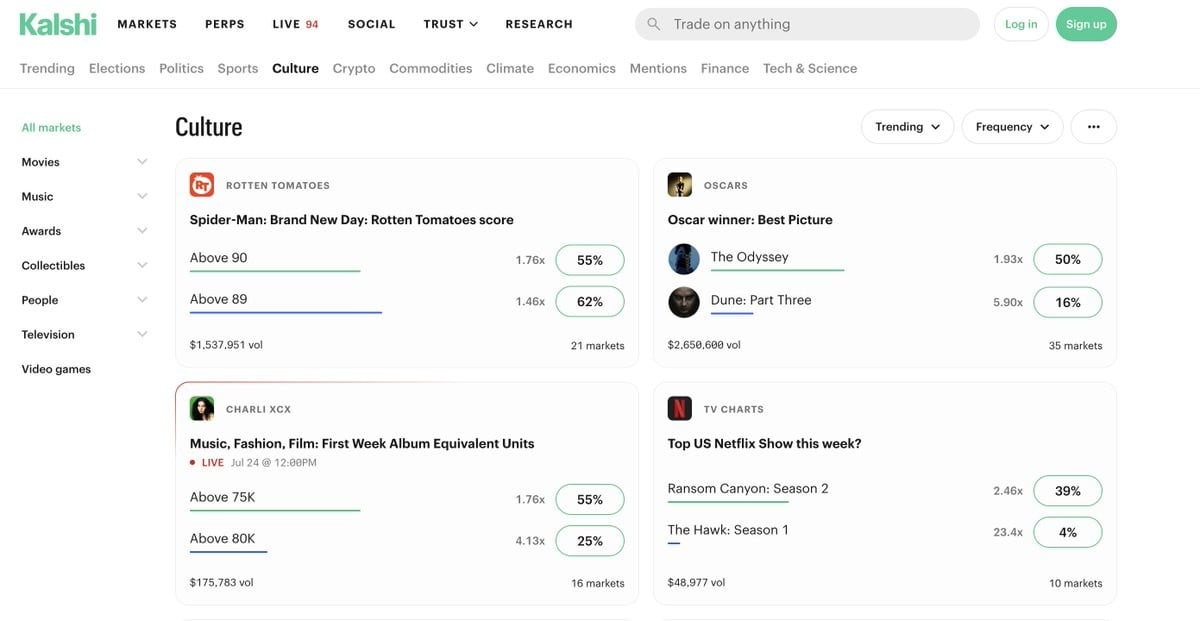
Kalshi’s cultural-themed prediction market
Theoretical foundation and early dilemmas
1988 is recognized as the founding year of modern prediction markets. The acknowledged pioneer of this field, Robin Hanson, wrote some of the first academic theories on information markets and idea futures. That same year, three professors from the University of Iowa set up the Iowa Electronic Markets (IEM). Over five election cycles, the probability predictions from the Iowa Electronic Markets were accurate in 74% of cases beyond polling accuracy, confirming Friedrich Hayek's 1945 assertion that markets are the most efficient means of aggregating collective intelligence.

Founders of the Iowa Electronic Market George Neumann, Forrest Nelson, Robert Forsythe, Source: NBC News
Despite having undergone concept verification early on, the years 2000-2010 were filled with numerous failed projects. In July 2003, the policy analysis market launched by the U.S. Defense Advanced Research Projects Agency (DARPA) was halted just a day after its launch due to accusations from two senators that the project, designed by Robin Hanson, resembled a betting market for assassination events. The U.S. Congress forbade the Hollywood Stock Exchange from transforming into a real movie futures exchange. Intrade operated in Dublin for over a decade but was sued by the U.S. Commodity Futures Trading Commission (CFTC) in 2012 for offering unregistered options to U.S. users, and the platform shut down in March 2013.
The cryptocurrency industry was seen as a solution. The launch of the Ethereum mainnet provided developers with programmable underlying infrastructure, and its decentralized and censorship-resistant features appeared to precisely meet the needs of prediction market development. But new problems quickly arose. Launched in 2018, Augur required users to bear high Ethereum gas fees, resulting in poor product experience. The platform's peak user count was only 265, plummeting to 37 within a month.
Problems faced by prediction markets
Before 2024, large numbers of projects disappeared, with common explanations being stringent regulatory environments and poor product execution. Teams underestimated the intensity of regulatory scrutiny while neglecting product interface and user experience. However, these factors alone do not adequately explain the deeper structural contradictions in prediction markets. In a widely circulated 2024 article titled "Works in Progress," Nick Whitaker and J. Zachary Mazlish offered a more profound analysis.
A sustainable market requires three core participants:
- Investors: Seeking long-term returns and wealth accumulation.
- Gamblers: Seeking excitement and thrill.
- Professional traders: Engaging in deep analysis to capitalize on mispricing.
The basic form of prediction markets lacks appeal to all three groups. Prediction markets are zero-sum games, and after deducting fees, they become negative-sum games, making investors completely unwilling to participate, as they require positive-sum markets for wealth growth. The vast majority of real-world events have long settlement cycles and niche topics, making them challenging to attract gamblers, who generally prefer bets with quick results.
Without trading counterparts from investors and gamblers, professional traders find it difficult to locate liquidity worth entering. Ultimately, the market is left with professional traders competing against each other, reflecting the real-world version of the no-trade theorem: if everyone is rational enough, no one is willing to act as a counterparty.
Aside from market structure, most topics hold limited appeal for the general populace. Without trading volume, professional traders lack the incentive to enter and compete for meager potential returns. Of course, there are exceptions, such as those in sports and political topics. Whitaker and Mazlish concluded that without external subsidies, the "everything is predictable" model of prediction markets cannot scale.
How prediction markets finally broke through
Despite the above-mentioned real deficiencies, prediction markets have matured into a viable product category. During the 2024 U.S. presidential election, they experienced an explosion of activity, with their probabilities widely referenced, becoming a factual point of reference. The New York Times cited prediction market data, CNBC reported on them, and Bloomberg Terminal even directly integrated relevant data. The total financing scale in this sector has exceeded $5 billion, with financing accelerating over the past 18 months.
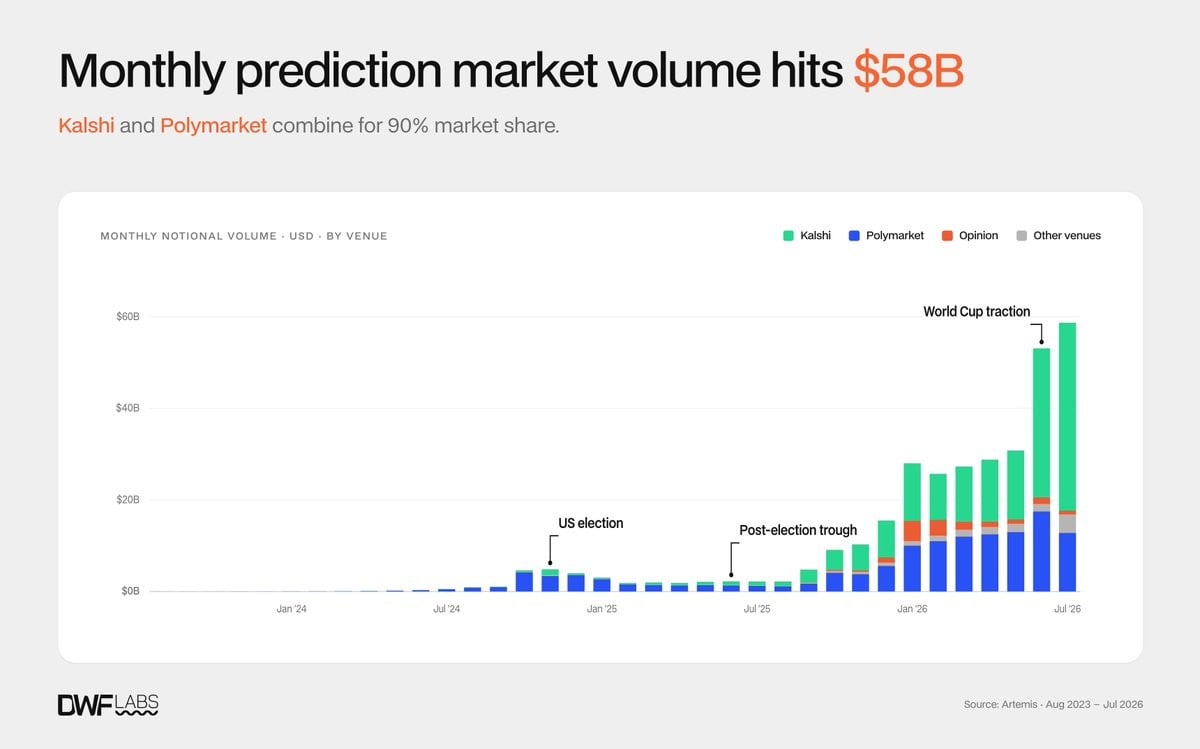
Even if you haven't been following this sector, you have likely heard of the two platforms that propelled the industry's breakthrough: Polymarket and Kalshi. The two combined represent over 90% of the industry’s trading volume, with total monthly trading volume exceeding $58 billion.
Polymarket
Polymarket was founded in 2020 by Shayne Coplan, a drop-out from New York University, who participated in the Ethereum ICO in 2014 and wrote to Robin Hanson in 2019, hoping to turn prediction markets into a reality. During the COVID-19 pandemic, he launched this product from his apartment in the Lower East Side of New York.
The iteration of cryptocurrency infrastructure, such as low-cost Layer 2 networks and stablecoins, helped Polymarket avoid the pitfalls of early crypto prediction markets. The platform operates on Polygon (Ethereum’s Layer 2 network), with gas fees compressed to just a few cents; using its own stablecoin PUSD for settlement means that a $1 payout is genuinely $1, with no price volatility risk during the holding period. The trading employs a hybrid order book, with off-chain matching ensuring speed, while on-chain settlement ensures reliability, combining the smooth experience of centralized exchanges with the characteristics of non-custodial settlement.

Polymarket founder and CEO Shayne Coplan, Source: Forbes
Polymarket adopted a "launch first, solve regulatory issues later" strategy, gaining greater freedom and faster iteration speed compared to contemporaneous competitors. The platform experienced early growth during the 2020 U.S. presidential election, with monthly trading volume reaching about $26 million, and then continued to expand reliant on pandemic and pop culture-related markets.
The lack of regulation, however, ultimately caught up with them. In January 2022, the CFTC fined Polymarket $1.4 million and ordered the platform to ban U.S. users. Compliance then became the utmost priority: the platform geoblocked the U.S. region, hired a former CFTC chairman as an advisor, and continued to operate in the rest of the world. By 2023, the platform's trading volume was approximately $73 million, which, in comparison to current figures, seems trivial but was sufficient for it to survive the crypto winter.
Next came the 2024 U.S. presidential election, a shining moment for the industry. Although formally prohibiting U.S. users from accessing, Polymarket became the representative platform for the cultural aspect of this election. The cumulative trading volume for election-related markets reached about $3.6 billion, with the accuracy of predicting Trump's victory exceeding polls and expert opinions. This massive surge thrust prediction markets into the global spotlight.
A week after the election, the FBI conducted a raid on Coplan's apartment to investigate whether the platform had any U.S. users bypassing the 2022 ban by trading on the international version of the site. In July 2025, the U.S. Department of Justice and the CFTC concluded their investigation without bringing any charges. A few days later, Polymarket spent $112 million to acquire QCEX, an exchange with CFTC licensing. In October of the same year, the parent company of the New York Stock Exchange, Intercontinental Exchange (ICE), agreed to invest up to $2 billion in Polymarket, with a pre-investment valuation of $8 billion; ICE also became the global distributor of Polymarket's event data. With the acquisition of QCEX, Polymarket re-entered the U.S. market in December 2025.
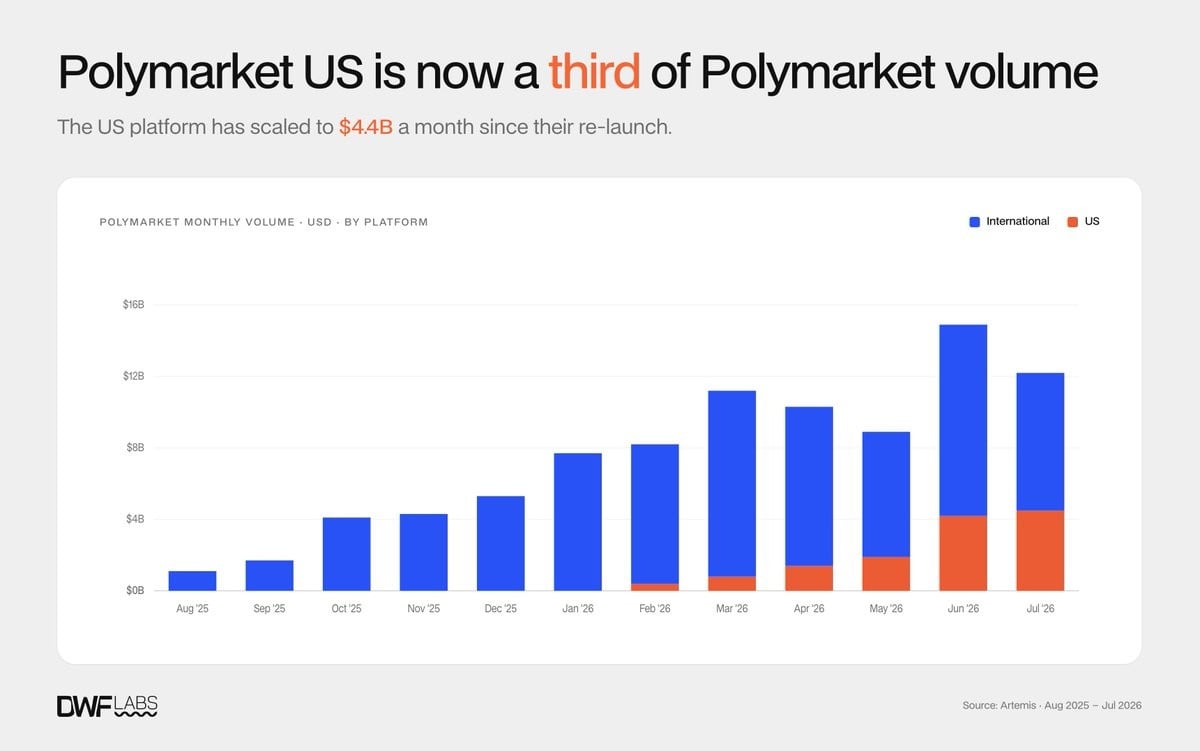
After the election excitement faded, sports and international geopolitical events continued to drive growth for the platform. By July 2026, Polymarket had completed a total of 707.7 million transactions, with total trading volume surpassing $111.9 billion. It was undoubtedly the leader of the industry in 2024, only to be surpassed by Kalshi later.
Kalshi
Kalshi made a starkly different choice from the outset. Founders Tarek Mansour and Luana Lopes Lara are both graduates of MIT (Lara was a professional ballet dancer, having performed in "Swan Lake" before transitioning to the financial markets), and they founded the company in 2018. They bet that being compliant from the start is more important than speed of development.

Kalshi co-founders Tarek Mansour and Luana Lopes Lara, Source: Forbes
The two founders waited almost two years to obtain approval for launch. In November 2020, the CFTC approved Kalshi as a designated contract market, making it the first exchange in the U.S. to receive federal regulatory licensing to list event contract derivatives. This license constituted Kalshi's core legal basis, as federal law holds precedence over state gambling laws. Kalshi officially launched in July 2021.
However, obtaining the license also brought about a series of challenges. The process for new hot events on the platform was slow, and strict KYC requirements further hindered growth. The most severe blow came when the platform's application to open a market for the 2024 U.S. presidential election was rejected by the CFTC. Faced with the largest catalyst in the history of the industry, Kalshi found itself unable to participate.
Kalshi filed a lawsuit and won. In September 2024, a federal judge ruled that the CFTC had overstepped its authority, declaring that election-related contracts are neither illegal nor considered gambling. With just 32 days remaining before election voting, Kalshi reopened election trading. This delay, compounded by strict KYC causing a lack of international users, resulted in it losing its foothold in user perception and market share to Polymarket. Kalshi's election-related trading volume was only about $500 million, while Polymarket achieved $3.6 billion.
After the election ended, the compliance investments began to pay off. Robinhood partnered with Kalshi to launch the first prediction market product; Bloomberg Terminal directly integrated Kalshi's data. The foundation for these collaborations was Kalshi's regulatory qualifications.
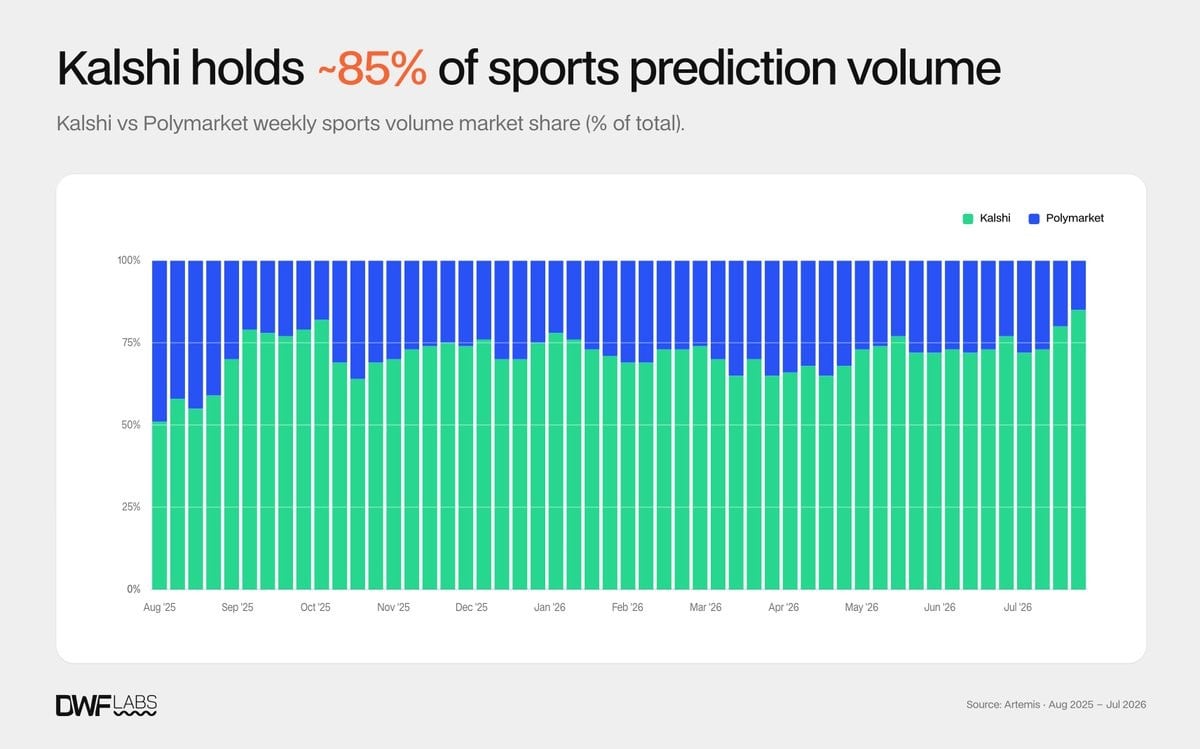
From 2025-2026, Kalshi significantly expanded into markets beyond politics. Sports became the largest category, with out-of-the-box marketing playing a significant role. The slogan "Knicks sweep four games" appeared in street interviews during the NBA Finals, with related clips garnering tens of millions of views. The team leveraged the World Cup for marketing, running ads featuring Timothée Chalamet, Lionel Messi, and Luka Dončić. During the World Cup, the platform had 3 million users generating $27 billion in trading volume.
By July 2026, Kalshi had completed a total of 982.6 million transactions, with a total trading volume of $155.7 billion, surpassing Polymarket and becoming the new leader in the industry.
Channels Fully Launched
The success of these two leading platforms has led to many exchanges and brokerages launching their own prediction market services. Many companies adopted a rapid launch strategy, testing market demand by integrating existing platforms into their applications.
Coinbase and Interactive Brokers took a different path by adopting an aggregation model, pooling liquidity and markets from multiple platforms. The CME Group built its own products from scratch. Robinhood followed a systematic approach, initially routing orders to Kalshi, and after demand was validated, built its underlying system, launching the CFTC-regulated exchange Rothera in June 2026. This bet quickly paid off, with Robinhood's event contract business generating $156 million in revenue in the second quarter of 2026, a tenfold year-on-year increase, which has already surpassed its $100 million in revenue from crypto trading.
Have structural issues been resolved?
Kalshi and Polymarket have addressed execution-level failures: regulatory strategies, low fees, and user-friendly product experiences. However, whether they have resolved the deeper demand issues raised by Whitaker and Mazlish remains to be seen.
- Gambler group: Partially addressed but far from achieving the goal of everything being predictable. Sports topics naturally align with prediction markets; the core issue is whether they can capture trading volume from traditional sports betting, and they have begun to do so. So far this year, the majority of trading volume has come from sports. Composite betting has been an important growth driver: it made up only 3% of total trading volume when it launched on Kalshi in September 2025, but by July 2026 it had climbed to 38%. Following closely are cryptocurrency price predictions. Political topics are no longer confined to elections, with military and geopolitical conflict market trading volume reaching $2.76 billion, slightly higher than the $2.73 billion of the U.S. election market; adding overseas elections, the scope of general political markets continues to rise. Markets related to culture (music, film, celebrities) are also growing. Economic topics such as Fed rate decisions and inflation show increasing volume. While there is still a long way to go before reaching the grand vision of "active markets for all topics," substantive progress has been made over the past 12 months.
- Professional traders: Partially addressed through incentives. Professional traders require ample trading volume and counterparty trading conditions outside of other professionals. The scale of the sports market at $120 billion, and cryptocurrency market at $22 billion, can meet this demand. Susquehanna joined Kalshi as a market maker in 2024, and later established a prediction market joint venture with Robinhood. Jump Trading has invested in both platforms to exchange for providing liquidity; Citadel is also assessing entry possibilities.
- Investor group: Issues remain unresolved. Prediction markets are still zero-sum games, where the money invested in gambling forgoes potential returns from investing in government bonds or other avenues.
The Next Era of Prediction Markets
In the next phase, prediction markets will evolve from niche platforms into infrastructures that price information globally. New markets will also give rise to entirely new mechanisms.
Customized Hedging
Businesses can hedge against unique risks that traditional finance and insurance cannot cover. For example, an ice cream shop can hedge against unseasonably low summer temperatures. Such demands were previously unmet, as traditional insurance companies would not underwrite, due to the difficulty of achieving profitability on niche topics.
Breaking the $0–1 binary pricing model
Perpetual markets: Continuous trading markets for any event. For inflation, for example, a binary market can only bet on fixed outcomes, such as "Will inflation exceed 3.1%?". A perpetual market allows you to long or short the inflation rate itself.
Composite markets and idea governance: Pricing no longer just focuses on a single event but on pricing the relationships between two events. For example, "If Elon Musk resigns, what will Tesla's stock price be?" or "If the U.S. invades, what will the oil price be?". Multiple markets price different variables, enabling more precise assessment of asset values. Idea governance goes a step further by assisting governance and policy decisions through conditional markets: implementing market predictions could lead to better outcomes.
AI Agents as Truth Explorers
In the future, markets will operate with a large number of AI agents, conducting research and trading around the clock. These agents can act as automated truth detectors, scanning Telegram groups and social media to quickly unearth factual evidence faster than human commentators, making trades on mispricing and further enhancing the accuracy of prediction markets.
Media's Data Infrastructure
Deep integration of news: Collaborations with CNN and CNBC signal a deeper symbiotic relationship with traditional media. Media reporting will no longer just focus on already occurred facts but also cover what will happen in the future.
Expansion into long-tail topics: Markets extend into long-tail areas, pricing local community events and niche cultural trends, such as layoffs in the tech industry or the performance of Taylor Swift's albums. However, to stimulate demand, user habits need to change; users need to not only read news but also participate in betting on outcomes.
Resolving the Issue of Missing Investors
Yield-bearing collateral: Traders no longer need to pledge idle USDC and can use interest-bearing assets, such as sUSDe or tokenized U.S. Treasury bonds as margin. For instance, Ethena's sUSDe has achieved annualized returns of 4% to 30% over the past two years by securing permanent funding rates and can already be used as collateral on platforms like Aave, Pendle, and Morpho. If prediction markets support similar collateral, the investors' capital can earn ongoing yields while serving as position guarantees, rather than lying completely idle prior to event settlement.
Modular combinations of finance and DeFi: Structured products can be built on top of prediction markets, either bundled with other assets or used as collateral for borrowing. When event contracts can be bundled with income-generating assets or used for collateral lending, then the zero-sum game is no longer the only return on that capital.
免责声明:本文章仅代表作者个人观点,不代表本平台的立场和观点。本文章仅供信息分享,不构成对任何人的任何投资建议。用户与作者之间的任何争议,与本平台无关。如网页中刊载的文章或图片涉及侵权,请提供相关的权利证明和身份证明发送邮件到support@aicoin.com,本平台相关工作人员将会进行核查。


