Author: Bankless
Translated by: Deep Tide TechFlow
Deep Tide Introduction: The Ethereum staking rate has exceeded 33% and continues to rise. Researchers at the Ethereum Foundation propose limiting the staking rate to below 50% through a burning mechanism. Supporters believe this can prevent staking giants from monopolizing and protect non-staked ETH holders; opponents warn it could disrupt DeFi yield benchmarks and stifle independent stakers. This debate is crucial to the economic model direction of Ethereum over the next decade.

The Ethereum community has engaged in fierce debates this week around the EIP-8363 proposal.
This concept of "decreasing issuance burn" can be traced back to 2023 when researchers at the Ethereum Foundation began publicly expressing concerns about the lack of an upper limit on the ETH staking rate. Discussions related to this were held at the Bankless Summit 2024.
Why EIP-8363 and why now?
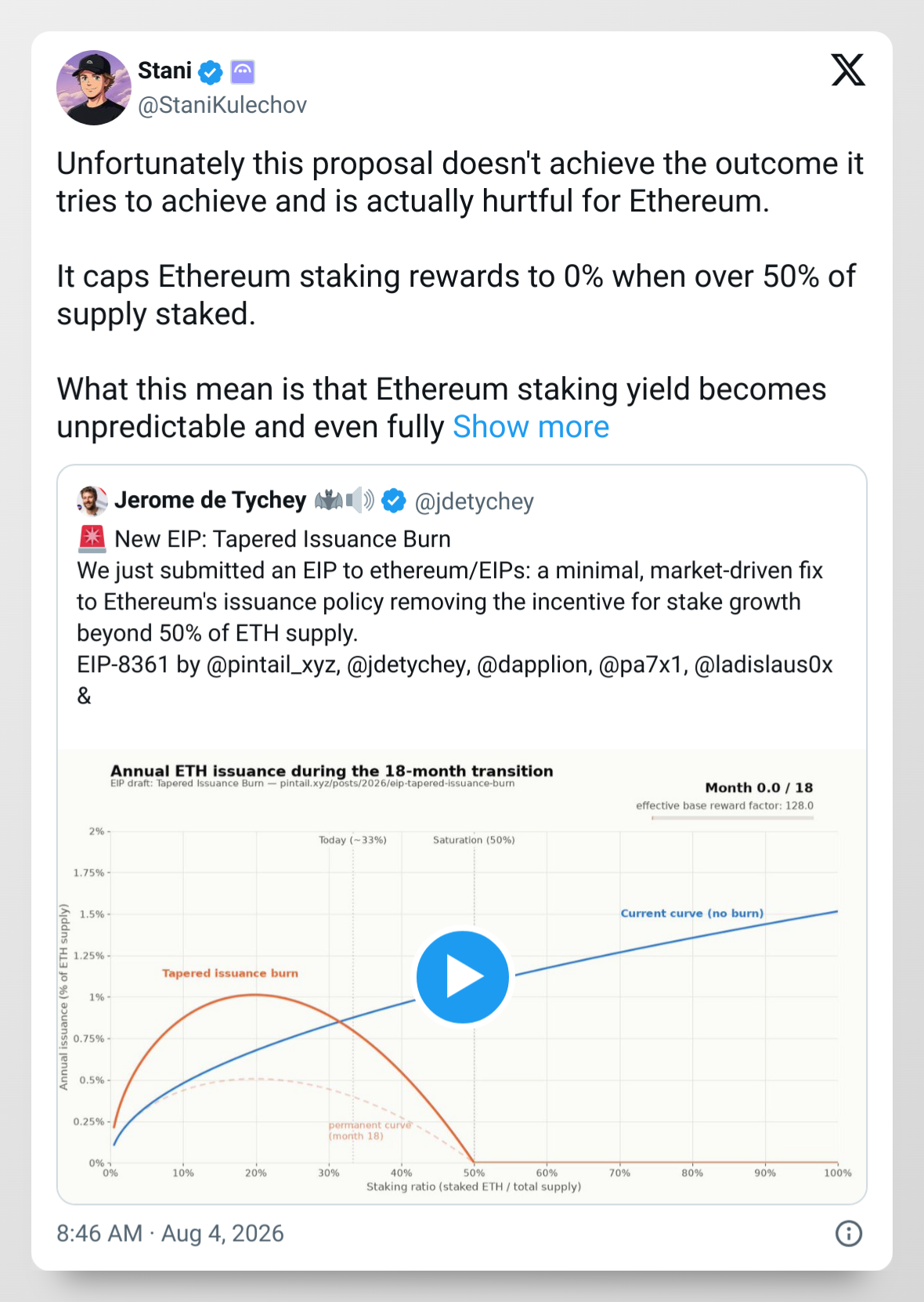
According to Ethereum's current issuance curve, staking incentives have no stopping point. As more ETH is staked, the yields will decrease, but researchers indicate that even if nearly 100% of the ETH supply is locked, the yield will only bottom out at around 1.5%.
The current Ethereum staking rate has already exceeded 33% of the ETH supply, with no signs of slowing down. The concern is that if this trend continues, it will pose two risks:
It could lead to the majority of ETH being concentrated in the hands of a few companies and liquidity staking providers, undermining the ability of the Ethereum community to combat manipulated validator sets through forks.
Once a certain staking threshold is exceeded, issuance effectively becomes a permanent dilution tax on all non-stakers, forcing each ETH holder to choose between joining staking or watching their share shrink.
EIP-8363 was created specifically to address this issue. If implemented, this mechanism would continue to calculate validator rewards in the current manner and then burn an increasingly large portion of it. The burning proportion would increase with the total staked amount until staked ETH reaches approximately 50% of the total supply, completely offsetting consensus rewards.
Once this line is crossed, EIP-8363 would allow validators to profit purely from transaction fees and MEV (the additional value that block producers receive by including, excluding, or reordering transactions) rather than new issuance, until the staking rate falls back below 50%.
Thus, under this model, validators would still have incentives, but the minted ETH would be less. The core goal of this model is to control the staking rate and the dilution risk of ETH. Although the intention is good, there have already been many critics who have come forward to denounce the proposal for being poorly designed.
The main opposing argument I see is that EIP-8363 threatens the vitality of DeFi. Staking yields have become the benchmark interest rate for ETH, with on-chain lending and liquidity staking tokens priced based on it. Aave founder Stani Kulechov believes this proposal would make it difficult for institutional buyers to predict staking yields, potentially killing the rationale for borrowing ETH.
"Ethereum should not be punished for its growth," he wrote.
I also see critics arguing that EIP-8363 would destroy the feasibility of independent staking. The key is that hardware and electricity costs for household stakers will not decrease as yields shrink, so any downturn in net rewards would erode the profit margins of smaller operations running far fewer validators than centralized exchanges.
Moreover, as consensus issuance decreases, MEV will account for a larger portion of the remaining income for validators. Critics point out that this dynamic could itself generate a centralization effect since MEV capture rewards scale and precision, rather than original issuance.
On the other hand, supporters of EIP-8363 insist that it can enhance ETH's monetary properties by protecting non-staked ETH from dilution while giving ETH a real supply cap, further solidifying ETH's status as "hard currency."
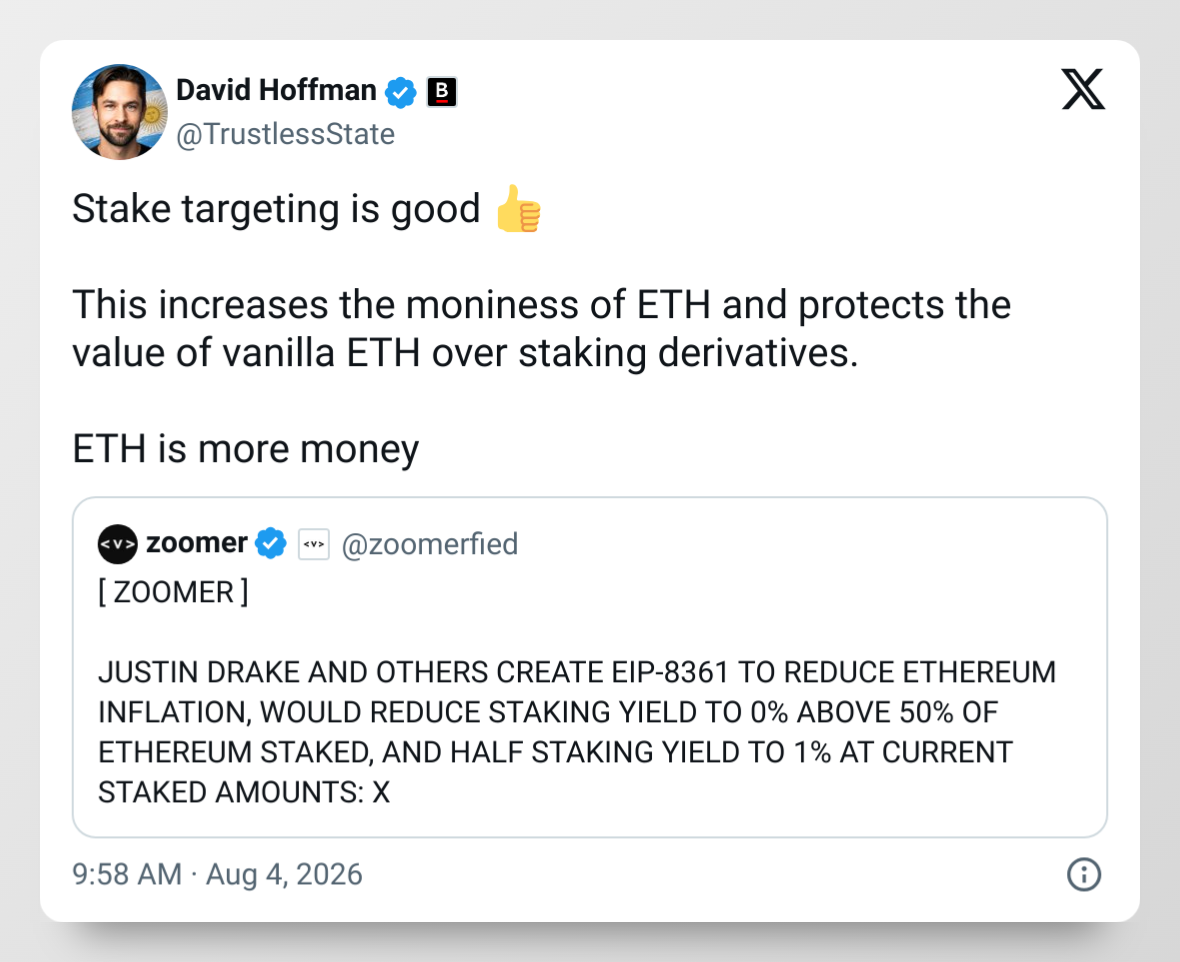
Supporters also rebut the claim that independent stakers would be more greatly impacted, arguing that due to the burning increasing with the total staked amount, the critical point at which adding more validators no longer becomes economical occurs earliest for those who already hold larger shares.
This means that household stakers still have the incentive to grow all the way to the 50% threshold, while large stakers do not. In contrast, today's curve design rewards growth regardless of who you are or how much has already been staked.
That said, the best discussion I've seen regarding EIP-8363 currently comes from EF's DeFi expert ivangbi, who offered a reasonable middle ground in a new (personal and not EF official) post today. He believes the model is theoretically feasible and DeFi can withstand it, provided that "the fixes and arguments are more solid" rather than based on "pseudo-economics." It's worth reading in full.

As far as I understand, today is the deadline for EIP-8363 to obtain PFI status (that is, "proposal for inclusion," the minimum procedural threshold for Ethereum, meaning "to include this in the agenda for discussion") for the Hegotá upgrade. That said, currently there is no approval, and the Hegotá itself is expected to launch on the mainnet next year.
If EIP-8363 does move forward, there will nevertheless be a long preparation period because its arrival would initiate an 18-month transition phase. However, this proposal may also stagnate after this week, with the staking rate continuing its upward trend. At that point, we will have to see if this debate resurfaces in the future.
Regardless of the outcome, the overarching question is whether Ethereum is currently paying too high a price for security, and if so, is this fix worth the pain of verification? No one has reached a conclusion yet, so please continue to follow this topic in the coming months.
免责声明:本文章仅代表作者个人观点,不代表本平台的立场和观点。本文章仅供信息分享,不构成对任何人的任何投资建议。用户与作者之间的任何争议,与本平台无关。如网页中刊载的文章或图片涉及侵权,请提供相关的权利证明和身份证明发送邮件到support@aicoin.com,本平台相关工作人员将会进行核查。


