

Author: PANews Big Pliers
Among 480 employees, only 14 can share in the company's listing bonuses. The other 466 will watch the company's value soar to hundreds of billions without holding a single share of stock.
On August 10, the subscription for Yushu Technology will begin, with an issue price of 150.8 yuan per share, valued at 61 billion yuan, regarded by the market as the "first humanoid robot stock." However, a detail disclosed in the prospectus has sparked controversy: this technology company with nearly 500 employees has granted equity incentives to only 14 employees as of the date the prospectus was signed.
In comparison to peer companies, UBTech has 41 employee stock ownership platforms covering 689 people, and Yujian Technology has 4 platforms covering 120 people. Yushu Technology's "elite stockholding" model appears particularly unconventional in the robotics industry.
14 people vs 689 people: A stark contrast in incentive coverage
According to the Yushu Technology prospectus (page 86):
As of the date the prospectus was signed:
14 employees have been granted incentive shares
11 employees have exercised their options, corresponding to 5,113,372 shares of the company's stock
9 employees had their incentive shares canceled due to resignation (turnover rate of 39%)
Composition of incentive recipients:
12 are from the R&D department
2 are from the sales department and the production department
3 disclosed core holding employees:
Yang Zhiyu - Director, core technical staff - indirectly holds 0.49%
Chen Li - Director, head of sales and service system - indirectly holds 0.26%
Zhang Yangguang - Director, head of algorithms and software - indirectly holds 0.15%
In comparison to industry competitors:
Among Yushu Technology's 480 employees, only 14 (about 2.9%) received stock options. UBTech's incentive coverage is 49 times that of Yushu, while Yujian's is 8.5 times that of Yushu.
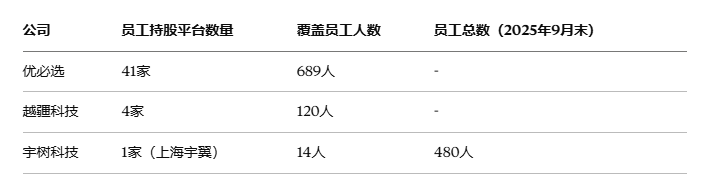
1 yuan/register capital: Favorable price, scarce quota
The prospectus reveals that Yushu Technology's equity incentives utilize two methods:
First equity incentive (September 2017 - December 2021):
Signed "Option Agreement" with "Yang Zhiyu and 17 other employees"
Grant price: 1 yuan/register capital
Exercise method: Employees hold partnership shares in the incentive platform Shanghai Yuyi, indirectly holding company shares
Second equity incentive (starting January 2024):
Based on the "2023 Incentive Plan", 6 employees will be granted incentive shares
Managed uniformly through the employee stock ownership platform Shanghai Yuyi
Favorable price, but very few quotas:
At 1 yuan/register capital, the price is indeed a huge discount compared to the IPO issue price of 150.8 yuan. But the problem is that this discount was only given to 14 people.
For a company projected to generate 1.7 billion in revenue by 2025 and valued at 61 billion, it is astonishing that only 14 out of 480 employees can share in the equity appreciation dividends.
39% turnover rate: Why can't incentives retain people?
The prospectus discloses a key figure: 23 employees had received incentives, but 9 subsequently left, resulting in the cancellation of their incentive shares.
What does a turnover rate of 39% mean?
Incentive conditions may be too harsh: A lock-up period of 8-9 years (36 months after listing + 5 years post-exercise), are employees unable to wait?
Company culture or management issues: Why do even core employees who received equity incentives choose to leave?
Lack of incentive attractiveness: Although the price is favorable, stringent unlocking conditions and buyback terms may have weakened the effectiveness of the incentives.
Comparing with the incentive coverage of 689 from UBTech and 120 from Yujian, Yushu not only has fewer people but also a low retention rate.
Unique design of the equity incentive platform
The equity incentives at Yushu Technology are realized through a three-tier structure:
Structural levels:
Yushu Technology (listing entity)
↑ Holds 10.9414%
Shanghai Yuyi (incentive platform)
↑
Hangzhou Yixin + Hangzhou Yiyi (upper-level partnership enterprises)
↑
Incentivized employees (limited partners)
Key design:
Wang Xingxing controls the incentive platform: Controls the employee stock ownership platform through Hangzhou Tianze (executive partner of Shanghai Yuyi)
Long lock-up period: 36 months after qualifying for listing + 5 years after each exercise phase, lasting up to 8-9 years
Four-phase unlocking: 25% is unlocked each year, linked to performance assessment; if the assessment is not met in that year, it will not unlock and will not accumulate
Strict buyback terms: Employees who leave voluntarily or engage in misconduct will only have their buyback price at the actual payment consideration (1 yuan/register capital), and will not benefit from any appreciation
This design, while ensuring the long-term stability of equity, may also be one reason for the 39% employee turnover rate.
350 million shares payment: Who is footing the bill for the incentives?
The prospectus discloses a shocking figure:
In 2022 and 2025, Shanghai Yuyi increased its capital twice at the registered capital price, triggering substantial share payments:
2022: Share payment expense of 18.7226 million yuan
January to September 2025: Share payment expense of 349.0655 million yuan
The combined total of approximately 368 million in share payments is fully accounted as non-recurring profit and loss, resulting in:
2022 net profit dropped from -8.0708 million (after deducting non-recurring) to -22.1005 million
Net profit from January to September 2025 dropped from 430.6123 million (after deducting non-recurring) to 105.3314 million
Who is paying for the equity incentives?
On the surface, it seems that the company bears the share payment expenses. But in reality, this expense dilutes the rights of existing shareholders. The question is, is it worth such a high cost to incentivize only 14 people?
9.54% equity still to be granted in the future
The prospectus reveals that the partnership shares held by Wang Xingxing in Shanghai Yuyi correspond to a 9.54% equity ratio in the company, and will all be used for employee equity incentives in the future.
Granting plan:
Within two natural years after the completion of 36 months after listing, grant no less than 50%
The remaining part will be completed within the effective period of the employee stock ownership plan (10 years)
What does this mean?
More employees will receive equity incentives, but the specific number and grant price have not been determined
Will generate more share payment expenses, the prospectus explicitly notes "may have a significant impact on the company's future operating performance"
The incentive recipients do not include Wang Xingxing himself, and the payment amount after deducting costs will all be delivered to the company without compensation
This is a positive signal, indicating that the company plans to expand the incentive coverage in the future. But why not implement it before the IPO?
466 of 480 employees: Excluded
Employee structure of Yushu Technology at the end of September 2025:
Management staff: 48 (10%)
Sales staff: 141 (29.38%)
R&D staff: 175 (36.46%)
Production staff: 116 (24.17%)
14 people holding shares means:
Out of 175 R&D staff, only 12 received incentives (6.9%)
Out of 141 sales staff, only 1 received incentives (0.7%)
Out of 116 production staff, only 1 received incentives (0.9%)
Of the 48 management staff, almost all were excluded
For a company with revenues of 1.7 billion, aiming for a market value of hundreds of billions, is this incentive coverage too narrow?
Comparison to Changxin Technology: Two philosophies of incentives
Changxin Technology, which went public in July 2026, had an issue price of 8.66 yuan per share, and its market value broke 3.3 trillion after listing, making it the highest in A-shares.
Changxin Technology's employee stock ownership plan has a wide coverage and low entry costs, allowing a large number of employees to achieve wealth freedom post-listing. This "inclusive incentive" sharply contrasts with Yushu's "elite incentive."
Two philosophies of incentives:
Incentive model Coverage Representative companies Advantages Disadvantages Inclusive Wide Changxin, UBTech, Yujian High motivation among all employees, strong cohesion High dilution of equity, complex management Elite Narrow Yushu Technology Concentrated equity, precise incentives Ordinary employees lack a sense of belonging, high turnover rate among core employees
Yushu has chosen elite incentives, concentrating the equity incentives on a small number of core personnel. However, a 39% turnover rate suggests that this model may not be successful.
Three major questions
Question one: Why only 14 people?
The prospectus does not clearly explain the reason for such a narrow incentive scope. Possible explanations include:
The founder has extremely high requirements for equity control (Wang Xingxing controls 68.78% of voting rights)
The company believes that precisely incentivizing a small number of core personnel is more effective
Other employee incentives will be postponed to post-listing
Question two: Why do 39% of incentivized employees leave?
With 23 people receiving incentives and 9 leaving, this ratio is quite high. Possible reasons include:
The 8-9 year long lock-up period makes employees impatient
Strict performance assessments and buyback terms reduce incentive attractiveness
Company culture or management issues may exist
Question three: In the future, how many will receive incentives?
Wang Xingxing promises to use 9.54% of the equity for employee incentives in the future, but how many people will actually receive it? If it just expands from 14 to 30, it still does not solve the problem of narrow incentive coverage.
What should investors pay attention to?
For secondary market investors, the equity incentive structure of Yushu Technology sends several signals:
Negative signals:
Employees' incentive coverage is extremely narrow (14/480 = 2.9%), which may affect team cohesion
39% turnover rate among incentive recipients indicates issues with incentive design or company culture
Long lock-up periods and strict buyback terms, could lead to continued loss of core talent
Future risks of significant share payment expenses, as the prospectus has clearly warned
Positive signals:
1 yuan/register capital price is a huge benefit for the employees who receive incentives
Future 9.54% equity will be used for incentives, indicating that the company has plans to expand incentive coverage
Neutral interpretation: Yushu chose the "elite holding" model, which is also seen in some successful companies. But the key point is that 9 of these 14 core employees have already left; can the remaining 11 truly uphold Yushu's future?
Yushu Technology's IPO is a "lonely listing"
Among 480 employees, only 14 can share the company's listing bonuses. The other 466 will watch the company's market value rise to hundreds of billions without holding a single share of stock.
This is not a traditional "pitfall," but a strategic choice. However, the cost of this choice is:
39% of incentive recipients chose to leave
Ordinary employees lack a sense of belonging
Team cohesion is in question
On August 10, when subscriptions begin, the market will provide the answers. But for those 11 remaining shareholders, they may wonder: did their 9 colleagues who left make the right choice?
And for the 466 employees without equity, they might purchase one lot of Yushu's stock on the subscription day with their 75,400 yuan, becoming "external shareholders" of the company—ironically, this may be their only way to hold Yushu stock.
免责声明:本文章仅代表作者个人观点,不代表本平台的立场和观点。本文章仅供信息分享,不构成对任何人的任何投资建议。用户与作者之间的任何争议,与本平台无关。如网页中刊载的文章或图片涉及侵权,请提供相关的权利证明和身份证明发送邮件到support@aicoin.com,本平台相关工作人员将会进行核查。


