Author: MD
Produced by: Mingliang Company
MiniMax (00100.HK) changed market expectations in just a week. As of August 7th at 10:53 AM, MiniMax's stock price soared by 23.15% that day.
On July 31, MiniMax released the all-modal generative model H3. On the day of the release, the company's stock price rose by 13.15%. After the weekend, on August 3, MiniMax announced that H3 would be open-sourced, and on that day the company's stock price increased by 7.20%. On August 6, MiniMax's stock price surged by 17.10%; looking back at the stock performance since H3's model release, the company's stock price has increased by 78.21%.
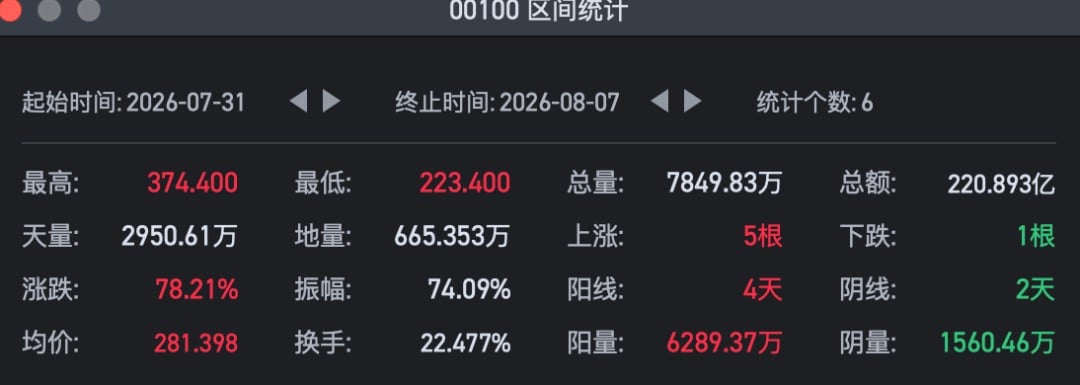
Source: Futu
Clearly, the market has started to reprice MiniMax.
"Mingliang Company" previously mentioned that after entering July, for domestic open-source large language models, the capital market has begun to "reduce" the weight of the single model's SOTA narrative in valuations. The reason is that the "ranking changes too quickly” and SOTA models are constantly being surpassed — since Kimi K3, DeepSeek, Qwen, and others have successively released their new models, fluctuations in valuations and market capitalizations are not as pronounced as before.
However, for MiniMax, the release of the video model has led the market not to "downgrade" the impact of a single model on valuations, but rather to begin to price in the video model.
The direct reason comes first from model performance. According to MiniMax's official website, H3 supports text, images, video, and audio multimodal contexts, capable of generating videos up to 15 seconds long, in 2K resolution, 24FPS, with native stereo sound. In blind tests conducted by Artificial Analysis, H3's text-to-video score with audio earned an Elo rating of 1242, ranking second globally; it ranked first in video editing; and image-to-video placed in the top three.
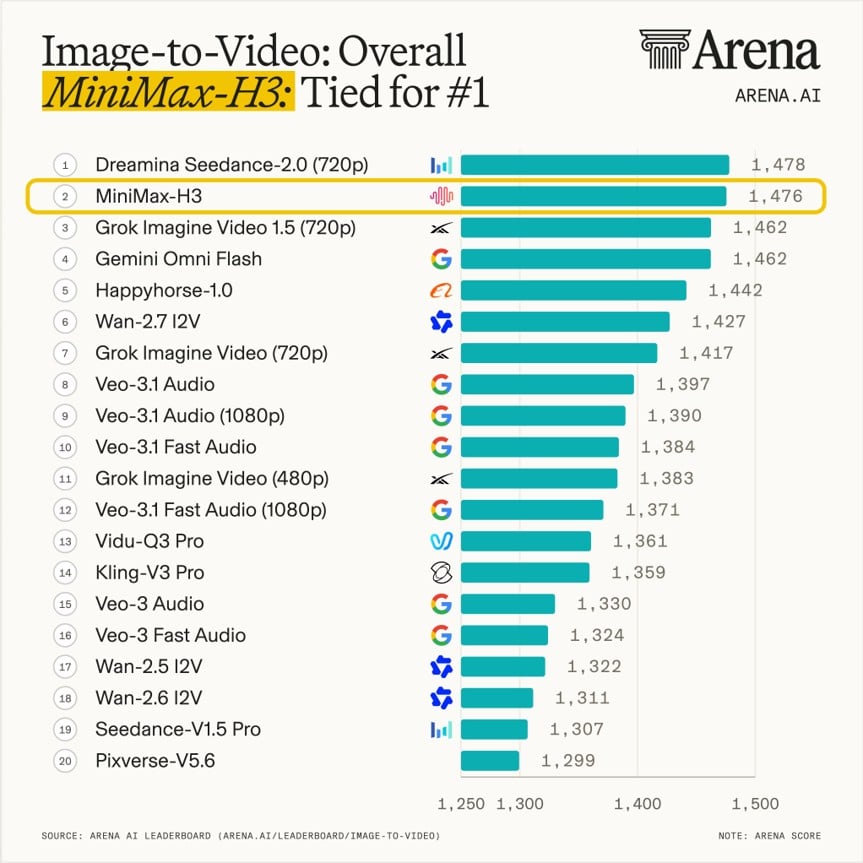
Source: Artificial Analysis social media
Pricing also provides another layer of explanation. H3's price at 2K resolution is less than one-third of the market's flagship models, and its price at 768P resolution is less than half of mainstream models.
Of course, the more significant meaning of H3 for the industry is its open-source nature.
On August 3, after H3 opened its weights, chip manufacturers, inference frameworks, development communities, and enterprise service providers all accessed simultaneously, raising the ceiling for the company and the ecosystem.
Furthermore, the open-sourcing of video generation models could replicate the impact that the open-sourcing of large language models had on the AI ecosystem in early 2025 — video models might not just be a product at the application layer, but are expected to become the foundational productivity for video content and creativity, with video generation narratives increasingly resembling Coding.
Video generation, the next Coding?
Since 2026, the most certain narrative in AI has been "betting on Coding," and the capital market's response to this narrative has been to "benchmark against Anthropic."
In reality, the popularity of products like OpenClaw and Claude Code has greatly increased the consumption of tokens. This has led the capital market to understand that as model capabilities improve, the demand for complex tasks will increase (and can be solved better); while the token consumption for a single task has increased, subsequently driving revenue growth.
A report from Ping An Securities shows that in early 2026, the global weekly token usage was about 6.4T, while by July 2026, the peak weekly usage had surged to 62.8T, a tenfold increase in six months. Coding and agents account for the largest share of consumption, with a single agent task's token consumption reaching 30 to 100 times that of ordinary chat. Anthropic's rapid ARR growth has also led the capital market to accept the logic of "high-value tasks - high token consumption - high ARR."
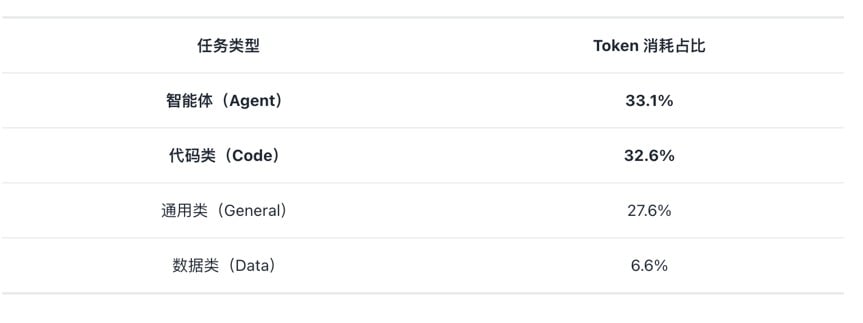
Source: Ping An Securities, Openrouter
Once this logic was established, the market began to look for the next high-density token scenario, with video generation being one of the candidates.
Compared to text, video inherently requires more computing power. According to research from Guotai Junan, the token consumption for 1080P, 25 frame video can reach between 30,000 to 50,000 tokens per second, potentially rising to 50,000 to 100,000 in the future. Seedance 2.0 consumes approximately 310,000 tokens to generate a 15-second video.
This means that once video generation transitions from experimentation into production processes such as advertising, e-commerce, short dramas, games, and product displays, it may become a new center for token consumption.
The paid scenarios for video generation are also more direct. Advertisers, e-commerce merchants, MCNs, game companies, and brands already have content budgets. If AI video can reduce the costs of filming, editing, and material production, clients can start paying without waiting for a long IT budget cycle.
This is also the context for H3's repricing. H3 entered a scenario that may rapidly amplify token consumption. If AI Coding validated the commercialization path for text and code tasks, video generation may validate the commercialization path for multimodal content production.
H3 open source, the "DeepSeek moment" for video generation models
Before H3, video generation models were mainly dominated by closed-source vendors. For example, domestic companies like Seedance and Kuaishou as well as leading models from American firms.
The closed-source model helps control the pace of commercialization but also limits ecosystem diffusion. Application companies rely on API pricing and usage rules, making it difficult for enterprise customers to achieve deep customization, and cloud and chip manufacturers can only adapt within a limited scope.
H3 open source has changed the industry's "historical process."
It allows more ecosystem companies to participate in this field. According to official information from MiniMax, 16 chip manufacturers, including Huawei Ascend, Haiguang, Moore Threads, Muxi, Kunlun Core, Biran, Tiandu Zhi Core, as well as AMD and Intel, have completed adaptation; development communities and cloud inference platforms such as HuggingFace, MoDa, ComfyUI, RunningHub, and fal have accessed; inference frameworks such as vLLM-Omni, SGLang, among others, provide simultaneous support; over a hundred companies launched on Day 0.
This transformed H3 from MiniMax's own API into a model that can be jointly distributed by developers, cloud providers, chip manufacturers, and enterprise service providers, which is almost completely aligned with the impact of the "DeepSeek moment" on the AI ecosystem in early 2025.
Previously, "Mingliang Company" also mentioned that investors in the secondary market "understood" that the valuation of domestic AI infrastructure hardware companies could "benchmark" against American companies, because DeepSeek V4 can be trained on domestic chips, "the logic has become clear."
Fast forwarding to now, the latest situation is that domestic mainstream open-source large language models, with their cost-performance ratio and ecological advantages, are already threatening the positions of North America's top two large model companies. This will undoubtedly further promote the penetration rate at the application layer.
In terms of valuation, when the preview version of DeepSeek V4 was released in April, the market initially interpreted it as a shock to the valuations of model companies, causing other model companies' stocks to drop on that day (considered as competitors); by the end of July when the V4 Flash official version was released, the market began to reprice based on ecological frameworks, seeing it as the cost benchmark and capability baseline for domestic open-source ecosystems (considered as ecosystem partners).
H3 followed a similar logic, but the scenario shifted to video generation.
As mentioned at the beginning, H3's capabilities place it in the top tier of video generation, with costs lower than mainstream models. MiniMax claims that H3's price at 2K resolution is less than one-third of mainstream models, with Guotai Junan's report stating it is about $0.13 per second.
The efficiency of the H3-VAE architecture has been greatly optimized. According to MiniMax's official WeChat account, H3 has thoroughly revolutionized the tokenizer technology of the previous generation, achieving comprehensive improvements in reconstruction and learnability, allowing H3 to achieve competitive results in efficiency, while its high compression rate brings four times the sequence length benefit, significantly reducing training and inference costs, which is also the key technology that enables us to provide native 2K resolution.
On this basis of open-source, not only the model call volume is amplified, but also the ecological position.
In the past phase, the closed-source commercialization of video models has not been easy. Relying solely on API fees, model companies have to bear the costs of promotion, computing power, customer service, and industry adaptation. After going open-source, cloud providers can offer hosting and inference, enterprise service providers can generate industry solutions, chip manufacturers can adapt domestic computing power, and developers can create plugins and workflows.
MiniMax can exchange open-source for ecological position, and then gain revenue through B-end customization, commercial licensing, model services, and enterprise customers. This path may not show immediate results in financial reports but will change the market's positioning of the company.
The facts that have occurred in the past almost perfectly illustrate the "Jevons Paradox" narrative that became popular in early 2025 — as the cost of tokens dramatically declines, users will only use them more, not less.
From narrative to market value: MiniMax undergoes reassessment
After the release of the H3 model, selling institutions quickly adjusted their views on MiniMax.
Citi maintained a buy rating for MiniMax in its July 31 report but significantly raised the target price to HKD 533, suggesting approximately 131% potential upside at the time. According to Citibank's valuation method, this is 12 times the expected P/S for 2028, and it anticipates the company’s revenue CAGR from 2025 to 2030 to be 128%.
According to statistics from AlphaEngine, several institutions gave positive ratings following the release of H3. Combining Citi's report with those from other institutions, the core valuation logic after the release of H3 still revolves around model-driven revenue (ARR) growth.
The growth potential of the H3 video generation model can also be benchmarked against current closed-source video models domestically. Huashan Securities mentioned in an analysis note that video models like Seedance and Keling "have collectively reached an ARR scale of nearly 3 billion dollars." Given their performance ranking and cost-effectiveness advantages, it is very likely that MiniMax, driven by H3, will achieve a revenue increase at least equivalent to that figure, and under this growth rate, MiniMax's current valuation (P/ARR) clearly has more attractive appeal.
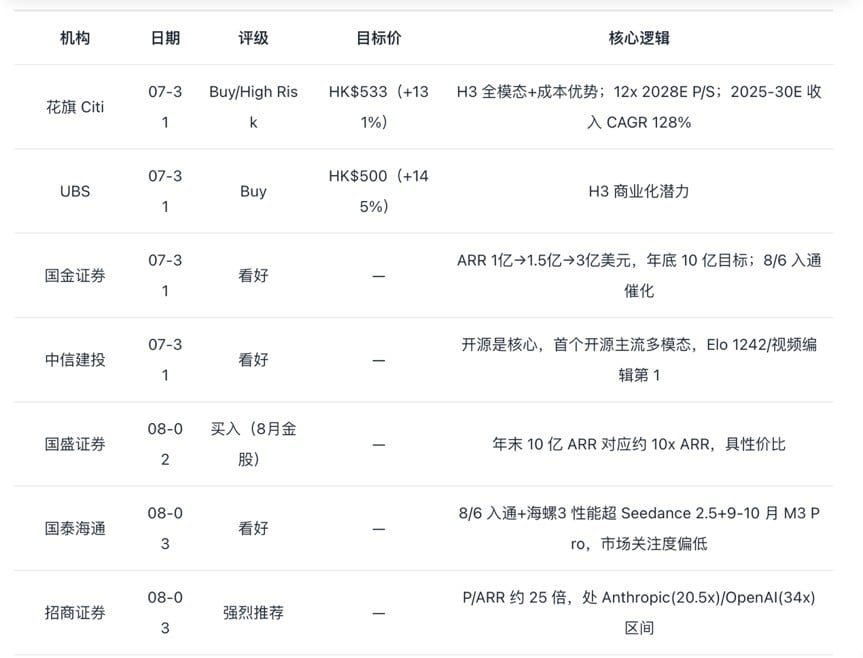
Source: AlphaEngine database
The longer-term imaginative space is that video models may become part of the physical AI foundation.
Chris Paxton, a researcher at Agility Robotics, stated on X: "The new Minimax H3 open-source video generation model seems to have great potential for robotics technology. Many advancements in robotics are driven by broader AI improvements, and the current interest in world models allows video generation to drive rapid progress."
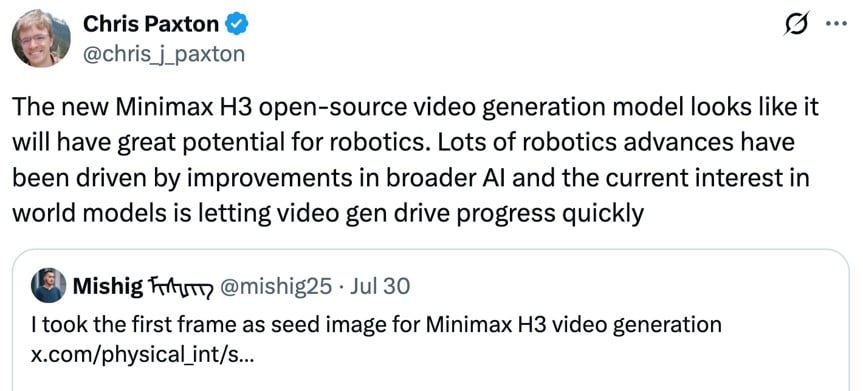
Source: Chris Paxton’s personal X account
H3 supports text, images, video, and audio, but compared to training systems aimed at world models and embodied intelligence such as NVIDIA's Cosmos, H3 and other video generation models still lack action trajectories, first-person perspective data, and robot interaction data.
Of course, the narrative about the "world model training foundation" can currently only be viewed as a "long-term option."
But for MiniMax right now, the market has already realized the core value of the H3 video model. H3 brings not only a historical turning point for a video model-driven ecosystem, but also the starting point for the next stage of the company's market value growth.
免责声明:本文章仅代表作者个人观点,不代表本平台的立场和观点。本文章仅供信息分享,不构成对任何人的任何投资建议。用户与作者之间的任何争议,与本平台无关。如网页中刊载的文章或图片涉及侵权,请提供相关的权利证明和身份证明发送邮件到support@aicoin.com,本平台相关工作人员将会进行核查。


