Organized & Compiled: Deep Tide TechFlow
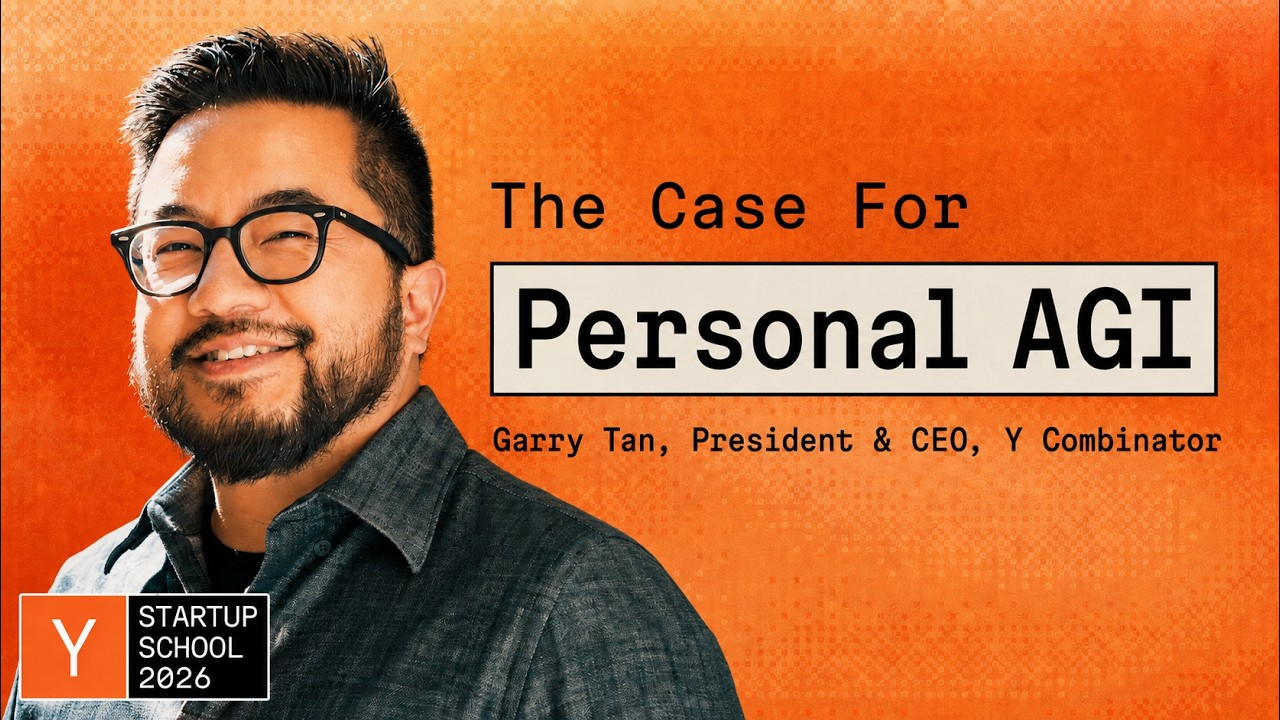
Speaker: Garry Tan, President and CEO of Y Combinator
Event: Startup School 2026
Podcast Source: Y Combinator
Original Title: Garry Tan: “Personal AGI Is How You Stay Under Your Own Power”
Broadcast Date: August 6, 2026
Disclosure: Garry Tan is the President and CEO of Y Combinator and also a co-founder of Initialized Capital, with a portfolio including 73 companies such as Coinbase, Flexport, and Perplexity. The YC incubated companies Emergent and Retail mentioned in this talk are part of the YC investment portfolio. GStack has been open-sourced under the MIT license; Tan does not derive direct commercial benefits from it, but its reputation aligns with the influence of the YC ecosystem and the direction of his talk.
Key Points Summary
Garry Tan delivered a 42-minute keynote speech at Startup School 2026, with one core argument: personal AGI has arrived, but most people will use it incorrectly.
What he means by "personal AGI" refers to a system of AI agents running on one's own infrastructure, distinct from general artificial intelligence: you consolidate all your conversations, meetings, decisions, and code into a knowledge base, allowing the agent to handle emails, prepare meeting notes, and conduct research while you sleep.
He has open-sourced this system, called GStack, which has received 123,000 stars on GitHub, ranking in the top 100 in the site's history.
Tan uses his own experience as an example. In 2013, he was a YC partner, working during the day and coding at night, producing 14 lines of effective code per day, which was exactly the median in programmer productivity literature. This year, operating YC full-time, with the same brain and same time, plus picking up his child at 5 PM, his output is 400 times that of 2013. Even if you squeeze out all extraneous factors, assuming half of the code is scaffolding and that he is boasting, there is still at least an 8-fold increase. He also cited data from the YC investment portfolio: in the Winter 2025 batch, a quarter of the companies had codebases that were 95% AI-generated, and this batch is becoming the fastest-growing and most profitable in YC’s history.
But the most interesting part of the speech is Tan's anxiety regarding the question of "who owns your skills." He told a fictional story about a customer support engineer named Maya: over two years, Maya teaches the agent 40 skills, and if these skill files are held by the company, the company owns the externalization of her cognition; if held by her, she becomes an amplified individual. The same file leads to two entirely different futures, depending on one variable: who controls it.
Highlights of Perspectives
About the qualitative change in productivity
“In 2013, I wrote 14 lines of effective code a day, which was exactly the median in programmer productivity literature. This year, I am full-time at YC, with the same time, plus picking up my child at 5 PM, and my output is 400 times that of the year before. Even if you squeeze out all the extraneous factors, there’s still at least an 8-fold increase. This number is substantial no matter how you twist it.”
“There are 2x people and 100x people using the same Claude, with the same weight and the same context window. The difference is not in the tools but in whether you treat it as an autocomplete or as a team.”
About the knowledge base
“Your life is a library. Every conversation, every meeting, every decision you’ve made, every mistake you’ve made should be there. Most should be compiled by the agent, curated by the agent, searched by the agent. You should never ask a question that has already been answered.”
“While I sleep, my agent is handling my inbox. It’s not sorting; it’s processing. It knows which emails are from struggling founders, which are from people trying to sell me something, and which are from the 17 email lists I've never unsubscribed from. What I wake up to is not a pile of emails but a briefing.”
About skill files
“A skill file is an employee. It has a capability, a clearly defined responsibility, so clear that a newcomer could execute it. A resolver is an organizational chart. When tasks come in, it decides which Markdown file to process.”
“Markdown is not magic. Fat skills, thin framework. GStack, with 123,000 stars, ranking in the top 100 in the site's history, is basically skill files along with a browser that an agent can drive. A few pages of English and a way to act on the world.”
About who controls your cognition
“A skill file is not a document; it is a piece of your cognition. How you do something is extracted from your mind, written down, and executable. Every skill you teach the agent is externalized you. The same file leads to two opposite futures depending on one variable: who controls it.”
“Hosting is a security model. My brain runs on its own infrastructure, in its own codebase, with its own keys. Compare this to the default state: your life is scattered across 10 clouds, owned by companies motivated by different incentives, and anyone but you can search it. I have not created risk by integrating context; I have taken over its hosting rights.”
About why open source
“Every era has had a private leverage technology, which is owned by the privileged and not by others. For a long time, that was literacy. Then it was capital. Today, it is this: frameworks, libraries, a labor force composed of Markdown. Those who own it operate quietly on a different scale. The gap is widening every month.”
About giving up
“In the first week, to be honest, it’s just a toy. The library is thin, the skills clumsy, and the time spent fixing is greater than the time saved. In the fourth week, the flywheel starts spinning. By the twelfth week, you have a library that can answer before you finish asking. Most people who try this will give up in the second week, which is exactly why those who persist feel like they are cheating by the twelfth week.”
Main Text
Starting with Spinoza: How the canceled continue to build
Tan started in an unexpected way. He mentioned product roadmaps and AI trends without a single word, first telling a story from 350 years ago.
Born in 1632, Baruch Spinoza was exiled from the Amsterdam Jewish community at 23, suffering the most severe curse issued by that community in that century. Cursed in the daylight, cursed in the night, cursed while lying down, cursed while rising. No one could speak to him, transact with him, approach him within four cubits, read anything he wrote. This prohibition was unique among about 40 in that century, with no repentance clause, and it has never been revoked.
His sin was having “heretical views” and expressing prohibited thoughts. Before being cursed, the community tried to bribe him with an annual salary of a thousand ducats, which was a lot of money at the time. The only condition was to occasionally attend synagogue and keep his mouth shut. In entrepreneurial terms, they were paying him to stop building. He refused, saying, “Not even ten thousand will do; I want truth, not comfort.”
Tan drew a parallel between Spinoza's story and today’s entrepreneurs: they tried to bribe him to stop building, but he refused. He chose truth over comfort.
In 1929, a rabbi in New York sent a telegram challenging Einstein: "Do you believe in God? Respond in 50 words." Einstein used only 25 words: “I believe in Spinoza's God, who reveals himself in the orderly harmony of the world, not a God who concerns himself with human fate and actions.” The most famous scientist of the time, facing the biggest questions, pointed to Spinoza.
Tan said that people on the internet call him “one of the most AI-crazy people,” so it seemed fitting to open with “the one who has been canceled most severely in history.” After being expelled from the community, Spinoza continued to write Ethics, which had to be hidden in his desk and smuggled out. Tan suggested that today’s AI believers, who are questioned by the mainstream, share a spiritual lineage with Spinoza, expelled 350 years ago.
Personal AGI is already here
Tan defined what he calls “personal AGI”: a system of AI agents running on your own infrastructure, unrelated to general artificial intelligence. It runs in your own codebase, using your own keys, compounding your knowledge over time and greatly increasing your ability to build things.
He believes this is already happening now. He himself uses this system every day. The core architecture he mentioned includes three parts: a knowledge base (which he calls “the library”), an agent coding framework (GStack), and a capability for the agent to drive a browser.
“The key difference is: are you renting intelligence or owning intelligence? Renting means your context is on someone else’s server, starting from scratch each time you converse. Owning means your agent knows what you asked yesterday, what you decided last month, what mistakes you made last year.”
Tan emphasized that it’s not about how smart the model is. The model is getting better, but if you can’t turn the model’s outputs into real memories, it doesn’t matter how good the model is. He distinguished between two types of people: 2x people and 100x people, using the same Claude, with the same weight and context window. The difference is not in the tools but in whether you treat it as an autocomplete or as a team.
400 times output and data from the YC portfolio
Tan made the most persuasive argument using his own data. In 2013, he was a YC partner, working during the day and building Bookface (YC’s internal social network) at night. He produced 14 lines of effective code per day at that time, which was exactly median for programmer productivity literature. That was his full effort’s result.
This year, he operates YC full-time with the same brain and work hours, plus picking up his child at 5 PM. He calculated his output to be about 400 times that of 2013. Before skeptics could intervene, he himself squeezed the numbers: distrusting raw lines of code is fine, impose the harshest possible redundancy penalties, assume the agent wrote bloated code, assume half is scaffolding, assume he is boasting. Even so, there’s still at least an 8-fold increase, with the median being 10 times that number. “No matter how you twist this number, it’s substantial.”
And this isn’t just about writing code. If you are early in your career, you are fortunate. This applies to design, product management, growth, and every area of knowledge work you might want to pursue.
He corroborated this with data from YC’s investment portfolio. In the Winter 2025 batch, a year and a half ago, a quarter of the companies had codebases that were 95% AI-generated. These companies now use AI agents for everything, not just coding. That batch is becoming the fastest-growing and most profitable in YC’s history.
Tan acknowledged that he knows what correlation is, so he carefully stated: he cannot prove that AI-generated code led to the growth. But he can tell you that the fastest growing founders in YC did not treat AI as an autocomplete; they treated it as a labor force.
Your life is a library
Tan elaborated on what he means by “the library.” It’s not just a simple note-taking app or knowledge management system. It encompasses all your conversations, all your meeting notes, every decision you’ve made, every mistake you’ve made, your photos, your drafts, mostly compiled by the agent, curated by the agent, and searched by the agent.
The core principle is: you should never ask a question that has already been answered. The life experiences accumulated in the system are the product themselves.
He provided a real scenario. A founder emailed him saying they were in crisis. Before he finished reading the email, his agent had retrieved all previous conversation records with that founder, found three portfolio companies that had encountered the same bottleneck before, and what strategies had actually worked at that time. Whenever his agent does anything, it does so on the basis of knowing everything he knows.
“That’s the difference between an assistant and a colleague. An assistant helps you do things but doesn’t understand you. A colleague knows what you were thinking yesterday, knows why you made that decision last month.”
He described a typical day. While he sleeps, his agent is handling the inbox; note that it is processing, sorting is just incidental. It knows which emails are from struggling founders, which are from people trying to sell him something, and which are from the 17 email lists he has never unsubscribed from. Important emails are categorized with context: who the person is, all their history with him, what they are really asking beneath what they are writing, what it could mean for Tan. What he wakes up to is not a pile of emails, but a briefing.
Before each meeting, the agent prepares a pre-read document: who is meeting, what was said last time, what changes have occurred since, what he should ask. The midnight curiosities of research topics are finished by morning. When something interesting happens in the world, the agent usually has already read it and cross-referenced it with what Tan cares about, filing it away before he has his coffee.
GStack: 120,000 stars, and Markdown is not magic
On top of the library, Tan's agent coding framework is called GStack, which has 123,000 stars on GitHub, ranking in the top 100 open-source projects in history. He showcased the truth of this architecture: the actual content is skill files plus a browser that an agent can drive. A few pages of English alongside a way to act in the world. Markdown is not magic. Fat skills, thin frameworks.
A skill file is an employee. It has a capability, a defined responsibility so clear a newcomer could execute it. A resolver is an organizational chart. When tasks come in, it decides which Markdown file to process. This means that before you register a company, before having co-founders or a logo or a pitch deck, you can already run an organization. An organization composed of you and your agent. You are the founder and also the entire management team. The number of people under you is determined by you.
Tan presented how this new model has been breaking old mathematics in output. Emergent from the YC Summer 2024 batch reached nine-figure revenue in just 8 months after going public. When they hit an annual revenue of $15 million, the team consisted of only 15 people. Retail from the Winter 2024 batch had about 40 people when they reached an annual revenue of $60 million. Tan said this level of revenue per person has no precedent in software, oil, or rail industries. These companies are not freaks of nature; they are the first companies native to the new physics.
He depicted a scene in the YC batch room: hundreds of founders every day, each completing work that used to take a whole year. “This is not the future. This is the baseline for this batch of people. If you are not doing this, your competitors are, and they will politely eat your lunch and thank you for it.”
Tan also pointed out that this changes the meaning of software itself. Software no longer has to be precious. You can build a tool precisely for one person’s needs over a weekend. The old advice was “scratch your own itch, hoping it’s the itch of the market too.” The new version is better: scratch your own itch because scratching it itself is now effective.
How to build your own personal AGI
Tan provided five concrete steps:
First, start today. Not next week, not waiting for you to finish reading papers. Open Claude Code or your chosen tool tonight and start writing your first skill file.
Second, capture everything. Every conversation, every meeting, every decision you’ve made. Don’t judge what’s important and what’s not; save everything. The agent will help you sort it out.
Third, write skill files. Whenever you find yourself repeating a task, turn it into a skill file. A skill file is an employee, with a capability and a clear responsibility.
Fourth, use a resolver. It’s an organizational chart that decides which skill file to handle as tasks come in. This is your "one-person company" management team.
Fifth, don’t ask twice. Tan said at YC they have a saying: if you have to ask twice, you’ve failed. Capturing what you learn makes you smarter every day. Waking up every morning with amnesia is wasting your time.
He gave a 90-day timeline expectation. In the first week, honestly, it’s just a toy. The library is thin, the skills are clunky, and you spend more time fixing than you save. By the fourth week, the flywheel starts spinning. The agent begins answering questions in your context. Morning briefings produce something you would actually read. You start writing the third and fourth skill files because the first two worked. By the twelfth week, you have a library that can answer before you finish asking. Dozens of skill files are managing the work you were once afraid to tackle. A couple of tools are being borrowed repeatedly by others; in this room, that’s called entrepreneurship.
Tan said this curve is like all compounding curves: flat, flat, flat, then suddenly not flat. Most who try this will give up in the second week; this is exactly why those who persist feel like they are cheating by the twelfth week.
Whoever owns your skills owns your cognition
This is the heaviest part of the entire speech. Tan returned to Spinoza’s definition of sadness: a feeling of declining agency. He said this issue will become politicized.
A skill file is not a document; it is a piece of your cognition. How you do something is extracted from your mind, written down, and executable. Every skill you teach the agent is externalized you. The same file leads to two opposite futures depending on one variable: who controls it.
He told a fictional example. The customer support engineer Maya taught the agent 40 skills over two years: how to handle a P0 incident at 2 AM, how to soothe a customer about to churn, how to write a postmortem review. If these skill files exist in the company’s system, when Maya leaves, she leaves behind a complete cognitive copy, which the company can hand over to the next person. Maya herself is replaced. But if these skill files are on Maya’s own infrastructure, she takes away an amplified version of herself that can be immediately deployed at the next company.
Tan escalated this to a question of the era. Every era has had a private leverage technology which the privileged own but others do not. For a long time, that was literacy. Then it was capital. Today, it is this: frameworks, libraries, a labor force composed of Markdown. Those who own it are operating quietly on a different scale, and the gap widens every month. This is the significance of this conference: empowering you to do this for yourself.
He responded to three anticipated objections. First, “Isn’t this just RAG?” Tan said retrieval is the simplest part. What is worth retrieving is the product. How your library is enriched and linked, what is elevated to hot memory and what is archived as cold reference, who arbitrates when two facts contradict, these are the products.
Second, regarding memory architecture. He didn’t elaborate much but suggested this isn’t merely about querying a vector database.
Third, about privacy. If you put your entire life into one system—emails, meetings, children’s schedules—what if it leaks? Tan’s answer, consistent with the main theme of the talk, is that this is why it must be yours. My brain runs on its own infrastructure, in its own codebase, with its own keys. Compare this to the default state, which is not privacy. The default state is your life having been scattered across 10 clouds, owned by companies motivated by different interests, and anyone but you can search it. I haven’t created risk by integrating context; I have taken over its hosting rights. Hosting is a security model. If you don’t trust yourself to hold the keys, I assure you the answer is not to trust someone else’s terms of service more.
Conclusion: Everything is fabricated, you have the right to fabricate your version
Tan explained why he open-sourced everything; people often suspect there’s something fishy. He said it’s because he’s at YC, and doesn’t need to make money off his own infrastructure. But "just because it can" is the answer to the wrong question. The right question is why anyone should do this, and the answer is he believes that the tools of the privileged should be freely given.
He shared a story about his young son. His son has a profound passion for certain things, and no one is going to build this system for him. So he built it himself. And no one is going to build yours for you.
Tan left with a line: “Everything is fabricated, but you have the right to fabricate your version.” Every institution in the world, including that which pronounced a curse over a 23-year-old young man in 1656, was crafted by people no smarter than you.
The difference between you and every previous generation of founders is that they had to recruit dozens of followers to start building. You only need a laptop and the life history you already possess. This event has about 7,000 people, 7,000 candidates, 7,000 efforts. For most of history, these efforts receive almost no audience. They die waiting for funding, for people, for permission, waiting for someone else to believe first.
Tan said that the machine he demonstrated tonight is the first one he’s seen that allows efforts to go directly to work. One person, no intermediaries, no permission required. He genuinely believes that the world hasn’t grasped what will happen when 7,000 people with this leverage walk out of a building.
Spinoza ended Ethics, the book that had to be hidden in his desk and smuggled out, with nine words: “All excellent things, indeed as difficult, also as rare.”
Tan said that difficulty has just collapsed. Rarity now depends on you.
Go build.
免责声明:本文章仅代表作者个人观点,不代表本平台的立场和观点。本文章仅供信息分享,不构成对任何人的任何投资建议。用户与作者之间的任何争议,与本平台无关。如网页中刊载的文章或图片涉及侵权,请提供相关的权利证明和身份证明发送邮件到support@aicoin.com,本平台相关工作人员将会进行核查。


