Written by: Thejaswini M A
Translated by: Block unicorn
All lending institutions in the world are doing one of two things: either understanding your identity or seizing your property.
The first job is vast in scale and costly. It establishes credit bureaus, credit scoring companies, underwriting departments, collection agencies, and courts that enforce judgments. The consequences of default can follow you for years. The existence of trillions of dollars of infrastructure is meant to allow banks to lend money to strangers and have a rough understanding of whether that money can be recovered.
The second job requires a set of scales, and that's it.
Securities borrowers, or margin lenders, are responsible for pricing the collateral and then sleeping soundly. This is the oldest form of lending, and it works perfectly. It has never grown in scale because a system that requires one to own something before borrowing something mainly serves those who do not need it.
Cryptocurrency lending plays the second most important role in lending, which is safety. When people think of cryptocurrencies, they often panic, first thinking of negative events like the Sam Bankman-Fried incident. So choosing a safer lending method is a good thing for us.
In the cryptocurrency space, to borrow one thousand dollars, you first need to have one thousand five hundred dollars.
This product is targeted at people who already have funds. It is highly effective for traders who want to use leverage but do not want to sell their positions, and it is itself a real business. As for others, our proposal is to prove you do not need it, and then we will give it to you. That seems fair.
In the traditional financial system, credit drives economic growth. Banks lend money to bakers based on their future ability to sell bread so they can buy ovens. Banks trust borrowers, thus creating new economic value. This model works because borrowers, by definition, are those who are short on funds.
Today I want to show everyone who is trying to do the first chain work and what happens to them in the end.
In the United States, the cryptocurrency market is valued at 5.14 trillion dollars. Yet the cryptocurrency market size is almost zero. There are few factors hindering the development of cryptocurrencies:
Identity. Unfortunately, wallets are not people after all. I can now create ten thousand wallets just by paying Gas fees. If lenders cannot determine whether the address coming to collect today is the same as the borrower who defaulted last year, then the credit system based on trust will collapse the first day someone attempts to attack it.
Pricing. Even if the identity verification issue is resolved, lenders also need a way to charge different interest rates for different borrowers: some borrowers are charged 9%, while others are charged 29%. This requires a historical record, which necessitates the involvement of credit agencies. On-chain data can show wallet activity in DeFi, but you cannot tell whether this person has kept their job or if they have paid back previous loans on time.
Recourse. Normally, when a borrower stops making payments, a series of consequences follows. Collection calls will come, default records will be noted in credit files, and courts may even garnish wages. But what can you do if a wallet stops making payments? Abandoning the wallet has no cost. Creditors know neither your name nor your address, and have nothing to seize.
The fourth point is legality. Each enforcement mechanism I just listed requires a license. Collection agencies must hold licenses to operate and comply with federal regulations, including the frequency of collections and the content of collections. The interest rates charged by lenders are also subject to usury limits, which differ by state and product. Consumer credit is one of the most heavily regulated activities in the financial sector, and any operation of such without a license would be illegal.
Look at where this will push everyone. We will all eventually head towards the grave.
Goldfinch was founded in 2021 with support from a16z and Coinbase Ventures, completely skipping on-chain identity verification. They provide loans to real businesses in these emerging markets by understanding specialized underwriters and letting cryptocurrency provide the funds. Goldfinch has motorcycle taxi financing operations in Kenya, lending institutions in Nigeria and Southeast Asia, with borrowers spanning 18 countries.
In October 2021, Tugende Kenya received a loan of 5 million dollars to expand its motorcycle financing business for taxi drivers. Goldfinch later found that 1.9 million dollars were transferred to Tugende's struggling Ugandan parent company, which was not allowed under the loan terms. Tugende defaulted in June 2023.
Another borrower, Stratos, defaulted on a credit line of 7 million dollars, while a third borrower, Lend East, defaulted on nearly 6 million dollars. In total, the agreement watched over 18 million dollars disappear into the real-world risks they originally aimed to solve. Goldfinch ceased operations in June of this year after issuing approximately 100 million dollars in funds. Its token price dropped by 99.8%.
Thinking about it carefully, these failure cases are all ordinary credit failures without exception. Rising oil prices caused drivers to be unable to pay, contracts were defaulted, and borrowers transferred funds that they should not have transferred. The blockchain works well; it just cannot predict whether these funds can still be recovered.
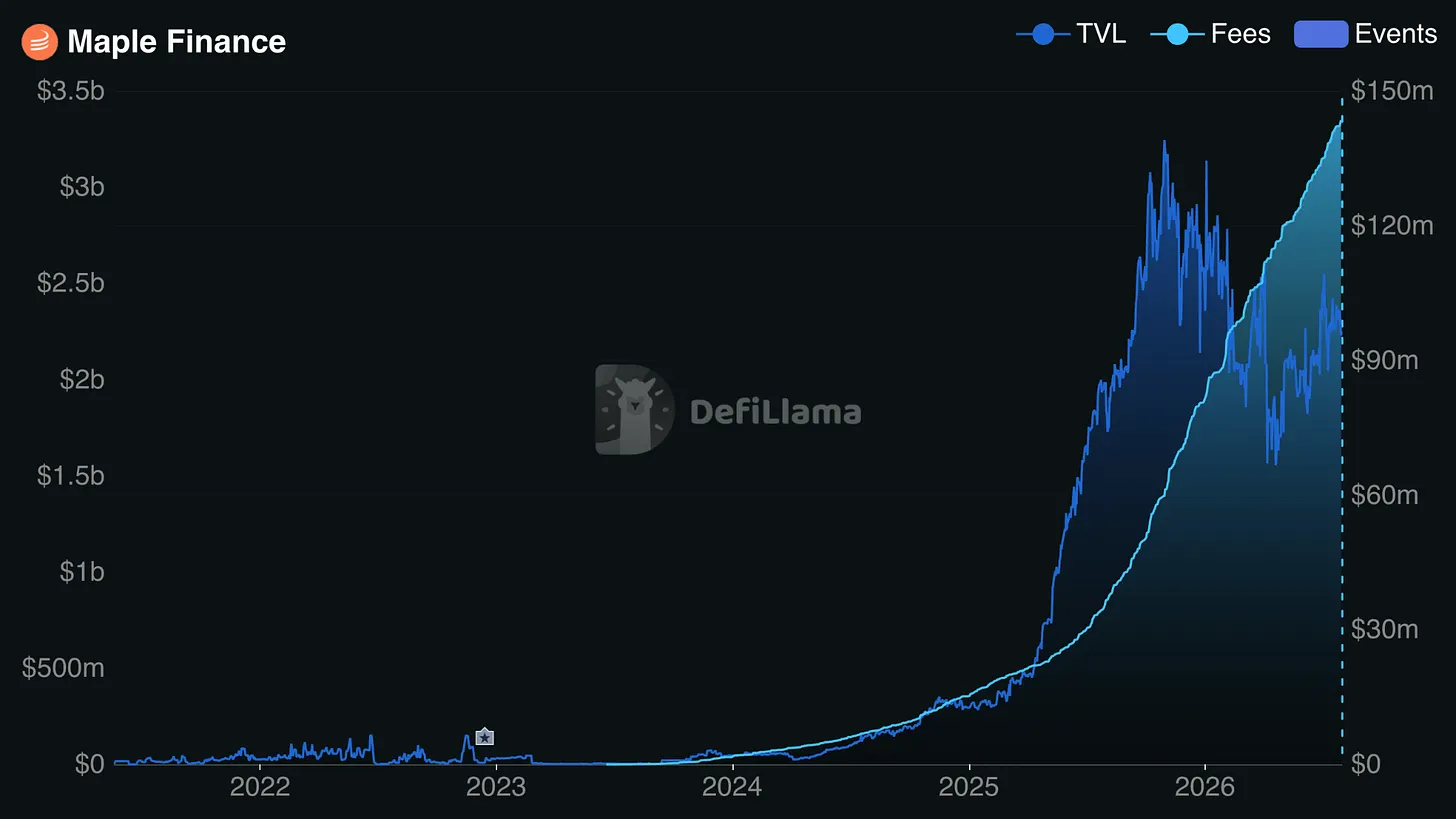
Maple is a more enlightening case because Maple is the largest unsecured cryptocurrency lending platform to date, and it has not perished. However, to survive, it had to completely abandon its initial mission. It realized that unsecured loans based on trust and identity carried too much risk in the cryptocurrency space.
On December 5, 2022, Orthogonal Trading defaulted on eight loans totaling 36 million dollars, which accounted for about 30% of all active loans in the agreement. Orthogonal had informed its underwriters before November that its risk exposure on FTX was about 2.5 million dollars. On December 3, the company admitted that the actual amount was far higher. This deception immediately resulted in 80% of the funds in the risk-exposed pool (M11 USDC pool, approximately 31 million dollars) vanishing, and Maple acknowledged that they might only recover 2.5 million dollars out of the total 36 million dollars.
Sid Powell later stated that under-collateralized loans require stricter due diligence, and Maple may turn to partially collateralized loans.
It has been cruising along. Today, Maple has a loan collateral rate of over 140%, with no losses since 2023, and deposits have thus increased by over 2.2 billion dollars. This more prudent choice is effective.
This raises the question of who is trying now, as many people are trying, and they have clearly categorized the barriers to attack.
Divine Research is dedicated to tackling identity blockage. Since December 2024, the company has issued about 30,000 loans, most of which are under 1,000 dollars, denominated in dollars, with borrowers including teachers, fruit vendors, and anyone who can go online. Borrowers must verify their identity through World ID iris scanning, which prevents someone from opening a second account after abandoning the first. The interest rate on loans is between 20% and 30%. According to the Financial Times, the default rate on the first loans is approximately 40%.
3Jane is focused on price blocking. It obtains borrowers' bank data via Plaid and uses Credit Karma's VantageScore rating, then packages both in zero-knowledge proofs to ensure that all sensitive information is not transmitted on-chain. Ultimately, they issue credit lines based on results. Paradigm led its seed funding round. 3Jane currently holds about 62 million dollars in funds, making it the largest on-chain unsecured lending institution today.
Wildcat is a recourse company that does not perform any underwriting. It publishes a template for the master loan agreement, and once the borrower and lender sign, Wildcat no longer intervenes. Its own documentation states that the company does not assess the creditworthiness of borrowers and should not intervene in market operations once the lending business starts.
Huma has taken a different development path and has completely stopped lending to individuals. Huma Finance is considered the first PayFi network. They have partnered with Qiro Finance, which serves as the strategic underwriting and risk monitoring partner for the Huma PayFi network.
Huma provides financing services for invoices and cross-border payment flows, where known institutions owe known amounts on known dates. The company has facilitated transactions totaling 2.3 billion dollars in this manner.
None of these schemes will enforce any terms on-chain. Divine will exclude you from the future, which is the weakest sanction among all schemes, and its 40% default rate indicates that borrowers have anticipated the consequences of such sanctions. 3Jane will hand the documents over to an American collection agency. This practice is effective because its borrowers are American citizens with legal identities and credit records, and defaults harm those records. Wildcat appeals directly to the courts.
If there are no over-collateralized assets to seize, all feasible mechanisms are forced to revert to the old system. When problems arise, in most cases, it is only after lawyers get involved that people pay the price.
Notice where all successful cases have turned to. 3Jane's website now describes it as a credit guarantee yield token for fintech originating institutions, offering warehouse limits of 5 million to 200 million dollars. It purchased 8.5 million dollars worth of small business receivables from a company named Slope. Huma provides financing for B2B payment processes. If payment defaults occur, Huma relies on real-world factoring agreements and dispatches lawyers to enforce contracts. Both agreements have turned to institutional lending, as institutional lending can anchor debt within the traditional system, possessing signed agreements and corresponding jurisdiction.
Therefore, the next attempt in the market is source withholding.
If your salary goes directly on-chain, lenders can receive repayment before you get the money. This is the first mechanism in the cryptocurrency space to directly touch consumer funds. This infrastructure went live this year. Deel handles 22 billion dollars in payroll and began offering stablecoin payroll services to about 40,000 businesses in the UK and EU through MoonPay in March of this year. Rise has supported stablecoin payroll payments natively for years. Toku collaborated with Aleo and Paxos to build a private version for companies that cannot publicly disclose salaries on public chains. Since these companies officially use stablecoins for payroll, the infrastructure for "source withholding" is finally in place.
But the problem remains. Deel pays out to non-custodial wallets— employees' wallets, employees' private keys. Once the funds arrive there, lenders lose any rights over them and cannot recapture funds from them. Interception must occur upstream of Web2 payroll documents. However, if service providers like Deel allow cryptocurrency protocols to access their systems, they suddenly turn into debt collectors or credit providers.
As we pointed out in the barriers section, "law" has strict regulations on wage garnishment and salary deductions. Currently, no payroll service providers, including Rise, Bitwage, and Deel, offer automatic loan deductions or salary withholding features for Web3 lending protocols.
Cryptocurrencies can transfer funds to anyone on Earth in seconds. Because the system guarantees irreversible settlements, it is essentially unable to enforce the return of funds. Every time someone tries to reclaim funds, they rely on traditional means such as courts, collection agencies, credit institutions, or employers.
In fact, source withholding is not a new technology.
Nineteenth-century employers in England and America paid wages in the form of company vouchers, which could be redeemed at company stores, with prices set by the company. Workers' wages never truly became currency that employers could control. Parliament passed the Truck Act precisely to stop this practice, requiring wages to be paid in national currency. The mechanism is such that employers control both the wages and where the wages go.
Source withholding also works for 401k plans. Student loan garnishments, child support, and all salary savings plans operate in the same way. These hardly qualify as exploitation.
Brazil has implemented a source withholding system for twenty years, known as "consignado," which deducts installment payments directly from wages. The average interest rate on wage loans is 28%, while unsecured loan rates soar to 146%. But this system entirely relies on a strict legal framework, such as employer contracts, wage caps, and labor courts. Cryptocurrencies also need such a system, but the blockchain itself cannot read or enforce the traditional legal mechanisms necessary to operate that system.
The Federal Trade Commission (FTC) of the United States established the Credit Practices Rule in 1984, one of which prohibited wage transfers. Creditors could no longer include terms in consumer loan contracts that would directly transfer the borrower's wages to lenders. Creditors may use wage deduction plans, where consumers authorize a series of deductions to pay each payment. However, creditors are not allowed to conduct wage transfers that borrowers cannot revoke.
Thus, it is permissible to allow deductions as a payment method, but not as a means of collection.
The FTC elaborated on its reasoning. The FTC found that wage garnishment forces people to forfeit legitimate defenses because borrowers would rather pay off their disputed debt than allow creditors to contact their employers about it. Some people are concerned about losing their jobs because of this. Due to the lack of legal enforceability, cryptocurrency payroll deductions rely on the borrower's voluntary consent, but this does not resolve any issues, as defaulting borrowers can easily revoke that consent.
The Brazilian model works because the law locks in the deductions and limits wage losses, thus depriving borrowers of the ability to cancel loans.
This is why these agreements strategically choose jurisdictions. Divine Research operates overseas, while 3Jane relies on US courts and credit institutions. They each choose to operate in jurisdictions that can provide the necessary legal effect in the real world to ensure that funds can be recovered.
So, what conditions must cryptocurrencies meet to obtain consumer credit?
Lending institutions need to confirm that multiple electronic wallets belong to the same person, and if everyone agrees to accept scanning, biometric technology can solve this issue. It also requires a legally regulated credit agency to track individuals’ repayment records across different protocols. Additionally, it needs a method to compel users to continue repaying after cancelling repayments. Consumer protection laws would never allow anonymous software to have such a significant impact on users' actual income.
Aave has been running for six years and has never known any user's name. The blockchain cannot resort to laws and courts. So we can only wait.
免责声明:本文章仅代表作者个人观点,不代表本平台的立场和观点。本文章仅供信息分享,不构成对任何人的任何投资建议。用户与作者之间的任何争议,与本平台无关。如网页中刊载的文章或图片涉及侵权,请提供相关的权利证明和身份证明发送邮件到support@aicoin.com,本平台相关工作人员将会进行核查。


