Author: Hulin Dance King
In 1999, when Jeff Dean joined Google, the company had only 20 people and its office was above a T-Mobile store in Palo Alto. 27 years later, he is Google's Chief Scientist, with MapReduce, Bigtable, Spanner, TensorFlow, TPU, Gemini—almost every core infrastructure supporting Google’s operations bears his name.
On August 5th, Jeff Dean announced his departure from Google to co-found Discovery Loop with three long-time collaborators. On the day the news broke, Alphabet’s stock price fell about 5%.
The market's reaction was honest. What left was not an executive, but a load-bearing pillar.
01 Building Infrastructure for AI Research
The goal of Discovery Loop, in the founding team’s own words, is to "automate the experimental loop of machine learning, science, and engineering."
This statement needs to be unpacked for understanding. The core process of scientific research is essentially a loop—formulating hypotheses, designing experiments, executing experiments, verifying results, and then proposing new hypotheses based on results, moving on to the next round. Humanity has relied on this loop for hundreds of years of science. The problem is that this loop is extremely dependent on human input, and its speed is limited by human energy and time.
What Discovery Loop aims to do is to automate this loop using AI models and massive computing power, running tens of thousands of experiments in parallel.
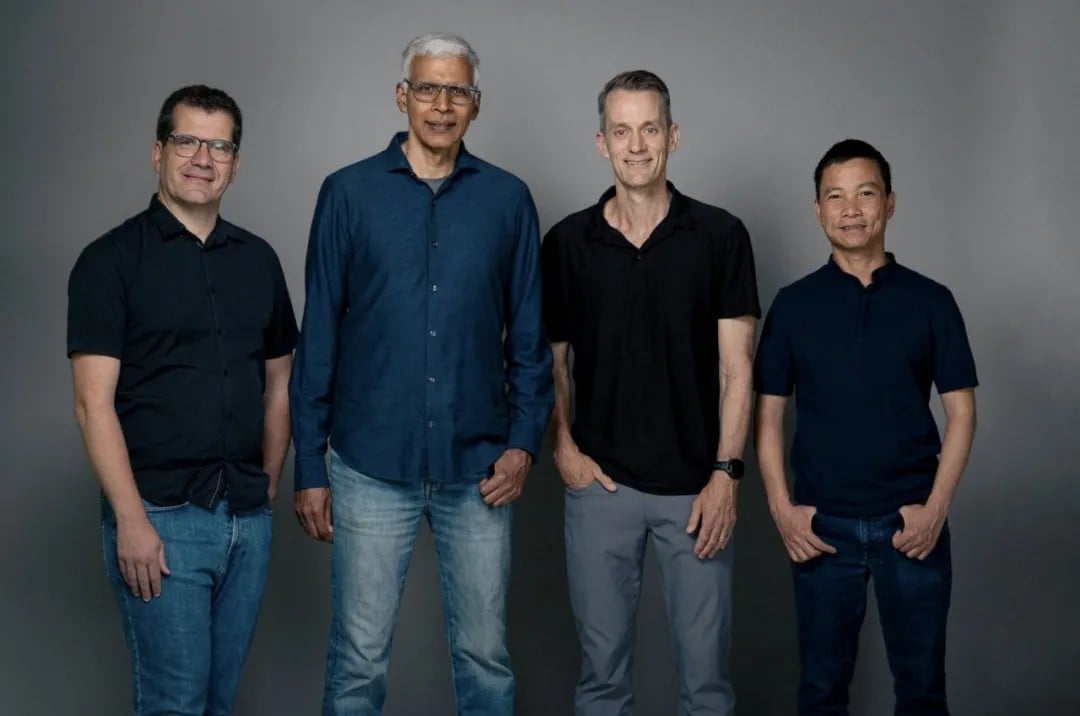
The Discovery Loop team, all from Google’s tech elite | Image Source: x
The specific roadmap consists of three steps:
First, start by addressing machine learning research itself—automating AI research, automatically proposing experimental plans, running evaluations automatically, and iterating models automatically. This is the most pragmatic starting point because the feedback loop in ML research is the shortest, evaluation metrics are the clearest, and data is the most readily available.
Second, optimize their own technology stack with this capability, making themselves their first client.
Third, expand to broader fields of science and engineering, including hardware design, drug discovery, and clean energy.
The company is registered as a Public Benefit Corporation, following the same governance path as OpenAI, Anthropic, xAI, and Ilya Sutskever’s SSI.
The seed round was co-led by Radical Ventures and Khosla Ventures, with participation from Lightspeed, Kleiner Perkins, Doerr Capital, and Alphabet itself. The amount and valuation were not disclosed.
It is noteworthy that Google not only invested money but will also act as a cloud partner, providing Discovery Loop with computing power support for at least the first year.
This detail is significant—an old employer willing to provide computing resources to support a company founded by its core employees is not common in Silicon Valley.
02 "Infrastructure Living Fossils"
The founding team of Discovery Loop consists of only four people, but together they represent almost a brief history of modern computing and AI infrastructure.
Jeff Dean, Google’s 30th employee, a 27-year veteran. He created MapReduce, Bigtable, Google File System, and Spanner with Sanjay Ghemawat—these are not flashy application-layer products, but the underlying "operating systems" that allow Google to handle global-scale data. Without these, there would be no Google Search, no Gmail, no Google Ads. Later, he led Google Brain, drove the development of TensorFlow and the design of TPU chips, and became Chief Scientist after the merger of Google Brain and DeepMind in 2023.
Sanjay Ghemawat, Senior Fellow at Google, Dean's partner for over 20 years. Within Google, Dean and Ghemawat are a legendary pairing—they almost always appear together in the most important papers and projects. Some joke that they share one brain.
Oriol Vinyals, Vice President of Research at Google DeepMind, one of the technical leaders of Gemini. During his time at DeepMind, he participated in landmark projects like AlphaStar (the AI that defeated professional players in StarCraft) and AlphaCode (code generation).
Quoc Le, co-founder of Google Brain and one of the pioneers of AutoML, made foundational contributions in the field of sequence-to-sequence learning.
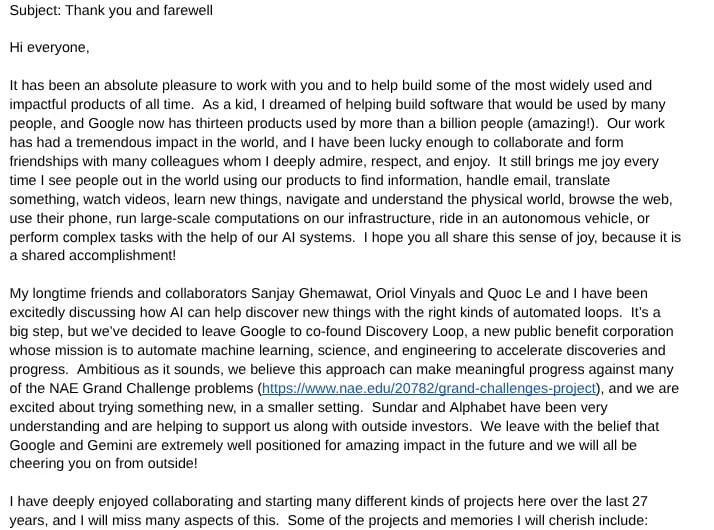
Jeff Dean's announcement of his departure posted on x | Image Source: x
The content of Jeff's departure announcement:
Tomorrow will be my last day at Google, having spent 27 years here, witnessing its growth from 25 people to over 190,000. It has been an incredible journey. Here is a note I shared with many at Google internally today. Excerpts are as follows:
It has truly been an honor to work with you and help build some of the most widely used and impactful products in history. As a child, I dreamed of helping build software used by many, and now Google has 13 products used by over a billion people (how incredible!).
Our work has had a tremendous impact on the world, and I have had the privilege of collaborating and building friendships with many colleagues whom I deeply admire, respect, and enjoy being with. Each time I see people using our products around the world to find information, manage emails, translate documents, watch videos, learn new things, navigate and understand the physical world, browse the web, use phones, run large-scale computations on our infrastructure, ride autonomous vehicles, or perform complex tasks with the help of our AI systems, I still feel immense joy. I hope you all share in this joy, as it's a shared achievement! Thank you to all my colleagues at Google over the years!
I am now excited to start @DiscoLoopAI with my old friends and colleagues @Sanjay_Ghemawat, @OriolVinyalsML, and @quocleix.
The four people have collaborated over spans ranging from 14 to 30 years. The introduction on Discovery Loop’s official website states that this team includes the three most cited researchers in the AI field and the two most cited researchers in the distributed systems field.
If you look closely at this resume, you will find a keyword that runs through Dean’s entire career—infrastructure. What he has done at Google has never been user-facing products, but rather the layer that allows others' work to be systematically scaled. MapReduce amplified engineers' ability to handle data, TensorFlow amplified researchers' ability to train models, and TPU boosted the computing power provided to the entire industry.
Now, what he aims to amplify is scientists' capacity to conduct research. The tools have changed, but the role has not. The essence of Discovery Loop is "the infrastructure for scientific discovery."
03 The Wave of AI Migration
Jeff Dean's departure is not an isolated incident.
Just this summer, Google DeepMind experienced an unprecedented wave of talent loss. In June, Nobel Laureate John Jumper (a core member of the AlphaFold team) left to join Anthropic, and co-author of the Transformer paper, Noam Shazeer, also left recently. In just one week in June, five senior researchers from DeepMind left for Anthropic and OpenAI, causing Alphabet's market value to evaporate by about $270 billion.
Now, even the person who built MapReduce has left.
And this is not just a problem for Google. Mira Murati left OpenAI in 2024 to found Thinking Machines Lab, raising $2 billion in funding within 5 months, with a valuation of $12 billion. Ilya Sutskever left OpenAI to found SSI, focusing on superintelligence safety. Andrej Karpathy also joined Anthropic this year.
A thought-provoking trend is emerging—the core technical talent in the AI industry is systematically migrating from large companies to startups.
The reasons behind this are not just financial. The pre-IPO equity at Anthropic and OpenAI is indeed highly attractive, but Dean is not lacking in money at Google. The reason he provided is more noteworthy—pressure from quarterly reports of public companies limits the freedom of scientific decision-making. The implication is that in a system that needs to answer to Wall Street about quarterly revenues, it is difficult to conduct foundational research on a ten-year scale.
Discovery Loop is registered as a public benefit corporation, which essentially addresses this issue at the institutional level. The PBC structure allows the company to pursue commercial returns while maintaining a legally protected commitment to its mission, ensuring that long-term scientific goals won't be sacrificed for short-term monetization due to shareholder pressure.
Google has clearly recognized this contradiction. Alphabet invested in Discovery Loop and provided the first-year computing power—this almost acknowledges that there are some things that cannot be done within their own framework, yet they do not want to entirely lose these people. This is a pragmatic choice for a large company facing talent outflow, but it also reveals a structural dilemma.
Meanwhile, Google is also making internal adjustments. In the restructuring announced on the same day as Dean’s departure, Demis Hassabis stepped down from daily management of Google DeepMind to become chairman and chief scientist of Alphabet; CTO Koray Kavukcuoglu was promoted to Senior Vice President to take over model development for Gemini. Pichai stated in an internal letter that this was to inject new momentum into Google’s AI efforts.
However, the signal read by the market may be precisely the opposite.
Analysts noted that this summer, the number of iconic figures leaving Google’s AI department surpassed any comparable period in the company’s history. It was not "the people training models on infrastructure" who left, but "the people building the infrastructure itself." This is a qualitative change.
Jeff Dean said something at this year’s graduation ceremony at the University of Washington that now looks like a prelude. He told the computer science graduates that one of the worthwhile problems to solve is "developing tools to accelerate scientific discovery and engineering."
He also said another thing that perhaps better explains why he chose to leave.
"The beauty of software is that a small group of people can build something that has a huge impact on the world."
27 years ago, he proved this at a 20-person startup. Now, at 58, he wants to prove it once again.
免责声明:本文章仅代表作者个人观点,不代表本平台的立场和观点。本文章仅供信息分享,不构成对任何人的任何投资建议。用户与作者之间的任何争议,与本平台无关。如网页中刊载的文章或图片涉及侵权,请提供相关的权利证明和身份证明发送邮件到support@aicoin.com,本平台相关工作人员将会进行核查。


