
Written by: angelilu, Foresight News
On August 5, Binance took a former partner to court, RedotPay, a unicorn that makes crypto payment cards, is rushing towards an IPO in the United States. Binance accuses it of quietly diverting over 470,000 users from Binance Card to its own crypto payment card during their cooperation, and has issued a claim bill of $472.8 million for this.
Specifically, Bloomberg reported that Binance's three affiliated entities, Nest Trading, Distributed Technologies, and Chaintecs Consulting Singapore, have submitted a legal petition in Hong Kong against RedotPay's three co-founders, Michael Gao, Chan Wa Choi, and Yao Chao, accusing them of violating the agreement signed by both parties last year. In addition to Hong Kong, one of Binance's affiliates, Chaintecs, has also filed another case against RedotPay's affiliated party in Singapore, with a hearing scheduled for this Friday (August 9).
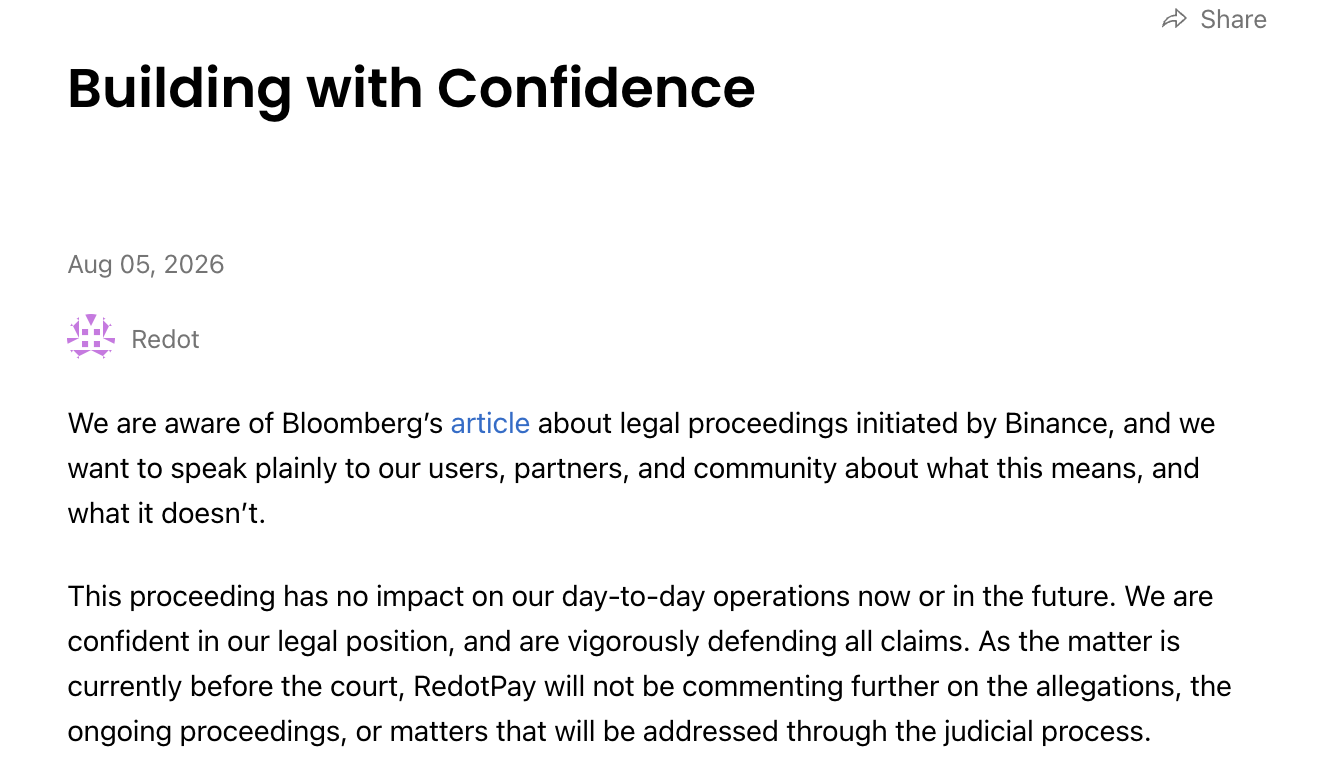
Both parties have made firm statements. A Binance spokesperson stated that they would not comment on the ongoing litigation but would seek "justice" through courts and other channels when necessary; RedotPay, on the other hand, responded that it would "respond through appropriate legal procedures," emphasizing that it would actively defend and that the lawsuit would not affect daily operations.
$472.8 Million Claim and $304 Million Lost Funds
Binance's calculation of the compensation amount is straightforward: it estimates a lifetime value (LTV) of $925 for each diverted user, then multiplies that by the number of diverted users to arrive at the total loss.
LTV is a metric commonly used in traditional finance and internet companies, indicating the net income a customer is expected to contribute over their entire lifecycle. Using this to quantify "how much a batch of lost customers is worth" is a widely accepted practice in business damage compensation. By this metric, $472.8 million ÷ $925 ≈ 510,000 users, which is essentially consistent with the statement of "over 470,000." Binance claims that it is these over 470,000 users who flowed from Binance Card to RedotPay that became one of the factors boosting RedotPay's valuation.
It should be clarified that this $472.8 million is considered "anticipated loss": it measures the income that these users could have contributed in the future but currently are not contributing, based on retention rate, customer unit price, lifecycle, and other parameters. Such estimates are made by the plaintiff in litigation, and whether full compensation can be obtained ultimately depends on how the court evaluates the evidence.
In addition to the claim amount, Binance has also thrown out another figure to support its accusation: it alleges that this cooperation allowed RedotPay to gain approximately $304 million in user funds from Binance Pay. This amount measures the actual flow size and directly points to that compliance red line—customer asset segregation.
Binance now accuses RedotPay of violating the customer asset segregation rule and characterizes it as a "fraud scheme"; this is primarily a breach of contract dispute. Whether it further constitutes regulatory non-compliance regarding "fund management" depends on the specific regulation RedotPay is subjected to and the court's determination, which currently has no conclusion.
A Strike on the Eve of IPO
The timing of this lawsuit is intriguing. RedotPay was founded in 2023 and is one of the fastest-growing crypto payment companies in Asia, offering virtual and physical cards using the Visa network with stablecoin top-ups.
It has raised funds at a rapid pace, completing three rounds in 2025 alone (March Series A $40 million, September strategic financing $47 million, December Series B $107 million), totaling approximately $197 million, with investors including Accel, Blockchain Capital, Circle Ventures, Coinbase Ventures, and Galaxy Ventures. By the end of 2025, its valuation surpassed $1 billion, and it is now planning an IPO in the United States, with a reported target valuation of $4 billion.
Bloomberg states that RedotPay has long promoted its partnership with Binance to potential venture capitalists. The materials specifically mention that users can directly top up their RedotPay cards through Binance payments.
Notably included in the list of shareholders is Coinbase Ventures—Coinbase being Binance's top competitor.
In terms of business data, according to investment materials seen by Bloomberg, RedotPay's annualized payment volume exceeded $10 billion in December last year, doubling year-on-year, with revenues also doubling to $158 million; the company claims that its current annualized payment volume reaches $14 billion, annualized revenue is $180 million, and users exceed 8 million. Additionally, according to Paymentscan data, RedotPay is currently the top-ranked crypto card by transaction volume, with a cumulative transaction volume of $5.8 billion.
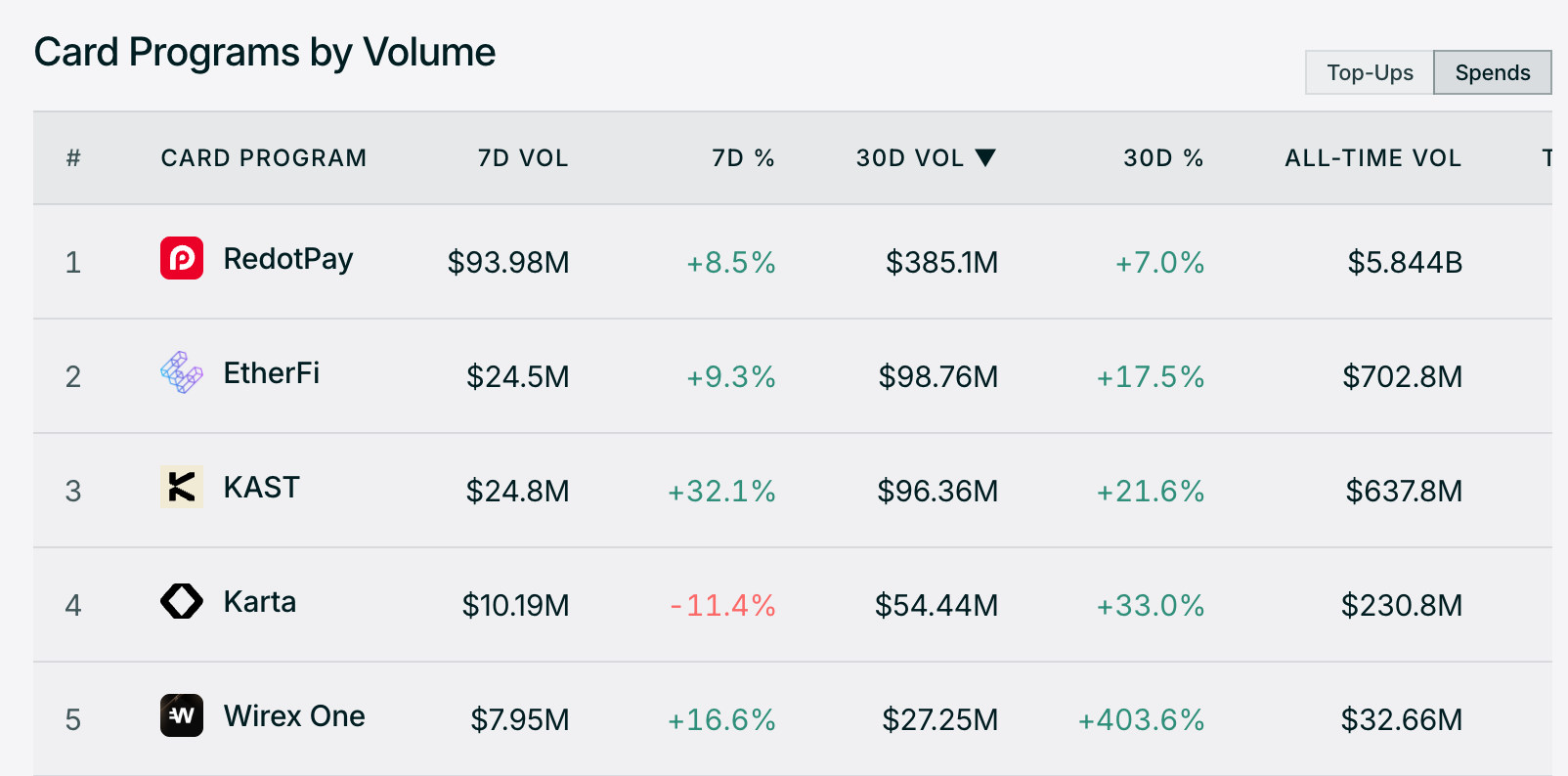
The $472.8 million claim is approximately 2.6 times RedotPay's annualized revenue ($180 million)—even if the final judgment is reduced (the court has yet to make a decision), this hanging lawsuit is a substantial blow to a company racing towards an IPO, regardless of the outcome, it must be included in the risk disclosure of the prospectus.
RedotPay Team and Executive Turmoil
The high growth comes with executive turmoil. According to another Bloomberg report from March, at least five executives at RedotPay left within less than a year of joining, and the company even pushed for an IPO without a CFO. RedotPay has had two compliance officers change in a year. Additionally, Jonathan Tsang, who has been the legal head of the startup since 2024, recently posted on LinkedIn that he left on July 21. This is particularly subtle in the context of this lawsuit: Binance is accusing compliance issues such as “fund segregation,” while RedotPay’s compliance position has seen frequent changes.
Looking at the team behind RedotPay, its holding entity is Rabbit7 Holding, registered in 2023 in the British Virgin Islands. According to Bloomberg's article, the name was derived from the seven co-founders' intention (it was the Year of the Rabbit), symbolizing "running fast like a rabbit," with one of the founders being former banker Michael Gao; the other two key figures—major shareholder Dawei Yuan and co-founder Troy Yao (possibly one of the defendants in this lawsuit, Yao Chao)—are from the crypto exchange Huobi (now HTX).
However, only three of them appear in Binance's lawsuit. There are no relevant documents explaining why only these three are being sued, but typically lawsuits target signatories or responsible persons directly related to the agreement.
From Teammates to Rivals
The partnership between Binance and RedotPay was initially a mutually beneficial relationship. After Binance stopped its European crypto card service in December 2023, it leveraged RedotPay's Visa crypto card to allow users to convert stablecoins into fiat currency for consumption, while RedotPay gained access to a massive user base via Binance.
A timeline of cooperation between the two companies summarized by Bloomberg also includes a detail that had not previously been noted: according to submitted documents, RedotPay first reached an agreement with a Binance affiliate in November 2023. This agreement broke down in less than six months due to accusations that Binance payment funds were used to preload RedotPay cards. Documents show that in March 2025, both parties reached a new agreement, ensuring that Binance funds would be kept separate from other funds. Starting in March 2026, Binance claimed to have discovered that RedotPay had again violated the agreement by using Binance funds to load cards, and on April 3, 2026, Binance stopped RedotPay's Binance Pay functionality; this lawsuit officially came four months later.
Binance has now rebuilt its own card business, joining Mastercard's global crypto collaboration program in March 2026, with cards rolling out in Brazil, Asia Pacific, and other markets. RedotPay, which benefitted from Binance's halt, now faces a resurgent Binance—turning the relationship from "cooperative replacement" to "direct competition." Binance's lawsuit is pursuing both old debts and sending a message to a rival that has capitalized on its own benefits and is racing towards an IPO.
免责声明:本文章仅代表作者个人观点,不代表本平台的立场和观点。本文章仅供信息分享,不构成对任何人的任何投资建议。用户与作者之间的任何争议,与本平台无关。如网页中刊载的文章或图片涉及侵权,请提供相关的权利证明和身份证明发送邮件到support@aicoin.com,本平台相关工作人员将会进行核查。


