Written by: Vaidik Mandloi
Translated by: Chopper, Foresight News
Last week, Aave announced it would shut down lending markets on six blockchains. Each of these chains generated less than $5,000 in quarterly revenue. According to Aave's typical commission ratio of 13 cents per dollar of interest, its earnings from Mentis and Aptos were probably just enough for a dinner. In contrast, Aave's deployment on Ethereum generated $142 million last year; meanwhile, it expanded to new chains like Linea, with the V4 version's deposit scale surpassing $300 million.
This article will delve into what these public chains will encounter after Aave's withdrawal and whether any projects will take over Aave. If no one takes over, these public chains may permanently lose their lending capabilities.
Collapse of Chain Reaction
What happens when a leading lending protocol withdraws from a public chain? Let's review past cases.
The first case is Harmony Protocol. In June 2022, its core cross-chain bridge Horizon was attacked, losing about $100 million. As the largest lending protocol on the chain, Aave froze all on-chain reserve assets. Later that year, the community proposed a rescue proposal, but it was rejected by 99% of Aave token holders. Nowadays, this public chain has vanished, with the root cause being a complete loss of lending liquidity.
You might wonder: why can't Aave simply fork and redeploy on Harmony? After all, the code is open-source and deploying a lending protocol takes less than a day. While that reasoning is valid, what is often overlooked is that the lending market still requires ongoing maintenance and an oracle supported by financial backers to quote collateral assets; it also needs sufficient DEX liquidity to ensure that when borrowers are liquidated, their collateral can be automatically sold without causing more than a 40% price slippage.
Additionally, stablecoin issuers need to recognize this public chain and support on-chain native redemptions. This means that issuers like Circle and Tether can natively issue tokens on that chain, allowing users to directly exchange USDC for fiat without needing cross-chain transactions. After Harmony's cross-chain bridge paralysis, all stablecoins on-chain were unpegged, oracle price feeds became ineffective, and the liquidation mechanism could not function at all. The entire suite of components supporting the lending market failed collectively. After that, no party had the business incentive to rebuild this system. On a public chain with no lending demand, who would be willing to spend money maintaining oracle price feeds?
An additional typical case is Fantom, which similarly encountered a cross-chain bridge hack in 2023. Before this incident, 78% of the chain's market value relied on this cross-chain bridge. After the attack, the bridged version of USDC on Fantom plummeted to about $0.22, causing a significant drop in the value of collateral, leading to insolvency.
The most noteworthy point to consider is that Fantom was once the third-largest DeFi public chain in the crypto industry, with real users and lending demand. Even with this foundation, it still could not rebuild its lending market. For a public chain that is losing users, the cost of rebuilding the complete underlying infrastructure of oracles and stablecoins is always higher than the revenue it can obtain, as the core user base has long departed.
Subsequently, Fantom attempted to rebrand itself, renaming to Sonic, and tried to solely rely on capital to turn the situation around. The project initiated a $190 million token airdrop, and on the first day, Aave, Silo, and Euler all completed their deployments, with Wintermute providing market-making support. However, the outcome was contrary to expectations, as the project suffered a witch attack. Depositors and borrowers were largely the same group of users: depositing assets to earn airdrop points, then using the same assets as collateral to borrow, maximizing point returns. The TVL was inflated, with the same funds being repeatedly counted through leverage cycles.
The lending demand completely stemmed from airdrop incentives rather than genuine economic activity on-chain needing operating funds or leverage. For example, Ethereum users borrowing might involve circularly pledging stETH or sourcing funds for trading strategies; regardless of whether protocols offer rewards, the demand is genuinely present. But for Sonic, once the incentives were removed, there was no real borrowing demand. This directly led to the on-chain TVL plummeting 98% after Wintermute's cooperation ended, with the token price dropping to less than one cent, and both founders resigning from the board. Subsidies and market-making collaborations could create a false appearance of a lending market, but they couldn't sustain it over the long term.
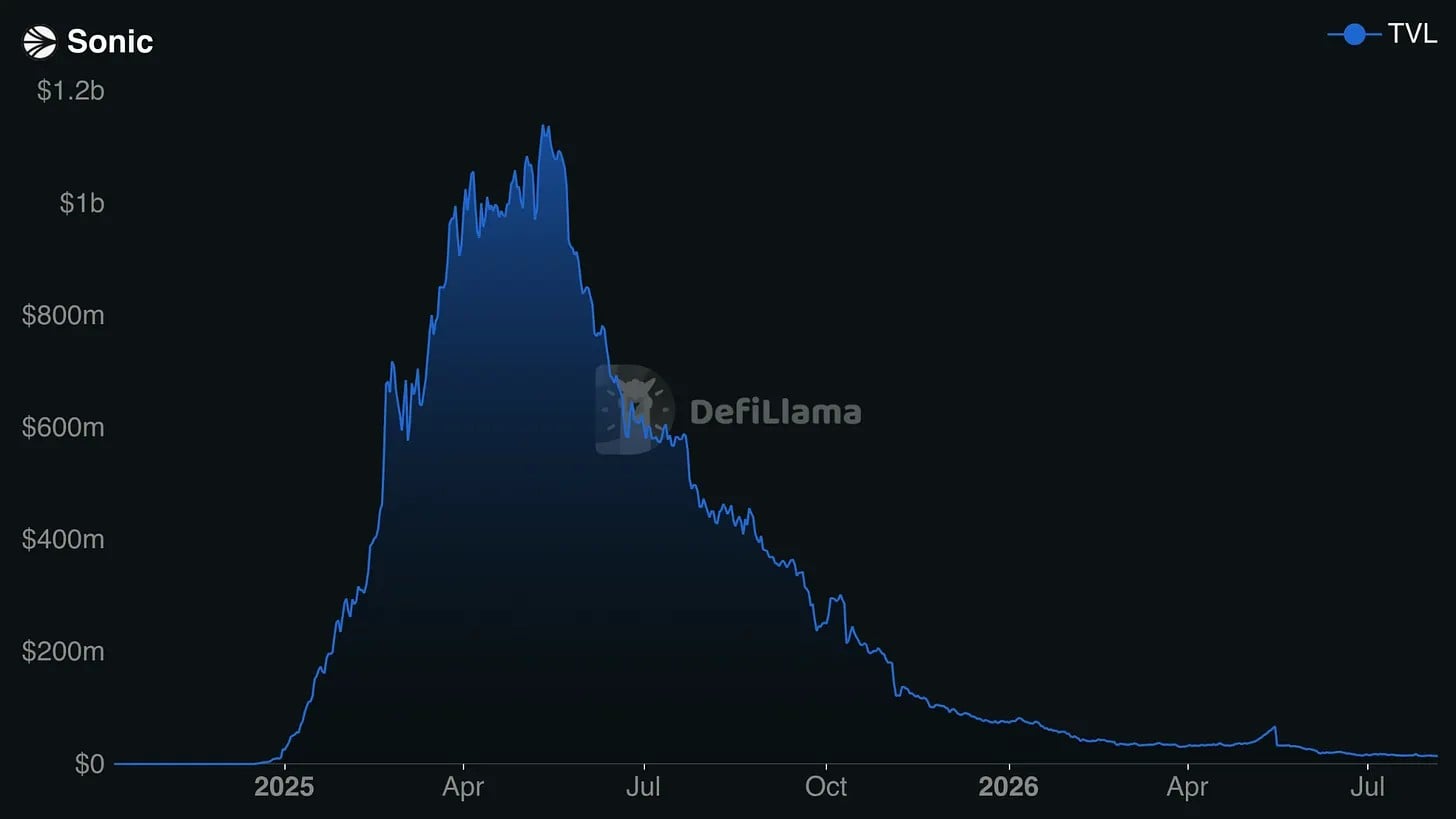
Data Source: DeFiLlama
Looking at the public chains from which Aave is about to withdraw, such as Soneium, Aptos, Zksync, and Scroll, their situation is even worse than that of Harmony and Fantom. On-chain deposits have already plunged 95%, and quarterly revenue from lending activities is less than $5,000.
Harmony and Fantom at least had genuine user-generated native lending demands before being hacked. However, these six public chains have never formed any native business demand from the start. On average, each of these public chains raised $250 million and deployed the most cost-efficient lending protocols in DeFi, yet they still failed to generate genuine demand.
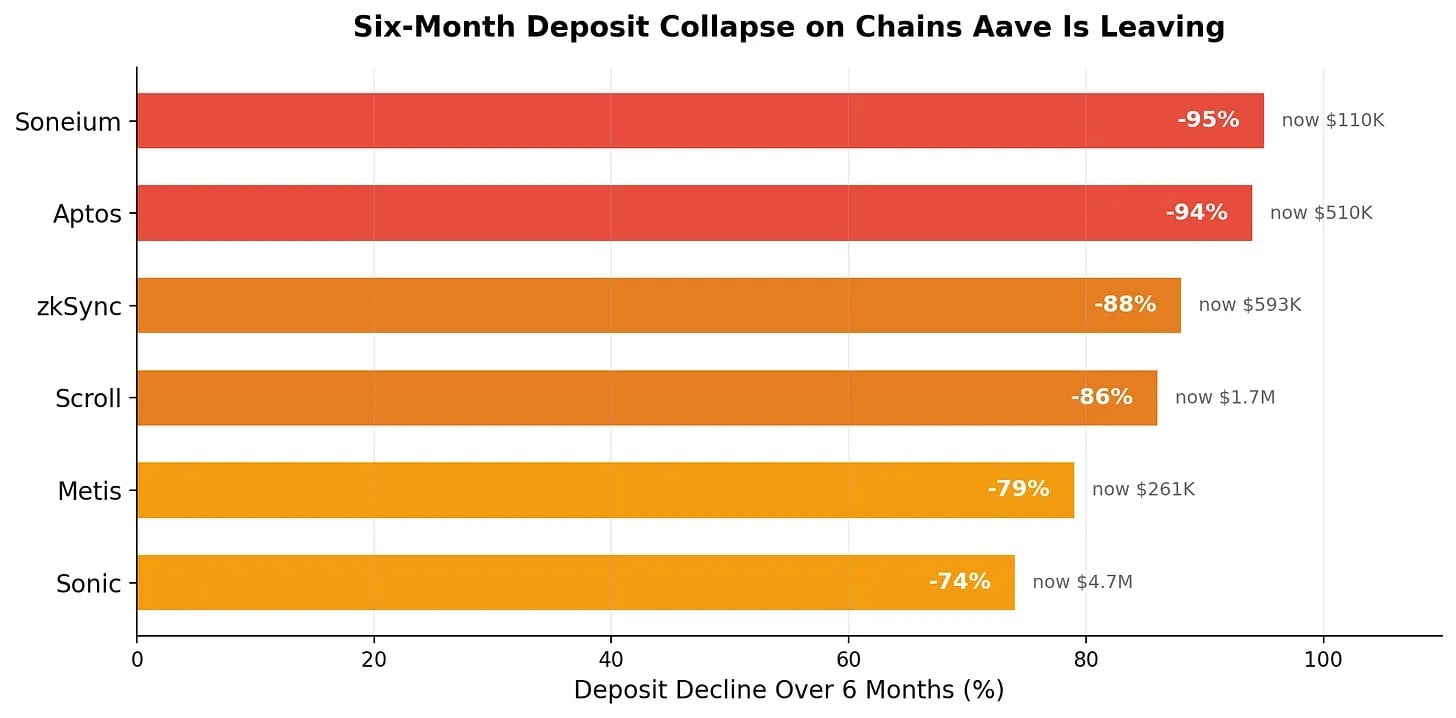
Data Source: Aave governance page
Aave's exit will also trigger a chain reaction. Many people do not realize that Aave is the core pillar of financial infrastructure on these public chains. Almost all Chainlink oracle price feeds on these chains are maintained at Aave's expense, as Aave is the largest caller. After Aave's withdrawal, all oracle service providers will reassess whether they still want to maintain price feeds for a public chain with no active lending market. Market makers will likewise stop investing in DEXs on these public chains for the same reasons. Even stablecoin issuers will not support native issuance for public chains with monthly revenues below $1,000. The exit of one service provider will accelerate the departure of the next; the commercial viability of all service providers is predicated on the normal operation of other complementary services.
Resources will accelerate to concentrate on public chains that are operationally sound, have ample liquidity, and where the lending market can function normally. The exit of each niche public chain's infrastructure will further strengthen the clustering effect of leading public chains, making it even weaker for the remaining niche public chains to maintain their own lending infrastructure's business logic.
This form of centralization reinforces itself; lending is the foundation of the entire financial system of a public chain. Without lending, most yield strategies cannot operate, as most strategies require using one type of asset as collateral to borrow another type of asset; efficient liquidity market-making is also out of the question, as concentrated liquidity positions often rely on borrowed funds. Once lending disappears, all financial applications built upon it will lose their foundation. Consequently, developers will leave one after another, leading to further declines in on-chain activity, and no infrastructure service providers will be willing to stay.
For this reason, Aave has set thresholds for future new chain deployments: annual revenue must reach at least $2 million. This amount essentially covers the costs of maintaining oracle price feeds, risk monitoring, and the complete lending infrastructure for a public chain. This situation fully demonstrates that the past model of public chains raising hundreds of millions and quickly launching through liquidity subsidies is no longer viable and lacks sustainability.
Not Unique to the Crypto Industry
The loss of credit infrastructure by public chains is not unique to the crypto domain. Any industry with high fixed costs and a narrow market size will encounter similar issues.
After 2008, major global banks began severing agency banking relationships with several small countries. The logic is highly similar to Aave's: anti-money laundering monitoring, regulatory reporting, and the establishment of each cooperative relationship incurs fixed costs, and the revenue from some small cross-border transactions cannot cover these costs. Between 2011 and 2022, the number of effective agency banking partnerships worldwide decreased by 30%. The dollar clearing channels in Pacific island countries shrank by over 60%, with some countries left with only one agency bank. The situation became so severe that the World Bank had to allocate $69 million to subsidize the continued operation of the only remaining clearing service provider in eight Pacific nations.
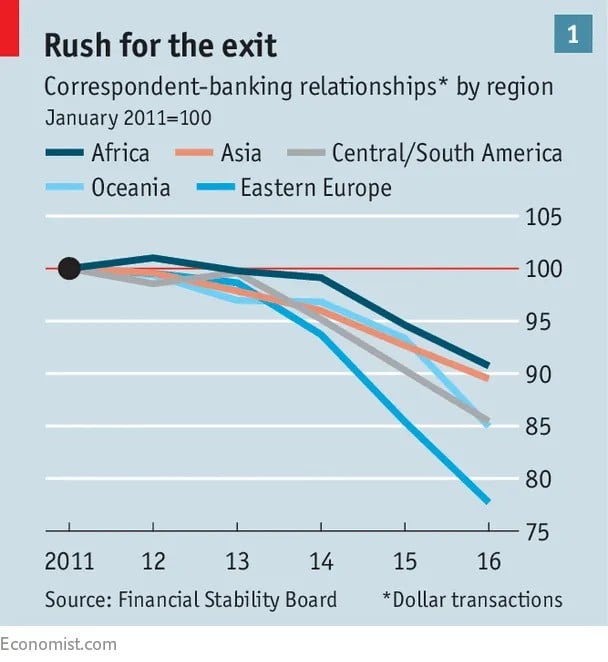
However, there is a crucial distinction between the crypto industry and traditional cases. In traditional agency banking systems, there are backing mechanisms by the World Bank and subsidies from central banks and development agencies to sustain operations. But such backing mechanisms are virtually nonexistent in the crypto industry, which is the reality these public chains are experiencing. A medium-sized bank faces operational compliance costs of $15 million to $40 million annually, and the World Bank's $68 million investment merely sustained the last dollar clearing channel for eight countries. In contrast, the total cost of Aave's risk monitoring contracts across all public chains is only $5 million to $8 million, which these six public chains cannot even afford to cover.
Of course, this does not mean that DeFi lending as a whole is shrinking; in fact, it is quite the opposite: the industry is experiencing rapid growth but is highly concentrated. Morpho's TVL grew from $105 million to over $8 billion within a year; Euler expanded from $6 million to $300 million in just a few months. Aave's V4 launch saw deposits exceed $300 million within a few months, and Société Générale became the first traditional bank to connect to DeFi lending protocols. The credit market is thriving, but resources are concentrated on Ethereum and a few layer two networks like Base and Arbitrum, rather than being dispersed across dozens of public chains.
The large number of public chains that emerged in the past was based on the premise that the cost of deploying infrastructure was extremely low, allowing each public chain to build its own financial system. This premise is only half correct: it is indeed inexpensive to launch a public chain, but running a set of lending infrastructure on top of it is very costly. Currently, among layer two networks, Ethereum and the top three public chains account for 90% of TVL. Other public chains can only compete for meager shares, which do not even cover the costs of operating a single Chainlink price feed. These public chains may eventually see a forked version of Aave with oracle defects emerge, or they may leave nothing behind.
免责声明:本文章仅代表作者个人观点,不代表本平台的立场和观点。本文章仅供信息分享,不构成对任何人的任何投资建议。用户与作者之间的任何争议,与本平台无关。如网页中刊载的文章或图片涉及侵权,请提供相关的权利证明和身份证明发送邮件到support@aicoin.com,本平台相关工作人员将会进行核查。


