Written by: Prathik Desai
Translated by: Chopper, Foresight News
Last week, I spent two days, totaling several hours, studying the financial reports of two similar yet distinctly different companies. The first was Robinhood, whose business layout inspires confidence as it can almost meet all the needs of traders and investors in the financial markets. The other was Coinbase, and after reviewing the financial report, I find it hard to remain optimistic about its future.
Coinbase's Q2 financial report revealed two sets of starkly contrasting data, leaving a mixed sentiment about the company's development direction. Coinbase's global market share in cryptocurrency trading hit a historic high of 10.3%, marking the third consecutive quarter of record share gains. This aligns perfectly with its vision of building a "universal exchange." However, at the same time, the company has recorded net losses for three consecutive quarters.
This is the typical play of financial report presentations: amplifying the impressive data while downplaying unfavorable indicators. The management hopes the market focuses on the aforementioned market share and the fact that 88% of its revenue no longer comes from cyclical Bitcoin spot trading. But a deeper analysis reveals that Coinbase has not truly escaped the constraints of market cycles. It still heavily relies on two market-driven variables: Federal Reserve monetary policy and altcoin prices.
This article will explain why the new businesses Coinbase is betting on have yet to convince people; and that its originally targeted core users may no longer fit the evolving landscape of the crypto industry.
Warning Signs
Coinbase's traditional main business of buying and selling cryptocurrencies for ordinary users is showing signs of structural decline. Consumer trading revenue decreased by over 30% year-on-year, approximately $452 million; retail spot trading volume shrunk from $41.5 billion to $25.8 billion. The reality behind the record 10.3% market share is that the overall pie is shrinking, and Coinbase is simply getting a larger slice.
In Q2 2026, the company reported a net loss of $359 million, marking three consecutive quarters of losses. In the same period last year, Coinbase achieved a net profit of $1.4 billion, the second-best quarter in the company’s history.
More concerning than the net loss is the next line of data in the financial report. Coinbase attributes most of its net loss to unrealized markdowns in the market value of its held crypto assets. This explanation holds water, but hidden dangers still exist. The adjusted EBITDA (earnings before interest, taxes, depreciation, and amortization) after excluding non-cash gains and losses did not exhibit a healthy trend, standing at $208 million this quarter.
Coinbase claims this metric has been positive for 14 consecutive quarters. However, what the company did not disclose is that this is also the lowest value for this metric in the past 11 quarters.
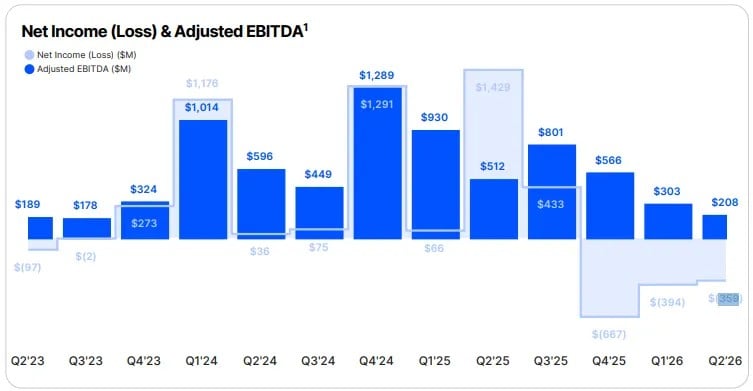
Even without considering the market value changes of crypto assets, the operating profit that directly reflects the business fundamentals has been negative for two consecutive quarters. Operating profit fell from $481 million in Q3 2025 to an operating loss of $114 million in Q2 2026. Compared to last year's Q2, the operational performance has severely deteriorated.
From the above trends, it is evident that the revenue decline in Coinbase’s core business is eroding its profits. One reason is the cost structure built for a larger business scale. During the market upcycle in 2025, Coinbase expanded its workforce to nearly 5,000 people. However, after the market cooled in late last year, the rate of cost contraction did not keep pace with the revenue decline. In Q2, operating expenses were $1.33 billion, exceeding net revenue of $1.15 billion. Without accounting for any impairment of crypto assets, the company’s operating expenditures have already surpassed operating income.
In May, Coinbase responded by announcing layoffs of about 700 people, which accounted for 14% of its global workforce.
Coinbase stated it is addressing the dependency issue by developing non-cyclical businesses. The company claims that currently over 88% of its revenue is decoupled from Bitcoin spot trading; subscription and services (S&S) now constitute nearly 48% of total revenue, setting a new high in nearly 11 quarters. However, breaking down the S&S segment data over the past few quarters dampens this good news. This quarter, S&S segment revenue was $555 million, the second lowest in the past eight quarters.
The subscription and services segment's revenue includes on-chain staking rewards, stablecoin-related income, interest and financing fees, and other miscellaneous income. Notably, stablecoin floating income accounts for over half of total S&S revenue. This business is still highly influenced by the macro environment, dependent on Federal Reserve interest rate policies. Ironically, despite the USDC supply on the platform hitting a historical high of $20 billion this quarter, stablecoin business revenue declined from $309 million last year to $292 million this year.
Larger circulation of stablecoins resulted in earning less.
Last November, I warned that every 1% decrease in interest rates by the Federal Reserve would reduce quarterly stablecoin revenue by approximately $70 million. Now, Coinbase is directly experiencing this situation.
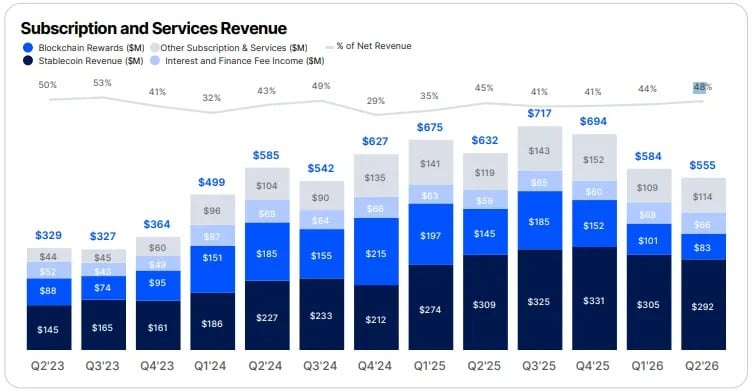
The second largest revenue source in the S&S segment also has fragile cyclical dependencies. Crypto staking rewards revenue fell from $145 million in Q2 2025 to $83 million in Q2 2026, a drop of over 40%. This revenue also fluctuates with crypto market prices.
Combining stablecoin income and staking rewards, these two items account for over two-thirds of the so-called "diversified non-trading businesses," still tied to macro interest rates and altcoin trends. The only true sustainable product revenue belongs to Coinbase One and custody service fees, which comprise only one-fifth of the S&S segment.
The revenue structure has indeed changed, but it has not migrated towards a reassuring diversification. It has merely shifted from a singular dependency on crypto spot trading to simultaneously being tied to the crypto market and a Federal Reserve that is not inclined to raise rates in the short term.
A Glimmer of Hope
Despite numerous risk signals, the Q2 financial report still showed some positive signs.
The first highlight comes from the prediction market business. In Q2 2026, this business's annual recurring revenue (ARR) surpassed $100 million, doubling from the previous quarter.
This business brings incremental demand and is expected to continue rising due to industry tailwinds; major events like the NBA playoffs and the World Cup serve as primary traffic sources.
In mid-June, Coinbase launched crypto binary options products, allowing users to predict price movements for assets like BTC, ETH, and SOL over various timeframes such as 15 minutes, one hour, one day, one month, and one year. By the end of the quarter, the daily trader scale for this business tripled, and daily revenue quadrupled. This business leverages the existing funding account system of the platform and does not squeeze the volume of spot trading.
The second highlight is the rapid growth of institutional and infrastructure business. Coinbase remains the largest platform in the world for custody of crypto assets, continuously safeguarding over 11% of global crypto assets by market value; the vast majority of the underlying crypto assets for Bitcoin spot ETFs in the U.S. are also custodied by Coinbase.
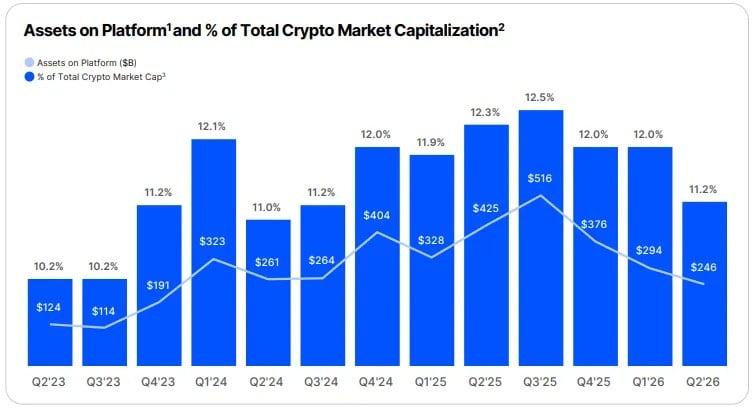
Derivatives business market share has also reached new highs, with Coinbase maintaining stable trading volumes in the face of an overall market drop of 12%. The acquisition of Deribit has opened the global options market for this publicly traded company, which is an advantage that other peers do not possess.
Currently, institutions are increasingly viewing cryptocurrencies as backend infrastructure, rather than just speculative tools, and I believe this is the advantage Coinbase should leverage moving forward.
However, these promising segments also harbor potential concerns.
Although the prediction market is thriving, Coinbase essentially acts only as a distribution channel, selling Kalshi's event contracts, with revenues needing to be shared with Kalshi. In contrast, Robinhood possesses its own prediction market exchange license, allowing them to continuously issue various event contracts independently. Coinbase does not have the qualifications to operate its own exchange, meaning its business volume and revenue cap are largely constrained by the new contracts Kalshi introduces.
Even the two major strategic layouts that Coinbase has pinned high hopes on are still in very early stages.
The x402 payment protocol, aimed at AI financial agents, recently recorded its historical high in monthly total transactions between agents. In July, x402's monthly trading volume set a new record.
But as Coinbase CFO Aleia Haas herself acknowledged, relying on the x402 protocol for commercialization is still "very much in the early stages." The protocol has already processed over 100 million transactions almost entirely based on USDC, and it currently does not generate any transaction fees.
It can drive USDC demand and bring indirect benefits from cross-selling other products, but the company has not provided a clear timeline for commercialization.
The Road Ahead is Rugged
Stepping back from all financial metrics, it's apparent that the crypto industry Coinbase initially sought to conquer has undergone significant transformation, exposing the structural issues the company urgently needs to address.
When Coinbase was founded, the industry envisioned that crypto would become an independent, parallel financial universe with its own native user base. I still remember Base initiating the Onchain Summer event, gathering artists and developers to co-build an on-chain ecosystem. But now, this narrative is being discarded by the entire financial world. Traditional financial giants and emerging fintech companies are more inclined to view cryptocurrencies as backend infrastructure, such as stablecoin transfers and minute-level blockchain settlements, serving traditional financial products that have existed for decades or even centuries.
In this new world, the extremely "crypto-native" identity has instead become a burden. The companies that truly hold an advantage are those with a large number of ordinary end-user clients, embedding crypto capabilities at the backend so that users can utilize them without awareness.
Robinhood is a prime example, with nearly 30 million funded accounts. This distribution advantage will allow the company to harvest large amounts of value in the Web 2.5 era.
Robinhood can direct the same batch of paying users to its dozens of offerings, increasing revenue per user. However, the "crypto-native label" that once granted Coinbase an advantage in the last cycle is now turning into a burden.
The path forward for Coinbase is through institutional business. This is a territory it can maintain and rapidly expand. The vision of a "universal exchange" sounds appealing and can accommodate a variety of financial products, but it must ensure that each business has sufficient profit margins to support the overall health of the enterprise.
免责声明:本文章仅代表作者个人观点,不代表本平台的立场和观点。本文章仅供信息分享,不构成对任何人的任何投资建议。用户与作者之间的任何争议,与本平台无关。如网页中刊载的文章或图片涉及侵权,请提供相关的权利证明和身份证明发送邮件到support@aicoin.com,本平台相关工作人员将会进行核查。


