Organized & Compiled: Deep Tide TechFlow
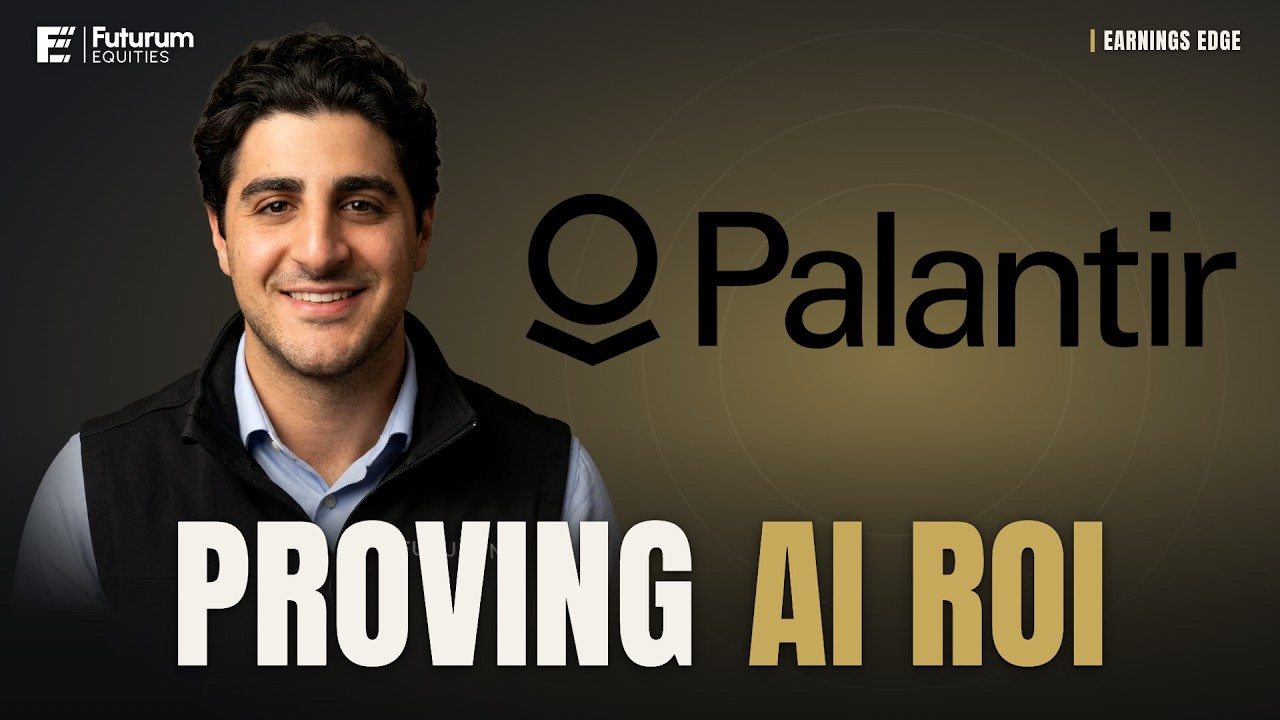
- Program: FE Earnings Edge · Palantir posted a Rule of 40 Score of 155. The elite standard is 40.
- Speaker Background: Shay Boloor, 32 years old, Los Angeles growth stock investor, X account @StockSavvyShay has 291,000 followers and an average of 55 million exposures per month. Since 2023, he has publicly shared a $100,000 portfolio, aiming to surpass one million by September 2025 through targets like Palantir and Rocket Lab. He has appeared on Bloomberg, Fox Business, and other television programs 44 times. In June 2025, he joined Futurum Equities as Chief Market Strategist.
- Core Topics: Q2 2026 earnings report breakdown, dual-engine growth model, Rule of 40 score, impact of open-source models on Palantir, valuation risks
- Earnings Report Release Date: August 3, 2026, after market close
Deep Tide Introduction: Everyone is asking, when will we see returns from this wave of AI investment? Palantir provided the most straightforward answer with a Q2 earnings report: a year-on-year revenue surge of 93%, an adjusted operating profit margin of 62%, a free cash flow profit margin of 63%, and a Rule of 40 score of 155—nearly four times the elite threshold of 40. This episode’s podcast notes break down what the speaker referred to as “the cleanest AI application layer results of this earnings season”: simultaneous acceleration in U.S. commercial and government sectors, contracts transitioning from experiments to eight-figure deployments, AIP Bootcamp maintaining business demand with zero slowdown for three years, and the operational logic that “the cheaper open-source models are, the more valuable neutral platforms become.” Of course, the valuation approaching a 90 times price-to-earnings ratio post-report has already priced in years of perfect execution.
Disclosure Statement: Shay Boloor is a long-term heavy holder of Palantir, having built his position since 2023 at prices below $8, currently holding an over-allocated position. He is also employed by Futurum Equities, which covers and recommends Palantir on its channel. Boloor has turned a $100,000 portfolio into $1 million through holdings in Palantir, Rocket Lab, and others. All opinions in this issue align with his personal holdings, and the title uses expressions like “comprehensive crushing” rather than phrases implying an independent analytical framework.
Key Points Summary
Palantir Q2 revenue reached $1.935 billion, a 93% year-on-year increase, marking the highest growth rate since its IPO. U.S. commercial revenue increased by 149% to $764 million, while U.S. government revenue grew by 90% to $809 million, both key businesses accelerating simultaneously.
Adjusted operating profit margin is 62%, and free cash flow profit margin is 63%. Rule of 40 score (revenue growth + operating profit margin) reached 155%, expanding for 12 consecutive quarters, nearly quadrupling the elite threshold of 40.
Full-year revenue guidance raised to $8.15 billion to $8.16 billion, about $500 million above prior expectations, indicating an overall growth rate of approximately 82%. U.S. commercial revenue guidance increased to at least $3.424 billion, representing at least 134% growth.
During the quarter, 220 contracts over a million dollars were completed, with 98 contracts over five million dollars, and 73 contracts over ten million dollars. Nearly one-third of million-dollar contracts have expanded into eight-figure commitments, showing that the platform has moved from the experimental phase to production deployment.
Remaining deal value (RDV) for U.S. commercial business reached $6.238 billion, a 124% year-on-year increase, providing strong visibility for future revenue.
Since the launch of AIP Bootcamp in 2023, U.S. commercial revenue has not experienced a single quarter of sequential slowdown, with year-on-year growth accelerating from 23% to 149%.
Palantir occupies the “operational layer” position in the AI value chain: while large-scale vendors invest in building data centers and buying chips, Palantir is responsible for converting intelligence into actual decisions and workflows for enterprises.
The narrative on open-source models is favorable for Palantir: as models become cheaper and more interchangeable, a neutral platform connecting models with enterprise data becomes more valuable.
Risk Warning: International growth is significantly weaker than in the U.S., and valuation is approaching a 90 times price-to-earnings ratio post-earnings report, having priced in years of perfect execution. Boloor believes the biggest risk is not a stall in growth but that the company continues to execute well yet may someday fail to surpass the extremely high expectations already priced in by the stock.
The day after the earnings report (August 4th), Palantir's stock surged 30.13%, closing at $163.51.
Highlights of Opinions
- “Everyone is asking, when will we see returns from this wave of AI investment? The returns are in Palantir's 60% operating profit margin.”
- “Large-scale vendors are building AI factories; Palantir sells the operational layer that turns outputs into enterprise decisions.”
- “Open-source anxiety actually benefits Palantir. The cheaper and more interchangeable the models are, the more valuable the neutral platform connecting the models to enterprise data.”
- “Since the launch of AIP Bootcamp in 2023, U.S. commercial revenue has seen no sequential slowdown. It accelerated from 23% to 149%, which is almost unheard of in large software companies.”
- “Palantir's biggest risk is not a sudden halt in growth, but that the company continues to execute very well and one day cannot surpass the extremely high expectations that have already been fully absorbed by the stock.”
- “What does an eight-figure contract mean? It means the platform has expanded from a small experiment in one department to more workflows, more departments, and more decision-making systems. This is the turning point for Palantir to transition from a ‘software vendor’ to a ‘company operating system.’”
1. Opening: From Government Black Box to AI Application Winner
Boloor opened by making his position clear. Since 2023, he has publicly shared his investment portfolio, with Palantir being one of the earliest positions he built, entered below $8, and increased his holdings below $6 to an over-allocated position. He has watched this company transform from a mysterious contractor viewed by the market as a “government black box” into the biggest winner in the AI application layer.
“This is one of the most impressive earnings reports I've seen from them,” Boloor said, “not just for them, I believe it’s the strongest combination of growth, profitability, contract momentum, and forward guidance that I've seen from any large software company.”
He acknowledged that market sentiment was not friendly leading into this earnings report. Competitive narratives from large model companies (Anthropic, OpenAI), the impact of open-source models, the stock price dropping below the 200-day moving average, and an 80 times price-to-earnings ratio combined to put Palantir on the edge of a technical breakdown. “But Karp delivered the paper.”
2. Core Data: 93% Growth Coupled with 62% Profit Margin
Boloor broke down the key metrics from Q2:
Revenue increased by 93% year-on-year to $1.935 billion. U.S. commercial revenue reached $764 million, growing by 149% year-on-year. U.S. government revenue reached $809 million, growing by 90% year-on-year. Adjusted operating profit margin achieved 62%.
Full-year revenue guidance has been raised to over $8.2 billion, nearly $500 million higher than previous market expectations. Boloor emphasized: “When Palantir gives guidance, they typically exceed expectations significantly. So the guidance itself being raised by $500 million indicates how drastically the company’s outlook has improved in just one quarter.”
He did not avoid a statement discrepancy in the U.S. government revenue data. The video description stated “U.S. government revenue of $109 million,” but the actual report figure is $809 million. Boloor aligned with the official report using $809 million. This is corrected according to the original report.
3. Dual-Engine Model: Commercial and Government Independently Support the Entire Company
Boloor believes the most significant structural change in this earnings report is that Palantir has evolved from a “government contractor with an AI business” into a company with “two completely different demand-driven engines.”
“U.S. commercial revenue of $764 million grew by 149%, and U.S. government revenue of $809 million grew by 90%,” he stated the data, “at this rate, in a few quarters, U.S. commercial revenue may surpass U.S. government revenue. Saying this two years ago would have been fanciful.”
The advantage of this dual-engine structure is risk diversification. If corporate tech spending enters an optimization cycle, the government defense and intelligence demands won’t slow down simultaneously. Conversely, if government budget environments change, AI adoption on the commercial side won't stall. “The customer bases of the two engines are completely different,” Boloor said, “with such a significant investment in AI, who knows when an optimization phase or slowdown will occur? Having two engines provides much reassurance.”
4. Contract Quality: From Experiment to Eight-Figure Commitment
Boloor particularly focused on the distribution of contract sizes. During the quarter, 220 contracts exceeding a million dollars were completed, with 98 contracts exceeding five million dollars, and 73 contracts exceeding ten million dollars.
Nearly one-third of million-dollar contracts have already expanded into eight-figure commitments, which he believes proves that Palantir’s platform is penetrating the core operational systems of customers instead of remaining in a trial phase.
The remaining deal value (RDV) for U.S. commercial reaches $6.238 billion, a 124% year-on-year increase. Boloor explains the significance of this metric: “These are contracts that have been signed but not yet recognized as revenue. It provides strong visibility for future growth. Customers are making long-term commitments rather than completing a small pilot and not responding to further communications.”
5. AIP Bootcamp: From Theoretical Discussion to Results Within Days
Boloor attributes the core driving force behind accelerated commercial demand to AIP Bootcamp. This is Palantir's customer acquisition mechanism launched in 2023: bringing customers into the Palantir platform, integrating real data and business processes, and producing a usable functional result in a matter of days.
“The traditional approach is to have customers spend 6 to 9 months discussing a theoretical AI project, during which interests may wane or seem too complex,” Boloor contrasts, “Bootcamp connects directly to the customers' real data and processes to produce results in days. Customers see the effects before their excitement from the first demonstration fades, and they immediately want more.”
He also points out a key data point: since the launch of AIP Bootcamp, there has not been a single quarter of sequential slowdown in U.S. commercial revenue. Year-on-year growth surged from 23% to 137% and then to 149%. “Three years without a single quarter of slowdown is nearly unheard of in large software companies.”
6. Rule of 40: What Does 155 Points Mean
Boloor explained the Rule of 40, a core valuation metric in the software industry, in simple terms: revenue growth plus operating profit margin yields the Rule of 40 score. The industry target is at least 40 points, with 50 points considered excellent and 60 points elite.
“Palantir scored 155 points,” he stated, “nearly four times the elite threshold. This means they have nearly doubled their revenue while converting over half of that revenue into operating profit.”
He further explains the rarity of this combination: “Most high-growth software companies either sacrifice profits for growth or preserve profits but see their growth slow. Palantir maintains a 62% operating profit margin while approaching 100% growth, concurrently generating substantial cash. This combination is virtually unprecedented among publicly traded software companies.”
7. AI Value Chain Positioning: Large-Scale Vendors Build Factories, Palantir Sells the Operational Layer
Boloor describes Palantir's position in the AI value chain very specifically. Microsoft, Amazon, Google, Meta are spending hundreds of billions to build data centers, buy accelerators, and expand networks, effectively constructing “AI factories.” Palantir does not build these factories but sells the “operational layer,” converting intelligence produced by those factories into executable decisions and workflows for businesses.
“Because Palantir does not need to invest in building physical infrastructure,” Boloor explains, “their proportion of incremental revenue that becomes actual profit and cash is significantly higher than that of large-scale vendors. This is why everyone is asking where the ROI from AI investment is; my answer is: it’s in Palantir's 60% operating profit margin.”
He also positions Palantir as “the perfect picks and shovels seller of the AI era,” as its client base spans enterprises, defense, intelligence, logistics, and sovereign AI, providing sufficient diversification.
8. Reversal of Open-Source Anxiety: The Cheaper the Models, the More Valuable the Neutral Platform
Before the earnings report, the market felt anxious about narratives around open-source models, believing that model commoditization would undermine AI application layer winners like Palantir. Boloor's view is completely the opposite.
“If you truly understand this company, you will know that Palantir will actually benefit from models becoming cheaper, stronger, and more interchangeable,” he argues, “they don’t need OpenAI or Anthropic to dominate the world. They want models to be as decentralized as possible so that more intelligence can be connected to enterprise data and processes for actual insights.”
Palantir can integrate commercial models, open-source weighted models, and internally developed models onto the same underlying data and workflow layers. Boloor believes this “neutral platform” positioning will become increasingly valuable under the trend of model commoditization.
“As models become cheaper, value will increasingly flow to the layer that explains how organizations operate (ontology),” he elaborates, “who has access to each piece of information, which actions can be automated, and where manual approval is still necessary. This is the layer Palantir has spent years building. In high-risk environments, mistakes and unauthorized access have serious consequences, which is precisely where their value lies.”
9. Risks and Valuation: What Does a 90 Times Price-to-Earnings Ratio Mean
Boloor did not shy away from addressing risks in the conclusion. He pointed out that international growth is clearly weaker than that of the U.S., and this state may persist for quite some time. More importantly, there’s the valuation.
“After this wave of increases post-earnings report, valuation may be approaching 90 times price-to-earnings ratio,” he admitted, “this valuation assumes that Palantir will continue to be one of the biggest winners in enterprise AI and sovereign AI for many years to come.”
He offered his understanding of the true risk framework: “Palantir’s biggest risk is not a sudden halt in growth. The company continues to execute very well, and business is growing rapidly. The risk is that someday, even with excellent execution, it may not be able to surpass the extremely high expectations that have already been fully priced into the stock. The disconnect between business and stock price is real.”
In other words, Boloor is not at all concerned about Palantir’s fundamentals; he is worried about how much the market pricing has already preempted years of perfect execution. But he still believes this earnings report is “one of the strongest quarters Palantir has delivered and the cleanest results in the AI application layer of this earnings season.”
10. Market Reaction and Conclusion
The day after the earnings report (August 4), Palantir's stock surged 30.13%, closing at $163.51. Boloor believes this increase is “well-deserved,” as Palantir has demonstrated three things to the market: customers are standardizing around its platform, customers are increasing spending, and AI adoption is being translated into real revenue and profits.
- Palantir Q2 2026 Official Earnings Report:
- https://investors.palantir.com/news-details/2026/Palantir-Reports-Q2-2026-U-S--Comm-Revenue-Growth-of-149-YY-and-Revenue-Growth-of-93-YY-Raises-FY-2026-Revenue-Guidance-to-82-YY-Growth-and-U-S--Comm-Revenue-Guidance-to-134-YY-Crushing-Consensus-Expectations/
免责声明:本文章仅代表作者个人观点,不代表本平台的立场和观点。本文章仅供信息分享,不构成对任何人的任何投资建议。用户与作者之间的任何争议,与本平台无关。如网页中刊载的文章或图片涉及侵权,请提供相关的权利证明和身份证明发送邮件到support@aicoin.com,本平台相关工作人员将会进行核查。


