Author: C Labs Crypto Observation
Today, after the US stock market closed, the highly anticipated SpaceX announced its Q2 financial report.
Revenue of $7.814 billion, a year-on-year increase of 92%, with market expectations at $6.93 billion, exceeding by about $900 million.
Net loss narrowed from $1.008 billion in the same period last year to $541 million. Loss per share was 9 cents, while the market expected a loss of 26 cents. Operating loss narrowed from $970 million to $143 million.
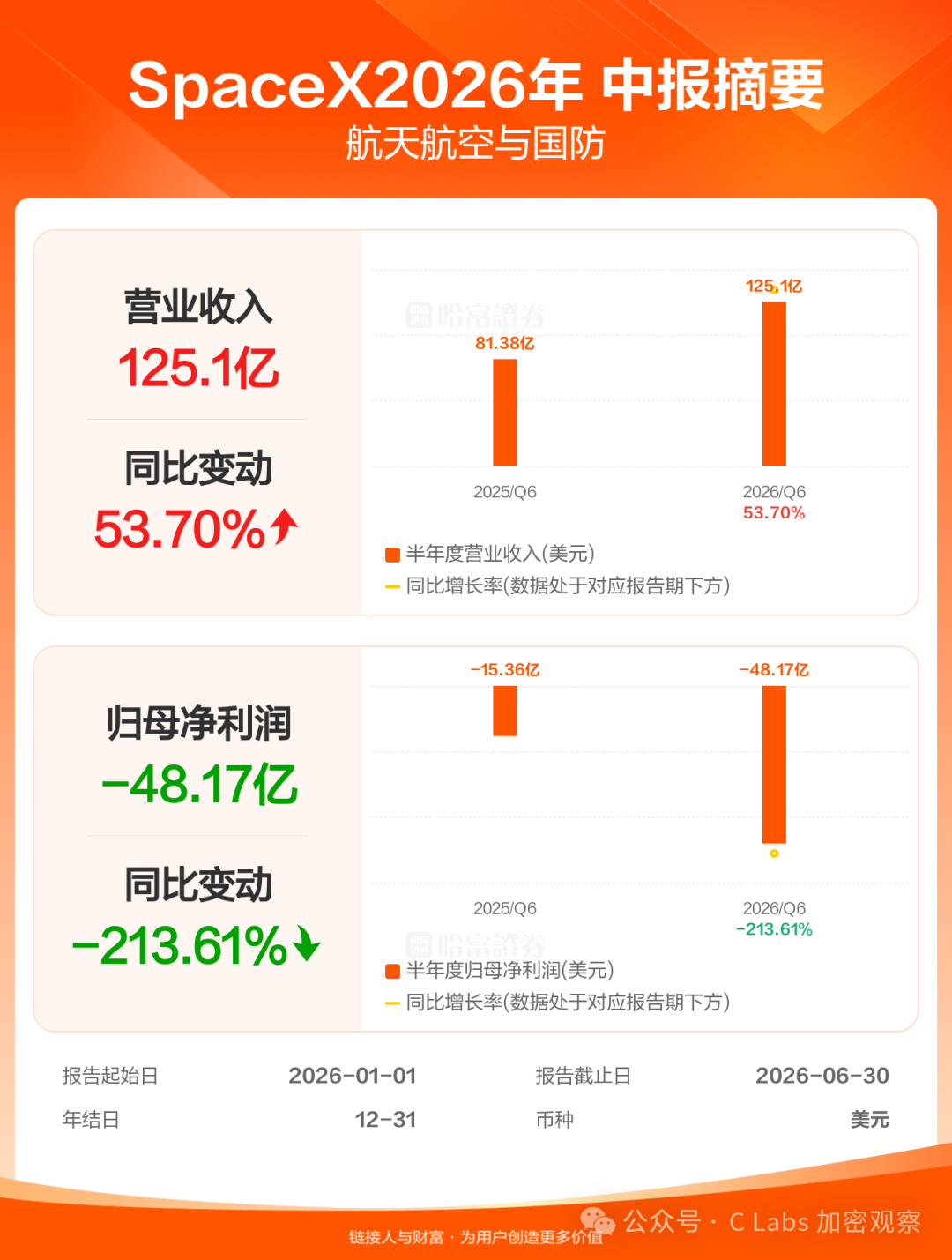
All three metrics exceeded analyst expectations. Starlink user count reached 12 million, doubling year-on-year. Revenue from the AI division surged 247% year-on-year, with losses halved quarter-on-quarter, and adjusted EBITDA turned positive to $1.146 billion.
Looking at these alone, it is a decent report card.
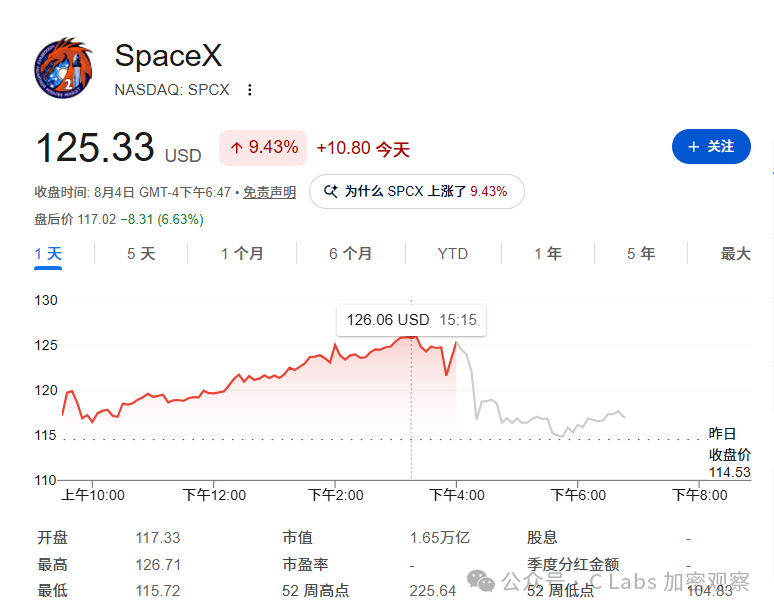
But the stock price fell 8% in after-hours trading.
Why is that?
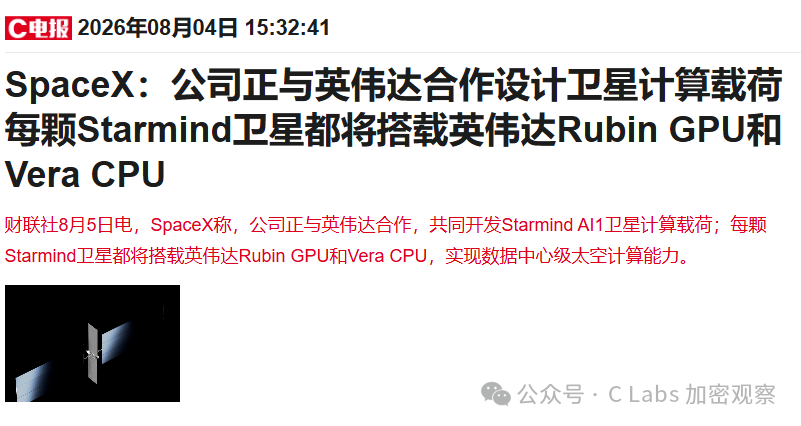
Just hours before the financial report was released, SpaceX announced a collaboration with Nvidia, where Nvidia would provide computing payloads for its Starmind AI1 satellite, each satellite equipped with Nvidia's latest generation Rubin GPU and Vera CPU, with peak computing power increased to 250 kW.
Nvidia refers to this business as "space computing," claiming that its Space-1 Vera Rubin module's AI computing power can reach up to 25 times that of the H100, with mass shipments starting this fall.
When this news came out, everyone thought the financial report would reveal something big, and the stock initially surged over ten points.
However, once the financial report was released, it plummeted:
First, the AI business, which saw a significant revenue increase, primarily earns revenue from low-tech computing rentals, including:
Anthropic at $1.25 billion per month, renting all capacities of Colossus 1, until May 2029, approximately 325,000 GPUs
Google at $920 million per month, until June 2029, approximately 110,000 GPUs
Reflection AI at $150 million per month, starting in July, until 2029
Meanwhile, SpaceX’s own xAI performance can be described as quite average. In March, Grok had 117 million monthly active users, but only 1.9 million purchased the premium version (SuperGrok), with another 4.4 million being bundled with the X social membership.
Calculations show that, when prorated by monthly active users, the revenue generated from the consumer side only covers 14% of the infrastructure costs. Operating profit margin deteriorated from -60% in 2024 to -200%, with projected annualized -302% by the first quarter of 2026. The larger the scale, the greater the losses.
There is also almost no substantial progress on the other two major projects SpaceX promised during the IPO.
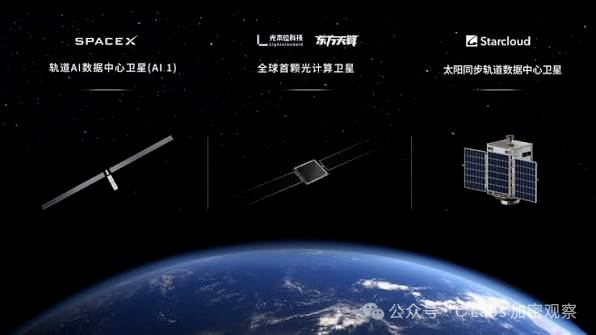
Space Data Center: Applied for 1 million satellites, built 0 satellites
SpaceX has applied to the FCC to deploy up to 1 million satellites in low Earth orbit at altitudes between 500-2000 kilometers, stating in the prospectus that it expects to begin deploying orbital AI computing satellites "as early as 2028."
Musk’s comments are even more aggressive: launching AI satellites next year, scaling up within two years, and achieving costs lower than ground data centers within three years.
The FCC accepted this application in February this year but has yet to make a ruling. Until a ruling is made, Starmind is essentially a unlicensed chip order. Environmental and astronomical organizations have already requested the FCC to suspend issuing such licenses until a systematic environmental assessment is completed.
Referring to Musk's past timelines: full autonomous driving in 2017, manned moon landing in 2024, and 10,000 Optimus units by the end of 2025.
Even Bezos has publicly stated that Musk's "two or three years" claim is "a bit overly ambitious."
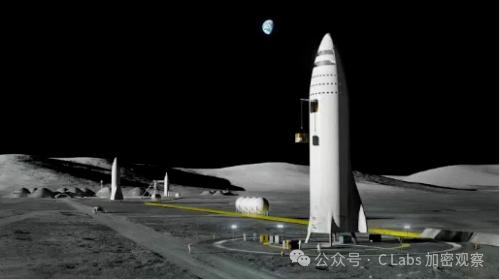
The progress on the lunar base is also not very optimistic.
This April, Artemis II successfully completed its manned lunar flyby. However, in February, NASA changed the plans for the first lunar landing (Artemis III) to a near-Earth orbit test, for a very straightforward reason: the lander is not ready. And SpaceX's Starship is that lander.
The first manned lunar landing has therefore been pushed to Artemis IV, targeting early 2028.
Currently, some brokerages have rarely issued a "sell" rating, with a target price of $75, indicating a further drop of 35% from the current price. Furthermore, on August 6, two trading days later, about 911.5 million shares of restricted stock will be unlocked, valued over $100 billion, marking the largest single unlock in Wall Street history.
免责声明:本文章仅代表作者个人观点,不代表本平台的立场和观点。本文章仅供信息分享,不构成对任何人的任何投资建议。用户与作者之间的任何争议,与本平台无关。如网页中刊载的文章或图片涉及侵权,请提供相关的权利证明和身份证明发送邮件到support@aicoin.com,本平台相关工作人员将会进行核查。


