Written by: Thejaswini M A
Translated by: Block unicorn
How do you tokenize a stone? Find a stone, mint a token that represents it, and that stone is stored somewhere. Now, this stone can be traded at any time of day and can be divided into fragments. This token trading is fast, highly liquid, and can settle in seconds, with more and more regulators endorsing it.
In this way, you can place anything on the chain, but at the same time, you cannot. We are not there yet; this relationship remains complex.
Today, a can of tuna in a supermarket in Lisbon has a QR code printed on it, which, when scanned, reveals the fishing boat that caught the fish, the date of catch, the sea area, and the full journey information from capture to market. However, if the unloading personnel stick the wrong label, the entire system will fail. The tracking system can only function properly once the data is entered. The entire process relies on one person accurately recording the information, and we are underinvested in this crucial first step.
Similarly, the success of blockchain chickens lies in the fact that they are not tradeable assets — their core idea is to establish an immutable traceability record. This aims to prove that these chickens are indeed high-quality free-range poultry after years of food safety scandals.
No one should ask whether you can place an asset on the chain. The answer is yes. But the ability to verify the reality of the facts is the key to judging the quality of a tokenization project.
This is why we should pay attention to environmental markets; there, I see the same technology heading in two directions. One records verified facts, while the other records completely fabricated claims.
Renewable energy certificates operate based on blockchain, while carbon credits do not. As the cost of addressing this issue decreases, the financial market for physical assets is opening up.
First, from an economic perspective, what exactly is a token? Because for the past decade, there has been a misunderstanding in the industry about the definition of a token. A token is a claim of rights. It declares the existence of a certain unit, and that unit belongs to the holder. Blockchain is very good at ensuring the latter point. It solves the double-spending problem of tokens, so the claim of rights cannot be duplicated or forged during transmission, and its ownership is apparent to everyone. However, the blockchain cannot verify whether the underlying entity to which the claim points actually exists or is consistent with what the claim states.
A renewable energy certificate (REC) indicates that one megawatt-hour of clean electricity has been delivered to the grid. This market is valued at approximately $22 billion to $28 billion and grows 14% per year. Why are RECs easy to put on the blockchain?
Because all electricity in the grid gets mixed together, once electricity flows in the lines, it is impossible to separate clean energy from polluting energy. To solve this problem, physical meters are directly installed at solar and wind power plants to accurately measure their output before clean energy enters the main grid. When the meter records a specific amount of clean energy, it generates an official document called a renewable energy certificate (REC). Companies use these certificates to verify that a specific amount of clean energy has indeed been generated and added to the system.
This is how the grid works:
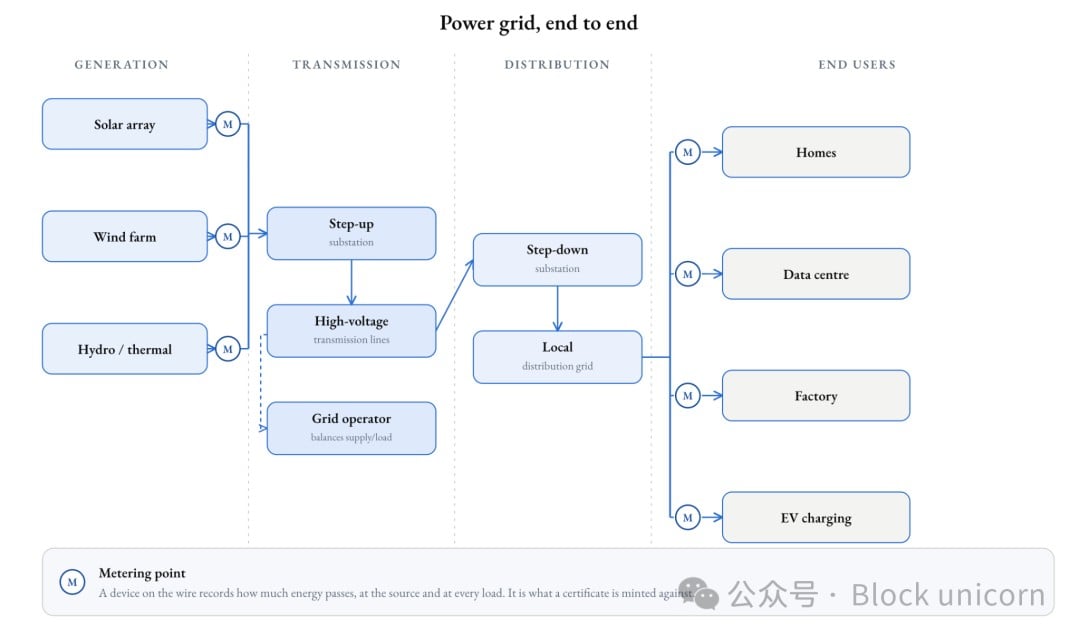
The economic significance lies in the fact that the person certifying the equipment is not motivated to alter the data. It is just a meter, and behind the meter is the grid — a non-voluntary third-party verifier with no vested interest in anyone's sustainability report. Tampering with readings means damaging a physical infrastructure that the seller does not own. In terms of information economics, there is virtually no information asymmetry about the core properties. Both parties in the transaction are faced with the same objective data, and this data is generated by equipment that neither party can control.
When you tokenize an REC, you are essentially packaging a unit whose quality has been verified by an independent entity. Blockchain inherits this fact. And its contribution is to reduce transaction costs, which is exactly what liquidity technology should achieve.
Australian company Power Ledger has been dedicated to peer-to-peer solar trading between neighbors for years and now operates a renewable energy certificate (REC) trading platform called TraceX. On this platform, generating companies and corporate buyers can transact certificates directly without spending weeks on bilateral paperwork and legal processes. In early 2025, TraceX completed over 1.2 million REC transactions in a month, linking with the actual issuing certificate registry. TraceX has connected with one of North America's largest voluntary REC registries, M-RETS, and plans to connect with Texas grid operator ERCOT by mid-2025. ERCOT issued over 32 million RECs in 2023 alone. Power Ledger states that users can save up to 72% on management costs.
However, the same principle does not work for carbon credits (similar to renewable energy certificates). Each carbon credit is a numbered, tradable unit representing one ton of avoided carbon emissions. Many companies promise their shareholders and the public that they will achieve "carbon neutrality" or "net zero emissions." Since they cannot fully stop polluting, they purchase carbon credits to mathematically offset the pollution they continue to cause.
In 2021, a protocol named Toucan built a bridge to place these tokens on-chain. Meanwhile, a project called KlimaDAO cleverly incentivized users to deposit tokens into its treasury and supported prices through acquisitions, theoretically raising the cost of pollution. Funds rushed in, and the market capitalization of the KLIMA token broke $1 billion before people took notice of the bridge connection.
The core problem with carbon credits is that they measure a hypothetical scenario, for instance, assuming that trees have never been cut down. Currently, there is no independent hardware that can verify this, making these metrics entirely subjective. While tokenization cannot fix this fundamental flaw, it makes it even more dangerous. By aggregating these credits on-chain, protocols like Toucan treat all assets as completely identical.
It is not that blockchain itself is bad, but the specific way they aggregate these credits causes the problems.
Then, KlimaDAO artificially created a demand for these pooled tokens by using its newly issued KLIMA tokens to purchase pooled tokens at prices far above the actual value of the junk assets in the pool. This strategy manipulated the market. If you hold a high-quality credit that could fetch a good price on a normal market, exchanging it for a low-priced pooled token is a bad deal, so you would stay away. If you hold a credit that nobody wants, and the price of the pooled token is higher than your credit, then you would perform a bridging transaction and sell. Pooled tokens ultimately become filled with the lowest quality credits, as only these credits are worth making such transactions.
A researcher from CarbonPlan found in 2022 that most carbon credits bridged into Toucan came from projects that were excluded from the legitimate carbon offset market due to quality issues. Because Verra's delisting information is publicly available, CarbonPlan was able to accurately read which carbon credits were placed on-chain. The research found that 99.9% of them came from projects that, due to their age, could not enter the standard carbon offset market, and another 28% came from "zombie projects," which had not sold carbon credits for years until the demand for cryptocurrency revived them. A hydropower project in China completed its first delisting through the bridge system 15 years after it began.
A meta-analysis published in Nature Communications in 2024 examined nearly 1 billion carbon credits (about one-fifth of all issued carbon credits) and found that fewer than one-sixth of the carbon credits had actually reduced emissions.
As the largest carbon emissions registry, Verra watched while its canceled carbon credits were transformed into tradeable "digital ghosts," and in May 2022, it officially prohibited this practice. The carbon credits of KLIMA plummeted from $3,600 to single digits. KlimaDAO used over a million dollars of its own funds to cancel the least valuable carbon credits it held.
Tokenizing a flawed unit does not fix it but industrializes it. You attach a measurement issue to a liquidity engine, and now, these originally flawed units circulate faster, command higher prices, and reach more buyers.
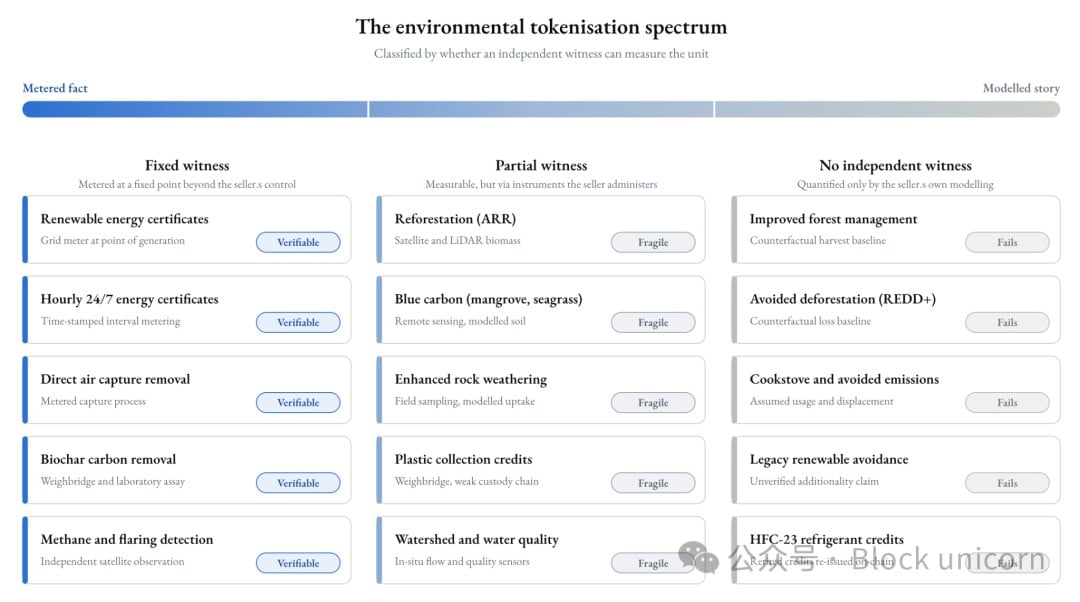
This provides you with a test that can be applied to any tokenization scheme and is unrelated to the tokens themselves. Is there an independent witness to measure each unit? Can this witness be forged? And here’s an easy point to overlook: Can the borrower own this witness? That is the real challenge.
If you tokenize a barrel of oil in a tank or a ton of grain in a warehouse, the entire transaction depends on someone proving that the barrel of oil is indeed in the tank and has been there all along. If the person making the proof is the one borrowing against that barrel of oil or grain, then you have no collateral.
For a century, commodity trade financing has been collapsing in this way, with warehouse receipts issued against metals that have already left or never existed.
Look at livestock; for those who cannot access credit, livestock is one of the largest means of storing value on earth. Banks have always been reluctant to lend against livestock, discounting the value of a cow by as much as 60% because they cannot ascertain whether the livestock is healthy, where it is located, or even if it is still alive. A cow as collateral can wander away, get sick, or quietly die in the field during the loan term. Who takes care of the cattle barn?
A few days ago, at a dairy farm in Paraná, Brazil, ten cows became the first livestock in the country to be formally registered as collateral on the stock exchange.
Each cow wears a smart collar produced by an agricultural technology company called Cowmed. The collar can track the cows' health, behavior, and location, and hash this data to generate a cryptographic identity tied to the loan. The farmer secured a loan of about $20,000 against the ten cows. This system can even detect when a cow has died and allow the farmer to replace it with another live one. Cowmed currently monitors 100,000 cows, with a total value of nearly $400 million.
If many farmers adopt this smart collar, it can only tell you that the collar is transmitting health and location data. But it does not itself tell you which registered cow is wearing the collar, or which cow is the one being collateralized, and it cannot even confirm that there really is a cow at the other end. All the loopholes that farm inspectors used to find still exist. You can put the collar on the healthiest cow and then collateralize a sick cow. You can transfer the collar between different cows. Theoretically, you could feed it false data. So, it does not itself prevent farm inspections. But it can turn an annual inspection into a daily record, so fraudulent behavior must be ongoing. Since there are records, the same cow can no longer be pledged to three lending institutions at once.
The meter is fixed in a position that the seller cannot move. But cows can move, and the reliability of the collar depends on the person who puts it on the cow.
A cow without a collar is nearly impossible to verify, so banks have valued it down by sixty percent. A cow with a collar is not fully verifiable either, but the verification cost is low enough that lenders are willing to accept a smaller loss. Therefore, the value of that cow has increased. This transaction is only three days old, and we do not have many similar examples to support this.
Successful tokenization relies on a range of reliable measurement metrics. High-quality assets use automated, tamper-proof sensors such as grid meters, satellites, and weighbridges; the data from these sensors cannot be altered by the seller. Low-quality assets rely on hypothetical forecasts and self-reported calculations, such as carbon offsetting.
Even measurement is not as simple as it sounds. Meters can prove the existence of megawatt hours of electricity, but they cannot prove that they are nearby or present when you need them. For years, a company in Ohio could purchase certificates from a Texas wind farm generating energy at 3 a.m. and claim to be operating on clean energy.
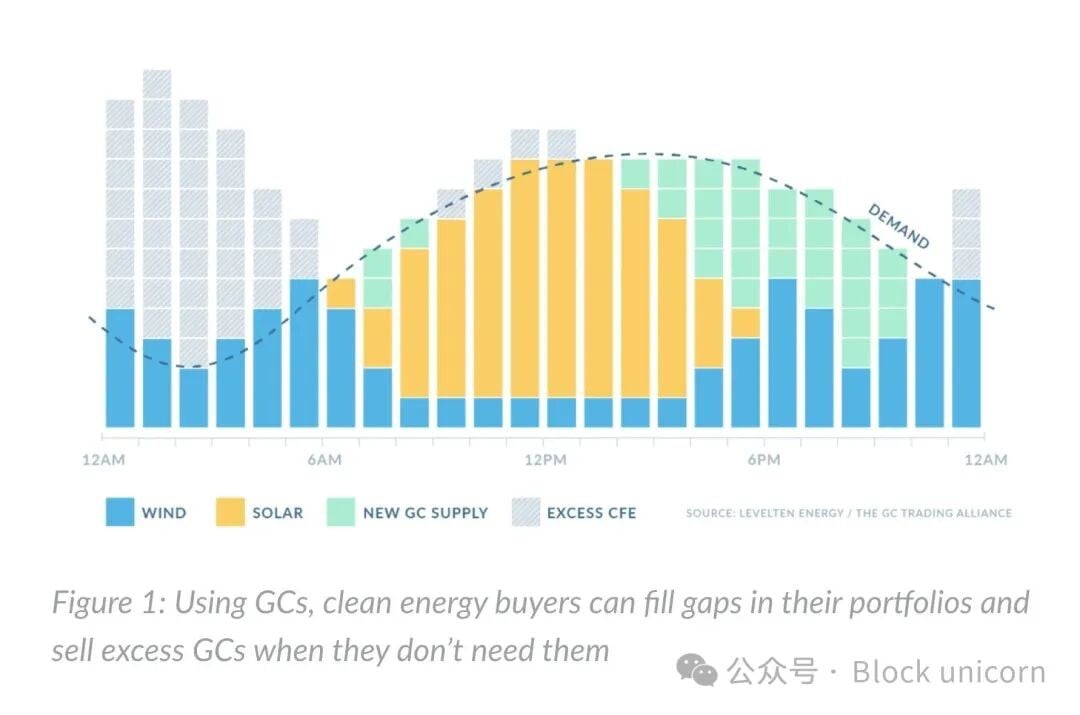
Therefore, the market is now subdividing units more finely, imprinting the time of production and the production grid on each certificate. Water credits also follow the same pattern. Watershed credits are easy to sell but difficult to validate; measuring whether a river has become cleaner is one thing, but proving that your project is the actual reason for the river’s cleanliness is another. Measurement metrics determine the accuracy of asset tracking. With every improvement in metrics, the market modifies the true meaning of certificates.
In a normal market, buyers and sellers constantly negotiate the value of assets, causing price fluctuations. This is completely normal, but the premise is that the asset has a solid, objective benchmark. For instance, the actual income of a company or the actual weight of a barrel of oil. Ultimately, the transaction price will align with these objective facts. If these objective bases are removed (for example, subjective carbon credits), the price will completely detach from reality. The price loses its benchmark.
Tokenization is just an accelerator. If the underlying assets are verified, tokenization can create wealth. If the assets are unverifiable, it will only accelerate the occurrence of fraud. Blockchain cannot distinguish between true and false. Cryptocurrency projects often use high liquidity and institutional capital as proof of their legitimacy. Liquidity does not create facts. You can build the most efficient and seamless trading system in the world, but if the physical assets hold no value, then the entire market is nothing more than a highly optimized scam.
免责声明:本文章仅代表作者个人观点,不代表本平台的立场和观点。本文章仅供信息分享,不构成对任何人的任何投资建议。用户与作者之间的任何争议,与本平台无关。如网页中刊载的文章或图片涉及侵权,请提供相关的权利证明和身份证明发送邮件到support@aicoin.com,本平台相关工作人员将会进行核查。


