The performance conference call expects capital expenditures in the third and fourth quarters to be similar to those in the second quarter. After the financial report, the stock price fell in after-hours trading, at one point dropping nearly 9%.
Written by: Li Dan, Wall Street Watch
SpaceX has released its first quarterly report since going public, with core financial indicators significantly better than market expectations. The loss in the AI business has narrowed more than expected, but AI-related capital expenditures were higher than expected, and it is anticipated that the scale of such expenditures will not decrease in the next two quarters.
On the East Coast of the United States on Tuesday, after the market close, SpaceX announced that as of June 30, 2026, the total revenue for the second quarter grew by 92% year-on-year to about 7.8 billion dollars, exceeding analysts' expectations by more than 10%; adjusted EBITDA (Earnings Before Interest, Taxes, Depreciation, and Amortization) grew approximately 192% year-on-year to 3.5 billion dollars, surpassing market expectations by 75%; earnings per share (EPS) was -0.09 dollars, far below the expected loss range of 0.23 to 0.26 dollars.
There has also been an improvement in earnings quality. SpaceX's net loss in the second quarter was about 541 million dollars, narrowing the loss from about 1 billion dollars in the same period last year by approximately 46%. The AI business continues to be unprofitable, but the scale of loss was lower than expected: the operational loss in the AI sector for the second quarter was 1.26 billion dollars, over 47% lower than analysts' expected loss.
By business segment, the connectivity business, where "Starlink" is located, remains SpaceX's most critical source of profit. In the second quarter, revenue from the connectivity business increased nearly 66% year-on-year to 4.29 billion dollars, exceeding market expectations by over 10%, and operational profit rose nearly 80% year-on-year to 1.66 billion dollars. In contrast, the aerospace launch business and the AI business are still operating at a loss.
The first shareholder materials disclosed by SpaceX also emphasized that its military and national security satellite business "Starshield" has secured over 6 billion dollars in long-term U.S. government contracts, highlighting the significance of government and defense orders in SpaceX's business model.
However, robust performance did not stabilize the stock price. Before the financial report was released, SpaceX shares rose 9.4% on Tuesday; after the report was issued, the stock initially rose by over 1% in after-hours trading but then turned to decline, at one point dropping nearly 9%. Analysts believe that the stock performance does not indicate poor financial results, but rather reflects the market's higher threshold for what constitutes "beat expectations" under conditions of high valuations, high expectations, unlocking pressure, and concerns over cash burn.
Commentary points out that high capital expenditures related to AI brought pressure. The financial report showed that capital expenditures in the AI business for the second quarter were about 15.8 billion dollars, higher than analysts' expectations, far exceeding the capital expenditures of 1.37 billion dollars and 1.17 billion dollars for the connectivity and aerospace businesses respectively. SpaceX executives also projected during the earnings call that capital expenditures in the third and fourth quarters would be roughly similar to those in the second quarter.
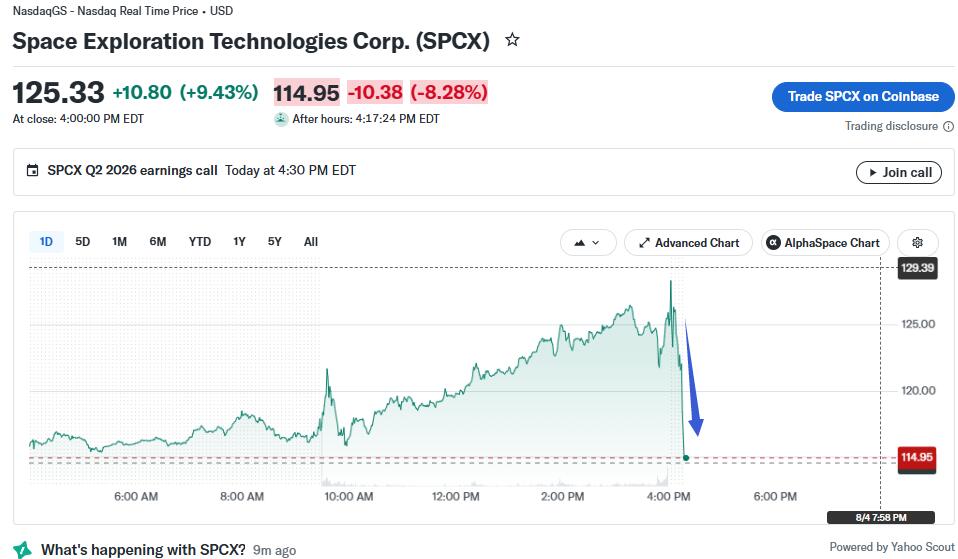
This financial report demonstrates that SpaceX's revenue growth is strong, that Starlink's profitability is solid, and that AI losses are not as severe as the market feared. However, from the stock price reaction, Wall Street will next focus on three issues: 1. Whether Starlink user growth can continue to maintain high growth rates and drive further profit expansion in satellite connectivity; 2. Whether the commercialization timeline for Starship can be clarified further; 3. When the AI business will transition from "high growth and high loss" to sustained "high revenue and shrinking losses."
Revenue and EBITDA significantly exceed expectations, net losses narrowed clearly
In the second quarter, SpaceX's total revenue was 7.8 billion dollars, significantly exceeding market expectations. According to different agencies, Bloomberg compiled expectations of about 6.81 billion dollars, while LSEG's expectation was 6.93 billion dollars; the actual company performance significantly surpassed these.
Adjusted EBITDA for the second quarter was 3.5 billion dollars, also clearly stronger than the market expectation of about 2 billion dollars, making it one of the brightest items in the financial report. Based on the 7.8 billion dollars in revenue, the adjusted EBITDA profit margin is close to 45%, indicating that the operational leverage of the company's core business was significantly released in the second quarter.
The bottom line loss has also improved. In the second quarter, the company's EPS loss was 0.09 dollars. Media pointed out that this figure should not be directly compared to the average analyst expectation of a per-share loss of 0.26 dollars, but in terms of absolute loss magnitude, it is significantly better than what the market had previously worried about. For the second quarter, SpaceX's net loss was about 541 million dollars, improving from last year's loss of about 1 billion dollars.
From the perspective of net profit, the company remains in a loss situation. The net loss for the second quarter was about 541 million dollars; although it is significantly less than the approximately 1 billion dollars loss from the same period last year, it still reflects the current reality of SpaceX's business mix: Starlink is profitable, while aerospace and AI are still consuming profits.
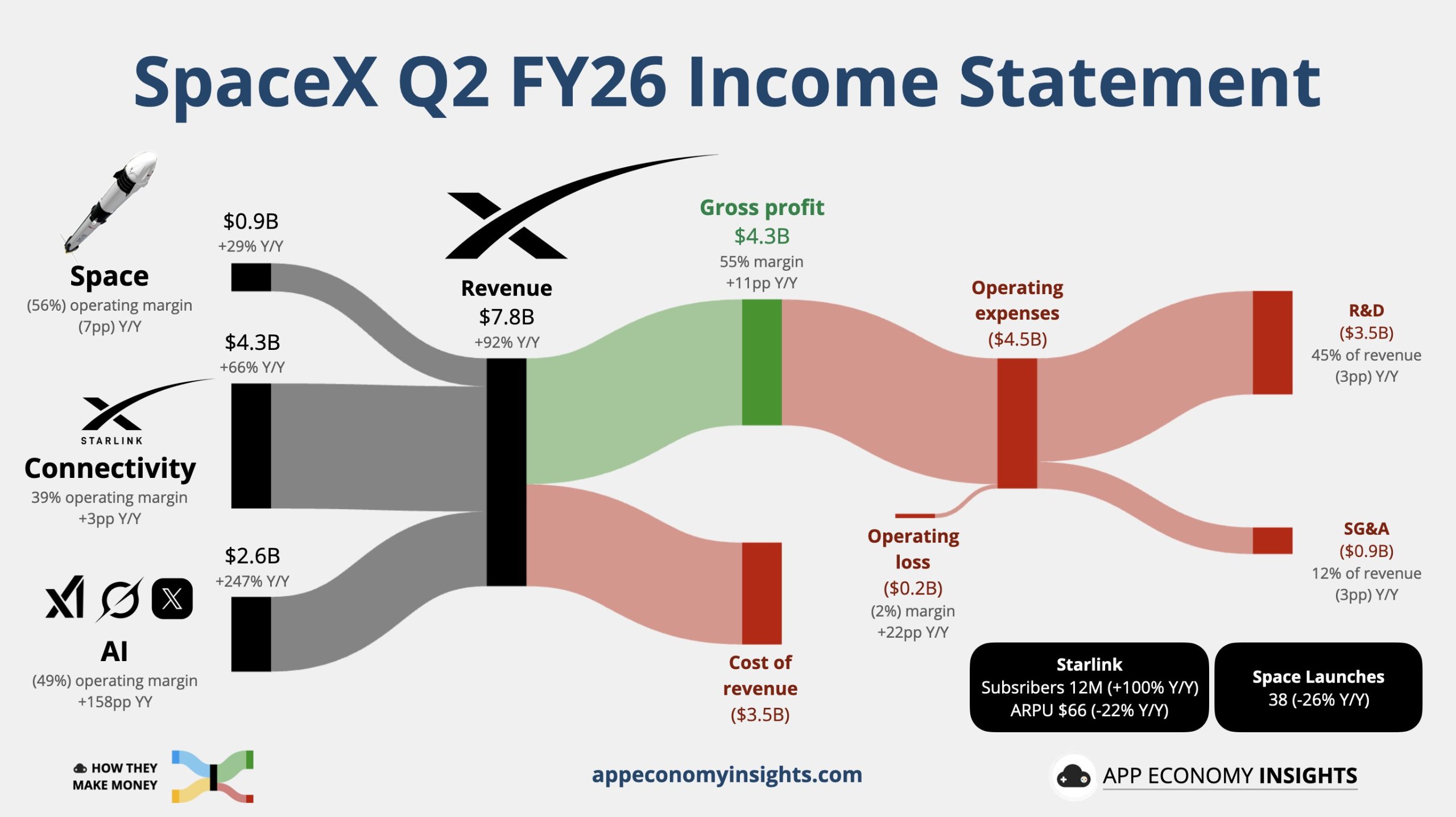
Capital expenditures are also a key focus for investors. Media noted that SpaceX's capital expenditures in the second quarter amounted to 18.4 billion dollars, roughly in line with the analyst mean expectation of about 18.5 billion dollars. In other words, the financial report did not show a significant easing of capital expenditure pressures for the company. For a company with a very high valuation, which is simultaneously investing in Starship, Starlink expansion, and AI infrastructure, this is enough to keep investors cautious.
The table below essentially explains SpaceX's current business model: satellite connectivity contributes the most revenue and all operational profits, AI contributes considerable revenue but still incurs substantial losses, while the aerospace business has strategic value but remains unprofitable in the short term.
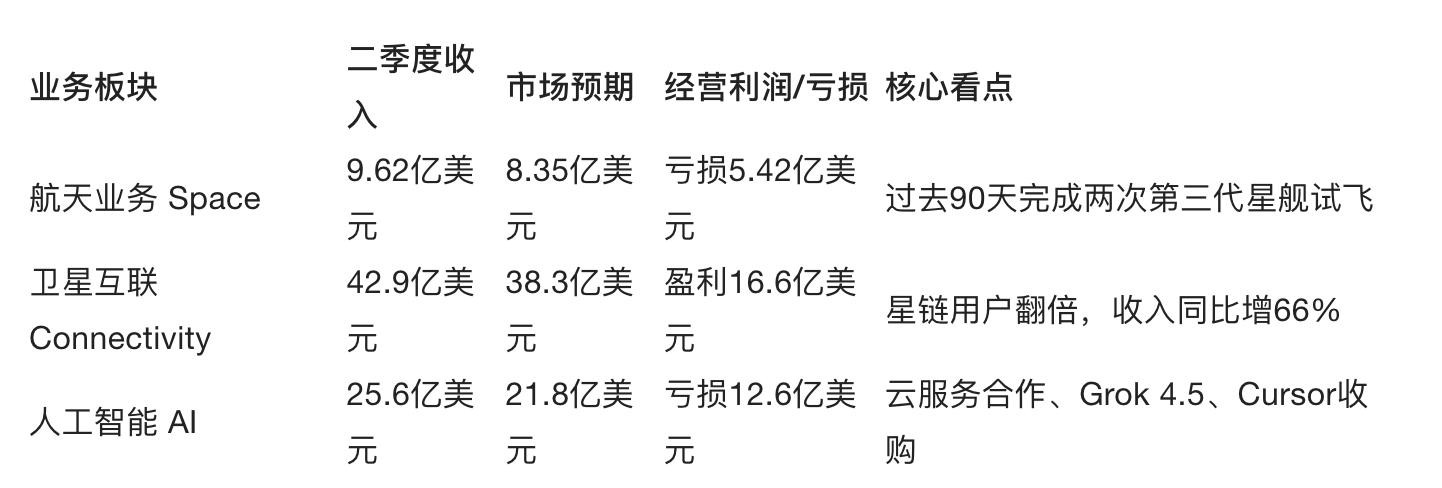
From the quarterly performance, the revenues of all three major segments were above expectations, which is the most positive aspect of the financial report. However, from the profit structure, investor concerns are also very intuitive—SpaceX is not yet a fully profitable multi-business company, but rather a high-growth, high-capital-expenditure firm reliant on Starlink's cash flow to support aerospace and AI investments.
Starlink remains the core of profit: the connectivity business is the唯一 stable source of profit.
The most clear profit pillar for SpaceX currently remains Starlink, the core driver of its business growth in the second quarter was that by the end of the quarter, the number of Starlink users doubled year-on-year to 12 million.
In the second quarter, revenue from the connectivity business grew by about 66% year-on-year to 4.29 billion dollars, exceeding the market expectation of 3.83 billion dollars; operational profit increased by 79% year-on-year to 1.66 billion dollars, corresponding to an operational profit margin of nearly 39%. This segment includes Starlink satellite internet services, with customers including individual consumers, as well as government and military institutions.
The value of Starlink lies in its transformation from a "space infrastructure story" to a business that truly possesses scalable income and profits in consumer and enterprise connectivity. Starlink sells satellite internet services to both individual users and provides connectivity to government, military, and enterprise clients.
It is worth noting that SpaceX, while disclosing shareholder materials for the first time as a public company, also emphasized the value of government contracts. The company revealed that the Starshield business had secured over 6 billion dollars in long-term contracts with the U.S. government. This not only enhances the visibility of future revenues but also strengthens SpaceX's barriers in national security, military communications, and low Earth orbit satellite networks.

Of course, government contracts are a double-edged sword. They bring stable orders and a higher strategic position but also mean that some of the company's growth is highly correlated with policies, budget cycles, and regulatory environments. At least for this quarter, Starlink and Starshield remain the most quantifiable parts of SpaceX's valuation for investors.
Aerospace business: Starship progress accelerating, but commercialization is still unfulfilled.
The performance of the traditional aerospace business also shows a "two-sided" nature.
In the second quarter, SpaceX's aerospace business revenue grew by nearly 29% year-on-year to 962 million dollars, exceeding the expected 835 million dollars; however, the operational loss for this business was 542 million dollars, expanding nearly 47% year-on-year. In other words, while SpaceX's launch and aerospace business revenue performance is good, it is still some distance from independent profitability.
This is not surprising. Reusable rockets, Starship development, NASA missions, deep space projects, and launch infrastructure all require continuous investment. A significant part of SpaceX's long-term value comes from the commercialization of Starship, but until Starship can achieve frequent, low-cost, reusable commercial launches, the aerospace business is likely to continue to drag down the profit statement in the short term.
On the operational level, SpaceX disclosed that it completed two test flights of the third-generation Starship in the past 90 days. This is an important development. Starship is one of the most critical assets in SpaceX's long-term valuation, with its core significance lying in its complete reusability: once both the rocket boosters and upper stage spacecraft can achieve high-frequency reusability, launch costs will significantly decrease, further supporting Starlink deployments, lunar missions, deep space exploration, and even future concepts like space data centers.
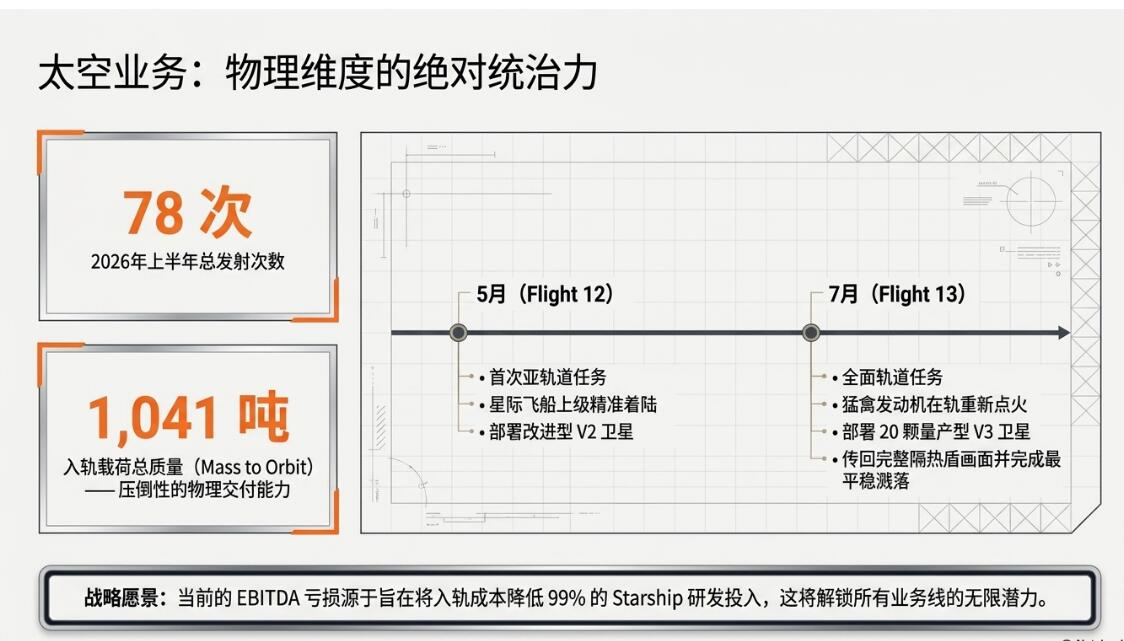
However, the capital market is concerned about how far Starship is from commercialization. The current financial report shows that while aerospace business revenues exceeded expectations, they are still at a loss. For investors, this means that the progress of Starship itself is a positive, but not enough to serve as a definite support in the profit statement.
This is also why some investors do not only look at quarterly revenues and EBITDA but pay more attention to management's statements on key timelines regarding commercial launches of Starship, NASA mission milestones, in-orbit refueling, and upper stage recovery and reuse. SpaceX's aerospace business has extremely high strategic value, but until the business model is truly operational, it will continue to consume funds.
AI business losses lower than expected, but the "money-burning" narrative is not over
The AI business is the most complex part of this financial report: it not only brought in revenues that exceeded expectations but also continued to generate substantial losses.
In the second quarter, AI business revenue grew about 247% year-on-year to 2.56 billion dollars, exceeding the market expectation of 2.18 billion dollars; operational losses narrowed year-on-year by 17.5% to 1.26 billion dollars, significantly lower than analysts' expected loss of 2.39 billion dollars. Looking solely at the expectation differential, the AI department performed better than the market's previously most pessimistic scenarios.
This is important for SpaceX. After integrating with Elon Musk's xAI in February this year, the company has included "space data centers" and AI computing infrastructure as part of its long-term growth narrative. Previously, there were concerns that the AI division would continue to consume cash flow, but the second quarter results indicate that AI business revenue recognition is quicker than expected, and cost pressures are not as severe as previously feared by the market.
However, the AI business remains one of SpaceX's largest sources of operational losses. SpaceX incurred a loss of 4.9 billion dollars last year, largely due to significant investments in AI infrastructure. The second quarter saw AI business losses of 1.26 billion dollars, roughly equivalent to half of the revenue from that segment.
SpaceX disclosed that it has signed several cooperation agreements with leading cloud service providers, with new cloud service contract sales amounting to 14.1 billion dollars. This provides visibility for AI computing business revenues. The company also launched its AI large model Grok 4.5 in July and announced a 60 billion dollar acquisition of Cursor, further expanding its AI ecosystem layout.
More importantly, SpaceX previously incorporated Musk's xAI into the company and proposed a vision of "building a data center in space." This narrative has vast imaginative potential but also inherently involves substantial capital expenditures. The 60 billion dollar acquisition of Cursor will similarly draw market attention to the transaction structure, potential dilution, integration costs, and future return cycles.
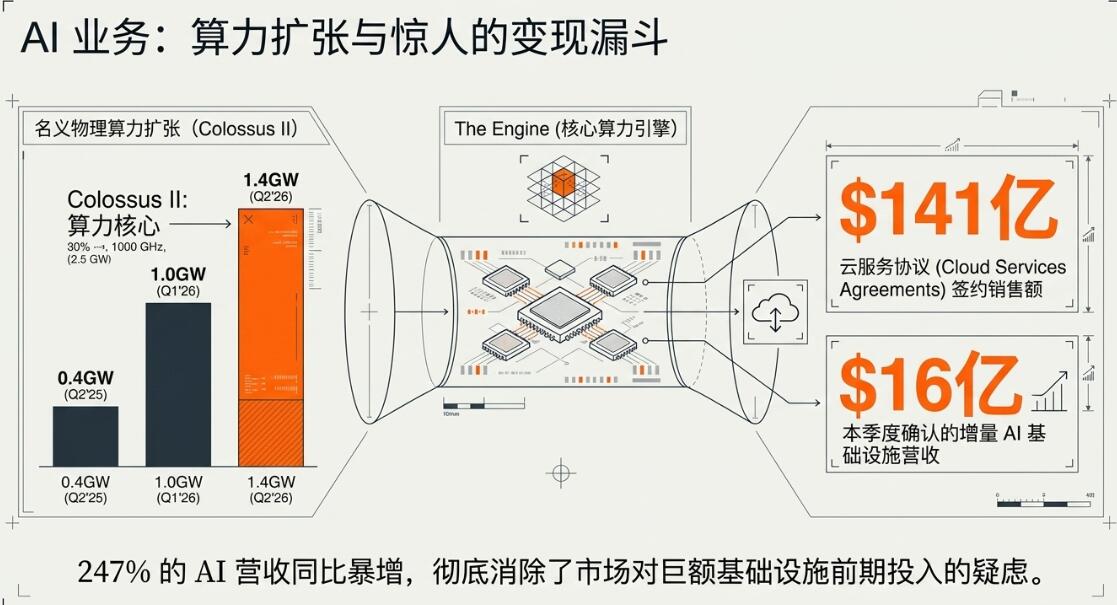
Thus, the AI segment in the second quarter report is not considered "bad news"; it is better than the market imagined, but it does not completely eliminate questions about the investment return of AI infrastructure.
The stock price turned to decline in after-hours trading: it is not that the financial report is poor, but the market is re-pricing risk
The initial rise and then decline in SpaceX's stock price in after-hours trading indicate that the market initially recognized improved revenues, EBITDA, and AI losses but then began to re-focus on more difficult-to-resolve issues.
1. The stock price had already rebounded ahead of the financial report release. SpaceX rose 9.4% in regular trading on Tuesday, and some investors had evidently bet on an outperforming performance. Following the earnings release, a "sell the fact" move by short-term funds is not surprising.
2. The company is still incurring losses. Although the net loss improved compared to last year, the second quarter still saw a loss of about 541 million dollars; the aerospace business lost 542 million dollars, and the AI business lost 1.26 billion dollars. Only the satellite connectivity business contributed operating profits. For a company with a very high valuation, the market demands not only growth but also a clear path to loss reduction.
3. There were no significant indications of a decrease in capital expenditures. SpaceX is still advancing projects such as Starship, Starlink expansion, AI infrastructure, and potential space data centers simultaneously. Capital expenditures were roughly in line with expectations and do not constitute new positive news; if some investors were expecting to see signals that the "peak cash burn is over," this financial report did not provide sufficient evidence.
4. Valuation and stock supply pressures remain. As of Monday's close, SpaceX's stock price has cumulatively dropped more than 15% from its issue price and nearly 50% from its all-time high since the listing on June 16, with a market capitalization that has evaporated over 1 trillion dollars since its post-listing peak. Meanwhile, the market had also been concerned that a large amount of stock supply would be released as the first lock-up period for its stocks is set to expire this Thursday. Even with performance exceeding expectations, high valuation combined with unlocking pressures can suppress continued after-hours buying.
5. Although the AI business performed better than expected, the market still lacks confidence in its long-term returns. The new 14.1 billion dollar contract sales, Grok 4.5 launch, and Cursor acquisition reinforce SpaceX's AI narrative, but contract sales do not equate to current revenues, and acquisitions do not guarantee profits. The next question for investors will be: when will these AI investments translate into free cash flow?
免责声明:本文章仅代表作者个人观点,不代表本平台的立场和观点。本文章仅供信息分享,不构成对任何人的任何投资建议。用户与作者之间的任何争议,与本平台无关。如网页中刊载的文章或图片涉及侵权,请提供相关的权利证明和身份证明发送邮件到support@aicoin.com,本平台相关工作人员将会进行核查。


