Author: Azuma, Odaily Star Daily
On August 5, Beijing time, stablecoin issuer Circle (CRCL) will release its quarterly financial report before the US stock market opens. However, just before the release of this quarterly report, there has already been a significant divide on Wall Street regarding the future value of Circle.
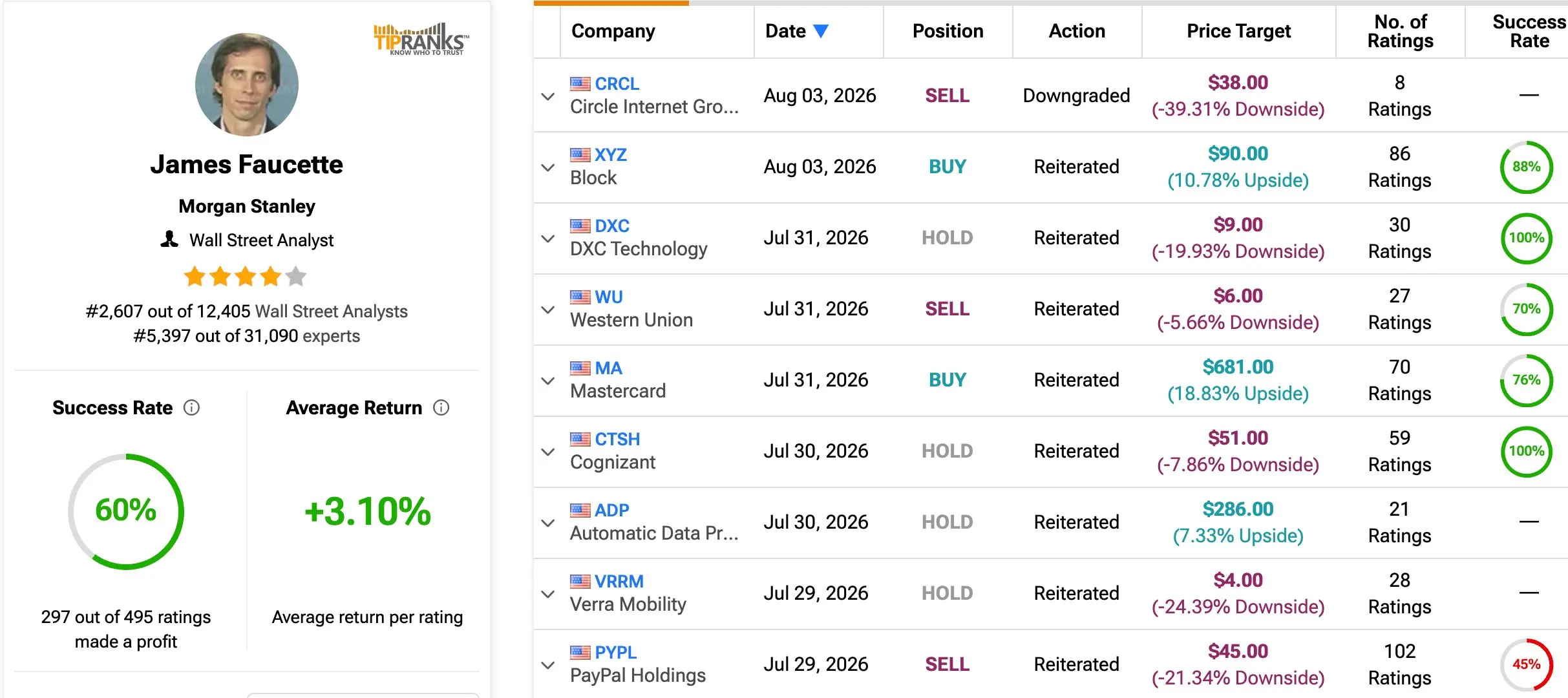
On August 3, Morgan Stanley (hereafter referred to as "Morgans") downgraded Circle's rating from "Equal Weight" to "Underweight", and drastically lowered the target price from $106 to $38.
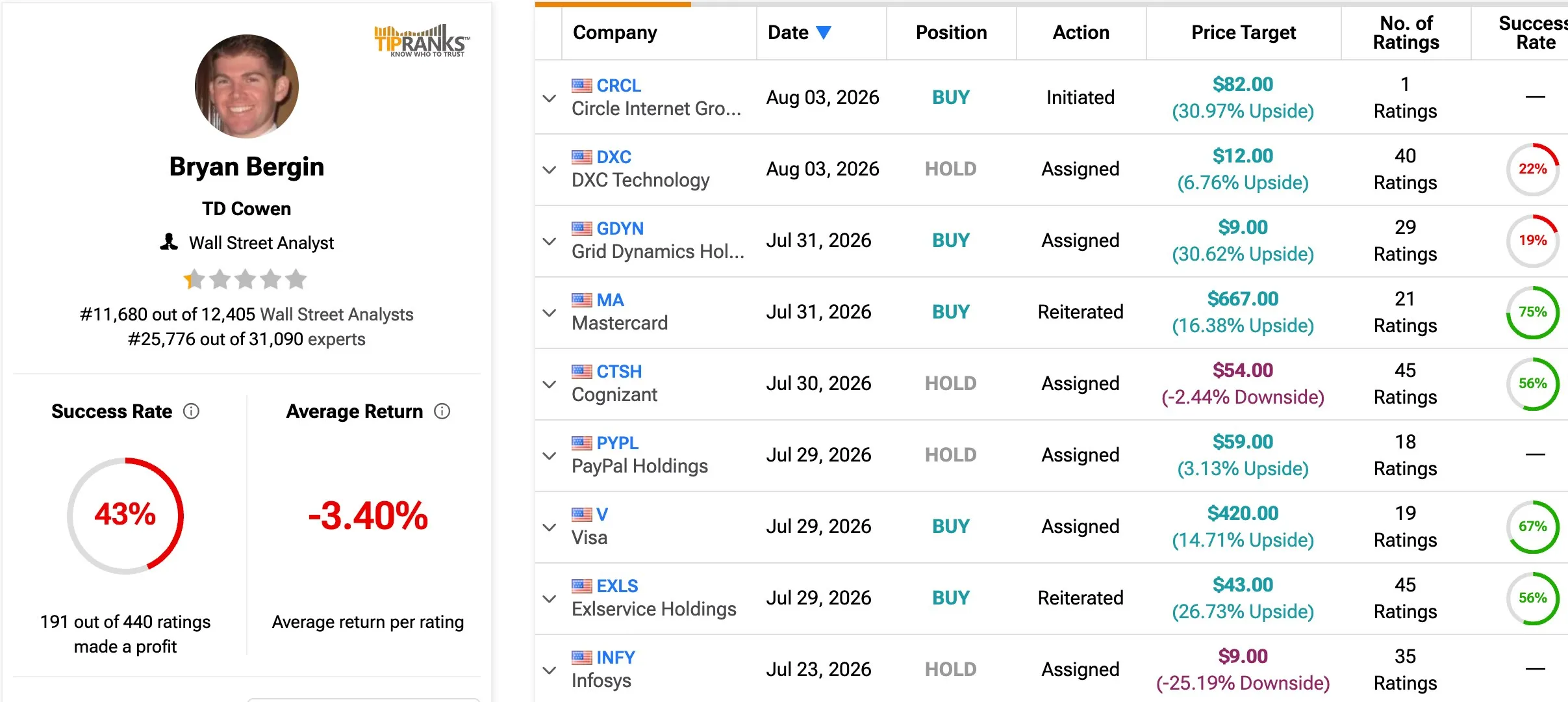
Meanwhile, TD Cowen covered Circle for the first time in its ratings and assigned a "Buy" rating with a target price set at $82.
The two institutions provided vastly different rating judgments, and the core divergence reflected behind them is actually how to define the current Circle — whether to continue viewing it as a stablecoin issuer reliant on USDC scale growth, or as a technology company transitioning into a digital financial infrastructure platform?
Institutional Divergence: Morgans Bears USDC Growth, TD Cowen Bets on Platform Transformation
The "Underweight" rating was given by Morgans analyst James Faucette. On TipRanks, Faucette has a four-star rating (out of five stars), and is generally regarded as a much-above-average sell-side analyst. Although Faucette's average return over the past two years has only been 3.1%, his judgment win rate stands at 60%.
Faucette's bearish logic revolves around Circle's current revenue model.
In his view, the market may be overestimating the future growth potential of USDC, while the pace of expanding stablecoin application scenarios is also slower than previously expected — since Q3 2025, USDC's circulation has not actually grown, and currently, apart from remittances and card consumption related to stablecoins, no large-scale new application scenarios for USDC have emerged.
This means that Circle's core source of revenue, "reserve income," may face growth pressure. Currently, Circle's main income heavily relies on allocating USDC reserve assets into cash and short-term US treasury bonds to earn interest income. Therefore, the growth in USDC's circulation is often seen as an important driver of the company's profit expansion.
Faucette believes that if USDC's scale growth slows down, Circle's future revenue structure may gradually tilt towards lower-margin trading income. Based on this judgment, he predicts that Circle's future earnings performance may fall short of market expectations and believes that the current valuation has already reflected excessively high growth expectations.
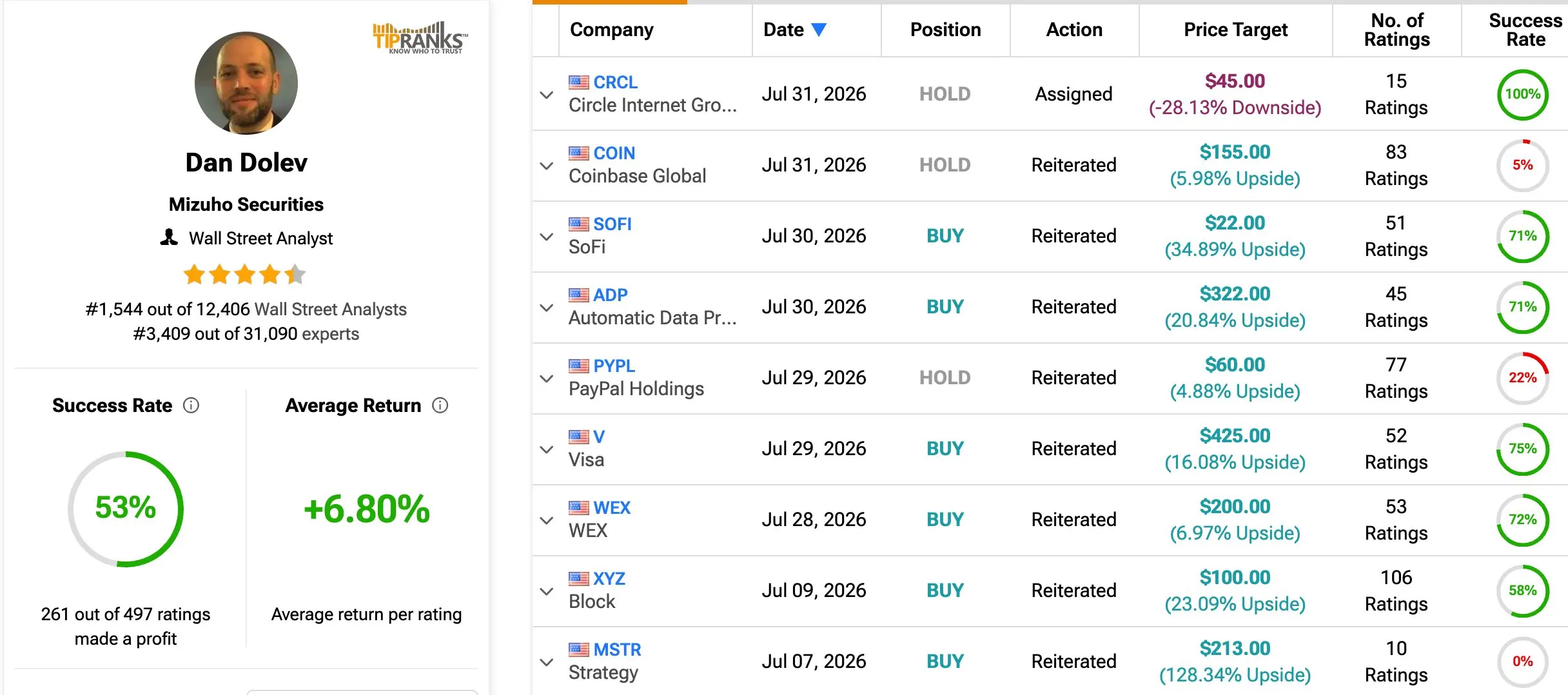
Another analyst with a similar bearish view is Dan Dolev from Mizuho Securities. Dolev has a rating of 4.5 stars on TipRanks, higher than Faucette, and last Friday gave Circle a "Hold" rating but lowered the target price from $50 to $45.
From TD Cowen, the analyst giving a "Buy" rating is Bryan C. Bergin, who only has half a star in his personal record rating on TipRanks, with a historical average return of -3.4% and a judgment win rate of only 43%...
Bergin believes that the market may currently underestimate Circle's potential to transition from a stablecoin issuer to a broader financial infrastructure platform.
In his analytical framework, Circle's future value does not only depend on the circulation scale of USDC, but also on its ability to establish a more complete financial service system around stablecoins, including payments, fund management, real-world asset (RWA) tokenization, developer services, and blockchain infrastructure.
Bergin expects that by 2030, the circulation of USDC is likely to maintain an annual compound growth rate of about 31%, while the growth rate of fee-based income will significantly outpace traditional reserve income. Moreover, the Arc network that Circle is advancing will also be a potential growth hotspot and may further expand Circle's influence in the digital financial infrastructure field.
Another Key Variable Recently: Progress of the CLARITY Act
In addition to the company's own business model, regulatory progress is also an important factor currently affecting market expectations for Circle.
Previously, the market generally viewed the CLARITY Act as a key catalyst for further development of the stablecoin industry — if this act is ultimately implemented, stablecoin issuance, trading, and related financial services will gain a clearer regulatory framework, which is expected to reduce compliance uncertainty for institutions adopting stablecoins.
However, currently, the progress of the CLARITY Act has not been smooth. With only a few workdays left before the Senate's summer recess, market expectations have significantly decreased regarding whether it can be advanced in the short term.
If the advancement of this act continues to be delayed, the market may reassess the commercialization pace of the stablecoin industry and the growth expectations for Circle. Therefore, before the financial report is released, the uncertainty of the CLARITY Act has also become one of the important factors suppressing market sentiment for CRCL.
Financial Report Approaches, Market Awaits Circle's Answer
Ultimately, Wall Street's divergence regarding Circle does not stem from short-term performance but from different assessments of the company's future positioning. Bears are concerned about whether Circle's traditional reserve income model can still support the current valuation after the slowdown in USDC growth; bulls are betting on Circle's ability to gradually grow into a digital financial infrastructure platform based on its stablecoin business.
Therefore, in this financial report, in addition to focusing on revenue and profit performance, the market will also closely observe reserve income (especially distribution agreements with Coinbase and other partners) and the progress of payments, RWAs, and other businesses.
免责声明:本文章仅代表作者个人观点,不代表本平台的立场和观点。本文章仅供信息分享,不构成对任何人的任何投资建议。用户与作者之间的任何争议,与本平台无关。如网页中刊载的文章或图片涉及侵权,请提供相关的权利证明和身份证明发送邮件到support@aicoin.com,本平台相关工作人员将会进行核查。


