SpaceX will announce its first quarterly financial report since going public after the close of U.S. markets on August 4. This report will not only provide the market with its operational status for the first time but will also serve as a critical window for outsiders to assess its progress in AI business, Starlink satellite internet, and the commercialization of its aerospace operations.
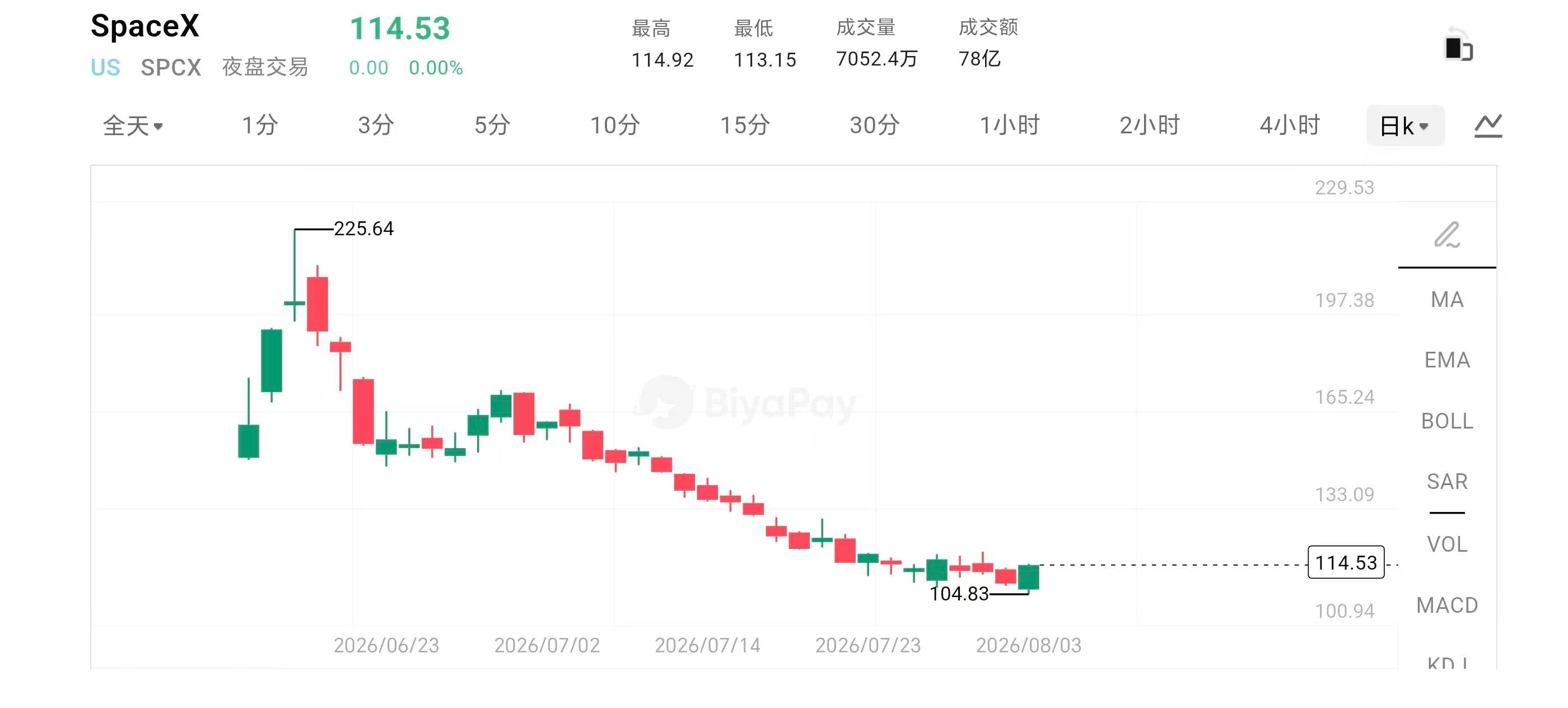
Prior to the earnings release, SpaceX's stock price has already undergone significant adjustments. On Monday, during trading, the stock briefly fell to $104.83, marking a new low since its IPO, and then rebounded to close up 5.7% at $114.53.
As a space technology company currently valued at approximately $1.4 trillion, SpaceX's core issue is not whether it will turn a profit in a single quarter, but whether the company can demonstrate that its future growth path is gradually materializing. The market is mainly focused on three directions: whether AI investments can translate into commercial revenue, whether Starlink's growth is sustainable, and whether stock release will bring short-term pressure.
Cantor Fitzgerald analyst Colin Canfield stated in a preview report that since this is SpaceX's first quarterly performance report, the market lacks historical data for reference, which may result in a significant expectation gap for the report.
AI Business Becomes the Biggest Focus: Will Huge Investments Start to Pay Off?
Currently, the AI business is the most closely watched part of SpaceX's financial report.
In February, SpaceX completed its merger with xAI, officially incorporating AI business into its corporate structure. Currently, xAI has built two large data centers, Colossus I and Colossus II, located in Tennessee and Mississippi, and continues to expand its AI computing power infrastructure.
Data shows that xAI generated approximately $818 million in revenue in the first quarter of this year, but at the same time, it incurred an operating loss of $2.5 billion, with capital expenditures around $7.7 billion, still in a phase of massive investment.
Therefore, the key to this financial report is not whether the AI business is profitable in the short term but whether SpaceX can prove that ongoing investments are being converted into new revenue sources.
Key points the market will focus on include:
- Whether the speed of AI data center construction meets expectations;
- Whether computing power leasing can contribute additional revenue;
- Whether the scale of capital expenditures continues to expand;
- How business synergies between SpaceX and xAI will advance in the future.
Previously, SpaceX had reached an AI computing power cooperation agreement with Anthropic, with a contract scale of approximately $1.25 billion per month, gradually increasing in scale from May and June. Additionally, the company has also established a related cooperation with Google, but specific revenue contributions are yet to be disclosed in the financial report.
If the AI infrastructure can gradually form a commercial closed loop, it will become an important support for SpaceX's future growth.
Starlink Growth Remains the Core of Current Commercialization
Compared to the AI business still in the investment phase, Starlink has become SpaceX's most mature commercialization project.
As of the end of the first quarter of this year, Starlink's global user base exceeded 10 million, doubling from approximately 5 million users one year ago. By 2025, Starlink is expected to generate approximately $11.4 billion in revenue and around $4.4 billion in operating profit.
In this financial report, the market will pay close attention to:
- Whether the user growth rate is maintained;
- The development of enterprise and government customers;
- Changes in average revenue per user (ARPU);
- The scale of corporate orders and future growth potential.
In recent years, Starlink has been expanding from consumer broadband services to the enterprise, aviation, maritime, and government markets. If the user scale and profitability continue to improve, it will further reinforce its important position as a source of cash flow for SpaceX.
Starship Business Still in Investment Phase, Limited Short-Term Profit Contribution
Besides AI and Starlink, rocket launch services remain an important foundation for SpaceX.
In July, SpaceX completed the 13th test flight of the Starship, and the market expects the company will disclose subsequent testing plans and commercialization advancement pace during the earnings call.
However, from a financial performance perspective, the aerospace business is currently still in the investment phase.
In the first quarter, SpaceX's space business capital expenditures reached $1.1 billion, mainly used for constructing new factories and equipment. By 2025, this business is expected to generate about $4.1 billion in revenue, but incur an operating loss of roughly $657 million.
Additionally, in the second quarter, SpaceX completed approximately 30 Falcon 9 rocket launches, most of which were for Starlink satellite deployments. Since internal launches will not be counted in traditional launch business revenue, the rocket business remains unlikely to become a major profit source in the short term.
In the future, the commercialization progress of Starship and its low-cost orbital transportation capability will determine the long-term value of this business.
Stock Unlocking Approaches, Short-Term Trading Pressure Increases
In addition to the financial report itself, stock unlocking is also an important factor that the market has been focusing on recently.
According to relevant documents, approximately 912 million shares of SpaceX stock will be freed from sale restrictions starting August 6, and an additional approximately 319 million shares will be unlocked one week later.
A large number of newly tradable shares may increase short-term supply pressure, which is one of the important factors contributing to recent stock price fluctuations.
However, the effects of unlocking are typically reflected in market trading in advance. After the official unlock, stock performance will still depend on changes in the company's fundamentals and future growth signals released by the financial report.
If the commercialization progress of the AI business goes smoothly and Starlink continues to grow, the unlocking pressure may be partially absorbed; but if capital investments continue to expand while revenue growth fails to match expectations, the market may reassess the company's growth path.
In a High-Valuation Context, the Financial Report Needs to Validate Growth Logic
SpaceX's current valuation of approximately $1.4 trillion already incorporates the market's high expectations for its future growth.
The company has three growth paths: rocket launches, satellite internet, and AI infrastructure, which are also the core factors supporting its high valuation. However, the market is also paying attention to whether these businesses can truly translate into sustainable revenue and profit.
Currently, Starlink has entered the commercialization phase and is contributing strong cash flow; the AI business, on the other hand, is still in a phase of massive investment and needs to prove that the construction of computing power infrastructure can yield long-term returns; while the Starship project, although strategically valuable, still requires continuous investment in the short term.
Therefore, the real questions that this financial report needs to answer include:
- Whether AI business revenue growth can match capital investments;
- Whether Starlink user growth and profitability continue to improve;
- Whether future capital expenditures will further expand.
If the company can demonstrate that AI and satellite internet businesses are forming new growth curves, the high valuation may still be supported; but if business realization speeds fall short of expectations, the market may reassess current growth predictions.
The First Financial Report Will Be a Key Milestone in SpaceX's Next Development Phase
Currently, Wall Street expects SpaceX to achieve approximately $39 billion in revenue and about $17.3 billion in EBITDA for the full year 2026.
However, compared to specific financial figures, the more crucial significance of this financial report lies in validating SpaceX's development logic for the next phase:
Can the AI business transition from a high-investment phase to commercialization?
Can Starlink continue to maintain rapid growth?
Can the aerospace business form new value in the long term?
As the first public performance disclosure after going public, SpaceX's financial report is not only a quarterly scorecard but will also serve as an important reference for the market to reassess its future growth path.
免责声明:本文章仅代表作者个人观点,不代表本平台的立场和观点。本文章仅供信息分享,不构成对任何人的任何投资建议。用户与作者之间的任何争议,与本平台无关。如网页中刊载的文章或图片涉及侵权,请提供相关的权利证明和身份证明发送邮件到support@aicoin.com,本平台相关工作人员将会进行核查。


