
Author: ChandlerZ, Foresight News
“The mission of this position is to achieve leapfrog / breakthrough growth, rather than to drive natural growth or marginal growth.”
This statement is written in the job description for the Head of Stablecoins position posted by the Solana Foundation on the recruitment platform Ashby on August 3. The foundation is a non-profit organization registered in Zug, Switzerland, nominally responsible for promoting the adoption, decentralization, and security of the Solana network, and usually does not write job postings in this sales-team style tone.
Along with this posting, four other senior positions were released, including Head of AI Ecosystem, Head of Institutional Growth for Greater China, Head of Institutional Growth for Japan, and Head of DeFi Growth, all posted under the growth team responsible for liaising with enterprises, financial institutions, and regulators.
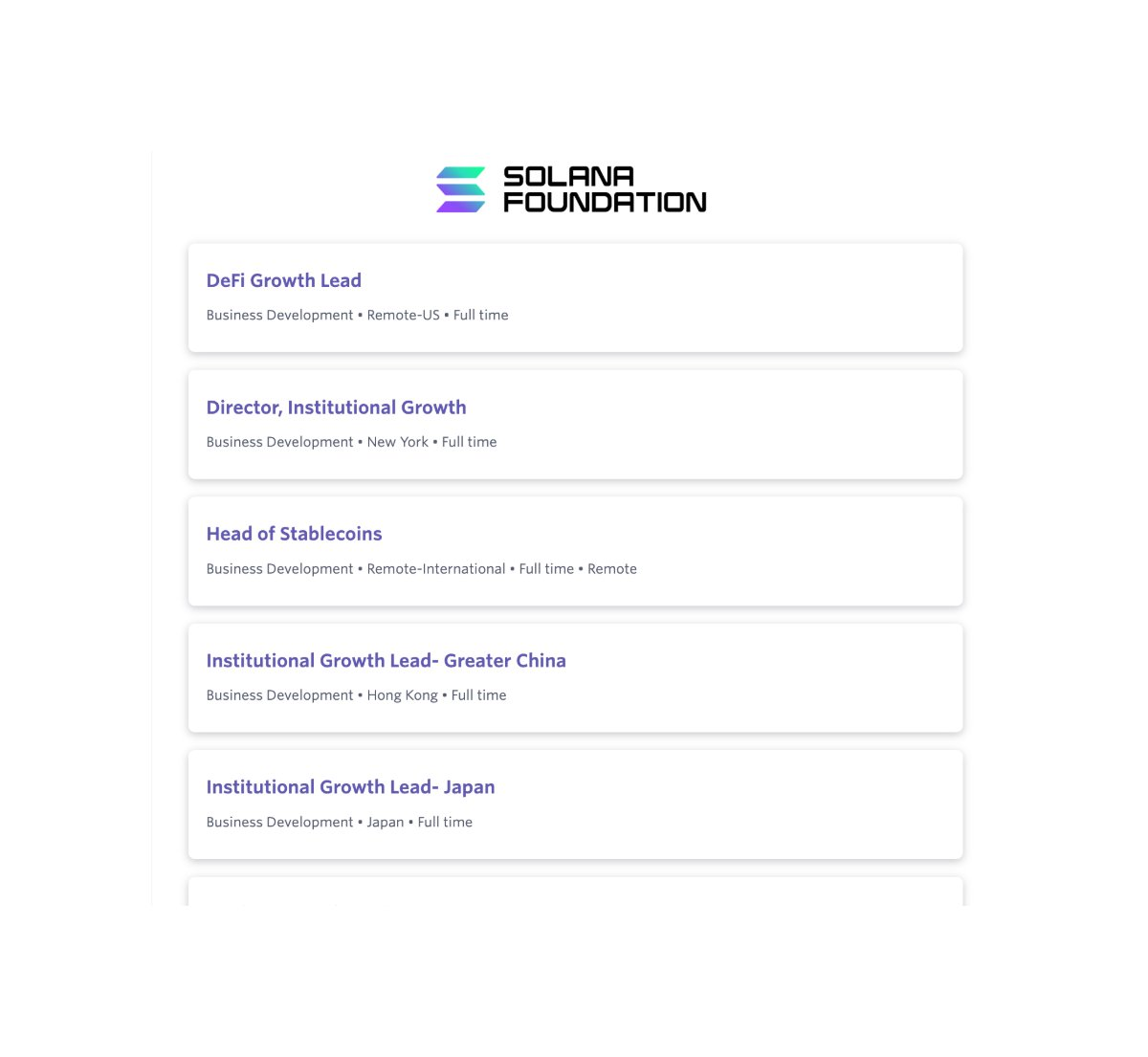
In terms of job details, the Japanese position requires candidates to be fluent in Japanese and capable of establishing direct relationships with executives of super banks, regulators, and large payment companies; the Greater China position specifies the region, yet the body covers Japan, China, and Singapore in the entire Asia-Pacific region, requiring 7 to 12 years of experience and pre-existing executive networks. The stablecoin position hopes candidates already have relationships with main issuers, custodians, and market makers to design commercial terms and liquidity incentives.
Five positions cover four areas: stablecoins, AI, Asian institutions, and DeFi, yet none relate to Memes. However, Memes have precisely supported the activity on the Solana chain over the past two years. This recruitment marks a strategic shift towards expanding into AI, stablecoins, and the Asian institutional market; to understand an organization's true anxieties, examining its roadmap is not as revealing as looking at its job postings.
So the question becomes: what is the foundation anxious about?
Fourth in All-Chain Revenue
According to Blockworks’ Solana Holders Report for the second quarter of 2026, the chain's real economic value for the second quarter was $51 million, a 43% decrease quarter-over-quarter, with April at $18.6 million, May at $18.1 million, and June at $14.3 million, experiencing a decline each month. Application layer revenue was $228.4 million, a 31% decrease, marking the lowest quarter since Q1 2024.
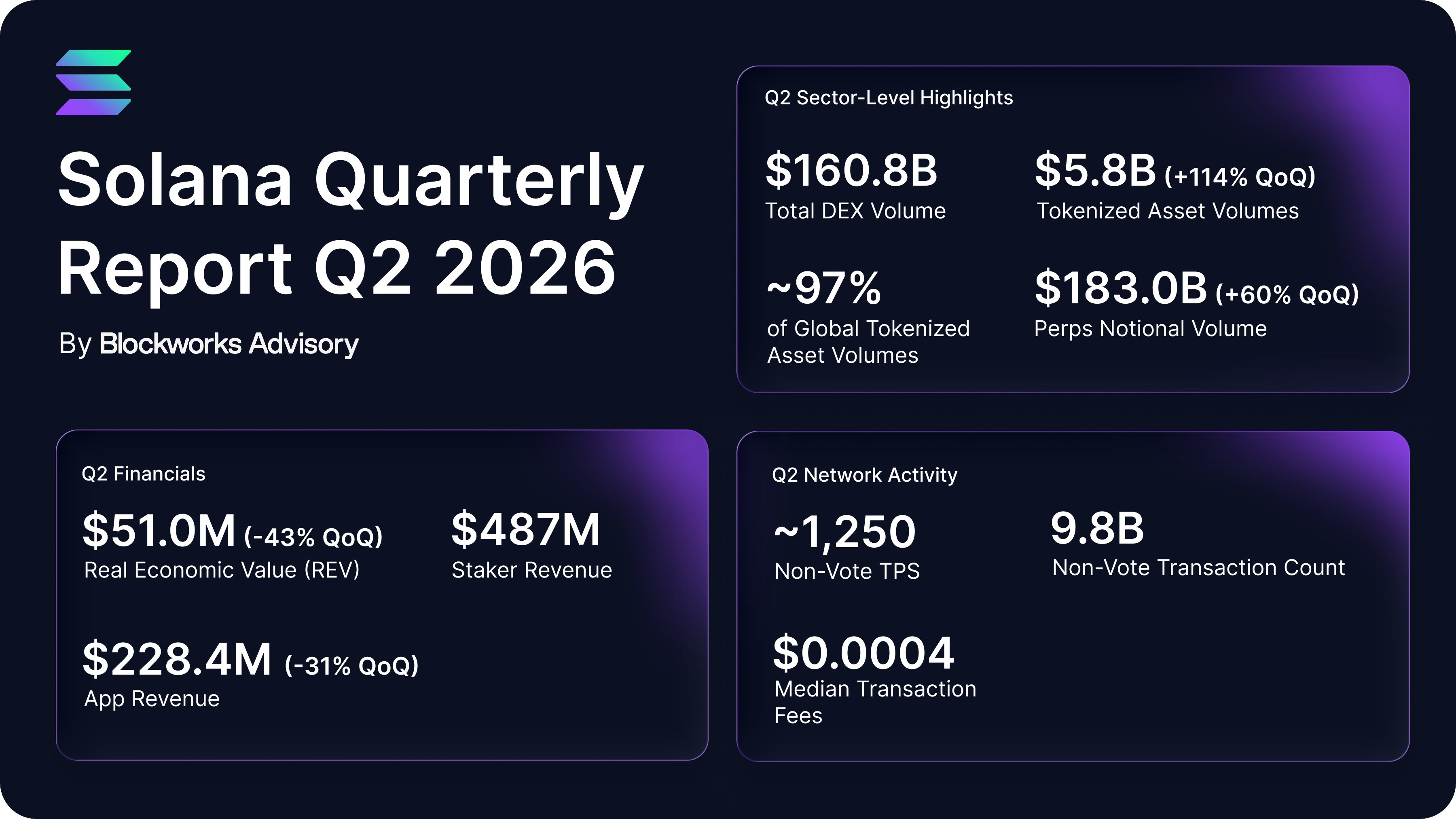
Worse than the drop percentage is the ranking; by single-chain quarterly revenue, Solana ranks fourth with a 12% share, behind Hyperliquid’s $141.4 million (33%), Tron’s $89.8 million (21%), and Ethereum’s $63.3 million (15%). By comparison, Solana's share in Q1 was still 18%.
The composition of revenue and the total amount are both seriously problematic; in Q2, the top application revenue came from the Meme issuance platform Pump.fun, at $90.1 million, accounting for 39% of total application revenue. However, the report also points out that Pump.fun’s revenue share hitting a record high was precisely because the rest of the market contracted even faster. The overall revenue for launchpad categories was $63.9 million, with Pump.fun alone accounting for 97%.
On July 18, Solana’s daily network revenue exceeded all other blockchains, returning to the top of the DeFiLlama chart, with SolanaFloor stating it was the first time in five months. On that day’s fee chart, Pump.fun led with $2.04 million, more than double the $800,000 daily revenue during the June low, while Solana's base layer trading fees were only $568,000.
At this point, the story looks like the old version: Memes retreat, public chains bleed, and the foundation hires for new growth.
New Demand Has Emerged
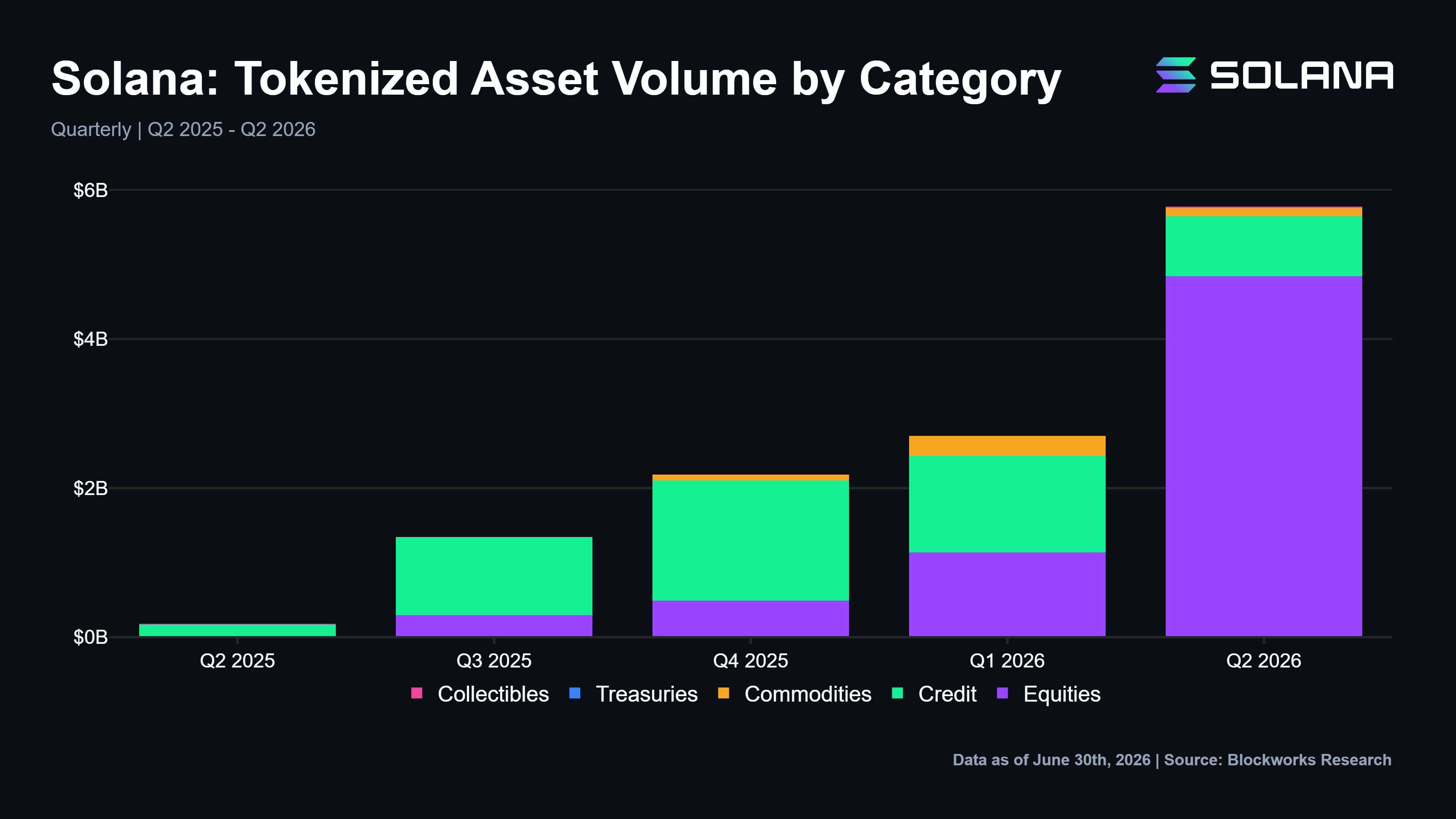
In the same quarter, Solana's tokenized asset transaction volume hit a record high of $5.8 billion, a 114% increase quarter-over-quarter, with tokenized stocks at $4.8 billion, more than four times the $1.1 billion of Q1. Growth was concentrated towards the end of the quarter, with April at $670 million, May at $871 million, and June reaching $3.3 billion; on June 12, the listing of SpaceX was a direct trigger, with tokenized SPCX issued through Sunrise and distributed by Backpack contributing about $770 million in a single month. About 97% of all tokenized stock trading took place on Solana.
In June, all-chain DEX transaction volume rebounded by 26% quarter-over-quarter, with Blockworks specifically pointing out that the driving force behind this rebound was tokenized assets, not Memes.
On the institutional side, of the 29 globally systemically important banks, 7 have already launched Solana-related businesses; JPMorgan is handling tokenization and securities settlements, Bank of New York Mellon is providing SOL custody and USDC minting, Morgan Stanley is engaged in custody, spot trading, and lending, and Société Générale is issuing stablecoins, while State Street is involved in money market funds. In Q2, the net inflow for SOL spot ETP was $120 million, while Bitcoin spot ETP saw a net outflow of $3.7 billion, and Ethereum experienced a net outflow of $500 million. Amidst a downturn in the market, this reverse trend in capital inflow is some hard evidence that demand truly exists.
However, while transaction volume is increasing, user structure is improving, and institutions are entering the market, revenue has dropped by 43%. The reason lies in the revenue rankings; in Q2, the top five application revenues were Pump.fun ($90.1 million), collectible card market Collector Crypt ($32.2 million), Pacifica ($20 million), Jupiter ($15.3 million), and wallet Phantom ($11.9 million). Despite the $4.8 billion transaction volume from tokenized stocks, none of the relevant applications made it into the top five.
This means that Solana's transformation has already shown a manifestation in transaction volume, yet it still has not highlighted in the revenue table. Tokenized stocks are handled by proprietary AMMs operated by professional market makers, such venues contribute to about half of the transaction volume of tokenized assets, relying on price spreads, and the fees deducted are far lower than the priority fees and tips in Meme trading.
Five Positions Filling the Same Gap
Considering this contradiction back in the context of the job postings, the logic of the five positions becomes complete; they are all seeking chargeable forms to meet non-speculative demands.
Stablecoins are the first area to act because they form the funding layer of all on-chain financial activities and are also the part that Solana has stagnated on the longest. By the end of Q2, the supply of stablecoins on the Solana chain was $16.3 billion, a mere 2% increase quarter-over-quarter, remaining basically flat in the context of four consecutive quarters of declining activity. Transfer volumes were $15 trillion, a 29% decrease quarter-over-quarter.
In the same time frame of DefiLlama’s segmented data, Ethereum carried about $154 billion, Tron about $90 billion, with Solana lagging by an order of magnitude. The phrase "leapfrog growth" refers directly to this lagging and meager figure. In a quarter where lending balances generally declined, the yield-bearing stablecoin market is the only clear source of new funds. The DeFi growth leader is addressing the second half of this line; money sitting in wallets produces no revenue, but only flows into lending, trading, and market making can start to generate fees.
The two Asian institution roles correspond to the source of volume; 7 systemically important banks have only opened the door slightly, but expanding that door into a corridor requires someone to sit in Tokyo and Hong Kong year-round negotiating with regulators and bank executives. The technological side has also been prepared; the consensus layer upgrade Alpenglow plan is set to launch around August with Agave v4.2, compressing transaction confirmation times to 150 milliseconds, about a hundredfold improvement over the current situation. Millisecond-level settlement is a negotiable asset, the timing of opening these two positions is likely not coincidental.
The AI Ecosystem Leader appears to be most like riding the trend but is actually the one closest to revenue among this batch of positions. Google Cloud and the Solana Foundation jointly launched Pay.sh in Q2, a pay-per-use stablecoin payment channel aimed at AI entities, while Amazon Cloud also launched a stablecoin system for charging AI traffic, with Blockworks calling this direction “the biggest new frontier” in payment business for that quarter.
As of the time of publication, the Solana Foundation has not issued a public statement regarding the overall strategic intentions of this recruitment; the AI ecosystem position has already shown to be stop accepting applications on some aggregated job sites, while the actual status should be confirmed by the foundation's official job page.
Conclusion
Blockworks in the report's conclusion divides Solana into two halves; the revenue tied to speculative speed is being repriced, while the demand tied to settlement is growing in the same environment.
The Q3 earnings report will be the first report card, and the only figure to watch is the revenue share of 39% from Pump.fun; let’s see if that drops. Will any projects appear for the first time bearing their names in the top five of the revenue chart within the lines of tokenized stocks, stablecoin payments, and AI entity payments?
Until then, “leapfrog growth” is still just a phrase written on a recruitment webpage.
免责声明:本文章仅代表作者个人观点,不代表本平台的立场和观点。本文章仅供信息分享,不构成对任何人的任何投资建议。用户与作者之间的任何争议,与本平台无关。如网页中刊载的文章或图片涉及侵权,请提供相关的权利证明和身份证明发送邮件到support@aicoin.com,本平台相关工作人员将会进行核查。


