Written by: David Christopher
Translated by: Saoirse, Foresight News
The biggest success of Hyperliquid HIP-4 so far comes from World Cup-related trades.
I did not foresee this situation before. When HIP-4 was first launched, I suggested that Hyperliquid was not actually aiming to compete directly with Polymarket or Kalshi. This type of outcome prediction market serves more as an extension tool for its trading framework: offering daily binary contracts on cryptocurrencies for hedging perpetual contracts, building options-like risk exposures, while enabling traders to keep their entire positions consolidated within the Hyperliquid platform.
However, the following developments were unexpected. Hyperliquid subsequently launched markets related to the NBA Finals, single matches of the World Cup, and championship-related trades. These three types of markets (with the latter two contributing most of the trading volume) account for about 48% of HIP-4's total transaction volume to date.
After reaching its peak trading heat for World Cup transactions, the associated open contract scale fell by over 90%. However, objectively speaking, this does not mean that HIP-4 has failed; it simply lacks events with trading heat at the moment.
The current system is still in a permissioned mode, and all trading markets need to be manually created and launched by validators. Most of the remaining markets on the platform are related to cryptocurrency price trends, with dismal trading volumes that cannot be compared to the trading volume driven by sports events.
Now, Hyperliquid wants to break this limitation. On July 31, the permissionless HIP-4 deployment feature was launched for testing, paving the way for third-party teams to independently create and operate prediction markets, while also clarifying the conditions required for operational implementation.
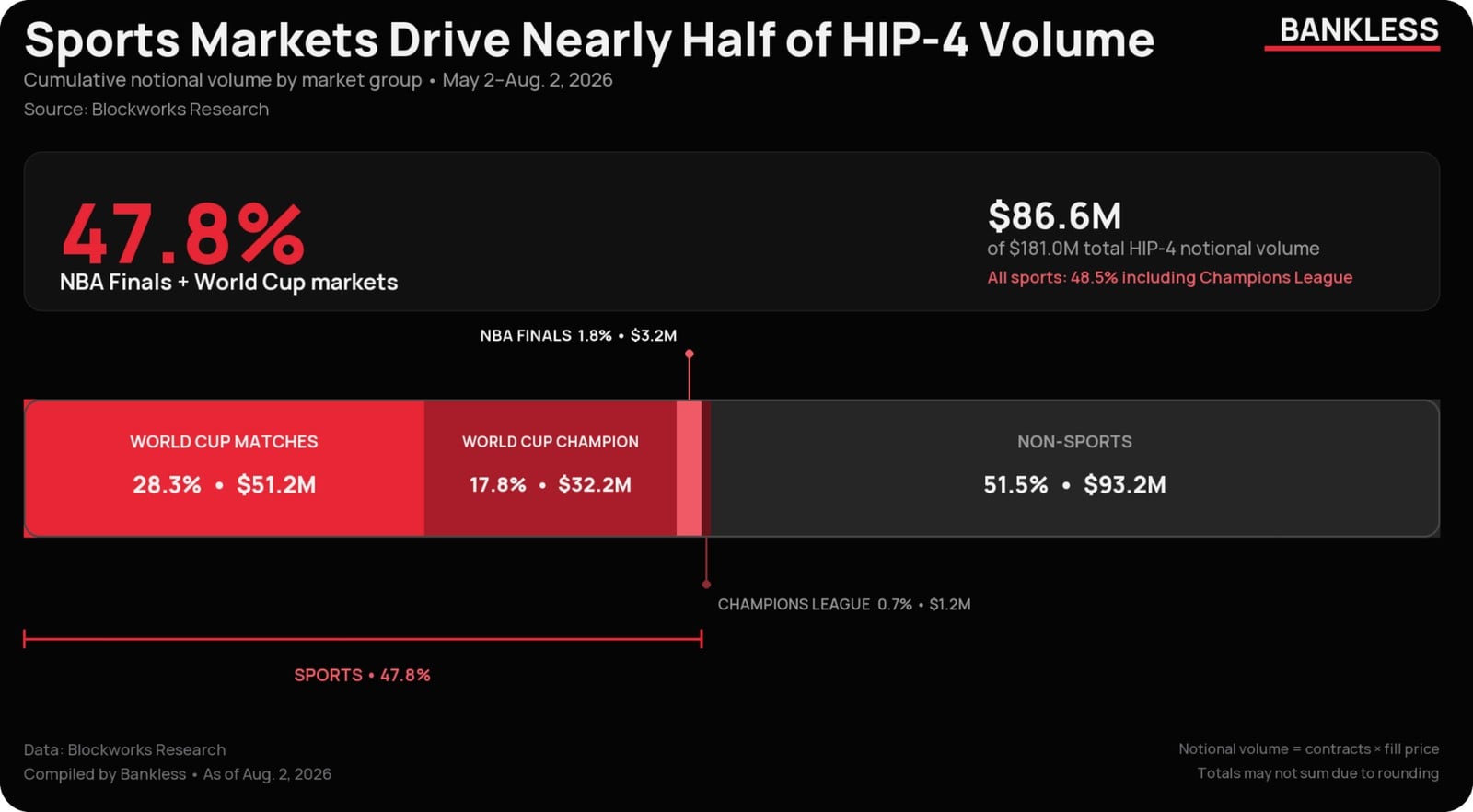
From May to August 2026, 47.8% of HIP-4's trading volume came from sports event markets, with the World Cup contributing the vast majority of sports trading volume, highlighting the platform's heavy reliance on major hot events to gain trading flow.
Operational Mechanism of HIP-4 in Permissionless Mode
It is important to note: permissionless deployment ≠ unrestricted random market creation.
According to the preliminary plan for the mainnet: Validators first approve market templates, a set of reusable standard frameworks that define market creation rules and settlement methods. The deployer then selects an approved template to create a specific trading market, filling in trading topics, optional outcomes, expiration time, settlement criteria, and other information.
For a politically related example (which will be explained later why political markets are emphasized): An approved binary event template can be used to build a market related to candidate election outcomes. However, Hyperliquid has not yet disclosed the applicable scope of the templates, and it is currently uncertain whether a single template can cover scenarios like Senate, House, gubernatorial elections; or whether different templates need to be separately built for party control, seat counts, and multi-candidate elections.
One certain point is that deployers only need to call upon the templates that validators have already approved to generate markets, without needing to apply for separate approval for each independent market.
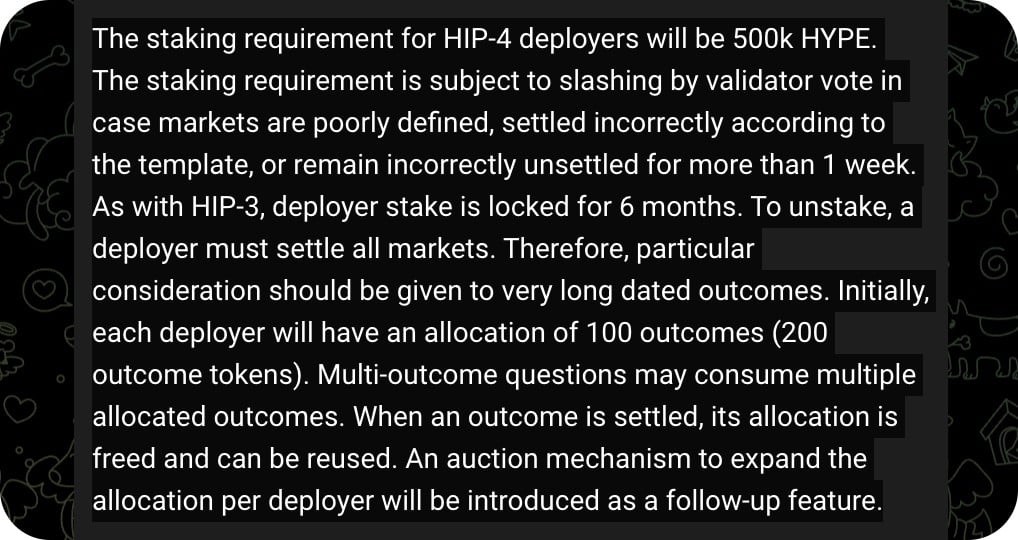
Consistent with the HIP-3 mechanism, deployers need to precisely define market rules and ensure proper settlement. If a significant error occurs, validators have the right to confiscate their staked assets.
The plan requires deployers to stake 500,000 HYPE (the same standards as HIP-3), with a staking lock-up period of six months; only after all markets under their name are fully settled can the deployer withdraw their staked assets. Initially, each deployer can create up to 100 outcome assets; the quota can be reused after market settlement. The platform plans to expand additional quotas through an auction process. Ultimately, deployers can earn up to 50% of trading fees from the markets they create.
After the World Cup, where is the next core opportunity?
The most obvious target: the U.S. midterm elections.
Prediction markets initially gained public attention through political issues. Kalshi and Polymarket have already established comprehensive election trading panels covering congressional control, district elections, total seat counts, and various other markets, while HIP-4 has not yet launched any related assets.
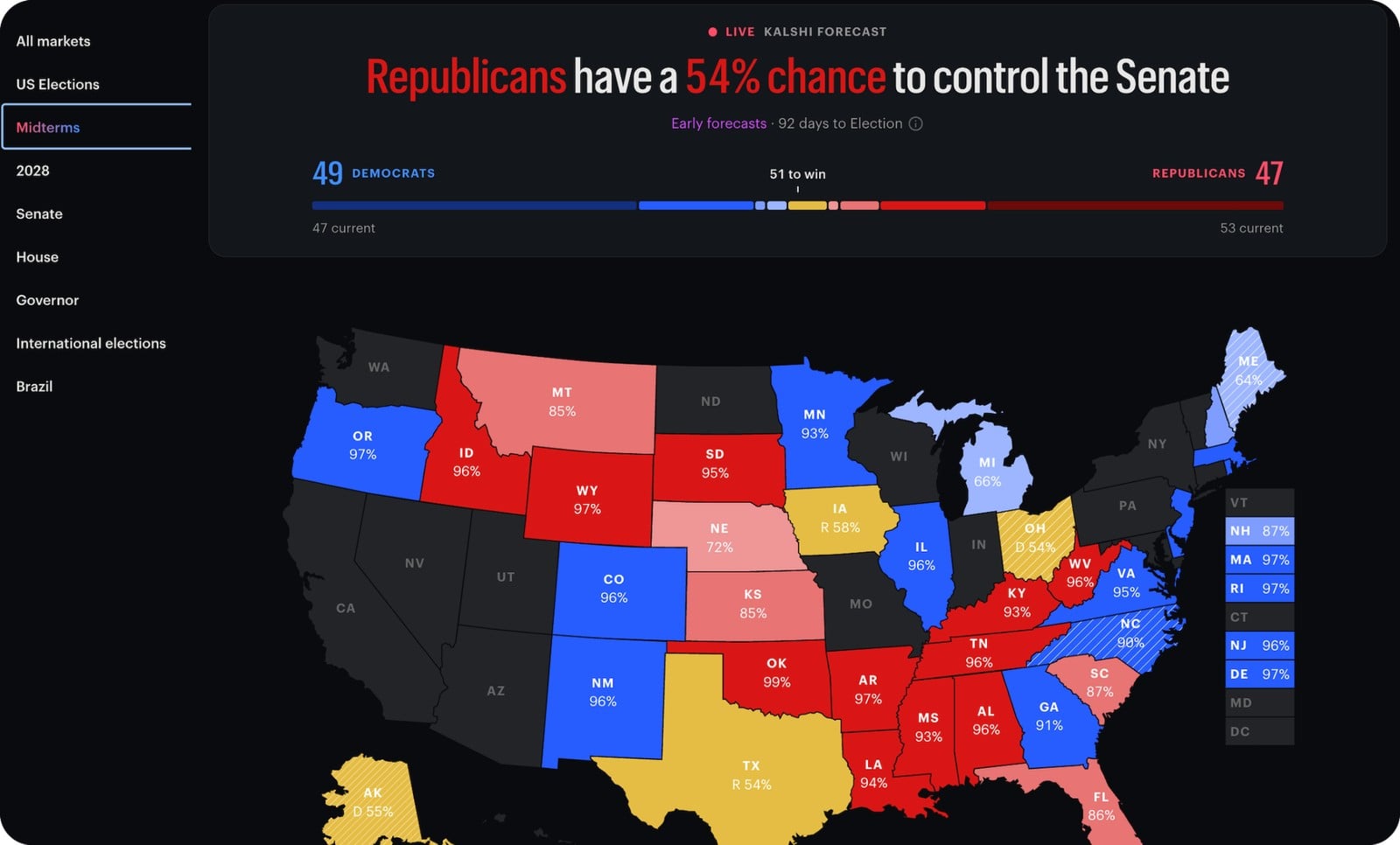
This is data from Kalshi prediction markets, with 92 days until the U.S. midterm elections. The market predicts a 54% probability that the Republican Party will control the Senate. Currently, the Democratic Party holds 49 seats and the Republican Party holds 47 seats, needing 51 seats to gain control of the Senate, with a map indicating the corresponding winning probabilities for each party in various states.
Whether third-party deployers can fill this gap depends on when the permissionless HIP-4 goes live on the mainnet. Referencing history: HIP-3 took 164 days from the launch of the first permissionless testnet simplest version to landing on the mainnet; however, only 18 days passed from the release of the initial mainnet specifications and the initiation of the mainnet vulnerability bounty program to the formal launch.
The current progress of HIP-4 is somewhere in between: the preliminary structure of the mainnet has been publicly released, the testnet has opened deployment features, but the mainnet-level vulnerability bounty program has not yet been launched, leaving the overall progress still uncertain.
If this system can be launched on time, deployers will be able to build a complete election trading area based on the midterm elections, rather than sporadically launching independent campaign topic markets—provided that validators simultaneously approve trading templates that support election scenarios.
If permissionless deployment misses the window for the midterm elections, validators can still manually launch various midterm election markets. Even so, HIP-4 will still be able to obtain trading flow, but it will miss its first major practical opportunity: unable to prove to the market that external third-party deployers can continuously provide timeliness of hot trading markets for the platform.
The World Cup has already proven that Hyperliquid users are willing to participate in trades of significant real-world events. At the same time, the rapid decline in trading volume after the World Cup has exposed a pain point: without major events, the platform struggles to maintain activity.
This round of midterm election enthusiasm is an excellent opportunity for HIP-4. The platform can maintain market heat through this opportunity while also promoting permissionless deployment. In the coming weeks, it will be important to closely follow relevant developments.
免责声明:本文章仅代表作者个人观点,不代表本平台的立场和观点。本文章仅供信息分享,不构成对任何人的任何投资建议。用户与作者之间的任何争议,与本平台无关。如网页中刊载的文章或图片涉及侵权,请提供相关的权利证明和身份证明发送邮件到support@aicoin.com,本平台相关工作人员将会进行核查。


