Written by: Oluwapelumi Adejumo
Translated by: Chopper, Foresight News
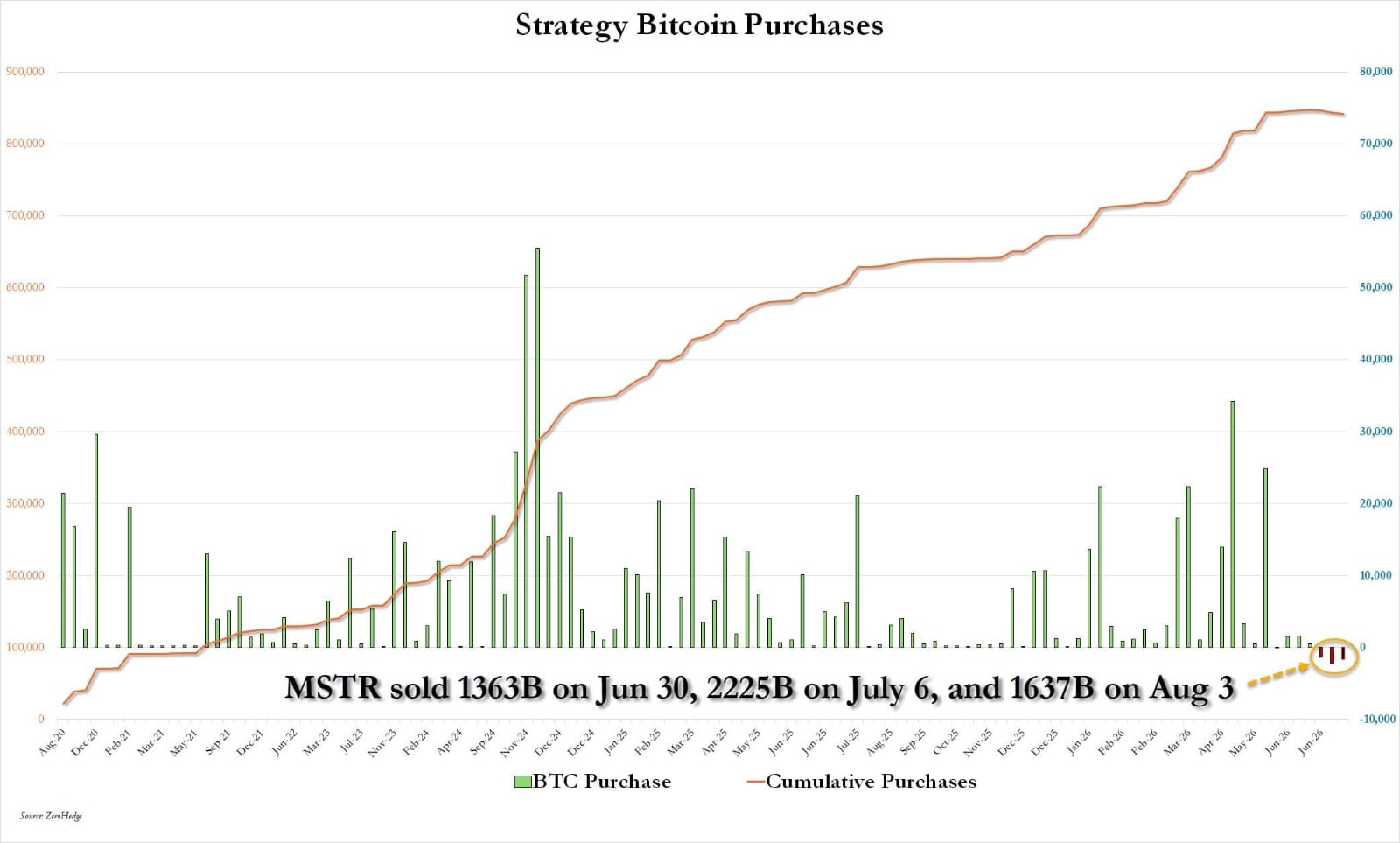
The latest round of Bitcoin selling by Strategy has brought its total Bitcoin sales for 2026 to 5,258 coins. This year marks the company's highest annual sell-off since it began investing in Bitcoin in 2020. Strategy is redirecting funds to support its STRC preferred stock.
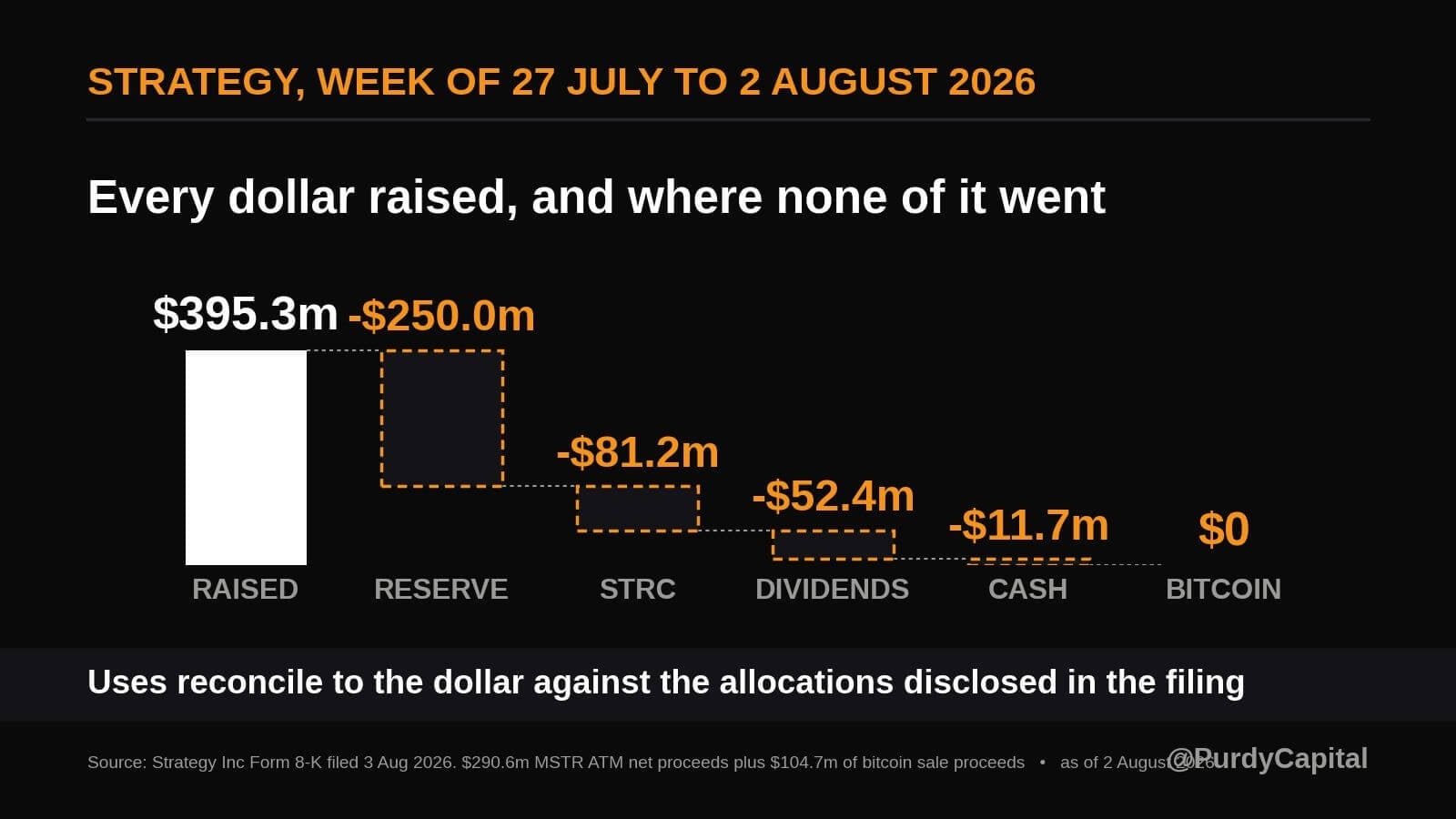
According to a document disclosed by the U.S. Securities and Exchange Commission on August 3: Between July 27 and August 2, Strategy sold 1,638 Bitcoins, cashing out $104.7 million; at the same time, it issued approximately 3.01 million MSTR common shares, raising $290.6 million.
The nearly $395 million raised was not used to purchase new Bitcoins. Instead, Strategy allocated the funds for paying preferred stock dividends, repurchasing STRC shares, and achieving its goal of expanding its cash reserves to $4 billion.
This allocation of funds has extended the company's purchase pause for Bitcoin to six weeks, marking the longest purchase window after 2024.
How Strategy utilizes the funds raised, source: PurdyCapital
STRC Continues to be Discounted, Forcing Strategy to Adjust Fund Allocation
The most direct reason for Strategy's pause in increasing its Bitcoin holdings comes from STRC. This is a floating-rate preferred stock, and the company aims to establish it as a sustainable financing channel for its Bitcoin treasury.
When the STRC trading price is close to the $100 par value, Strategy can issue new shares near par value and flexibly allocate the raised funds to its balance sheet, including purchasing Bitcoin.
Once share prices remain discounted for the long term, this financing channel will become ineffective: new share issuances will either need to lower the sale price or require an increase in the dividend yield to attract investors.
Although Strategy can adjust the dividend policy to support the share price, since May, the STRC price has consistently remained below par value. In response, the company raised the annualized dividend to 12% and repurchased shares in the secondary market.
Last week, Strategy used $52.3 million from Bitcoin sales and $28.9 million from MSTR stock issuance to repurchase 912,143 shares of STRC, totaling $81.2 million.
The previous week, the company had completed a round of repurchases worth $25 million, buying 288,930 shares at an average price of $86.53.
During the second quarter earnings call, Strategy President and CEO Phong Le stated that repurchasing STRC below par values allows for discounted payment of future dividend obligations; at the same time, it increases buying pressure to push the share price back towards the $100 par value.
Since initiating the repurchase plan in July, Strategy has spent approximately $106.2 million to repurchase STRC. The current authorized amount remaining for preferred stock repurchases is $893.8 million; an additional $1 billion MSTR common stock repurchase authorization has yet to be utilized.
The company's goal is to push STRC back to par value before September, and future repurchase pace will depend on stock price trends and market liquidity.
If the target is achieved, this important financing channel will become unobstructed again. As of July 26, 2026, Strategy has raised a total of $7.53 billion across various capital instruments, with the weight of preferred stock in the financing system of the balance sheet continuing to increase.
$4 Billion Reserve to Ensure Preferred Stock Payments
Strategy is also utilizing the funds raised from the common stock issuance to quickly expand its cash reserves for paying preferred stock dividends and debt interest.
Out of the $290.6 million raised from the MSTR issuance, $250 million has been allocated to a dollar-specific reserve, with the remaining $11.7 million kept as working capital.
At the end of June, this reserve amounted to $2.55 billion and, bolstered by the common stock issuance, had increased to $3.75 billion by July 26; following this funding allocation, the $4 billion target has been officially reached.
During the capital framework update in June, Strategy estimated the total annual expenditure on preferred stock dividends and debt interest to be approximately $1.76 billion. At this expenditure level, a $4 billion reserve could cover about 27 months of payment needs.
Unless otherwise approved by the board, these funds can only be used to pay preferred stock dividends and existing debt interest.
The reserve funds can mitigate a certain risk: the company does not have to sell assets or issue securities in adverse market conditions to tackle short-term repayment pressure. Even if Bitcoin prices decline and the capital market financing environment deteriorates, preferred stock investors have cash safeguards.
However, this safety net is largely achieved at the expense of diluting common stock shareholders' equity.
Last week, Strategy issued 3.01 million shares of MSTR common stock but did not buy any Bitcoin; during the same period, the treasury Bitcoin decreased by 1,638 coins, and the Bitcoin holdings corresponding to the diluted shares also declined.
Long-term Bitcoin bear Peter Schiff commented that a series of transactions indicates that Strategy is continuously relying on selling Bitcoin and issuing MSTR to prioritize the interests of preferred stockholders.
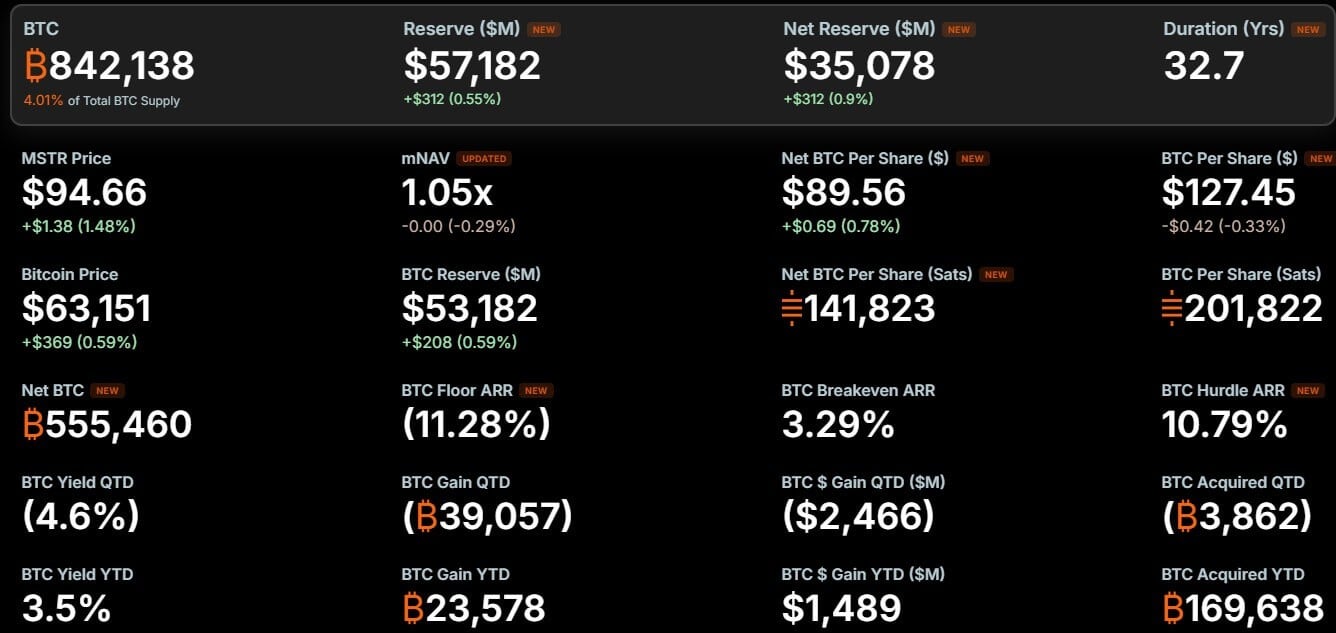
The impact is intuitively reflected in the company's Bitcoin per share metric; year-to-date, the number of Bitcoins corresponding to each MSTR share has only increased by 3.5%. At the end of May, this increase was still at 13.3%. In the current quarter, this metric has even decreased by -4.6%.
Key Bitcoin metrics for Strategy, data source: Strategy Official
Strategy defines BTC yield as the percentage change in Bitcoin holdings corresponding to each diluted share; BTC holding increment converts this percentage into estimated Bitcoin numbers.
The company reminds that the above two metrics are not equivalent to shareholder returns, revenues, cash flows, nor do they represent the company’s ability to fulfill its debt.
Cash reserves enhance Strategy's ability to fulfill its preferred stock and debt obligations, but the financing pressure has shifted more onto MSTR common stock shareholders. Common stock investors' returns are highly dependent on the speed at which Bitcoin holdings outpace the dilution rate.
Bitcoin Becomes a Normalized Source of Liquidity
Strategy has been continuously selling Bitcoin this year, marking that Bitcoin has transformed into an operational liquidity source for its associated securities business.
In fact, the company sold 32 Bitcoins in late May, 1,363 Bitcoins on June 29 and 30, 2,225 Bitcoins in the first five days of July, and another 1,638 Bitcoins last week.
Strategy's historical Bitcoin transaction records, data source: Zerohedge
Bitcoin analyst Will Clemente stated that this series of transactions clearly demonstrates how Strategy balances the interests of three groups: Bitcoin holders, MSTR common stock shareholders, and preferred stock investors. He noted that the selling behavior indicates that management is willing to allocate funds internally within the balance sheet to avoid a single security weighing down the overall financing structure.
Strategy has formally established this flexibility through its "BTC Monetization Plan." This framework authorizes the company to sell Bitcoin, allowing for an additional reserve of up to $1.25 billion; the funds can be used for paying preferred stock dividends, debt interest, repurchasing preferred or common stock. Sales that exceed these uses or breach the cap limits require additional board approval.
Company Executive Chairman Michael Saylor rebutted external opinions, denying that the plan contradicts the commitment to "permanently hold Bitcoin." He stated: "Strategy announced the BTC Monetization Plan 31 days before the publication of the second-quarter financial report, which was on June 29, and not after reporting a loss. We have never instituted a 'never sell' policy. This plan does not mandate the sale of any Bitcoin; in the long term, we still hope to continue to net buy Bitcoin."
Strategy remains the publicly traded company with the largest Bitcoin holdings globally, holding 842,138 Bitcoins, which is about 4% of the total Bitcoin supply cap of 21 million coins.
This holding has an accumulated cost of $63.51 billion, with an average holding cost of $75,419. As of publication, Bitcoin is priced at approximately $62,633, with the treasury’s total market value around $5.27 billion, translating to an unrealized loss of about $10.8 billion compared to the total purchase cost.
This unrealized loss implies that subsequent liquidation costs will further rise. If Bitcoin is sold below the average cost line, losses will be confirmed while the significant Bitcoin holdings that support the large common stock and preferred stock system and continued dividend obligations will continuously shrink.
Therefore, Saylor's expectation of achieving long-term net purchases of Bitcoin increasingly depends on one thing: pushing STRC back to par value, allowing the company to resume smoother financing without continually diluting MSTR shareholders' equity or depleting Bitcoin inventory.
免责声明:本文章仅代表作者个人观点,不代表本平台的立场和观点。本文章仅供信息分享,不构成对任何人的任何投资建议。用户与作者之间的任何争议,与本平台无关。如网页中刊载的文章或图片涉及侵权,请提供相关的权利证明和身份证明发送邮件到support@aicoin.com,本平台相关工作人员将会进行核查。


