Author: Capital Flows
Translation: Deep Tide TechFlow
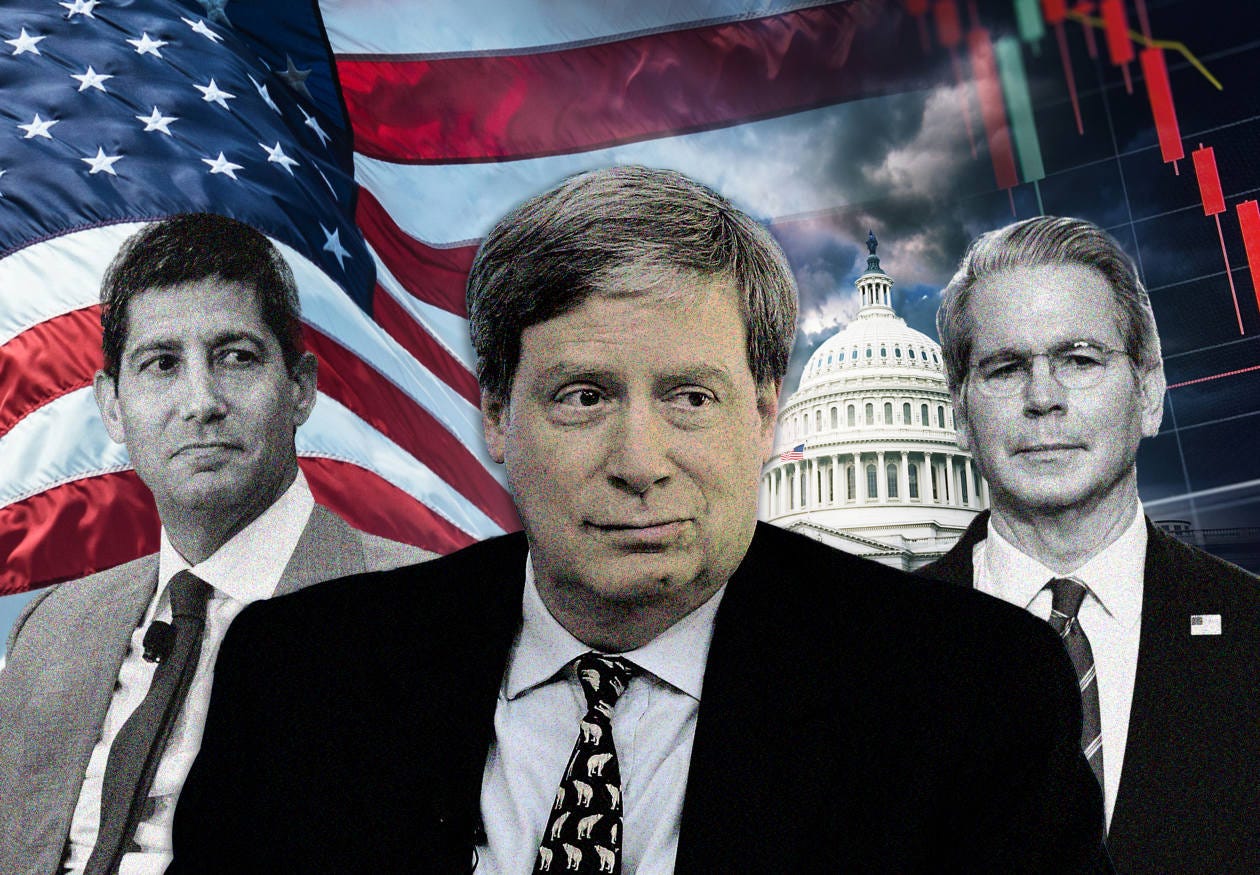
Deep Tide Introduction: The Federal Reserve Chairman Kevin Warsh and Treasury Secretary Scott Bessent, both nominated by Trump and trained under macro trading legend Stanley Druckenmiller, are coordinating a financial counterattack against China. This is not a conspiracy theory—understanding their operational logic allows us to see the underlying drivers of current capital flows, VC investments, and the AI arms race.
Political establishments are playing a bigger game, systematically mobilizing global capital flows and trade to ensure the U.S. maintains its dominance in the AI arms race. Almost no one notices the pieces moving behind the scenes because players are concealing their actions, misleading the public market, while both political factions' commentators are demonizing each player on the board.
This is not a conspiracy theory. If the so-called "conspiracy theories" were truly effective, they should contain realizable alpha extractable from the markets. But we have not seen these "gatekeepers" make big money in the market, which in itself indicates the level of misleading embedded in the algorithms. The real players are hiding rather than revealing the whole picture.
For what I am about to elaborate on to be effective, there needs to be clear quantification and direct links to financial markets, rather than vague statements based on broad generalizations. By the end of this report, you will clearly see that Kevin Warsh (Federal Reserve Chairman) and Scott Bessent (Treasury Secretary) are actively coordinating to advance a larger goal: to establish American dominance over its adversaries through economic and financial counterattacks that respond to coordinated economic and financial assaults from China. This directly relates to how capital flows, and how the entire venture capital space, defense spending, AI, and frontier labs operate.
Druckenmiller's Disciples
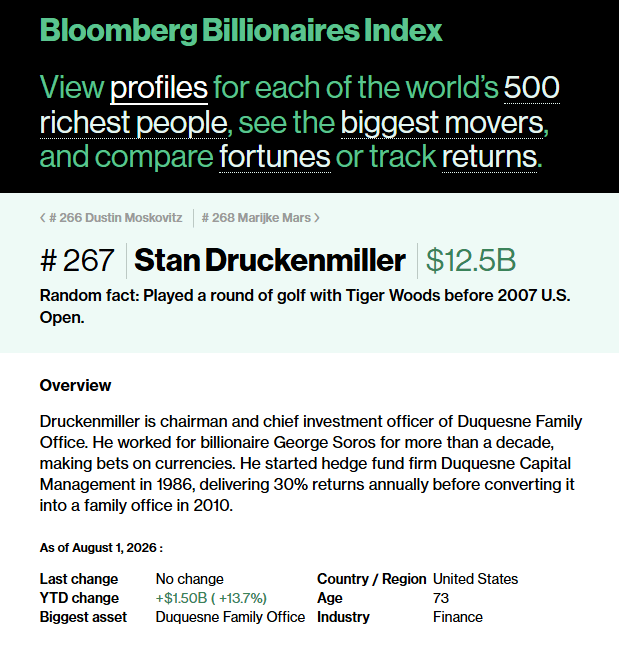
It all begins with how Bessent and Warsh traded under Stanley Druckenmiller, one of the greatest macro traders in history. Why is this important? Because as practitioners and risk-takers, they possess a deep understanding of global capital flows, which is extremely rare. Druckenmiller has said that Kevin Warsh is more knowledgeable about international capital flows than anyone else. But why does this matter? Isn't capital flow a reflection of fundamentals? Shouldn't they influence policy, right?
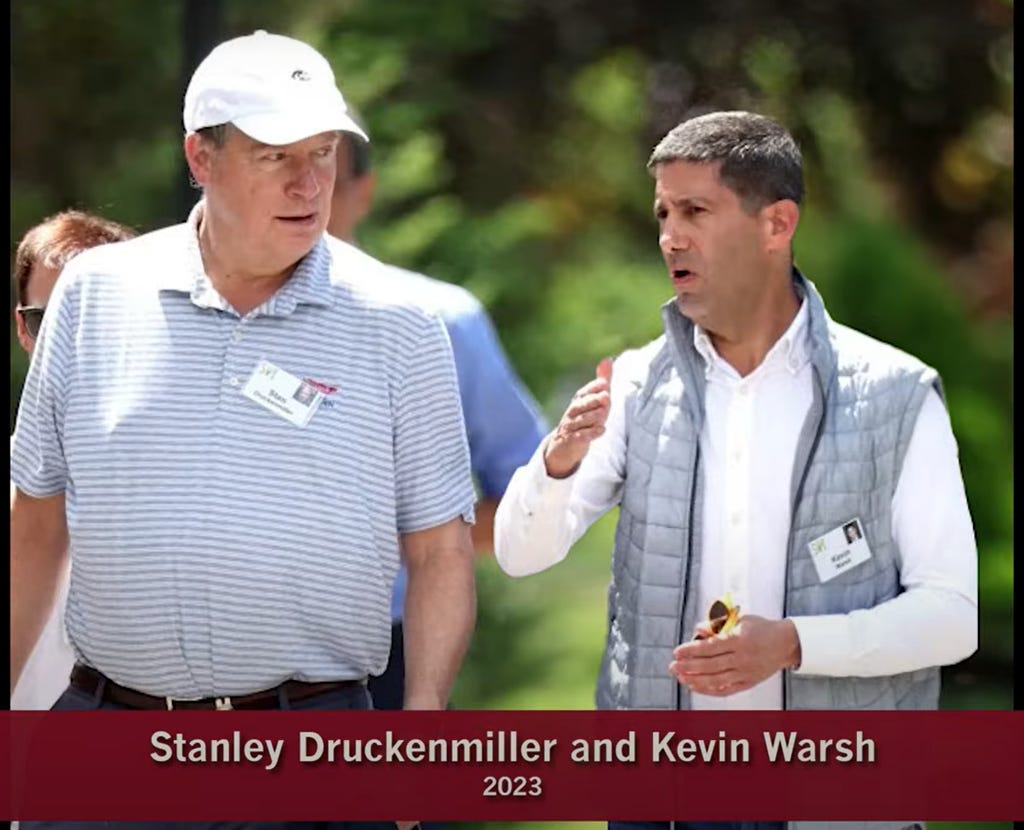
The elusive truth, which morphs into different financial bubbles, is that international capital flows are the root cause of your biggest economic and financial problems. Druckenmiller's career was about understanding these flows and their core mechanisms, and then making huge bets on how the symptoms change.
Social media algorithms and political establishments have been chasing symptoms of this core issue so fervently that entire social groups believe absurd ideas, like "fixing the currency will fix the world," and then suggest you buy and sell certain things, rather than addressing the world’s greatest economic and financial imbalances.
One of Druckenmiller’s biggest bets was early investment in Palantir before anyone was talking about the U.S.-China AI race. Why? Because Druckenmiller and his closest allies understand the core mechanisms that drive the world’s major economic and financial issues: international capital flows between the U.S. and China. Every technological advancement is merely another accelerator within the existing international monetary order. (The entire VC defense sector is now employing the same strategy, essentially replicating Druck's approach)

Alex Karp is one of the few to have a recorded interview with Kevin Warsh, illustrating how much their views overlap on AI, American dominance, and issues with China.
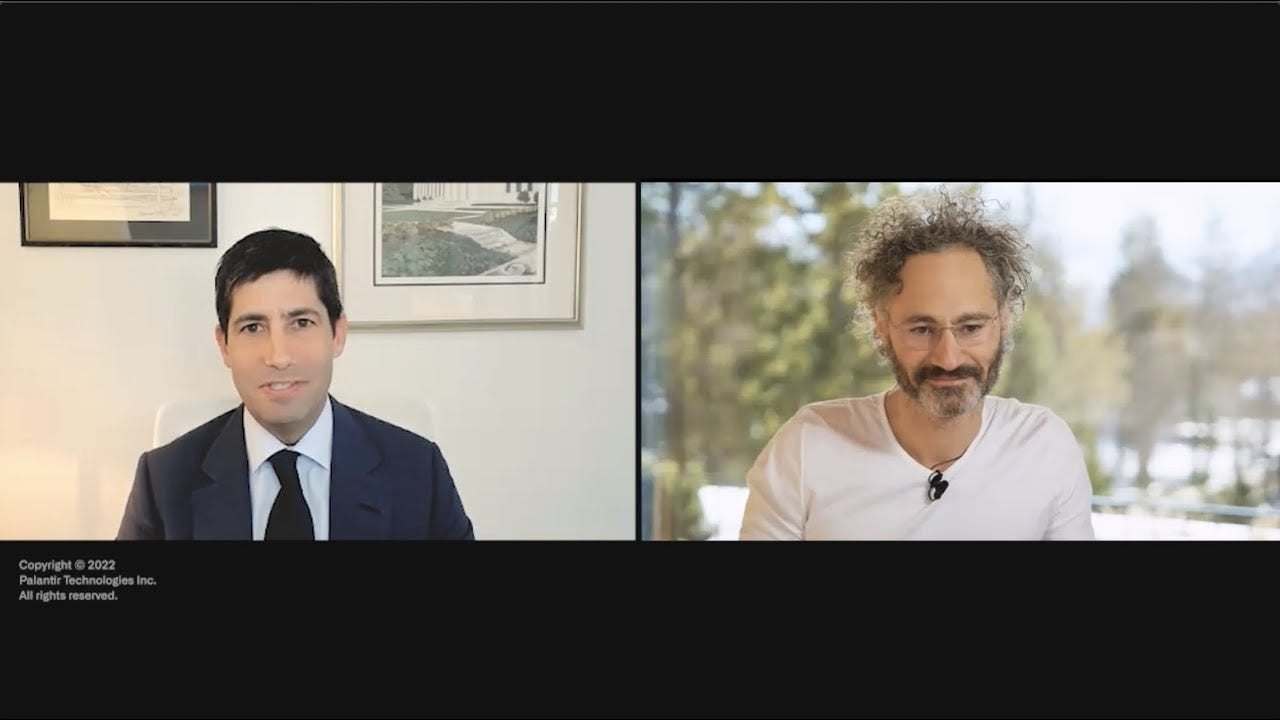
If you understand the core economic and financial issues that exist in today’s world (not just their symptoms), you will begin to see why Bessent and Warsh were chosen: they possess one of the few records of the actual core flows and causal mechanisms of the trading system, not just its statistical reflections. If you can connect this to the markets, you will be able to align yourself with the most core elements of the international monetary order, as opposed to the false narratives surrounding currency dislocation.
All players, flows, and markets are interconnected.
Monetary Order and Macro Conclusion
So, what is the core mechanism that pulls all these players together?
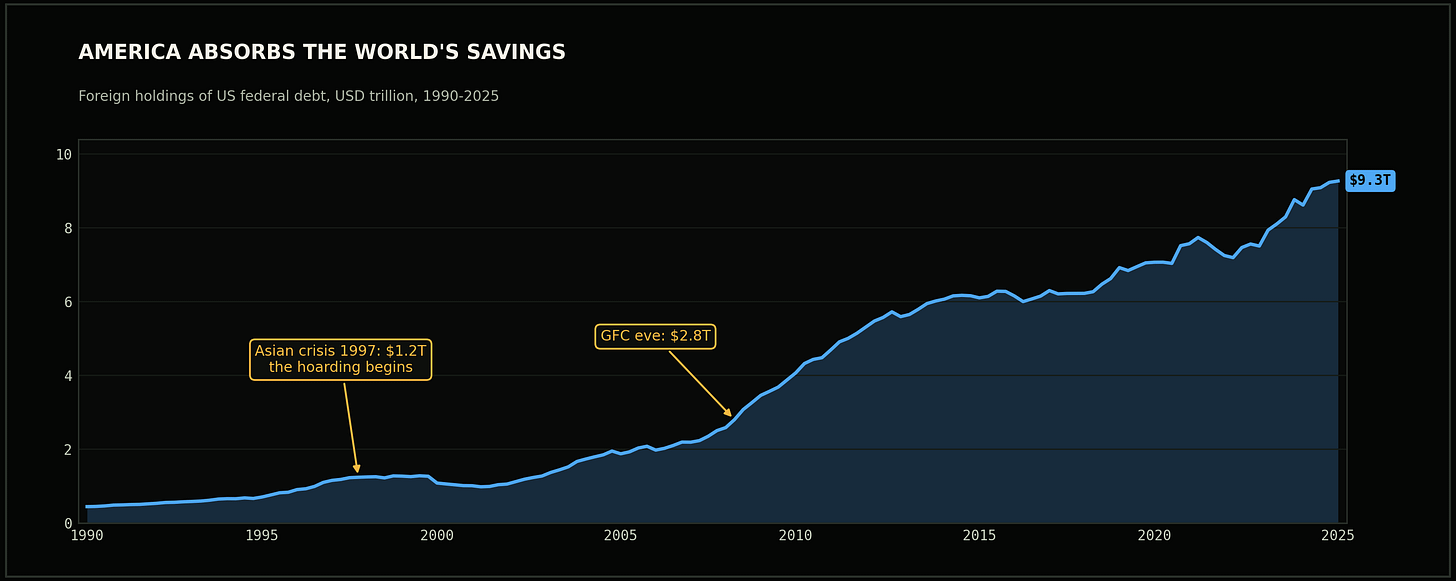
The U.S. purchases more goods from the world than it sells; it pays in dollars, which have to go somewhere. Since the dollar is the reserve currency, the U.S. has the only sufficiently deep and open financial market to absorb these volumes, pushing the world’s excess savings into U.S. assets, regardless of whether the U.S. needs that financing.
Now ask a harder question: if the U.S. is truly begging the world to finance its deficit, you would expect yields to rise and the dollar to fall. But just the opposite happened. Throughout the 2000s, the current account deficit widened while real long-term yields fell, and the dollar remained expensive, signaling that these were never profit-seeking investors making choices. They are policy flows, designed to be price-insensitive. The U.S. absorbing the world’s surplus is not because Americans chose to live beyond their means. The system is designed such that someone must absorb it, and the dollar makes the U.S. that entity. Look at what happened to foreign holdings of U.S. debt once this system was locked in.
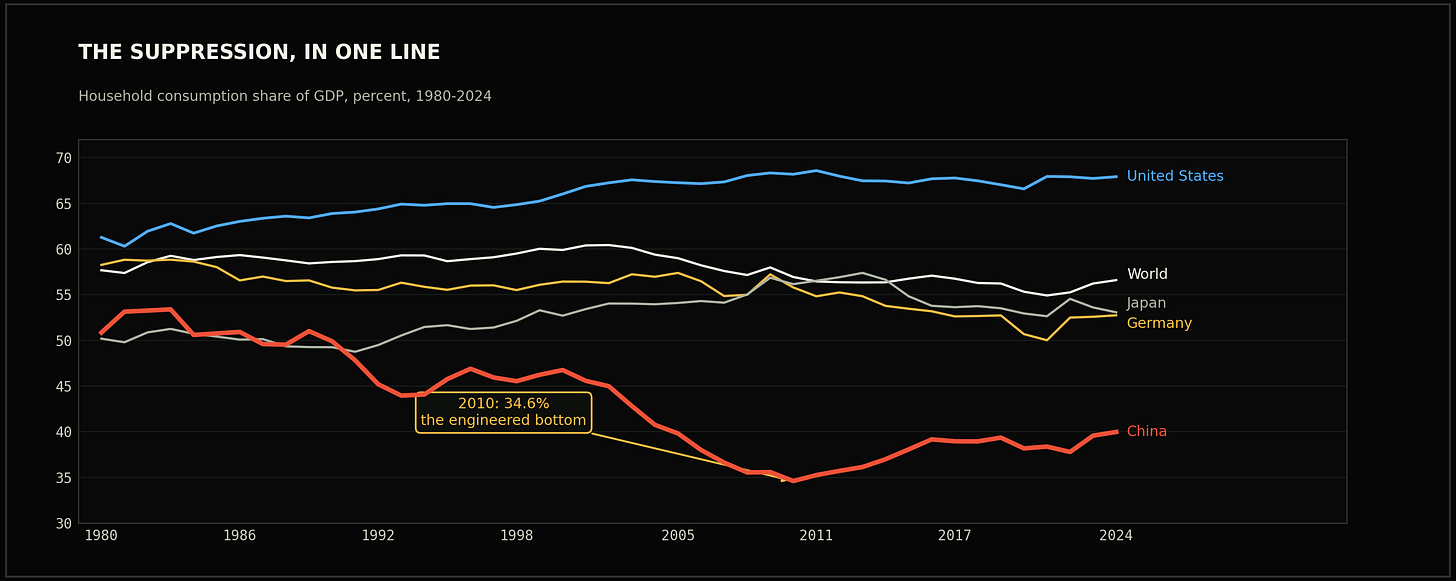
Why do surpluses exist in the first place? Because Chinese workers produce far more than they are allowed to consume. This is not a cultural preference for frugality; it is a result of Communist Party design. About 40% of the value created by Chinese workers is returned to them as income, whereas in most major economies, this figure is close to 70%. For over a decade, capped deposit rates have quietly transferred wealth equivalent to about 5% of GDP each year from household savers to state-affiliated borrowers. Migrant workers pay into benefits that they cannot claim in the cities where they actually work. And artificially suppressed currency is essentially a permanent transfer from every consuming household to every exporter. In total, Chinese household consumption remains below 40% of GDP, lower than any other major economy in the world. Income that never reaches households cannot be spent by households, so excess production must be sold to others. This constitutes the entire surplus. This has never been a conflict between American and Chinese households. It is a cross-border conflict initiated by the Communist Party, with Chinese households and American workers both being losers. You can see this suppression represented in the line below.
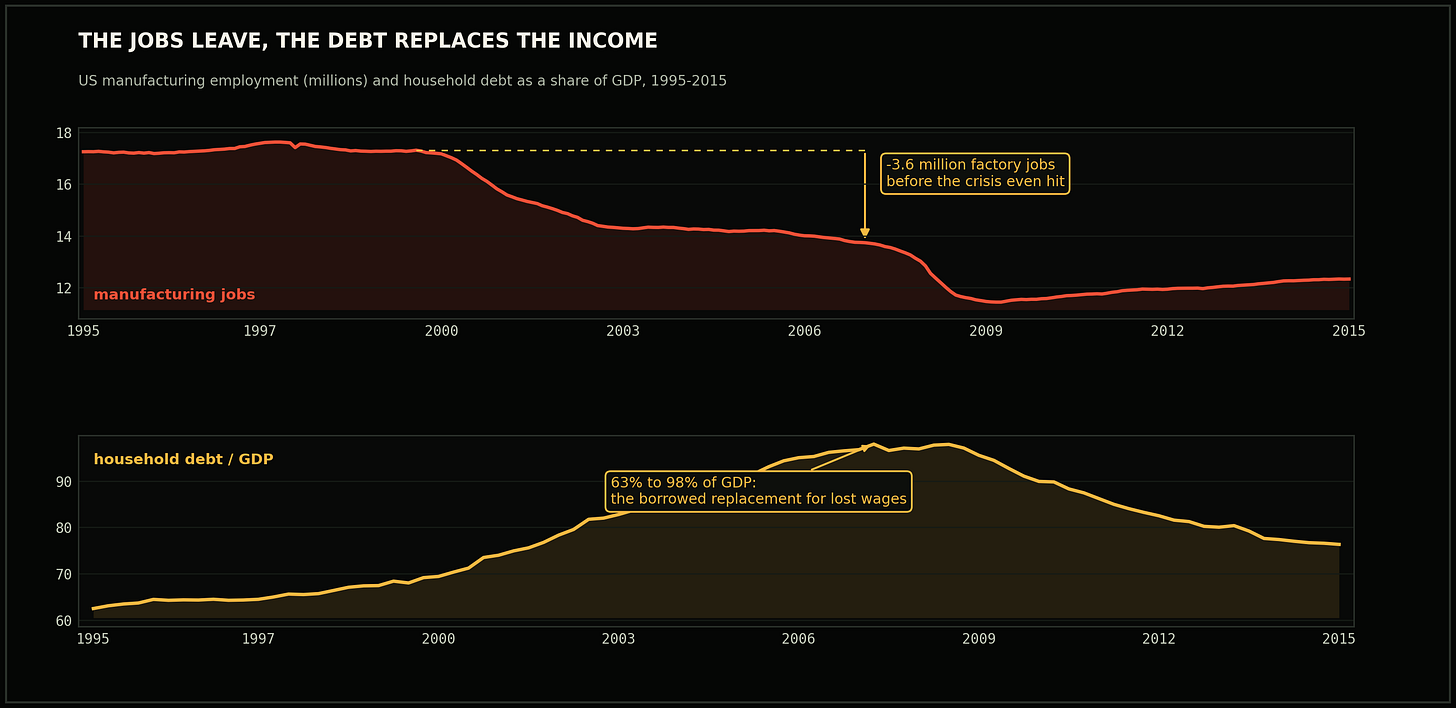
So, what happens when these export surpluses flow into the U.S. system? The forced inflow of funds does not build factories; it inflates the prices of existing assets. Between 1998 and 2008, foreign official entities purchased about $4 trillion of U.S. assets, nearly equal to the size of the entire U.S. current account deficit during that period. There were not enough government bonds to meet the demand, so Wall Street created the missing safe assets using subprime mortgages—the collapse of credit standards was the only way to mint enough securities, as households withdrew nearly $5 trillion from home equity to replace income that their jobs no longer provided. Jobs did indeed disappear: the same inflow kept the dollar expensive, and manufacturing output shrank, with over 80% of private sector unemployment in the early 2000s being in factory jobs. The unwanted inflow forced a country into some combination of rising debt and rising unemployment. Asset owners became wealthy as the inflow happened, while the working class absorbed the transfers; the bubbles and inequality that everyone screams about are not independent problems. They are emissions from that machine.
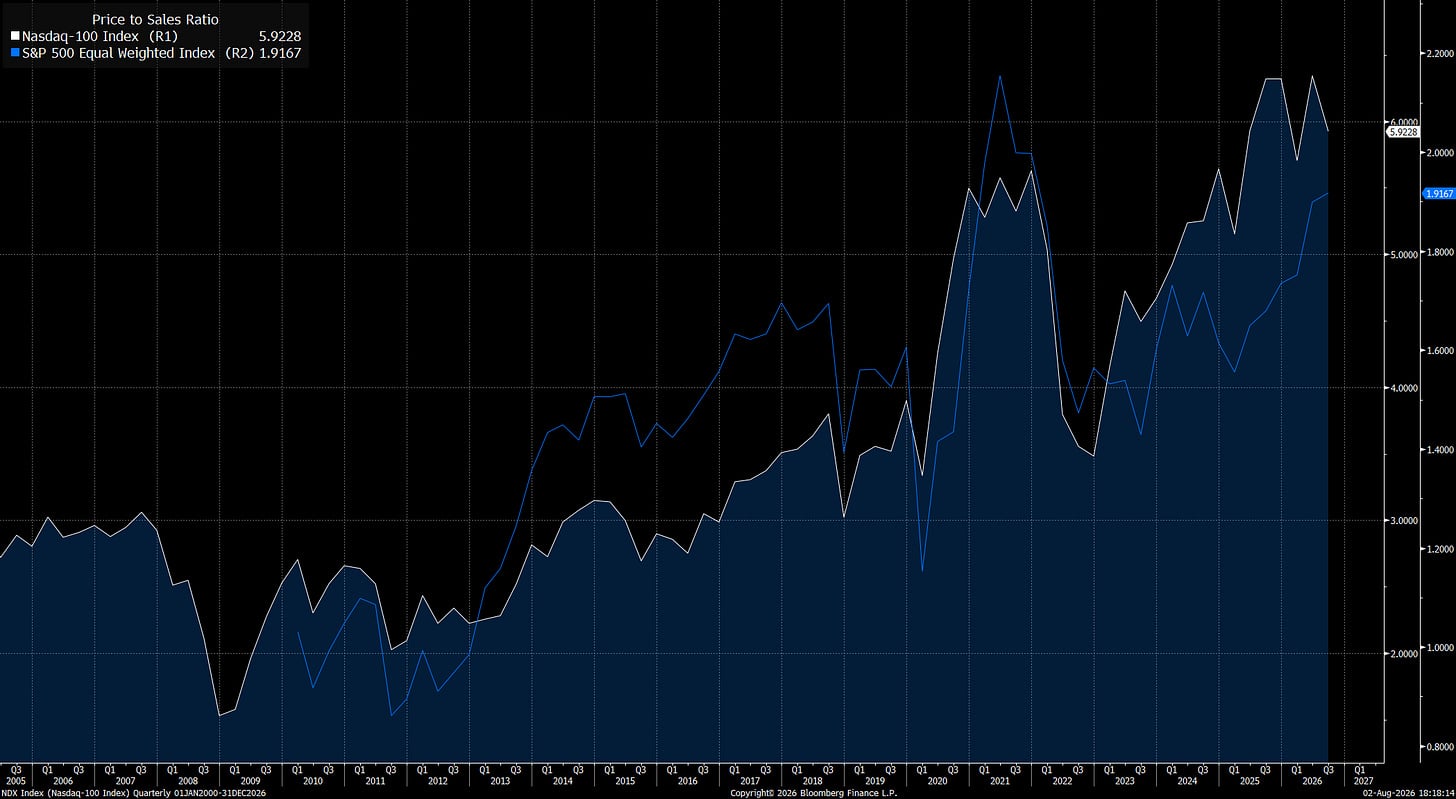
Step back and look at what everyone calls the most expensive stock market in history. Why have valuations for almost everything been inflated, and not just AI stocks? The standard answer is "mania," and the standard answer misses the mechanism. The excess savings flowing into this country must be absorbed by financial assets, while the asset pool is not growing as fast as the flows are. When trillions of price-insensitive dollars are forced into the same market year after year, the prices of everything that already exists are elevated relative to their cash flows; this is just another way of saying valuations are rising everywhere simultaneously. The core function of Wall Street in this system is to create purchasable things for this money, and 2008 already showed you what happens when it runs out of legitimate products. AI trading is built upon this machine; it does not create it. Valuations are not high because investors are losing their minds. They are high because the world's surplus has nowhere to go. (This is the mechanical function of flows.)
This is also where the government spending debate goes off track. Should you worry about the deficit?
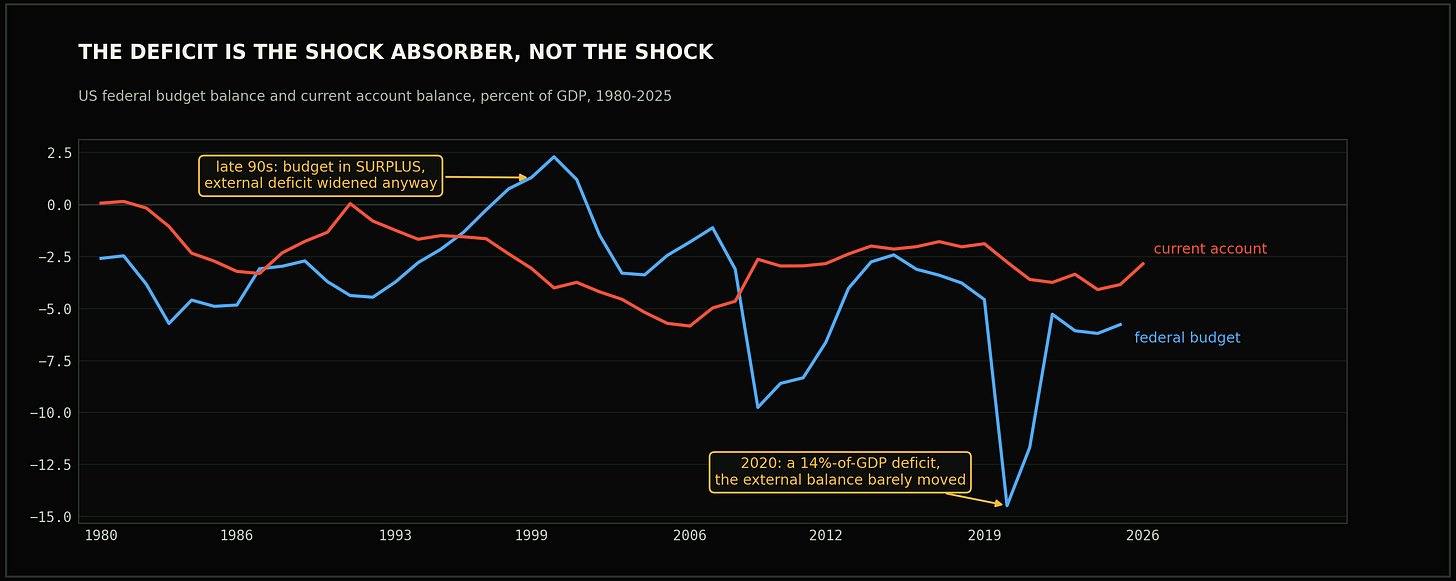
A better question is: why did the deficit reach this scale in the first place? The popular story is reckless spending in Washington, and everything else follows. Now look at the accounts. When vast amounts of foreign savings flood into this country, someone in the domestic economy must take on the corresponding deficit—either the private sector borrows, which is what households did before 2008, or the government borrows, which is what happened after. Every major fluctuation in fiscal balance over the past forty years has been matched by an inverse fluctuation in private borrowing, while the external deficit has continued regardless of who is in power or what they spend money on. External balance is set beyond our borders, and budget deficits are buffers, not shocks. Cutting spending without addressing flows does not correct imbalances; it merely hands the borrowing back to households or forces adjustments through unemployment. Government spending is a symptom with mechanical causes; the cause is the same machine.
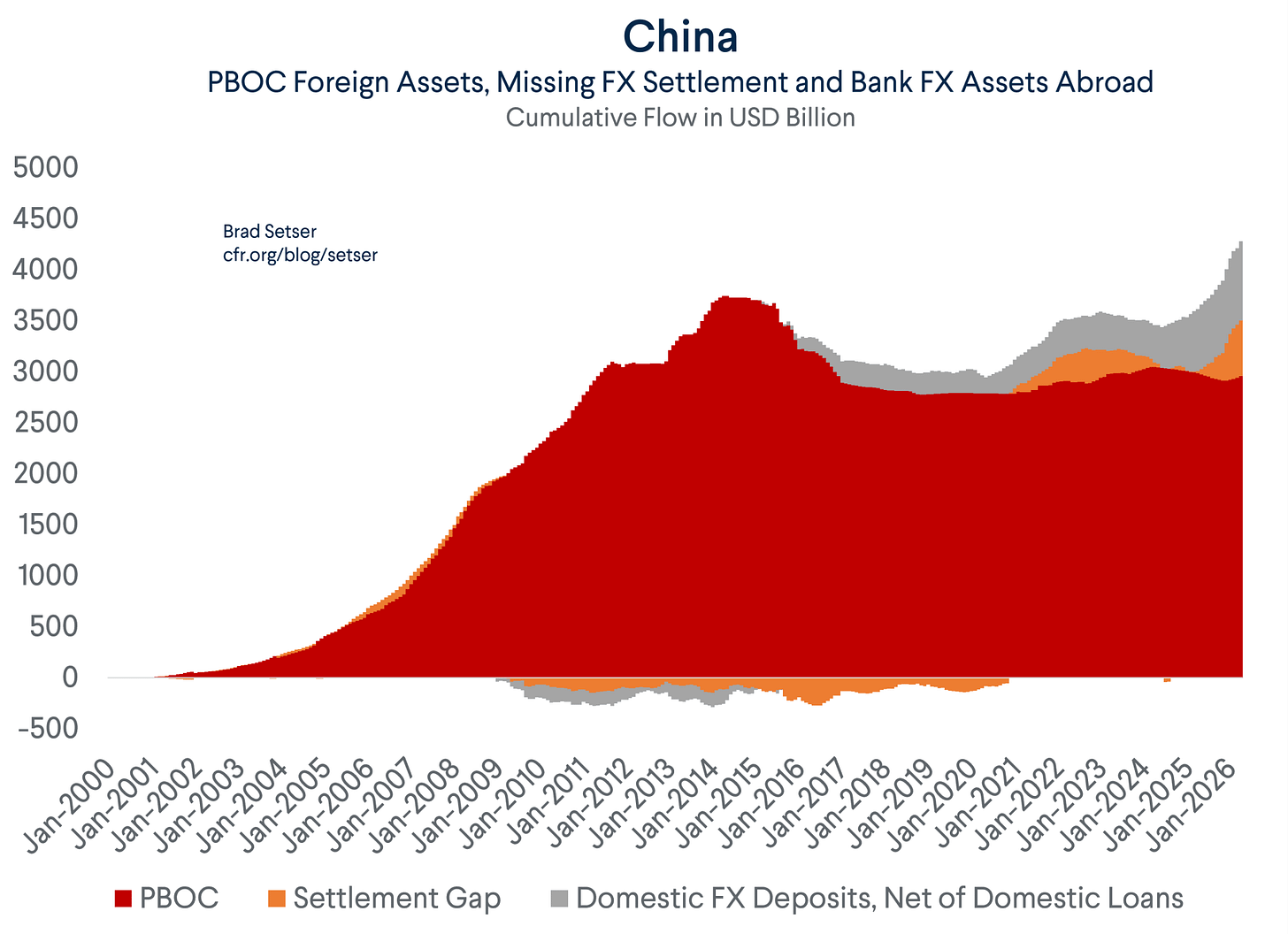
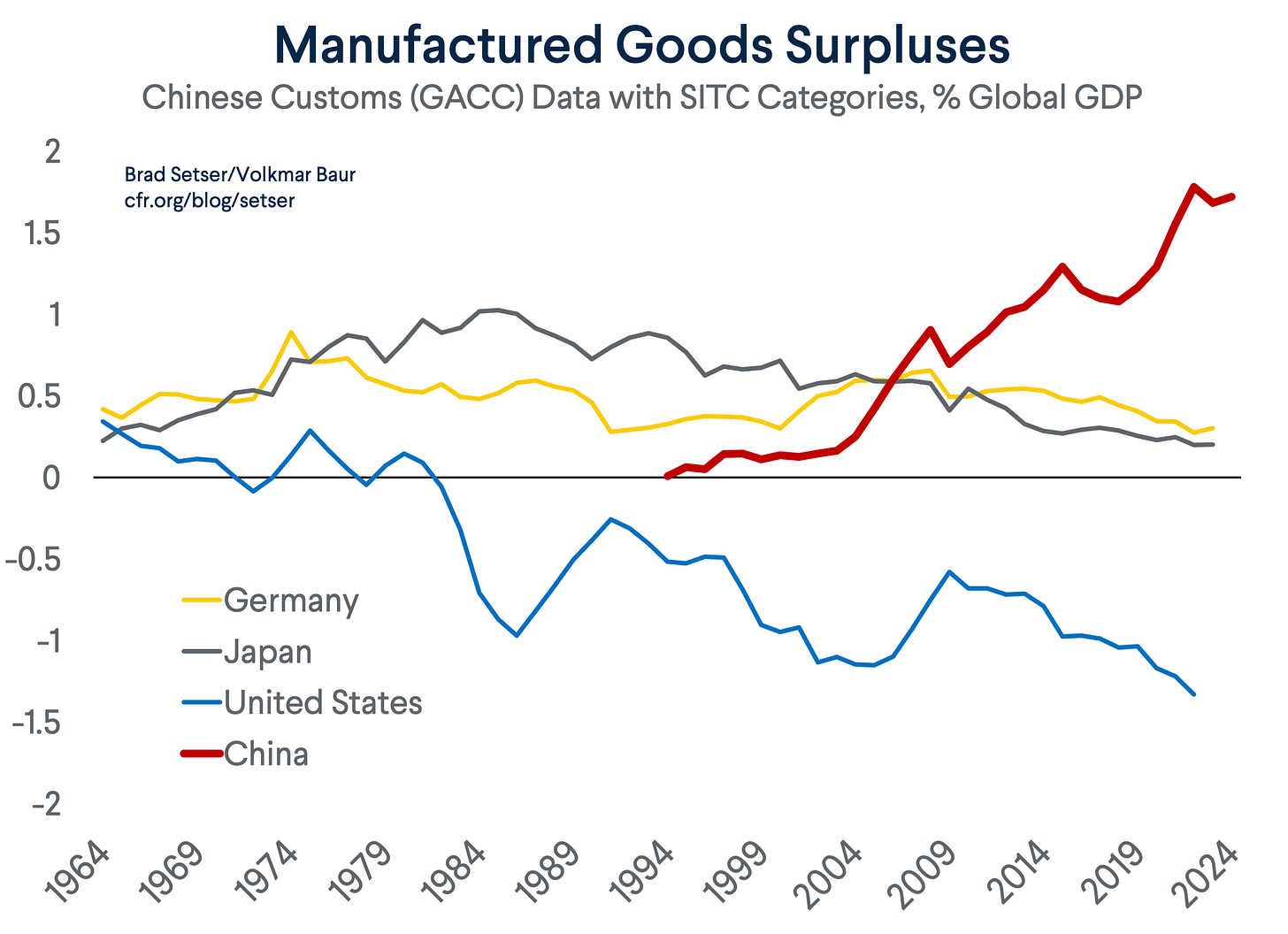
If this machine is so powerful, why did it disappear from the headlines after 2014? Because it grew quiet, not to disappear. For over a decade, China's official reserves have been flat, which is exactly what you should notice. Underneath, the surplus is the largest ever: the manufacturing surplus is about 2% of world GDP, larger than the combined peaks of Germany and Japan, recycled through state-owned banks that absorb about $700 billion in dollars annually, while official figures report nothing. The dollars never left the system; they moved from central bank balance sheets into channels that do not count as reserves. This is what non-kinetic warfare looks like: pricing power over goods you rely on, with choke points like rare earths capable of halting your automotive production without firing a shot, and a slow drain of purchasing power that never announces its actual existence. The fact that this attack is designed to be invisible, with almost no one talking about it, tells you how successful this design has been. The chart below measures that kind of silence.
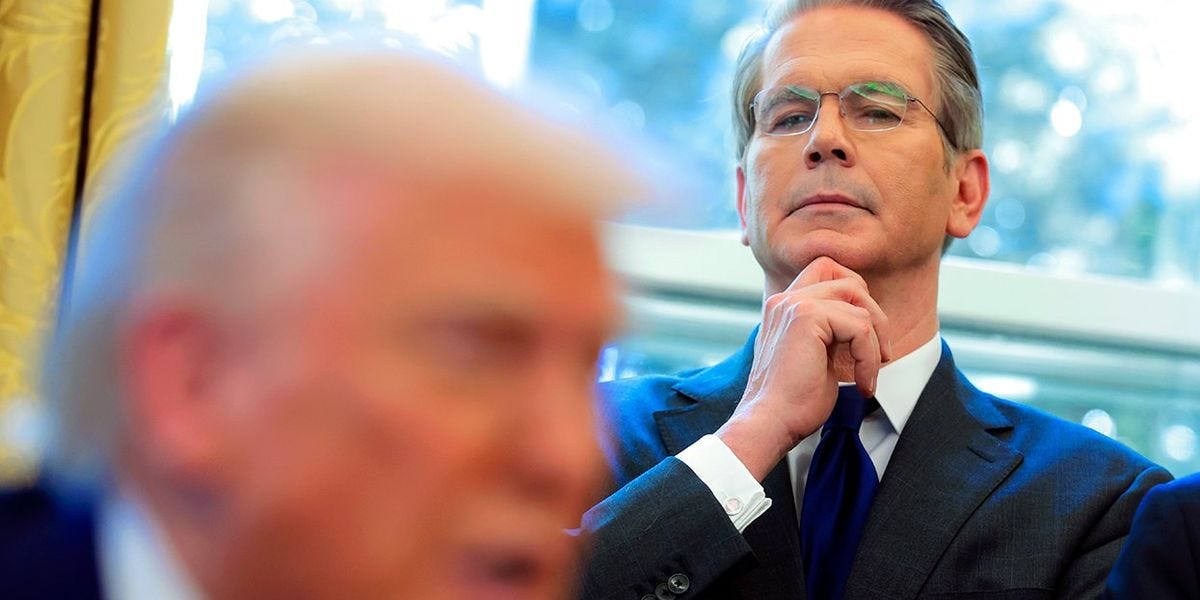
Now pull back to Warsh and Bessent. Once you see this machine clearly, these appointments were never personnel decisions but strategic placements by Trump. You don’t just place two capital flow experts trained by Druckenmiller into the Fed and the Treasury to merely manage interest rates and debt issuance. You place them because counterattacks must proceed through the same channel as the attack: capital flows themselves.
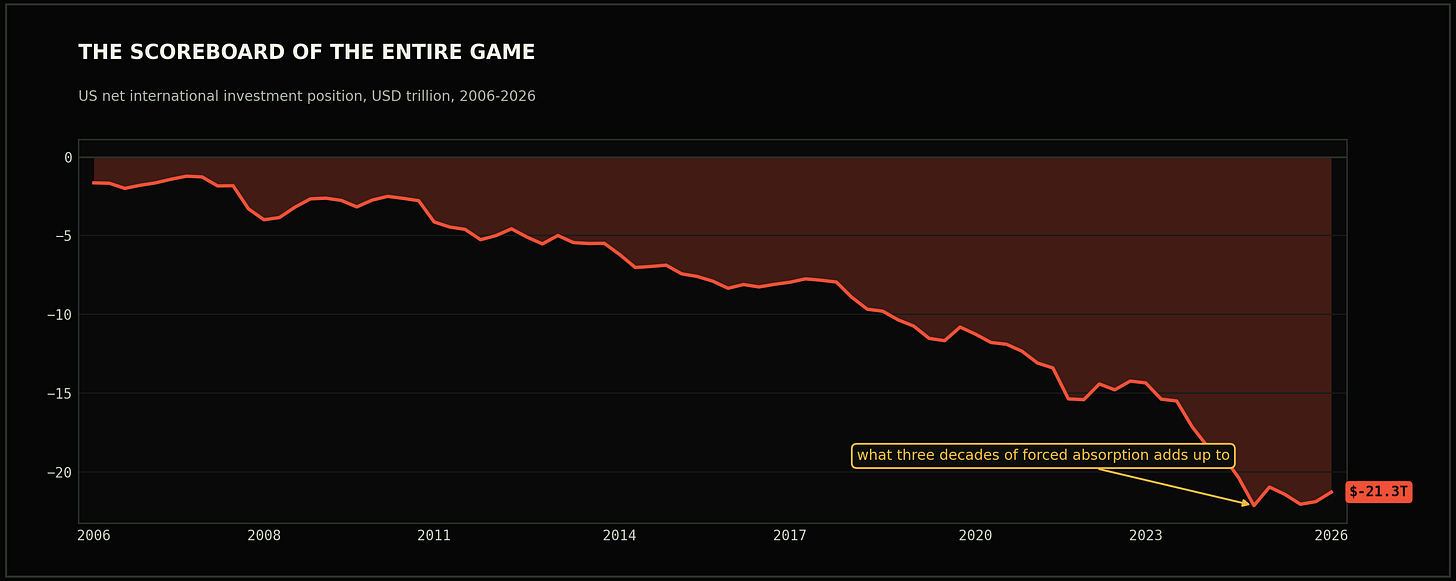
The dollar’s role as the reserve currency cannot be surrendered—surrendering it is tantamount to ceding the system to adversaries, so the real operation is converting burdens into weapons. Allow global capital to continue flowing into U.S. assets, but direct it from financing consumption debt to productive capacities: AI infrastructure, defense, and frontier labs. This is why the VC circle, frontier labs, and the two strongest financial institutions globally are all moving in the same direction simultaneously. Capital flows are the war itself, and this is the first time U.S. policymakers have truly understood this. The entire game has a core scoreboard, which is the chart below.
This is likely why Marc Andreessen was appointed by Kevin Warsh to the new Fed AI working group. They have aligned Alex Karp and Palantir with this strategy, and now they are aligning capital from private markets. The key is that Warsh and Bessent need to coordinate every element of technological development and capital flows to collectively combat China's economic and financial attacks.
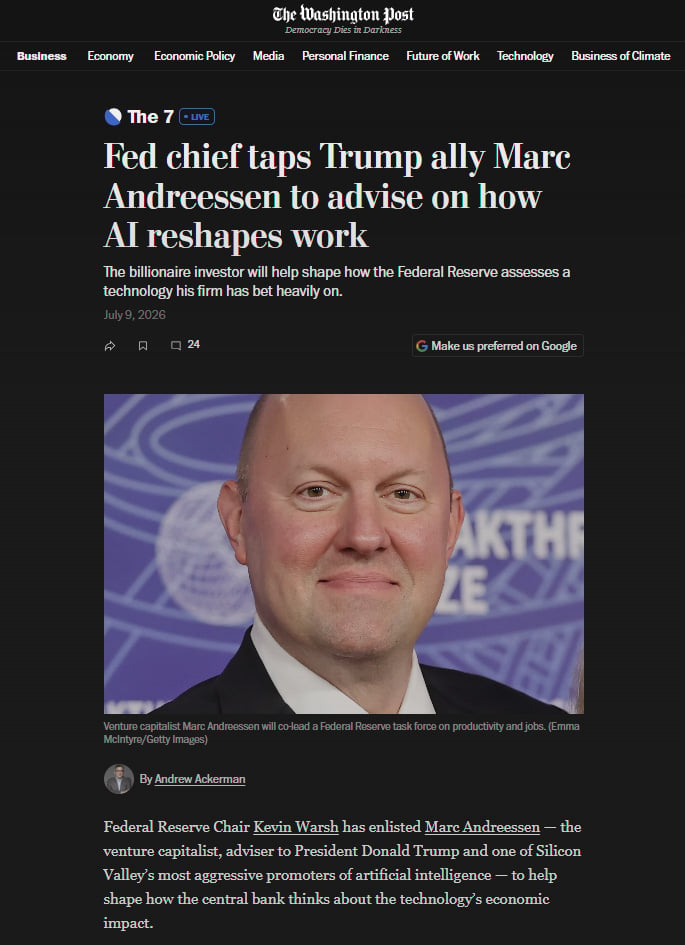
This is also why, after understanding the context correctly, Anthropic's actions become crucial. Trump uses grand rhetoric, and Dario frames the context as "defending the freedom of the American people," but understanding the actual structural dynamics reveals that if the U.S. drops the ball in the AI arms race, the eventual outsourcing could extend far beyond manufacturing jobs. If China wins the AI race, America's economic and social problems will amplify tenfold!
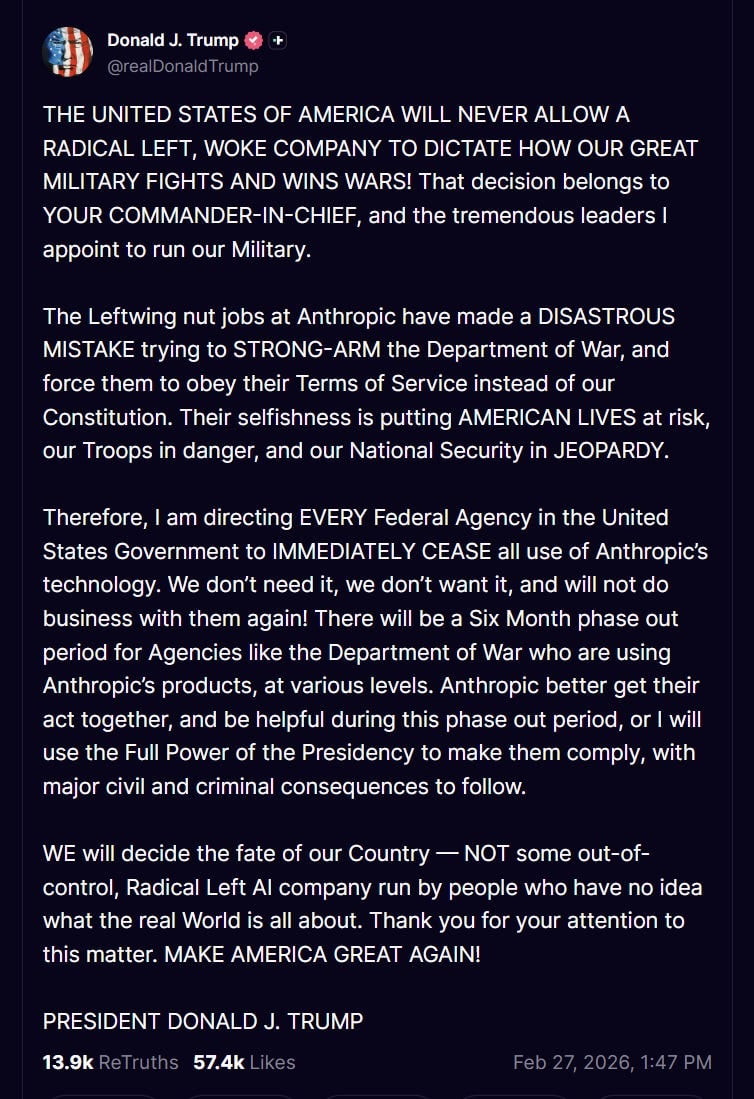
This is the monetary order, this is the macro conclusion: every player is positioned around the same core mechanism—international capital flows between the U.S. and China. Once you see the mechanism itself clearly, the actions of venture capital, defense spending, and AI frontier labs will no longer seem like isolated headlines, but rather like moves on the same chessboard.
So how do you observe this coordination in real-time? Starting with Warsh's FOMC meeting last week. The Federal Reserve kept rates steady, three members voted for a rate hike, and Warsh spent significant time in the press conference discussing capital expenditures:
"The most notable feature of the economy is the strong growth in business investment. The surge in high-tech capital expenditures is very significant."
——Kevin Warsh, July FOMC
He provided specific numbers:
"In the AI-related category of high-tech equipment and software, the latest data show an annual growth rate approaching 20% in the fourth quarter."
——Kevin Warsh, July FOMC
He precisely told you how he views this round of infrastructure in relation to the path of interest rates:
"It’s a race between supply and demand. The surge in corporate capital expenditures surrounding AI has made this judgment harder."
——Kevin Warsh, July FOMC
Two weeks ago, he stated more bluntly in Congress:
"What is now termed AI investment will soon just be called investment."
——Kevin Warsh, July FOMC
A Federal Reserve chair thinking in terms of capital flows tells you that the AI capital expenditure cycle is now the economy itself, with him stabilizing the policy rate below to let the market adjust itself. His own words: "We've done nothing for 42 days, and the market has done a lot." Look at what the market did to the path of interest rates after he spoke.
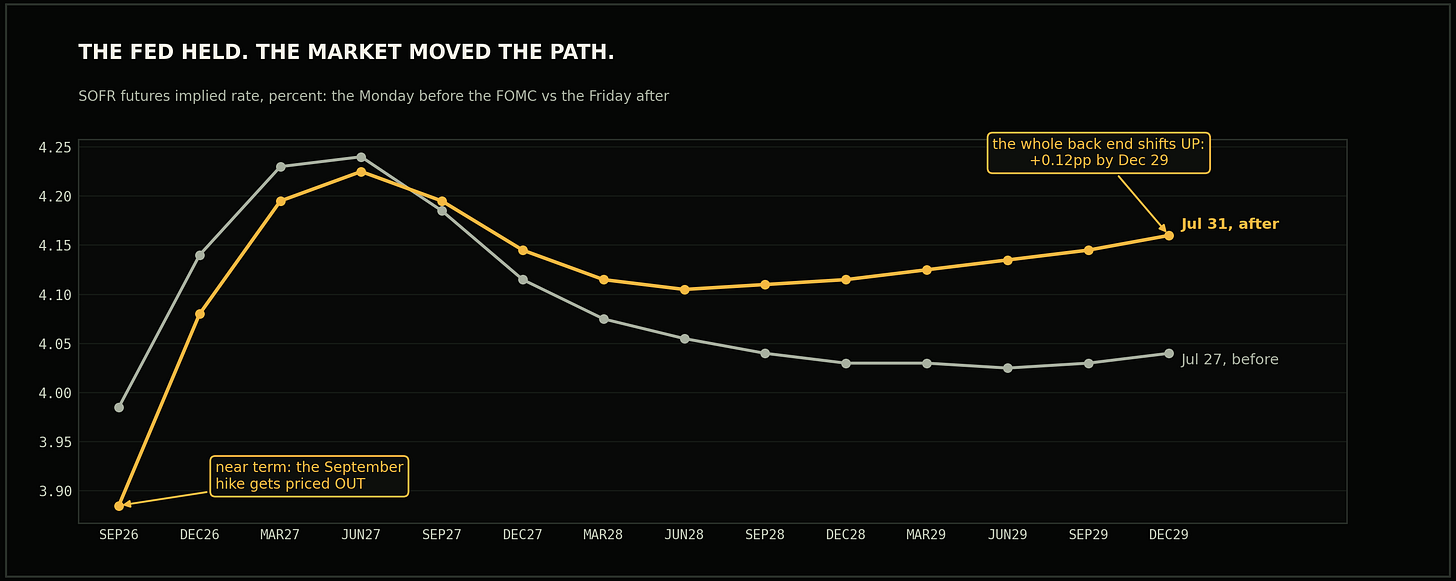
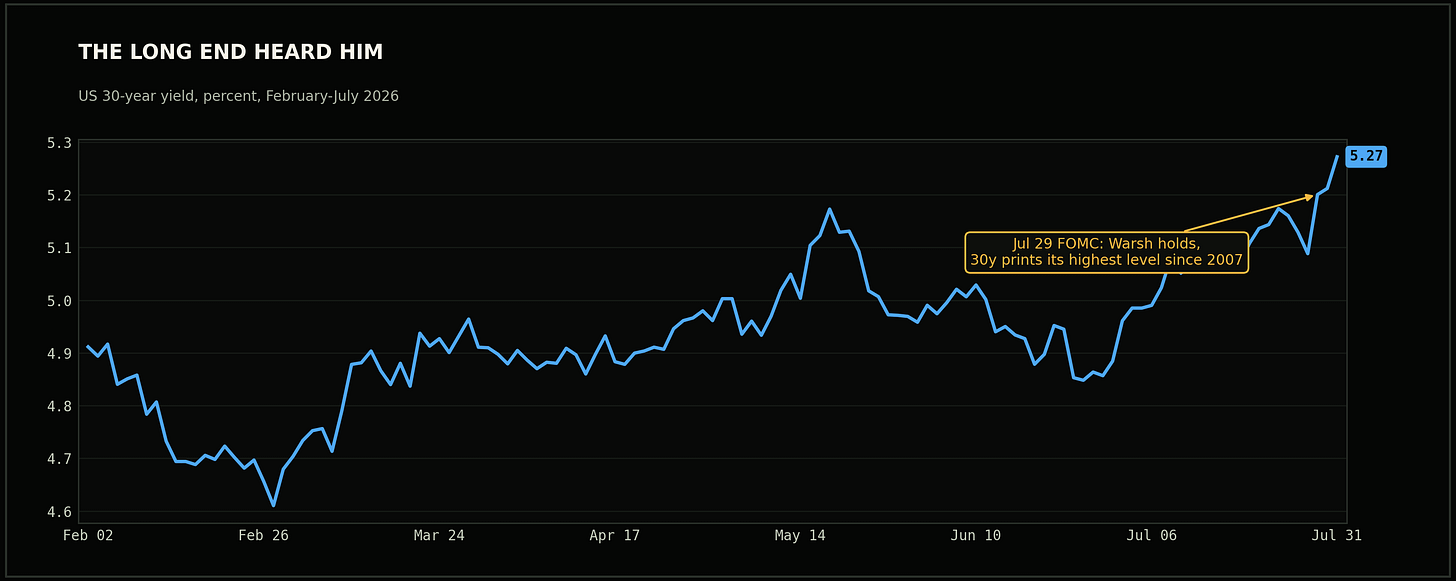
Refer to my report on rates after the FOMC:
Will Warsh Cause a Market Crash? Misleading in the Market
So what role does Bessent play in all of this?
Where does the marginal liquidity for this entire trade come from? Japan. The Bank of Japan still maintains the cheapest financing rates in the developed world, borrowing cheap yen to buy dollar assets, which is the oldest liquidity pipeline in modern markets: direct cross-border yen lending is about $250 billion, and if you count derivatives, it is estimated to be close to $1 trillion. This money does not sit idle; it flows into the deepest and fastest markets on the planet, which today means U.S. assets and their core AI sector.
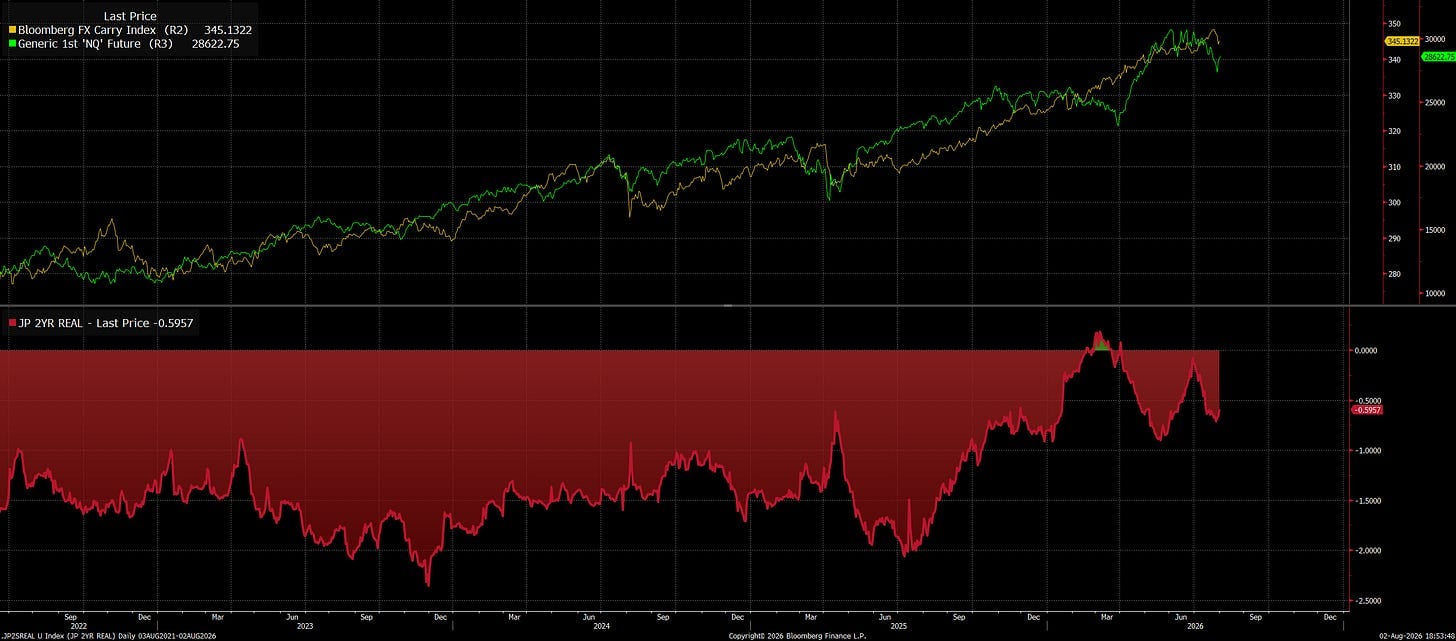
Now look at last week's time series. The yen plummeted to its weakest level since 1986. Reports indicate Japan spent over $50 billion in a single day to defend the currency—possibly the largest intervention on record.

The next day, the U.S. Treasury intervened in concert with Tokyo, with the New York Fed buying yen.
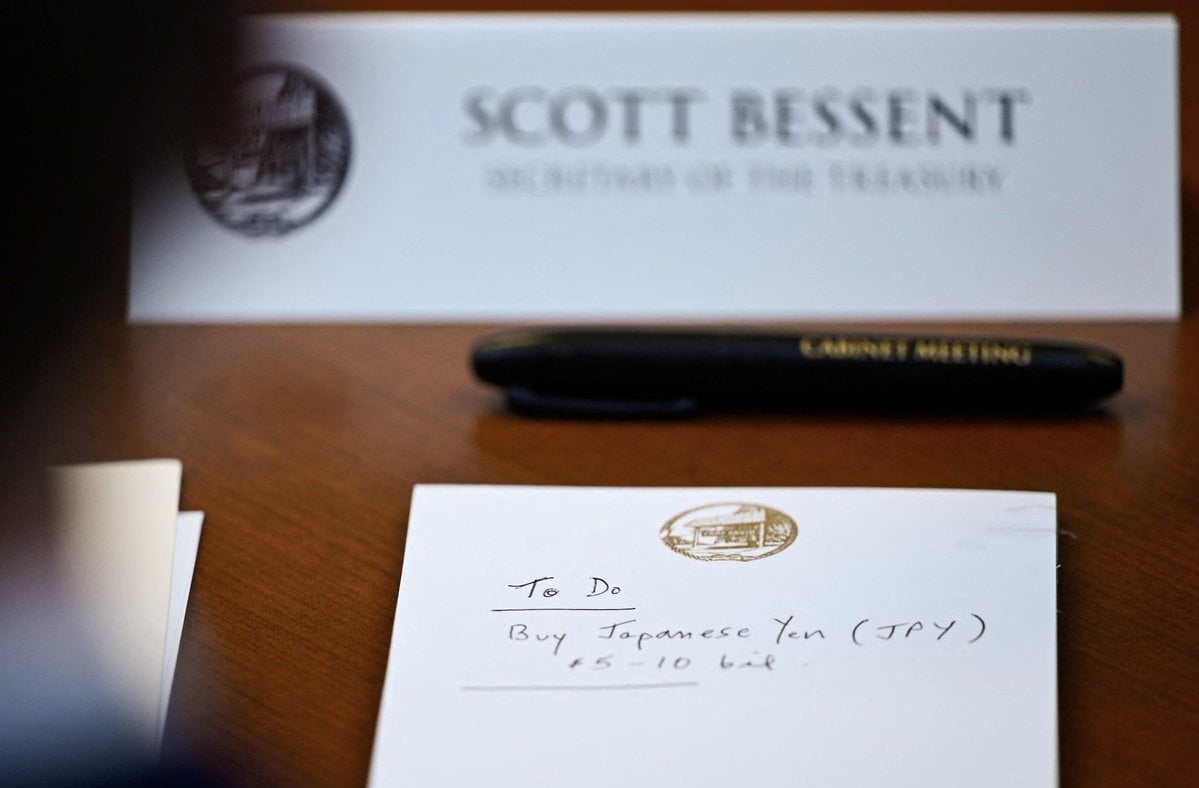
Then Bessent appeared on television, calmly stating, "The yen is severely undervalued in my view," and that "the excessive volatility in the yen is unhealthy." What the Treasury can least afford is for the market to link the financing currency with AI trading, while still needing liquidity for infrastructure, thus beginning to dismantle that pipeline.
Bessent deliberately allows everyone to see his notes on the yen, a trick he has previously employed. Bessent knows precisely what he is doing—trying to actively reshape market expectations (essentially providing forward guidance for the forex market). Japan's economy is beginning to face the negative impacts of high oil prices and a weak currency. Bessent knows that arbitrage trades must remain intact for liquidity to continue flowing to AI infrastructure, but he also needs to balance helping Japan without allowing the new prime minister to lose public support due to rising inflation. Bessent prefers to intervene proactively to maintain capital flowing into AI trading rather than let the entire situation truly explode, causing volatility detrimental to both countries.
Why are these liquidity flows so important right now? Because frontier labs are approaching a moment where private funding runs short. Anthropic's revenue run rate has surged from about $9 billion to nearly $50 billion in just five months, and it has secretly submitted for an IPO. OpenAI is close to $25 billion but is still losing more than $1 for every $1 it makes, as the compounding speed of computational bills outpaces income.
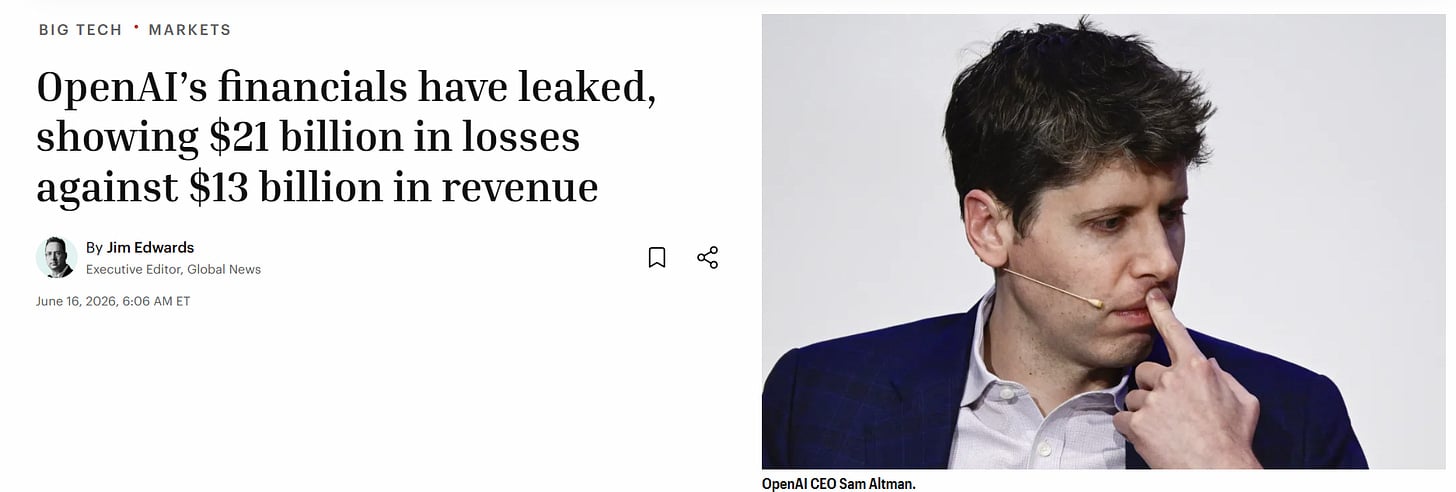
These scale-burning companies ultimately need public markets, and their window coincides with the moment that window could suddenly close: SpaceX, the largest IPO in history, went public seven weeks ago and is now trading 20% below its issue price, having been cut in half from its peak, and the semiconductor sector just experienced its worst month since the financial crisis.
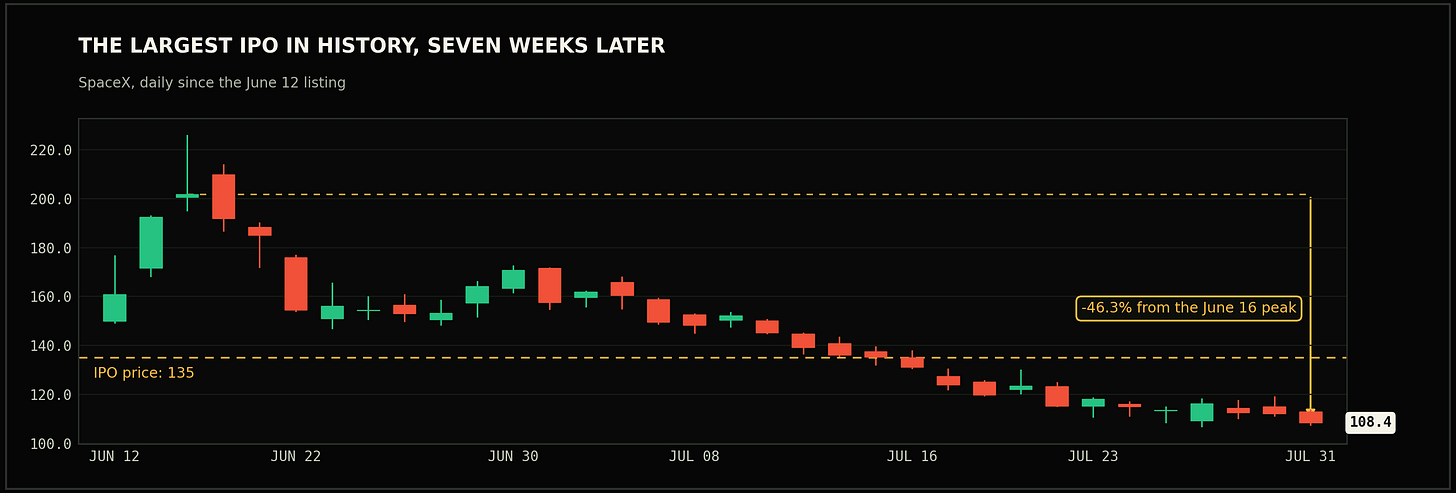
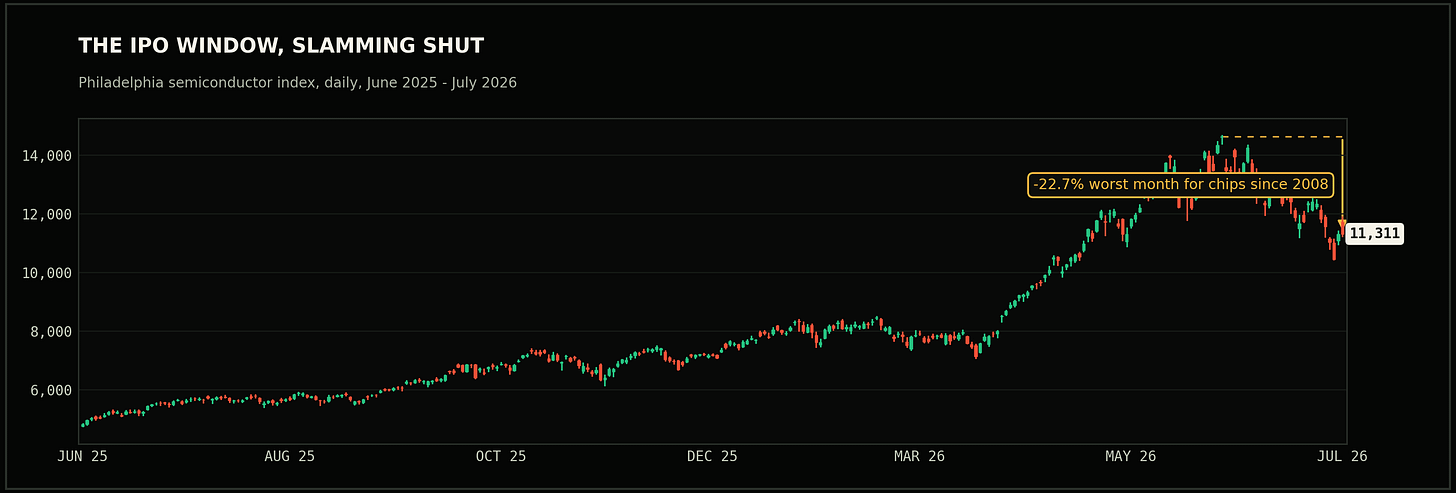
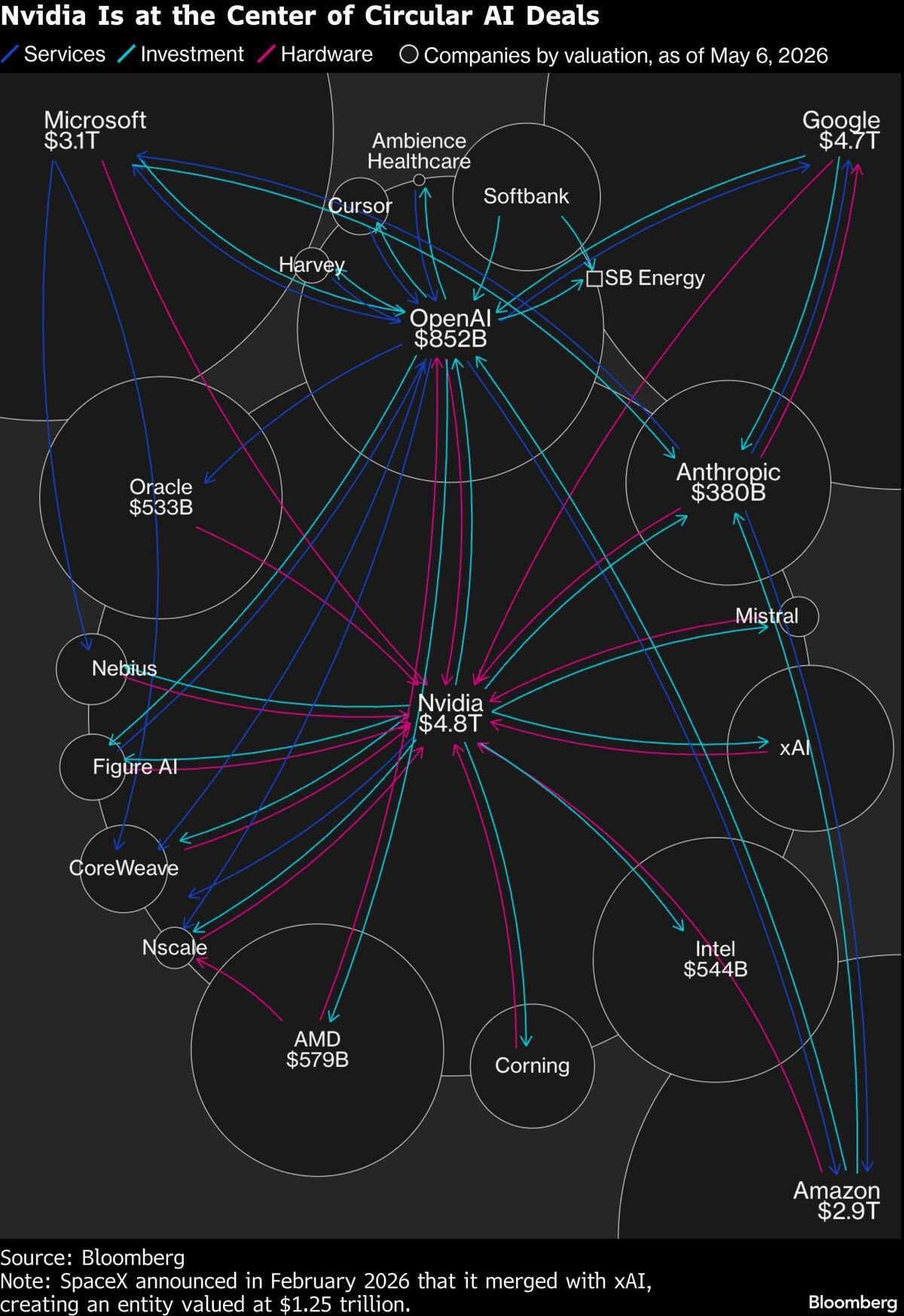
So let's ask the question Warsh and Bessent must face: what happens if companies carrying the AI arms race cannot access public capital? These are not ordinary companies. They are operating as national security assets, with Pentagon contracts and export controls treating their frontier models as strategic capabilities. The funding for the entire infrastructure—labs, chips, data centers, power—is cross-collateralized, and any leg that collapses will pull down all the other parts. A Federal Reserve chair backing a capital expenditure cycle, a Treasury Secretary defending a financing currency in the same week—this is no coincidence. It reflects the larger mechanism of the global monetary order.
Summary
If you pull everything together, you can see why the misleading is so effective. The core forces at play—real purchasing power changes and international capital flows—are extremely difficult to comprehend, yet you can feel their pressure on the financial layer of society. This is why most people ultimately build the entire narrative around the symptoms of core issues, while people like Bessent, Warsh, Druckenmiller, Karp, and Andreessen build everything around the actual mechanisms.
This is also the background for why financial markets are at historical valuations, with correlations nearly perfectly aligned. Stocks and interest rates move in sync because every capital flow exists around core mechanisms—the closed capital accounts of China, the dollar’s status as reserve currency, and the economic and financial attacks triggered globally by the Communist Party.
Maintaining neutrality and inaction in this world is as dangerous as making wrong decisions based on systemic symptoms. This is why Bessent and Warsh actively act on rates, currency, and fiscal sides while clearly aligning with Alex Karp and Marc Andreessen on the AI arms race and private capital markets. They are aligning both the public and private sectors in the same direction, actively countering all attacks from the Communist Party, especially in the AI arms race. Without understanding the backdrop of international monetary flows, all their actions might seem arbitrary.
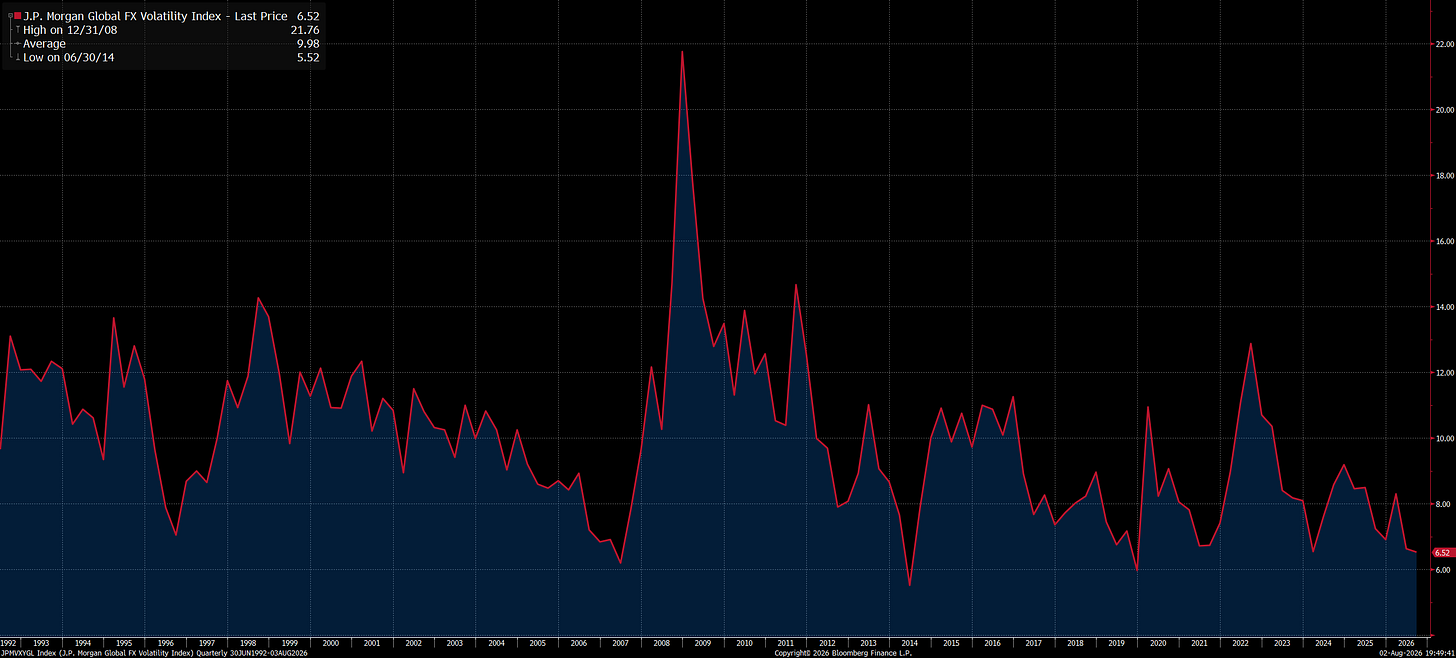
The most important factor to understand in this context is that policy decisions will be built around core issues rather than symptoms. This is why many policy decisions to date seem senseless to people. The tariffs implemented in 2025 that led to a market crash make no sense to many because Trump implemented them at the expense of the stock market. Whether triggering a rise or crash in financial assets, priorities adjust around core mechanism issues—what is the biggest factor in the international monetary system and macro conclusion. All this is happening while the volatility of interest rates and forex is abnormally low and complacent relative to the accumulated risk below the surface, and historical peak stock valuations will further compress tail risks.
Now, we are in the macro conclusion that will be recorded in history. For proactive traders who understand these mechanisms, this will be one of the best opportunities in history. That is why I am here. I believe the U.S. must win this battle with China, and I fully support the ongoing strategic coordination to improve the lives of ordinary Americans. However, we know this will not be smooth sailing. The existence of volatility is there to transfer money from the weak to the strong.
Expect volatility. That is why trading and investing exist.
免责声明:本文章仅代表作者个人观点,不代表本平台的立场和观点。本文章仅供信息分享,不构成对任何人的任何投资建议。用户与作者之间的任何争议,与本平台无关。如网页中刊载的文章或图片涉及侵权,请提供相关的权利证明和身份证明发送邮件到support@aicoin.com,本平台相关工作人员将会进行核查。


