Written by: Rita
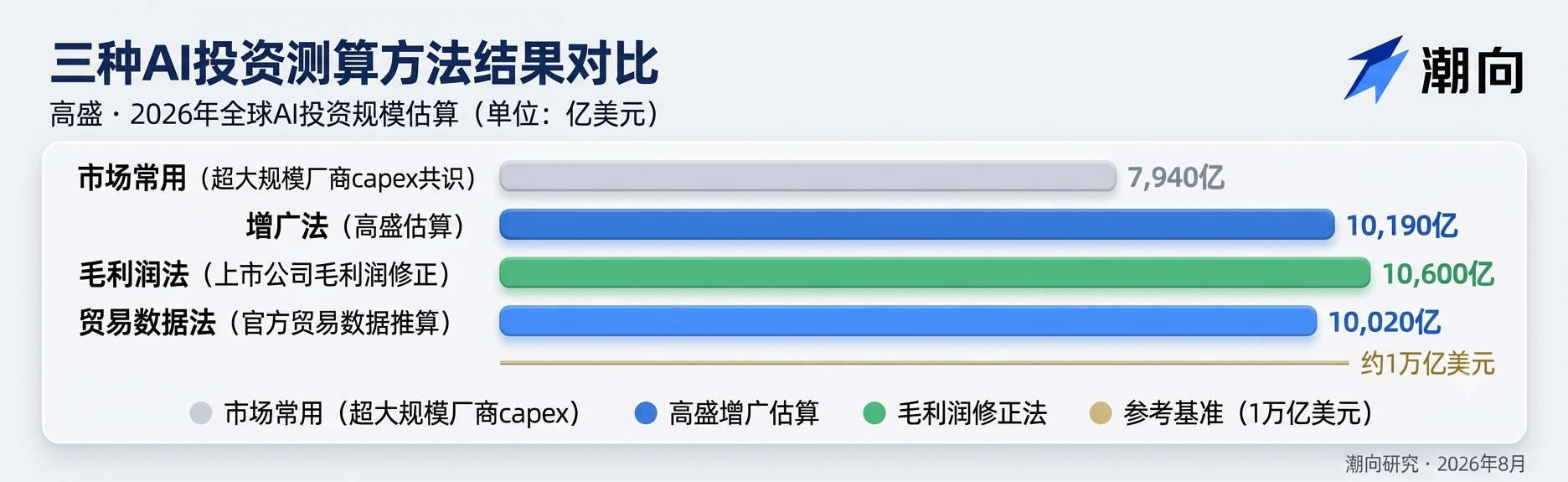
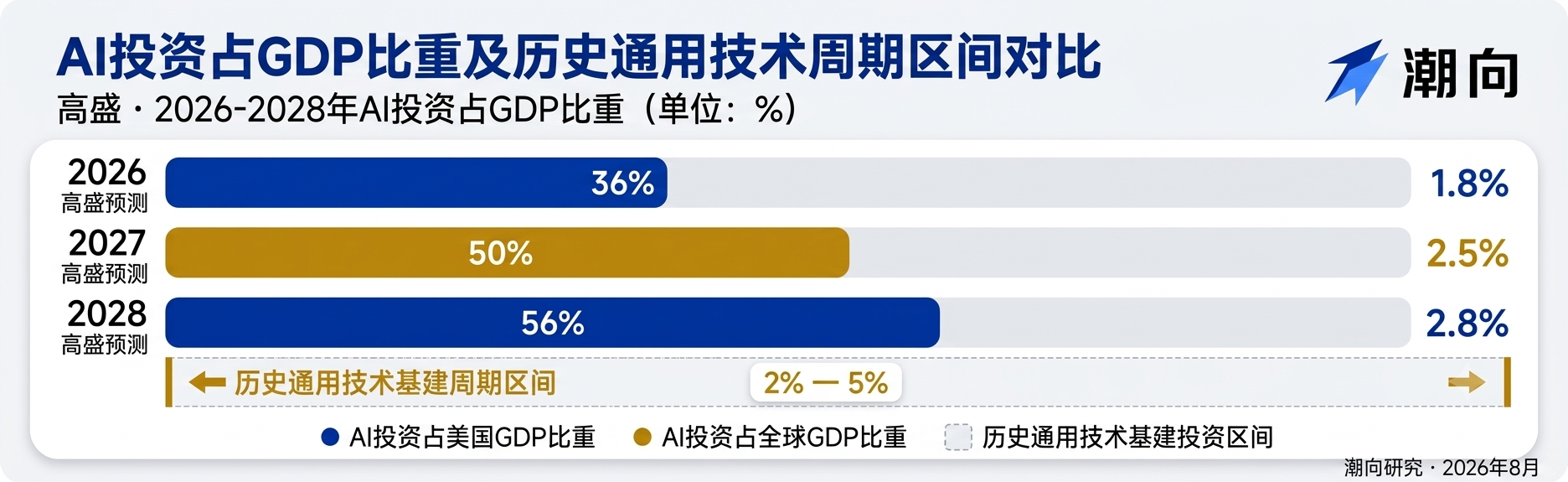
The most commonly cited figure for AI investment in the market is approximately $800 billion in capital expenditure from hyperscale companies in 2026. Goldman Sachs noted in its global economic analysis report released on August 2 that this figure underestimates the global scale of AI investment by about $200 billion, while overestimating domestic investment in the US by about $200 billion. After adjustments are made for private companies, non-US enterprises, and non-AI expenditures, Goldman Sachs estimates that the total global AI investment in 2026 will be approximately $1,019 billion, with the US accounting for about $581 billion. The conclusions drawn from three independent calculation methods are highly consistent, indicating that global AI investment is approaching $1 trillion. AI investment's share of US GDP will increase from 1.8% in 2026 to 2.5% in 2027, further rising to 2.8% in 2028.
The commonly used $800 billion underestimates global $200 billion and overestimates US $200 billion
Goldman Sachs pointed out that the commonly used hyperscale company capex figure (about $800 billion) has four issues. First, it ignores the significant AI investment made by private companies in the US, which play an important role in the AI ecosystem. Second, it overlooks investments from non-US companies, particularly AI investments from China and the broader Asian region. Third, investments made by hyperscale companies before the AI boom have exceeded $150 billion, with some current capex unrelated to AI. Fourth, the operations of US hyperscale companies are global, and some investments occur outside the US.
Goldman Sachs has addressed these issues one by one. In addition to considering hyperscale companies, it included AI capex from other US publicly listed companies and private firms, as well as expenditures from non-US AI-related companies. Investments made in 2022 were excluded, retaining only the incremental portions. Simultaneously, based on the data regarding the locations of investments already disclosed by hyperscale companies, the global total was allocated to various countries and regions.
The adjusted result is that the total global AI investment is approximately $1,019 billion, with the US accounting for about $581 billion. The commonly used $800 billion figure underestimates global AI investment by about $200 billion and overestimates domestic AI investment in the US by about $200 billion. Goldman Sachs estimates that about 70% of US hyperscale companies' capex is directed toward domestic projects, 15% toward Asia, and 9% toward Europe.
Corporate profit adjustments and official trade data validate the $1 trillion assessment
Goldman Sachs used two additional methods to cross-verify the aforementioned results. The first method is based on adjusted forecasts of gross profits from AI-related publicly listed companies. AI investment ultimately materializes as revenue and profit growth for upstream suppliers, and by tracking the incremental gross profits related to AI companies relative to 2022 levels, the scale of AI investment can be back-calculated. This method estimates global AI investment in 2026 to be about $1,060 billion.
The second method is based on official national account and trade data. In the US, Goldman Sachs applied the commodity flow method, summing domestic production, net imports, and inventory changes, arriving at an annualized AI hardware investment of about $500 billion as of May 2026, plus about $100 billion in AI-related R&D and intellectual property investments, totaling about $600 billion. At the global level, Goldman Sachs used net import data related to AI from various countries and the correlations with known countries (such as the US) to estimate global AI investment at about $1,020 billion.
The numbers derived from the three methods are highly consistent: approximately $1 trillion globally and nearly $600 billion in the US. Goldman Sachs believes this set of data provides a reliable benchmark for the scale of AI investment. Since 2022, cumulative global AI investment is expected to reach approximately $1.8 trillion by the end of 2026.
AI investment's share of GDP will rise to 2.8%, with short-term resilience
Goldman Sachs extrapolated AI investment paths for 2027 and 2028 using projections from publicly listed company capex consensus. AI investment's share of US GDP will increase from 1.8% in 2026 to 2.5% in 2027, further rising to 2.8% in 2028. Global AI investment's share of global GDP will increase from 0.9% in 2026 to 1.3% in 2027, and rise to 1.4% in 2028. These levels are consistent with the investment share during historical peaks of general technology infrastructure (2% to 5%).
When the growth rate of AI investment will slow down is currently a core uncertainty in the macro market. Goldman Sachs has compiled a set of leading indicators, including imports of semiconductor manufacturing equipment, relevant PMI subcomponents, import prices, memory procurement, and GPU rental prices. All leading indicators are currently at the upper end of the range since 2022, indicating that short-term growth remains strong.
However, based on economies like Taiwan and South Korea, which have released trade data early, Goldman Sachs' immediate forecasts show that AI-related investments slowed down in June and July (moderately retreating from extremely high levels). Official US data indicates that AI investment is increasingly driven by cost inflation, rather than actual growth in investment volumes. In the first half of 2026, about 8% of nominal AI investment growth came from price factors rather than actual investment volume growth. If this trend continues, the boost of AI investment to actual GDP in 2026 may be smaller than in 2025. Since semiconductor procurement is not counted as investment goods in US national accounts and AI hardware import content is highly excluded in GDP accounting, Goldman Sachs believes the impact of AI investment on overall US GDP levels remains limited.
AI investment is approaching $1 trillion. The market has constantly discussed AI investment using the figure of $800 billion, but Goldman Sachs has revised this figure. Global AI investment is larger than the market thinks, and domestic US AI investment is smaller than the market assumes. The share of AI investment in GDP is entering the range of historical general technology infrastructure cycles. The market's cognitive framework around AI investment itself needs to be recalibrated.
The information in this article is a summary and interpretation by Trend Research of third-party brokerage research reports (Goldman Sachs, August 2, 2026), combined with publicly available market information. The ratings, target prices, profit forecasts, and related judgments quoted in this article are the views of the brokerage analysts and only represent the position of their respective institutions, not the views of Trend Research, and do not constitute any investment advice. The market carries risks, and decisions need to be made independently. This article should not be used as a basis for buying or selling any securities.
免责声明:本文章仅代表作者个人观点,不代表本平台的立场和观点。本文章仅供信息分享,不构成对任何人的任何投资建议。用户与作者之间的任何争议,与本平台无关。如网页中刊载的文章或图片涉及侵权,请提供相关的权利证明和身份证明发送邮件到support@aicoin.com,本平台相关工作人员将会进行核查。


