Written by: Long Yue, Wall Street Insight
As AI, re-industrialization, defense restructuring, and sovereign debt vie for capital simultaneously, Goldman Sachs believes this capital competition will rewrite the investment paradigm — while the Federal Reserve is merely a spectator in this grand drama.
For decades, the backdrop of the global economy has been one of "savings overcapacity" — abundant capital, low interest rates, with money unable to find a place to go.
This era is coming to an end.
Mark Wilson, head of Goldman Sachs' European hedge fund business, bluntly stated in his latest weekly report: "We are in the most capital-hungry investment cycle in history."
The driving forces are not singular. The construction of AI infrastructure itself has severely consumed capital, but this is just one aspect. Meanwhile, re-industrialization, reinvestment in defense, rebuilding power systems, and the reshaping of supply chains under de-globalization pressures, combined with the financing needs of sovereign nations to cover rapidly rising interest expenses and expanding welfare expenditures — multiple demand curves are rising simultaneously, naturally pushing up the price of capital.
Wilson's conclusion is: This competition for capital "is likely to be a lasting mid-term characteristic that will drive capital pricing and costs higher, thereby changing the investment paradigm relative to modern history."
The Federal Reserve is a passenger, not a driver
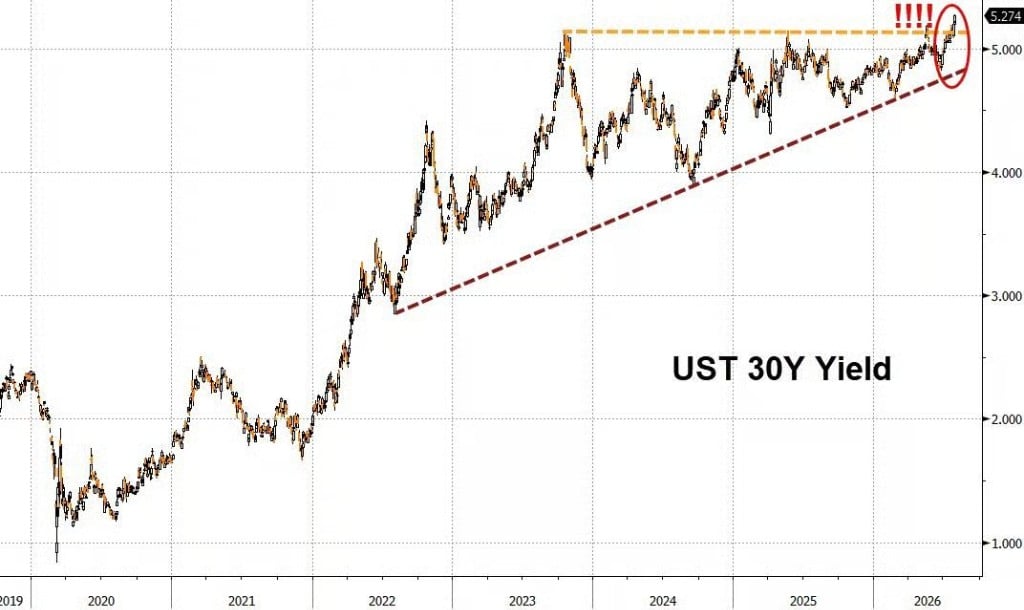
This week, the 30-year U.S. Treasury yield decisively broke through, reaching levels unseen before the financial crisis (pre-GFC).
The backdrop of this breakthrough is the new Federal Reserve Chairman, Waller, intentionally minimizing forward guidance, leading to a significant rise in market uncertainty regarding policy trajectories. Wilson cites historical data: "Looking back at the six Federal Reserve chairmen since 1970, Bernanke and Yellen each experienced a 10% drawdown in their first year, while the other four suffered drawdowns of 20% to 36% in their first years." Historically, the markets have not fared well during the early tenure of a new chairman.
However, Wilson clearly stated: "I believe the Federal Reserve is more a passenger than a driver in this discussion."
In other words, the fundamental driving force behind rising yields is not monetary policy, but the aforementioned structural capital demand. "Given the capital competition described at the beginning, do not expect this breakthrough to reverse quickly."
Indexes calm, but undercurrents surge
For investors focused solely on index fluctuations, July may seem calm. But Wilson points out, "Beneath the index, the trends are historic."
Two main narratives are unfolding simultaneously:
First, individual stocks are highly dispersed. Just last Friday: Amazon rose 15% in a single day, while Apple fell 10% on the same day — this kind of divergence among the two largest companies by market capitalization is rare.
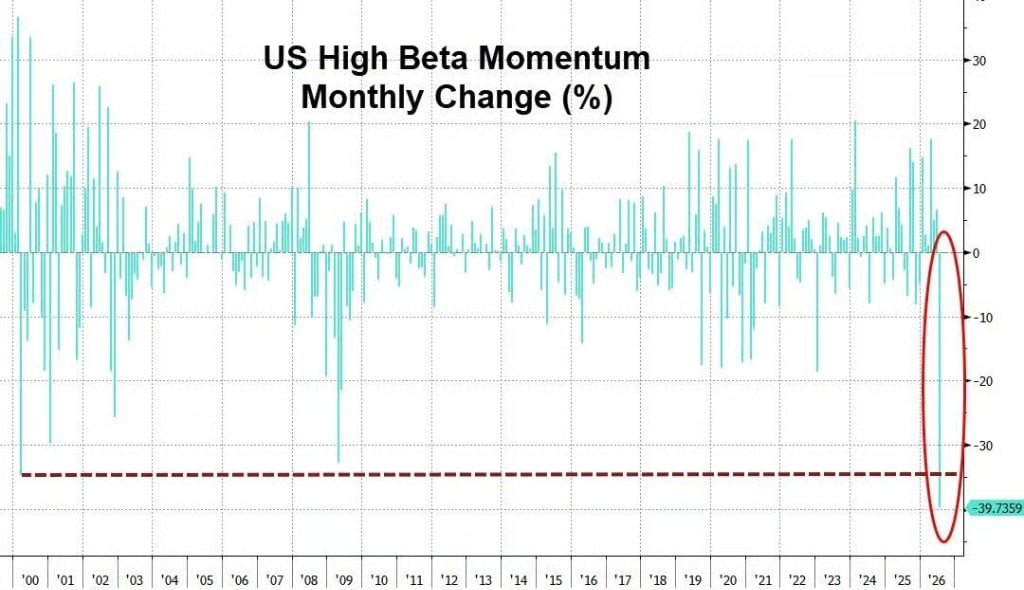
Second, the momentum factor has collapsed. The market-neutral portfolio saw a decline of 40%, surpassing extreme factor rotation records during the bursting of the tech bubble in March 2000, "causing significant difficulties for effective risk management for many."
The result is large-scale de-risking. Goldman Sachs Prime data shows that the total exposure of fundamental managers has decreased to a yearly low, with net longs falling to the bottom quartile. Wilson believes that after this cleansing, the market structure is "much cleaner."
August: Why it's unwise to easily buy the dip
With de-risking completed, does it mean we can start to go long? Wilson provides several reasons explaining why July's price performance will not simply reverse:
- The impact of yield breakthroughs has not yet been fully digested by the market, and related recalibrations are ongoing;
- The extreme volatility in July (the South Korean Composite Index rose 18% in a single day, and SK Hynix surged 26%) has changed the input parameters of risk models, making it difficult for many institutions to quickly reallocate capital;
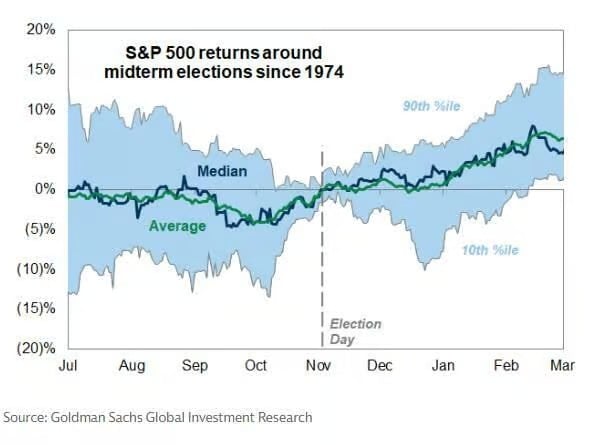
- When extending the horizon to 3 to 6 months, the outlook is not simple — the focus will shift to the upcoming U.S. mid-term elections. Wilson cites data: Since 1974, in 13 mid-term election years, the median return of the S&P 500 from early August to election day is 0%.
- August is likely to be a digestion period.
Fundamentals: Strong earnings, but internal divergence
Despite severe market fluctuations, the fundamental picture is unexpectedly robust.
Wilson points out that, contrary to typical years, EPS expectations for 2026 and 2027 have been continuously revised upward throughout the year. Second quarter results are overall impressive, but the second derivatives are starting to diverge: The EPS growth rate for the U.S. is expected to peak in this quarter at around 26%, while Europe's EPS growth rate for the first half is 13%, with an expected acceleration to 19% in the second half, creating a rare strong second half pattern.
The memory chip sector, however, is an exception. Although it is one of the best-performing sectors year-to-date, marginal news has shown signs of deterioration: spot DRAM prices are stabilizing, low memory consumption model technological progress is accelerating, and more critically — after the IPO of Chinese memory chip company CXMT, its stock price has increased sixfold from the issuance price, with a market value exceeding $550 billion, hinting at significant future supply expansion.
Hyperscale cloud companies: Capital expenditures are "astonishing," but returns are equally impressive
The most important confirmatory proposition of this earnings season is whether hyperscale cloud companies can provide sufficiently strong revenue growth and ROI signals while increasing capital expenditures.
The answer is affirmative — at least for Amazon and Microsoft.
Goldman Sachs currently forecasts capital expenditures for Alphabet, Amazon, and Microsoft as follows:
- Alphabet: $350 billion in 2027, $415 billion in 2028
- Amazon: $325 billion in 2027, $366 billion in 2028
- Microsoft: $262 billion in 2027, $284 billion in 2028
Wilson states that this scale is "astonishing."
At the same time, business performance is also shocking: Google Cloud's growth rate accelerated to 82% year-on-year; Microsoft confidently describes that enterprise customers are migrating from "frontier models" to "frontier ecosystems" (the infrastructure that routes requests between the most suitable model capabilities); AWS revenue growth rate accelerated to the highest level since the COVID-19 pandemic.
What is most striking is Amazon's management's direct statements during the earnings call:
"AI revenue is significantly increasing on an annualized basis, currently exceeding $25 billion, with a year-on-year growth rate in the triple digits."
"We see that the profit margins and returns of the AI business are slightly ahead of the trajectory we had when we initially established the cloud business."
"Despite capital expenditures reaching $220 billion in 2026, we will still not have enough capacity to meet all demand in 2026, and it is likely to be the same in 2027, while the demand scale in 2028 has already become astonishing... We have long believed that AWS could become a revenue business of hundreds of billions, and now we believe it will be at least double that number, very likely becoming a $1 trillion annual revenue business, accompanied by highly attractive free cash flow and return on invested capital."
The private sector and the public sector: A contradictory transition period
Wilson concludes with a macro framework: We are currently in a transition period.
Hyperscale enterprises in the private sector are competing to invest, sprinting towards an AI-empowered future; while the public sector is increasingly constrained by capital, the contradiction between the two will become increasingly prominent.
"Global economic realities will, at some point, force us to confront the political choices inevitably brought about by capital repricing — but that is a discussion for another day."
For now, the AI supercycle is still ahead, and August is likely to be a relatively calm digestion window.
免责声明:本文章仅代表作者个人观点,不代表本平台的立场和观点。本文章仅供信息分享,不构成对任何人的任何投资建议。用户与作者之间的任何争议,与本平台无关。如网页中刊载的文章或图片涉及侵权,请提供相关的权利证明和身份证明发送邮件到support@aicoin.com,本平台相关工作人员将会进行核查。


