Written by: Prathik Desai
Translated by: Block unicorn
When I first read this guest article, the first thing that came to mind was how insurance reveals human behavior. Ask most people what insurance they have bought, and you’re likely to hear about mobile phone insurance. Not health insurance, nor the safety net that protects dependent income. But mobile phone insurance can be purchased for just a few hundred rupees at checkout, and choosing it involves barely any decision-making.
This reveals how we make risk decisions. No one sits down to list all the things that could go wrong, ranks them by potential loss, and then decides to prioritize mobile screen protection. Risk coverage is provided by default, while what is covered is designed around aspects that are easy to market. The risk exposure itself seems to not matter.
However, it works. Claims are approved, screens are replaced, and the insurance fulfills its promise.
This leads to what I want to talk about today.
Lauris studies how countries around the world become financial markets - event contracts, derivatives, corporate risks, and the legal and market structures between them.
In today's article, Lauris argues that hedging is not a tool bought casually. It should be a carefully constructed relationship, built around the risk exposure you have already identified. If you get it backward, you might end up with a hedge that only benefits one investment while your real issues still exist.
Anyone can engage in trade hedging. But that does not mean anyone can sell "hedging products" to a corporation.
For traders, any position that can reasonably reduce risk elsewhere on the books can be called a hedge, whether the trader is working at a macro trading desk, trading cryptocurrencies, or using a retail brokerage account.
Purchasing a hedge contract related to election outcomes can achieve a hedge for that portfolio. While the match might not be high, and the protective effect may not be complete, it still counts as a hedge.
Corporate finance uses the same term to describe a relationship that demands higher standards. Risk exposure is first and foremost risk: cash flow, liabilities, or operational risk. Trading tools must match amounts, durations, and risk factors. Any deviation constitutes basis risk. Credit, collateral, documentation, and accounting treat transactions as they unfold because the product itself is a relationship, not just a return.
Swap contracts, forward contracts, options contracts, or event contracts can hedge the risks of one account and express views on another account. Their economic function depends on the risk exposure of other accounts on the holder's balance sheet. For corporations, the relevant questions are: What risk exposures does the tool offset? What is the offset amount? And how long is the offset duration?
Both meanings of the term are valid. The fallacy lies in treating them as interchangeable.
In recent conversations I've participated in, this misunderstanding has arisen: people presume that experience in quantitative trading or market making can be applied to structured trading. This misunderstanding is particularly common in the tech industry, as a quantitative background often gives the impression of superior capability, which often, indeed, is justified: traders have built excellent exchanges, many of whom are strong operators themselves.
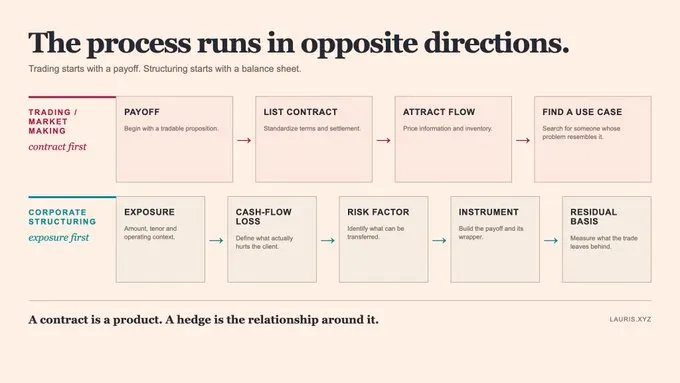
But technical prowess does not make knowledge in specific roles universal. Quantitative trading and market making revolve around pricing, information, and inventory. Building a product or swap contract that can serve as a hedging tool is a service-oriented operation focused on customer risk exposure. The two are not the same.
Predictive market operators often make the same mistake when considering this issue. Their usual unit is contracts: listing events, attracting liquidity, and then looking for cash flow. The same process does not work in corporate risk transfer, where risk exposure must be the primary concern. However, this approach has spread from trading and cryptocurrency domains: using existing 'yes/no' contracts, linking them to company issues, sending orders to exchanges, and then calling this portfolio a hedge.
International Financial Reporting Standard 9 (IFRS 9) applies this distinction at the operational level. It requires the provision of hedged items, hedging instruments, hedged risks, risk management objectives, and the economic relationships between them. The Commodity Futures Trading Commission (CFTC) applies the same principles when testing swap trades used for hedging physical positions: the risks must originate from assets, liabilities, services, or physical business activities.
What Event Contracts Add
The financial argument for predictive markets begins with state-related claims. Arrow and Debreu proposed the related framework: the more states the market can name, price, and transfer claims for future events, the more complete it is. For example, if tariffs are passed, mergers completed, drugs approved, or carbon emission auction prices exceed certain levels, event contracts can pay out.
Even if traditional markets can price these states, they often can only do so through agency means. Event markets, on the other hand, can create observable market prices for those states that previously only existed in research reports, scenario models, or bilateral discussions.
For price threshold claims based on the same underlying asset, their correlation to traditional derivatives is entirely consistent in extreme cases: the price of digital returns is the negative slope of the call option price curve relative to the strike price, and it can be approximated as an increasingly smaller vertical spread. Event contracts isolate the final state. Before expiration, options trading may involve volatility and market value risks that buyers do not wish to bear, as well as interdealer and replication frictions.
This equivalence relationship has its limits. "The S&P 500 Index closing above 7000 points" can map to the S&P options surface. "The Federal Reserve lowering interest rates in March" or "the tariff bill passing" remains a legitimate prediction, even though it is not a derivative of some call option price curve; its market price differs from the actual probability because it also reflects risk preferences, collateral, liquidity, trading channels, and settlement rules.
Government claims are input factors in corporate cash flow issues. Predictive markets can artificially create missing claims, but they cannot artificially create the relationship between that claim and a company's balance sheet.
The Importance of Event Contracts
Two factors determine the financial significance of event contracts:
Whether traditional derivatives or credible replicas exist.
Whether a company or investor actually bears the relevant risk.
When significant risks already have derivatives, event contracts become an alternative. They must provide better alignment or lower overall costs. The structural costs embedded in traditional channels must outweigh the spreads, depth, collateral, and impact costs of the event market. This constitutes replication cost differentials.
The biggest long-term opportunities lie in significant risks that currently lack derivatives. Event contracts may be the first such tools that make risks related to work stoppages, policy decisions, regulatory milestones, weather conditions, and corporate events observable and transferable.
If derivatives exist but no relevant users actually hold those derivatives, the demand for risk transfer is nearly nonexistent. Another binary option might still be a useful trading product. If neither of the above two situations is met, the market is better suited for prediction, entertainment, or general price discovery rather than corporate hedging infrastructure.
Tradability tells you whether a proposal can be priced. Significance tells you whether someone bears the risk worth transferring.
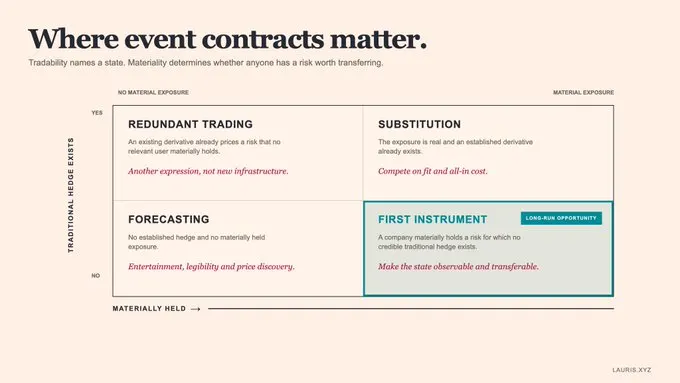
The contract-first sales funnel skips the second test: it starts from the available list and searches for companies that can be linked to these lists.
The Wrong Side of the Desk
Trading thinking starts with profit targets and seeks profit opportunities. Structured thinking starts with the balance sheet and builds trading strategies.
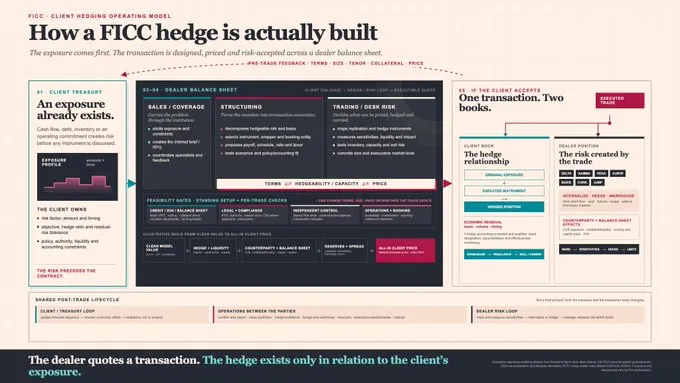
In the fixed income, currency, and commodities sectors, corporate clients come with existing risk exposures, such as floating rate debt or currency mismatches; fuel costs, inventories, or planned bond issues; and acquisition financing, which is an abstract object referred to as hedging.
It identifies risk factors, selects tools, and sets amounts and durations. Then, it calculates remaining value bases and incorporates the results into the client's documentation, credit arrangements, and accounting policies.
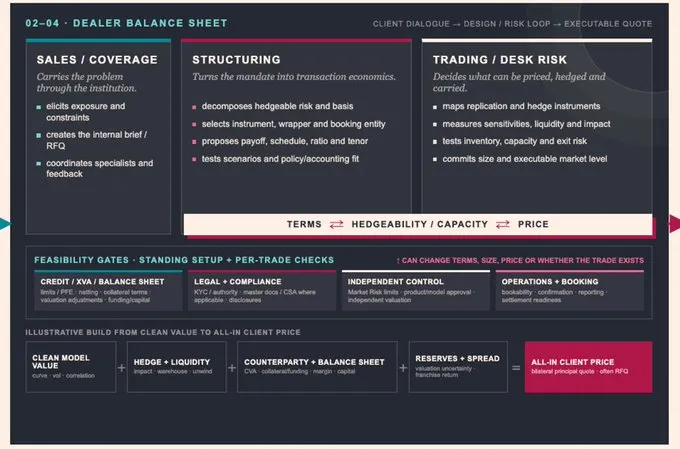
ISDA organizes the derivatives market in the following order: users, underlying risks, tools. HSBC's Autohedge system also follows this principle and, before pricing transactions, takes risk exposures, hedging strategies, and risk preferences as inputs. The tool itself may be legally independent; but economically, hedging refers to the relationships built around that tool.
In fixed income, currency, and commodities (FICC) trading, dealers can respond to inquiry requests at determined principal risk prices. This is execution: it prices defined tools without considering the client's risk exposure or whether the tool can hedge those risks. Adding inquiry requests (RFQs) to mismatching contracts can provide prices for such mismatches.
What Problems Does Contract Priority Bring?
Suppose an importer is concerned about potential tariffs. Its loss depends on shipping volumes, shipping times, inventory, costs passed on to customers, exchange rate fluctuations, and the company's ability to find alternative suppliers. Yet an event contract might stipulate that if tariffs are publicly imposed above a threshold before a specific date, the company will pay one dollar. This proposal is simple in itself, but its fit with the importer's cash flow is far from ideal.
This mismatch is basis risk. Structured traders decide which risk exposures can be transferred and which are retained by the client. Intermediaries that start from the contracts do the opposite. They find a public binary option similar to the client’s issue and regard that similarity as a hedging tool. After the trade is completed, the finance officer holds that binary option but continues to bear most of the original risk.
Contract customization brings a second problem. Robert Bartlett and Maureen O'Hara studied 41.6 million Kalshi contract trades. In their framework, there are no liquidity traders in the Grossman-Milgrom sense, as the tool does not frequently serve the purposes of hedging and portfolio rebalancing like in mature markets, thus generating liquidity flow. Individuals can still use the contract for defensive purposes.
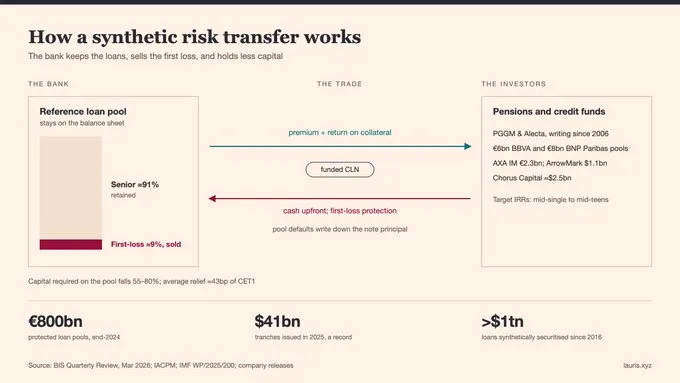
The credit market showcases how institutions buy state-related risks. In the significant risk transfer (SRT) mechanism, banks retain their loans and purchase first-loss protection via credit-linked notes funded by investors; the Bank for International Settlements (BIS) reports that by the end of 2024, the protected loan pool will total around 800 billion euros. This is a precedent in bank capital, not a recommendation for corporations to purchase credit-linked notes. It explains why institutions place risks in financing tools with coupons, documentation, loss allocation, and authorized limits.
The paper also found that informed pricing effects are greater in single-brand markets than in macro markets. Tariff decisions are often exogenous to the typical importer; thus, the information contained in their directives is minimal. Market makers may be keen on the movement of goods, but the publicly stated tariff codes have only a weak association with the importer's losses.
If contracts around mergers, drug trials, factories, or other company-specific outcomes were tighter, the basis would improve. At this point, companies might have more information than the quote providers, so market makers would expand trade sizes, reduce trade sizes, or even abandon trades. The most favored trades are those with the largest basis. The trades that the market is least willing to underwrite are those with overly large bases.
Even if contracts are signed, companies still need to explain objectives, ratios, bases, valuations, and financial statement treatment methods. Dashboards cannot establish this connection, nor can inquiry requests compel audit committees to accept it.
This business model is facing pressure from two sides. If risk exposures are small and matched to listed contracts, clients can trade directly. If risk exposures are large or require customization, clients then need structured design and funding support. Companies that only provide information about listed contracts cannot increase trading capability. Those responsible for designing return schemes, preparing documentation, committing, or raising funds are less a new business category and more like brokers, insurance companies, or fixed income, commodities, and currency (FICC) structured entities.
Packaging Changed the Market
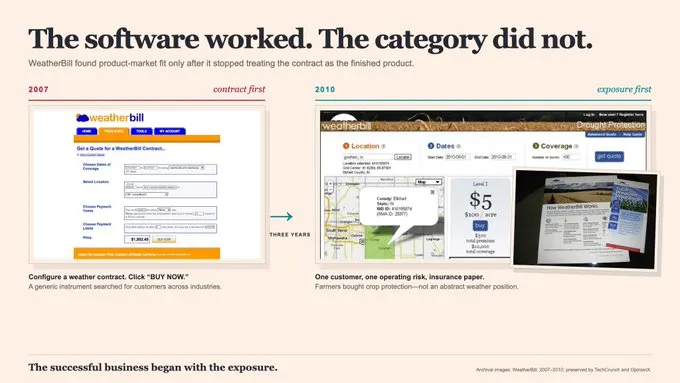
WeatherBill launched a self-service weather derivatives platform in 2007. The idea was that businesses affected by weather would purchase hedging products. But this was not the case. The company later narrowed its target clients to farmers, shifted to insurance products and external distribution, and rebranded as The Climate Corporation.
Event contracts found native demand elsewhere: the FanDuel platform of the Chicago Mercantile Exchange launched in December 2025 and reported 100 million contracts in about eight weeks.
Weather forecast products entered the insurance market; sports products found retail channels. Meanwhile, independently sold hedging products via software channels remain a blank space.
Where the Risks Lie
Once risk exposure is identified, the remaining issue is risk tolerance.
In practice, event risks are reflected on the balance sheet through three pathways. The risks themselves do not appear directly but must be transferred elsewhere.
1. When the investment subject is appropriate, it can be traded directly.
A bar in Manhattan insured an event contract of about $5,000 to handle a promotion where patrons drank free if the Knicks won; liability and contract issues were resolved in the same game. If the settlement scheme is appropriate, the same approach can handle larger risks.
Reportedly, a contract related to California's solar tax credits transferred about $600,000 through a transparent central clearing market. The size of the company is not the dividing line; alignment and balance sheet capacity are.
I am working with some talented individuals at Kalshi, particularly with 0x_ultra, to provide a showcase for this project as part of the "Builders Program." It will launch soon.
2. Risk pools should be established only when risks can truly be dispersed.
Mutual betting markets allocate a pool of pledged funds to the winning bidders and limit total liabilities to existing capital; Goldman Sachs and Deutsche Bank have used this mechanism for economic derivatives trading since 2002, with the average scale of non-farm payroll data auctions around $9 million, afterward transitioning to trade at the Chicago Mercantile Exchange (CME) in 2005. The Bank for International Settlements (BIS) still questions whether genuine hedging demand can offset seasoned informed traders.
Funds can only work when loss amounts differ, risk exposures are opposite, or when external funds are involved. If all participants suffer losses simultaneously, the fund pool will create a long list of claimants, eventually requiring those needing the funds to take on responsibility: either through insurance, reinsurance, or again through warehouse financing.
I know that very smart people like Aadvik Vashist are studying this issue.
3. Incorporate events into existing tools of the institutions
In April of this year, Marex issued structured notes of up to $10 million to a Swiss institutional client, stipulating that if Nvidia remains the highest valued company in the world a year later, a 7% interest payment will apply; the client holds Marex's debt, while Marex uses event contracts for replication. The institution purchased securities that included issuer, documentation, and authorization terms, while the event contract remained with the trader. Before the transaction reached the client, Marex had converted the event contract into fixed income, currency, and commodities (FICC).
The software's role is after determining risk exposure. It can test traditional tools, identify coverage gaps, and compare event claims across aspects such as basis, cost, execution, collateral, legal, authorization, accounting, and residual risks. A practical product should be able to encode this process and allow for the final choice to not trade.
Regulatory Impact Radius
Poor corporate hedging schemes often bring problems to buyers. However, here, the scope of damage is broader because the event market is still debating its role in the financial system. Commercial usage does not dictate the CFTC's jurisdiction over event contracts.
The Cryptocurrency Innovation Committee believes that the definition of swaps in the Commodity Exchange Act, federal supremacy, the CFTC's exclusive jurisdiction over the derivatives market, and event contracts will not cease to receive federal regulation simply because the purchasers are speculating.
The significance of public interest extends far beyond corporate hedging. Regulated event markets can price previously unpriced states, generate public pricing, and create transparent, collateralized claims with clear settlement rules. Even before a finance officer engages in transactions, these are important financial functions. But hedging remains at the core of policy argument.
The CFTC has described predictive markets as tools for forecasting, planning, hedging, and speculation. In February 2026, the Commission defended its jurisdiction by emphasizing commercial hedging, portfolio management, and information about future outcomes to counter state gaming regulators. The CFTC differentiates predictive markets from gambling by characteristics like multi-to-multi trade execution, transparent pricing, clear settlement benchmarks, regulation, client protection, and market integrity.
In March, the CFTC reminded predictive market exchanges of their obligations under the Commodity Exchange Act and Core Principle 3. Its June proposals involved event contract design, public interest review, and responsible innovation.
Serious cases of corporate hedging failure often follow a simple pattern. Corporations are told that binary option positions can hedge operational risks and thus invest cash. Even if the company incurs losses, the contracts may expire worthless because factors like trade volume, time, or cost transfer were never factored into return considerations; before settlement, the contract subject might have already been booked as profits, while original risk exposures persisted, ultimately leaving the company with not protection, but a short position.
Regulators have previously witnessed similar schemes. The CFTC and the Securities and Exchange Commission (SEC) jointly issued warnings after receiving complaints about binary options platforms refusing withdrawals, identity theft, and losses caused by software manipulation. The regulated trading venues discussed in this article are not those fraudulent brokers: their markets are regulated, transparent, and centrally cleared, but past cases have also increased the costs of mislabeling trading errors as protective trades.
Opponents of federal predictive markets would not write seminar papers on basis risk. They would argue a company's bet was sold under the guise of a derivative.
If intermediaries use mismatched binary options as a corporate protection means, it would provide state gaming regulators with the most powerful argument against federal regulatory predictive markets.
免责声明:本文章仅代表作者个人观点,不代表本平台的立场和观点。本文章仅供信息分享,不构成对任何人的任何投资建议。用户与作者之间的任何争议,与本平台无关。如网页中刊载的文章或图片涉及侵权,请提供相关的权利证明和身份证明发送邮件到support@aicoin.com,本平台相关工作人员将会进行核查。


